Patterns of Social Inequality and Exclusion — Flashcards
Meghalaya Board · Class 12 · Sociology
80 flashcards for Patterns of Social Inequality and Exclusion (Meghalaya Board Class 12 Sociology) to test yourself on key terms and facts.
Interactive on Super Tutor
Studying Patterns of Social Inequality and Exclusion? Get the full interactive chapter.
Quizzes, flashcards, AI doubt-solver and a step-by-step study plan — built for flashcards and more.
Free trial, no card needed.
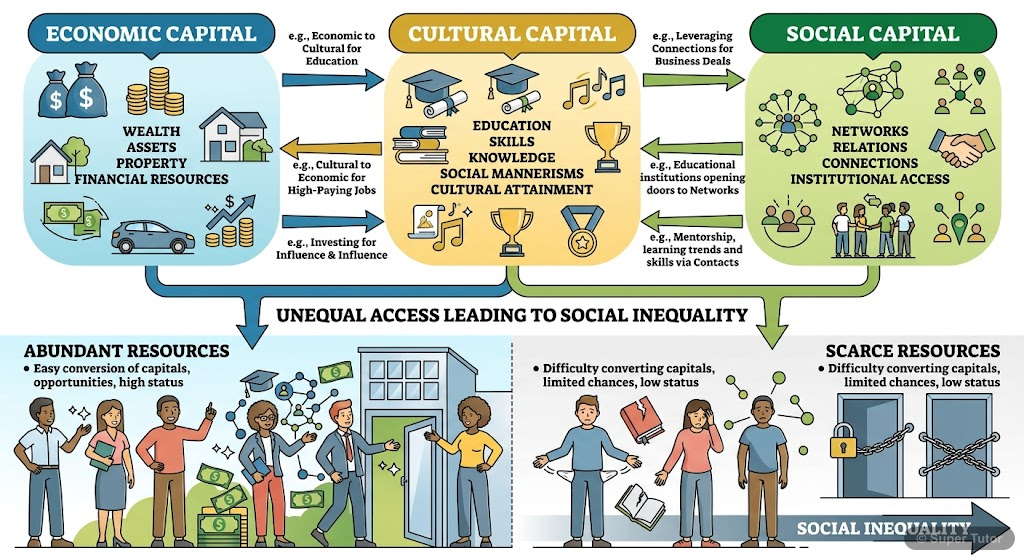
Learn better with visuals Super Tutor pairs illustrations like this with notes and quizzes for Patterns of Social Inequality and Exclusion.
सामाजिक असमानता क्या है?
Answer
सामाजिक असमानता का अर्थ है धन, संपत्ति, शिक्षा, स्वास्थ्य और शक्ति जैसे मूल्यवान संसाधनों तक असमान पहुंच। यह मुख्य रूप से एक समूह-आधारित पैटर्न है, न कि केवल एक व्यक्तिगत अंतर। किसी व्यक्ति की स्थिति …
What is social inequality?
Answer
Social inequality means unequal access to valued resources such as money, property, education, health, and power. It is mainly a group-based pattern, not just an individual difference. A person’s posi…
What are the three forms of capital identified by Bourdieu?
Answer
Bourdieu identifies three forms of social resources: economic capital, cultural capital, and social capital. Economic capital means material assets and income. Cultural capital means education and sta…
बोरड्यू द्वारा पहचाने गए पूंजी के तीन रूप क्या हैं?
Answer
बोरड्यू सामाजिक संसाधनों के तीन रूपों की पहचान करते हैं: आर्थिक पूंजी, सांस्कृतिक पूंजी और सामाजिक पूंजी। आर्थिक पूंजी का अर्थ है भौतिक संपत्ति और आय। सांस्कृतिक पूंजी का अर्थ है शिक्षा और स्थिति। साम…
सामाजिक स्तरीकरण को केवल एक व्यक्तिगत अंतर क्यों नहीं बल्कि एक सामाजिक व्यवस्था क्यों कहा जाता है?
Answer
सामाजिक स्तरीकरण एक समाजव्यापी व्यवस्था है जो समूहों को श्रेणीबद्ध क्रम में रखता है। यह केवल व्यक्तिगत क्षमता पर आधारित नहीं है। यह पीढ़ियों से परिवार, विरासत और अंतर्विवाह के माध्यम से बना रहता है और…
Why is social stratification called a social system and not just an individual difference?
Answer
Social stratification is a society-wide system that ranks groups in a hierarchy. It is not simply based on personal ability. It persists over generations through family, inheritance, and endogamy, and…
Define prejudice.
Answer
Prejudice refers to pre-conceived opinions or attitudes held by members of one group towards another. It is formed before proper knowledge or evidence. Prejudice can be negative or positive, such as f…
पूर्वाग्रह की परिभाषा दीजिए।
Answer
पूर्वाग्रह (prejudice) एक समूह के सदस्यों द्वारा दूसरे समूह के प्रति पूर्वकल्पित राय या दृष्टिकोण को कहते हैं। यह उचित ज्ञान या प्रमाण से पहले बनता है। पूर्वाग्रह नकारात्मक या सकारात्मक हो सकता है, जै…
+72 more flashcards
Practise AllFrequently Asked Questions
What are the important topics in Patterns of Social Inequality and Exclusion for Meghalaya Board Class 12 Sociology?
How many flashcards are available for Patterns of Social Inequality and Exclusion?
How should I revise Patterns of Social Inequality and Exclusion for the Meghalaya Board Class 12 board exam?
Sources & Official References
Content is aligned to the official syllabus. Refer to the board website for the latest curriculum.
More resources for Patterns of Social Inequality and Exclusion
Practice Quiz
Test yourself with a quick quiz
Important Questions
Exam-style questions with answers
Revision Notes
Key points for last-minute revision
Chapter Summary
Understand the chapter at a glance
Concept Maps
See how topics connect
Study Plan
Step-by-step plan for this chapter
Syllabus
What topics to cover
NCERT Solutions
Every textbook question solved step by step
For serious students
Get the full Patterns of Social Inequality and Exclusion chapter — start free.
Quizzes, flashcards, an AI doubt solver and a study plan for Meghalaya Board Class 12 Sociology. Free to start, no card needed.