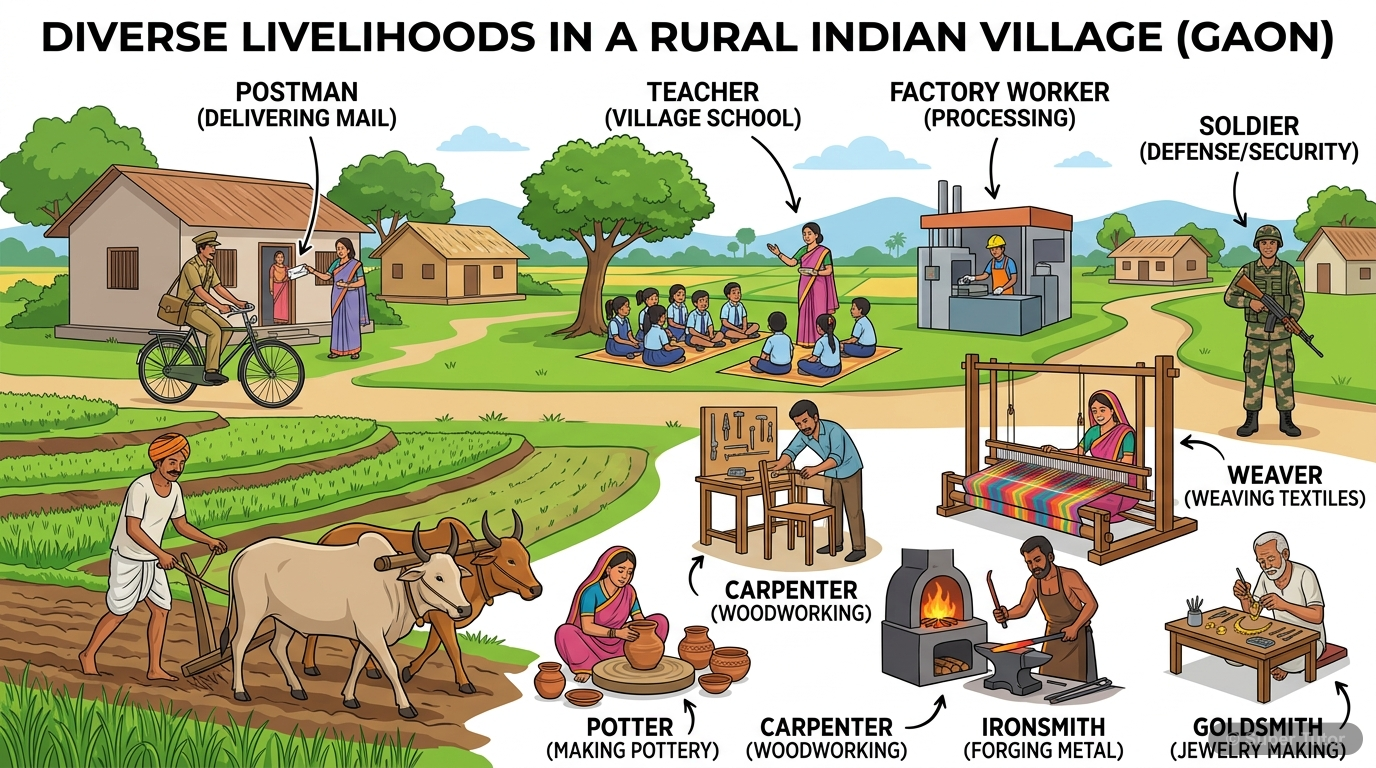
Change and Development in Rural Society
Meghalaya Board · Class 12 · Sociology
NCERT Solutions for Change and Development in Rural Society — Meghalaya Board Class 12 Sociology.
Interactive on Super Tutor
Studying Change and Development in Rural Society? Get the full interactive chapter.
Quizzes, flashcards, AI doubt-solver and a step-by-step study plan — built for ncert solutions and more.
1,000+ Class 12 students started this chapter today

Super Tutor has 8+ illustrations like this for Change and Development in Rural Society alone — flashcards, concept maps, and step-by-step visuals.
See them allChange and Development in Rural Society — Questions
1iWhy do you think the maliks were able to use the power of the state to advance their own interests?Show solution
Answer:
The maliks were able to use the power of the state to advance their own interests due to the following reasons:
1. Economic Power: The maliks formed a dominant class that controlled land and capital. Economic dominance gave them the resources to influence local administration, police, and judiciary.
2. Caste-based Social Power: As members of a dominant caste, the maliks enjoyed high social status. In rural India, dominant castes have historically controlled local institutions, panchayats, and administrative bodies.
3. Political Connections: Their economic and social power translated into political influence. They could elect their own representatives or influence elected officials, thereby shaping policy and law enforcement in their favour.
4. Nexus between Class and State: The state apparatus at the local level — police, revenue officials, courts — was often staffed by or sympathetic to the dominant caste/class. This made it easy for the maliks to get favourable treatment.
5. Lack of Counter-power among Labourers: The landless labourers were economically dependent on the maliks, lacked organisation, and had little access to legal or political resources, making it difficult for them to challenge the maliks' misuse of state power.
Conclusion: Thus, the combination of economic dominance, caste privilege, and political connections enabled the maliks to use the state machinery to protect and advance their class interests at the expense of the labouring underclass.
1iiWhy did labourers have harsh working conditions?Show solution
Answer:
Labourers had harsh working conditions due to the following reasons:
1. Economic Dependence: Landless agricultural labourers had no land of their own and were entirely dependent on the maliks for employment and sometimes even for food, shelter, and credit. This dependence gave the maliks enormous power to dictate terms of work.
2. Caste Hierarchy: The labourers typically belonged to lower castes or Scheduled Castes. The caste system legitimised their subordination and made it socially acceptable to treat them poorly.
3. Bonded/Attached Labour: Many labourers were tied to their employers through debt bondage (bonded labour). Once indebted, they had no freedom to seek better employment elsewhere.
4. Absence of Legal Protection: Although laws existed to protect labourers (e.g., Minimum Wages Act, Bonded Labour System Abolition Act), the maliks' control over the state machinery meant these laws were rarely enforced.
5. Lack of Collective Bargaining: Labourers lacked strong trade unions or collective organisations in rural areas, leaving them with no means to negotiate better wages or conditions.
6. Political Marginalisation: As the passage notes, political factors widened the gulf between the dominant class and the underclass, meaning labourers had no political voice to demand better conditions.
Conclusion: The harsh working conditions were therefore a direct result of the structural inequalities of class and caste, reinforced by the maliks' ability to manipulate state power in their favour.
2What measures do you think the government has taken, or should take, to protect the rights of landless agricultural labourers and migrant workers?Show solution
Measures Already Taken by the Government:
1. Minimum Wages Act, 1948: Fixes minimum wages for agricultural and other workers to prevent exploitation.
2. Bonded Labour System (Abolition) Act, 1976: Abolishes bonded labour and provides for rehabilitation of freed bonded labourers.
3. Mahatma Gandhi National Rural Employment Guarantee Act (MGNREGA), 2005: Guarantees 100 days of wage employment per year to rural households, reducing distress migration.
4. Inter-State Migrant Workmen Act, 1979: Regulates employment of inter-state migrant workers and provides for their welfare including wages, displacement allowance, and suitable accommodation.
5. Contract Labour (Regulation and Abolition) Act, 1970: Regulates conditions of contract labour and provides for their welfare.
6. National Food Security Act, 2013: Ensures subsidised food grains to the poor, including agricultural labourers.
7. Pradhan Mantri Awas Yojana and other housing schemes for the rural poor.
8. Pradhan Mantri Jan Dhan Yojana: Financial inclusion of the poor, including migrant workers.
Measures the Government Should Take:
1. Strict Enforcement of Existing Laws: Laws protecting labourers must be strictly enforced. Corrupt officials who collude with employers should be penalised.
2. Portability of Benefits: Social security benefits (ration cards, health insurance, MGNREGA wages) should be portable so migrant workers can access them in the states they migrate to.
3. Registration of Migrant Workers: A national database of migrant workers should be created to track their movement and ensure they receive entitlements.
4. Education and Skill Development: Providing education and vocational training to children of agricultural labourers to improve their long-term prospects.
5. Land Reforms: Redistribution of surplus land to the landless would reduce their dependence on landlords.
6. Strengthening Trade Unions: Encouraging the formation of agricultural labour unions to give workers collective bargaining power.
7. Social Security Net: Universal social security covering health, accident insurance, and old-age pension for all informal workers.
Conclusion: While the government has enacted several laws and schemes, effective implementation remains the key challenge. A combination of strict enforcement, social security, and empowerment of labourers is essential to protect their rights.
3There are direct linkages between the situation of agricultural workers and their lack of upward socio-economic mobility. Name some of them.Show solution
Direct Linkages:
1. Landlessness: Without land, agricultural labourers have no productive asset. They cannot accumulate wealth, access credit easily, or gain economic independence. Land ownership is the primary source of rural wealth and status.
2. Low and Irregular Wages: Agricultural work is seasonal, meaning labourers earn wages only during sowing and harvesting seasons. Low and irregular income prevents savings and investment in education or business.
3. Debt and Bonded Labour: Labourers often borrow from landlords or moneylenders at high interest rates. Debt traps them in a cycle of bondage, making it impossible to accumulate capital or seek better opportunities.
4. Caste Discrimination: Most agricultural labourers belong to Scheduled Castes or Other Backward Classes. Caste-based discrimination limits their access to education, better employment, and social networks that could facilitate upward mobility.
5. Lack of Education: Poverty forces children of agricultural labourers to work instead of attending school. Without education, they cannot access non-agricultural, better-paying jobs.
6. Poor Health and Nutrition: Low income leads to poor nutrition and inadequate healthcare. Poor health reduces productivity and earning capacity, further entrenching poverty.
7. Lack of Access to Credit: Banks and formal financial institutions are reluctant to lend to the landless poor who have no collateral. This prevents them from starting small businesses or investing in skill development.
8. Seasonal and Circular Migration: Migrant workers move from place to place in search of work, which disrupts their children's education and prevents them from building stable social networks or accessing government welfare schemes.
9. Absence of Social Security: Without health insurance, pension, or unemployment benefits, any crisis (illness, drought, death of earning member) pushes the family deeper into poverty.
10. Political Marginalisation: Lacking economic resources and social capital, agricultural labourers have little political voice to demand better wages, land rights, or public services.
Conclusion: These factors are deeply interconnected and mutually reinforcing, creating a vicious cycle that makes upward socio-economic mobility extremely difficult for agricultural workers without significant structural intervention.
4What are the different factors that have enabled certain groups to transform themselves into new wealthy, entrepreneurial, dominant classes? Can you think of an example of this transformation in your state?Show solution
Factors Enabling Transformation:
1. Land Ownership and Land Reforms: Groups that already owned medium to large landholdings benefited most from land reforms. While zamindari was abolished, rich peasants and middle-level landowners consolidated their holdings and gained from the redistribution.
2. Green Revolution Technology: The introduction of High Yielding Variety (HYV) seeds, chemical fertilisers, pesticides, and irrigation (especially in Punjab, Haryana, and western Uttar Pradesh) dramatically increased agricultural productivity. Groups with sufficient land and capital to adopt these technologies became prosperous.
3. Access to Institutional Credit: Richer peasants had collateral (land) and social connections to access bank loans and government credit at subsidised rates, enabling them to invest in modern agricultural inputs and machinery.
4. Government Subsidies and Support Prices: Minimum Support Prices (MSP) for crops like wheat and rice, along with subsidies on fertilisers, electricity, and water, disproportionately benefited larger landowners who produced more surplus.
5. Diversification into Non-Agricultural Activities: Surplus income from agriculture was invested in transport (trucks, tractors), trade, agro-processing industries, and later in urban real estate and businesses. This diversification created a new entrepreneurial class.
6. Political Mobilisation: Dominant peasant castes (e.g., Jats in Punjab/Haryana, Patidars/Patels in Gujarat, Reddys and Kammas in Andhra Pradesh, Marathas in Maharashtra) organised politically to demand favourable agricultural policies, reservations, and state patronage.
7. Education: Investment in children's education allowed the next generation to enter professions, government services, and business, further consolidating the family's socio-economic position.
8. Caste Networks: Caste-based social networks provided access to markets, labour, credit, and political connections, giving certain groups a competitive advantage.
Example (Illustrative — students may use their own state):
- Punjab/Haryana — Jat Farmers: The Jat community in Punjab and Haryana is a classic example. Originally peasant cultivators, they benefited enormously from the Green Revolution. Surplus agricultural income was invested in tractors, tube wells, and later in transport businesses and urban real estate. Their political organisation (through parties and farmer unions) ensured continued state support. Today, many Jat families are wealthy landowners, businesspersons, and professionals.
- Gujarat — Patidar Community: The Patidar (Patel) community transformed from prosperous farmers into a dominant entrepreneurial class through investment in trade, industry, and migration (both internal and international).
Conclusion: The transformation of certain groups into new dominant classes was not accidental but resulted from a combination of pre-existing advantages (land, caste networks), state policies (Green Revolution, subsidies), and strategic investment of agricultural surplus into non-agricultural enterprises.
5Hindi and regional language films were often set in rural areas. Think of a film set in rural India and describe the agrarian society and culture that is shown in it. How realistic do you think the portrayal is? Have you seen any recent film set in rural areas? If not how would you explain it?Show solution
**Example Film: *Lagaan* (2001) — Director: Ashutosh Gowariker
Agrarian Society and Culture Depicted:
- The film is set in a drought-affected village in colonial India (1893). It depicts a subsistence agrarian economy where the entire village depends on rain-fed agriculture.
- The social structure shown includes a hierarchical caste system — the village has upper-caste landowners, lower-caste farmers, and an 'untouchable' character (Kachra) who faces discrimination but is eventually included in the cricket team.
- The village community is shown as cohesive yet divided by caste. There is a strong sense of collective identity when faced with an external threat (the British tax/lagaan).
- The role of the village headman (mukhiya) and the dependence of villagers on the goodwill of the colonial ruler (and local raja) reflects the feudal agrarian relations of the time.
- Cultural elements include folk songs, religious rituals, and community festivals that are central to rural life.
- Women are shown in traditional roles — fetching water, cooking, supporting the men — though the British woman Elizabeth plays a more active role.
How Realistic is the Portrayal?
- Partially Realistic: The depiction of drought, heavy taxation, and the vulnerability of peasants to both nature and the state is historically accurate and sociologically valid.
- Romanticised Elements: The film romanticises rural unity and the idea that caste divisions can be easily overcome in the face of a common enemy. In reality, caste conflicts are deep-rooted and not easily resolved.
- Stereotyping: Some characters are stereotypical (the noble hero, the villain zamindar, the loyal villagers), which simplifies the complex realities of agrarian society.
- Positive Aspect: The film does highlight the exploitation of peasants under colonialism and the importance of collective action.
Recent Films Set in Rural Areas:**
Recent Hindi cinema has largely shifted to urban settings. Films like *Newton* (2017, set in a Naxalite-affected rural area), *Peepli Live* (2010, on farmer suicides), or *Masaan* (2015, set in a small town) are exceptions. The shift away from rural settings in mainstream cinema can be explained by:
1. Changing Audience Demographics: The primary audience for multiplex films is urban middle-class youth who prefer urban stories they can relate to.
2. Commercial Considerations: Urban settings are perceived as more glamorous and commercially viable.
3. Migration to Cities: As India urbanises, the cultural imagination increasingly centres on cities.
4. Neglect of Rural Issues: The declining political and cultural visibility of rural India in mainstream discourse is reflected in cinema.
Conclusion: Films set in rural India offer valuable sociological insights but must be viewed critically. The best films combine entertainment with an honest portrayal of agrarian realities including poverty, caste, gender inequality, and the relationship between peasants and the state.
6Visit a construction site in your neighbourhood, a brickyard, or other such place where you are likely to find migrant workers. Find out where the workers come from. How are they recruited from their home villages, who is the 'mukadam'? If they are from rural areas, find out about their lives in their villages and why they have to migrate to find work.Show solution
Objective: To understand the lives, recruitment process, and reasons for migration of workers at a construction site or brickyard.
Method: Personal interview/observation at a local construction site or brickyard.
Model Framework for the Report:
1. Place Visited: [Name of construction site/brickyard, locality]
2. Workers' Places of Origin:
Most migrant workers at construction sites in Indian cities come from states like Uttar Pradesh, Bihar, Jharkhand, Odisha, Rajasthan, Madhya Pradesh, and West Bengal — states with high rural poverty and limited local employment opportunities.
3. Recruitment Process:
- Workers are typically recruited through a mukadam (also called contractor or labour contractor).
- The mukadam is usually a person from the same village or region who has established contacts with urban employers/contractors.
- The mukadam visits villages before the agricultural off-season (after harvest) and recruits workers, often advancing them a small sum of money (advance/peshgi) which binds them to work for the season.
- Workers travel in groups to the work site, often by train or bus, arranged by the mukadam.
- The mukadam acts as an intermediary between the employer and the workers — he negotiates wages, manages the workforce, and takes a commission from both sides.
4. Role of the Mukadam:
- The mukadam is a crucial figure in the migration chain. He provides information about work opportunities, arranges transport, negotiates wages, and sometimes provides credit.
- However, the mukadam can also be exploitative — he may take a large cut of wages, keep workers in debt, and prevent them from seeking better employment.
5. Lives in Home Villages:
- Most workers are landless or marginal farmers (owning less than 1 acre).
- Agricultural work in their villages is seasonal — available only during sowing and harvesting (2–3 months a year).
- Wages in villages are very low (often below minimum wage) and employment is irregular.
- Many are in debt to local moneylenders or landlords.
- Lack of irrigation, drought, and crop failure make agriculture unreliable.
6. Reasons for Migration:
- Lack of local employment: MGNREGA provides only 100 days of work; for the rest of the year there is little work.
- Low agricultural wages: Urban construction wages (₹400–600/day) are significantly higher than rural agricultural wages.
- Debt repayment: Many migrate specifically to repay debts.
- Drought and crop failure: Environmental stress pushes farmers off the land.
- Social reasons: Some migrate to escape caste discrimination or domestic problems.
7. Conditions at the Work Site:
- Workers typically live in makeshift shelters on or near the construction site.
- They have limited access to clean water, sanitation, and healthcare.
- Children of migrant workers often accompany their parents and miss schooling.
- Workers are paid daily or weekly wages, often without any written contract.
Conclusion: Migration is not a free choice but a survival strategy forced upon rural workers by structural poverty, landlessness, and lack of local employment. The mukadam system, while facilitating migration, can also perpetuate exploitation. Government policies need to address both the push factors (rural poverty) and the conditions of migrant workers at their destinations.
7Visit your local fruit-seller, and ask her/him about the fruits she/he sells, where they come from, and their prices. Find out what has happened to the prices of local products after fruits began to be imported from outside of India (such as apples from Australia). Are there any imported fruits cheaper than Indian fruits?Show solution
Objective: To understand the impact of imported fruits on local fruit prices and the livelihoods of local fruit growers.
Method: Interview with a local fruit vendor/seller.
Model Framework for the Report:
1. Place Visited: [Name of local market/fruit stall]
2. Fruits Sold and Their Origins:
| Fruit | Origin | Price (approx.) |
|-------|--------|-----------------|
| Apple (Indian — Himachal/Kashmir) | Himachal Pradesh / J&K | ₹120–200/kg |
| Apple (Imported — Washington/Australia) | USA / Australia | ₹200–350/kg |
| Grapes | Nashik, Maharashtra | ₹80–120/kg |
| Kiwi (Imported) | New Zealand / Italy | ₹150–250/kg |
| Banana | Local/regional | ₹40–60/dozen |
| Orange | Nagpur / imported | ₹60–100/kg |
*(Prices are indicative and vary by season and location.)*
3. Impact of Imported Fruits on Local Products:
- Competition: The arrival of imported fruits (especially apples from the USA, Australia, and China) has increased competition for Indian apple growers in Himachal Pradesh and Jammu & Kashmir.
- Price Pressure: When imported apples are available at competitive prices (especially after reduction in import duties), local apple prices come under pressure. Farmers in Himachal Pradesh have reported declining incomes.
- Quality Perception: Imported fruits are often perceived as superior in appearance (uniform size, shiny skin due to wax coating), which affects consumer preference even when Indian fruits may be nutritionally equivalent or superior.
- Seasonal Availability: Imported fruits are available year-round, disrupting the seasonal price advantage that local growers previously enjoyed.
4. Are Imported Fruits Cheaper than Indian Fruits?
- In most cases, imported fruits are more expensive than Indian fruits due to import duties, transportation costs, and cold storage charges.
- However, in some cases (e.g., certain varieties of apples from China or grapes from Chile during off-season), imported fruits may be competitively priced.
- After India signed Free Trade Agreements (FTAs) with some countries, import duties on certain fruits were reduced, making some imported fruits more affordable.
5. Impact on Local Farmers:
- Local fruit growers, especially small and marginal farmers, are adversely affected when imported fruits flood the market.
- They lack the resources to compete in terms of packaging, cold storage, and marketing.
- Many farmers in apple-growing regions have reported distress due to falling prices.
6. Broader Implications:
- Globalisation and trade liberalisation have integrated Indian agriculture into the global market. While consumers may benefit from greater variety and sometimes lower prices, local farmers face increased competition and price volatility.
- There is a need for government support in the form of better cold storage infrastructure, marketing support, and fair trade policies to protect Indian farmers.
Conclusion: The entry of imported fruits has created both opportunities (greater variety for consumers) and challenges (price competition for local farmers). The impact of globalisation on Indian agriculture is complex and requires careful policy management to ensure that the benefits are shared equitably.
8Collect information and write a report on the environmental situation in rural India. Examples of topics: pesticides; declining water table; impact of prawn farming in coastal areas; salination of soil and waterlogging in canal irrigated areas; loss of biodiversity. Possible source: State of India's Environment Reports, Reports from Centre for Science and Development and the magazine Down to Earth.Show solution
---
# Report on the Environmental Situation in Rural India
Introduction:
Rural India, which is home to nearly 65% of the country's population and the backbone of its agricultural economy, is facing a severe environmental crisis. Decades of intensive agriculture, industrial expansion, and unsustainable resource use have taken a heavy toll on the natural environment. This report examines key environmental challenges facing rural India.
---
1. Pesticides and Chemical Pollution:
- India is one of the largest consumers of pesticides in Asia. The Green Revolution, while increasing food production, led to massive use of chemical pesticides and fertilisers.
- Health Impact: Farmers and agricultural workers are exposed to toxic pesticides without adequate protective gear. Studies have linked pesticide exposure to cancer, neurological disorders, and reproductive problems in farming communities in Punjab (known as the 'cancer belt').
- Soil and Water Contamination: Pesticide residues contaminate soil, groundwater, and surface water, affecting both human health and biodiversity.
- Food Safety: Pesticide residues in food crops pose risks to consumers.
- Example: The high incidence of cancer in Malwa region of Punjab has been linked to excessive use of pesticides. A 'cancer train' runs from Bathinda to Bikaner carrying patients for treatment.
---
2. Declining Water Table:
- Intensive irrigation, particularly through tube wells and borewells, has led to a rapid decline in groundwater levels across India.
- Punjab and Haryana: The water table in these Green Revolution states has been falling at an alarming rate — by 0.5 to 1 metre per year in some areas. At this rate, groundwater could be exhausted within decades.
- Rajasthan and Gujarat: Traditional water harvesting systems (stepwells, tanks) have been neglected, and groundwater is being over-extracted for agriculture.
- Causes: Free or heavily subsidised electricity for agricultural pumps encourages over-extraction of groundwater.
- Consequences: Declining water table increases the cost of irrigation (deeper borewells), leads to crop failures, and threatens drinking water security in rural areas.
---
3. Impact of Prawn Farming in Coastal Areas:
- Aquaculture, particularly intensive prawn (shrimp) farming, has expanded rapidly along India's coastline (Andhra Pradesh, Odisha, West Bengal, Kerala, Tamil Nadu).
- Destruction of Mangroves: Prawn farms have replaced vast areas of mangrove forests, which are critical ecosystems providing coastal protection, nursery habitat for fish, and carbon sequestration.
- Salinisation: Prawn farming introduces saline water into coastal agricultural land, rendering it unfit for cultivation.
- Displacement of Communities: Traditional fishing communities have been displaced from their lands and livelihoods by prawn farming companies.
- Water Pollution: Effluents from prawn farms pollute coastal waters, harming marine biodiversity and traditional fisheries.
- Example: In Andhra Pradesh, large-scale prawn farming has destroyed thousands of hectares of mangroves and agricultural land.
---
4. Salination of Soil and Waterlogging in Canal-Irrigated Areas:
- Canal irrigation, while increasing agricultural productivity, has created serious problems of waterlogging and soil salination in many parts of India.
- Waterlogging: Excessive irrigation without adequate drainage raises the water table, leading to waterlogging. Waterlogged soils become anaerobic and unproductive.
- Salination: When waterlogged soils dry out, salts are drawn to the surface through capillary action, making the soil saline and infertile.
- Affected Areas: Large parts of the Indira Gandhi Canal command area in Rajasthan, parts of Punjab, Haryana, and Uttar Pradesh are affected by waterlogging and salination.
- Extent: An estimated 6–7 million hectares of agricultural land in India is affected by salinity and waterlogging.
---
5. Loss of Biodiversity:
- The shift to monoculture farming (growing a single crop over large areas) as part of the Green Revolution has drastically reduced agricultural biodiversity.
- Loss of Traditional Varieties: Hundreds of traditional varieties of rice, wheat, millets, and pulses have been replaced by a few high-yielding varieties. This genetic erosion makes agriculture vulnerable to pests and diseases.
- Loss of Wild Species: Deforestation for agriculture, use of pesticides, and habitat destruction have led to the decline of wild plant and animal species in rural areas.
- Pollinators: Decline in bee populations due to pesticide use threatens crop pollination.
- Example: India once had thousands of varieties of rice; today, a handful of HYV varieties dominate cultivation.
---
Conclusion and Recommendations:
The environmental situation in rural India is alarming and requires urgent attention. Key recommendations include:
1. Promotion of Organic and Sustainable Farming: Reducing dependence on chemical inputs through organic farming, integrated pest management, and natural farming.
2. Water Conservation: Reviving traditional water harvesting systems, promoting drip and sprinkler irrigation, and regulating groundwater extraction.
3. Coastal Zone Regulation: Strict enforcement of Coastal Regulation Zone (CRZ) norms to protect mangroves and coastal communities.
4. Drainage Infrastructure: Investment in drainage systems in canal-irrigated areas to prevent waterlogging.
5. Biodiversity Conservation: Promoting conservation of traditional crop varieties through seed banks and farmer-led conservation programmes.
6. Awareness and Education: Educating farmers about the long-term costs of chemical-intensive farming and the benefits of sustainable practices.
Sources:
- Centre for Science and Environment (CSE), New Delhi — *State of India's Environment* Reports
- Magazine: *Down to Earth*
- Ministry of Agriculture and Farmers' Welfare, Government of India
- Indian Council of Agricultural Research (ICAR) Reports
---
Note to Students: This is a model report. You are encouraged to supplement it with current data from the suggested sources (CSE reports, Down to Earth magazine) and local examples from your own state or region.
Stuck on a step?
Ask Super Tutor AI to explain any solution on this page in a simpler way — free, 24x7.
Ask a Doubt FreeFrequently Asked Questions
What are the important topics in Change and Development in Rural Society for Meghalaya Board Class 12 Sociology?
How to score full marks in Change and Development in Rural Society — Meghalaya Board Class 12 Sociology?
Where can I get free NCERT Solutions for Change and Development in Rural Society Class 12 Sociology?
Sources & Official References
Content is aligned to the official syllabus. Refer to the board website for the latest curriculum.
More resources for Change and Development in Rural Society
Important Questions
Practice with board exam-style questions
Syllabus
What topics to cover
Revision Notes
Key points for last-minute revision
Study Plan
Step-by-step plan to ace this chapter
Flashcards
Quick-fire cards for active recall
Formula Sheet
All formulas in one place
Chapter Summary
Understand the chapter at a glance
Practice Quiz
Test yourself with a quick quiz
Concept Maps
See how topics connect visually
For serious students
Get the full Change and Development in Rural Society chapter — for free.
Quizzes, flashcards, AI doubt-solver and a step-by-step study plan for Meghalaya Board Class 12 Sociology.