Number System — NCERT Solutions
Meghalaya Board · Class 9 · Mathematics
NCERT Solutions for Number System, Meghalaya Board Class 9 Mathematics: 25 textbook questions solved step by step.
Interactive on Super Tutor
Studying Number System? Get the full interactive chapter.
Quizzes, flashcards, AI doubt-solver and a step-by-step study plan — built for NCERT solutions and more.
Free trial, no card needed.
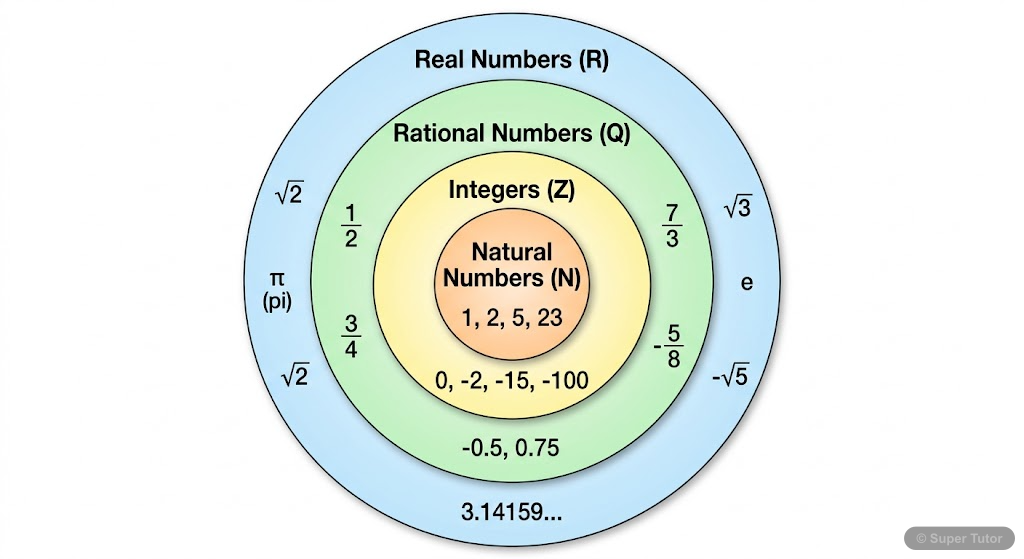
Learn better with visuals Super Tutor pairs illustrations like this with notes and quizzes for Number System.
The first 13 solutions are open to read. The other 12 are free with a Super Tutor account.
Exercise 1.1
1Is zero a rational number? Can you write it in the form , where and are integers and ?Show solution
Given: The number zero (0).
Concept: A number is rational if it can be expressed as , where and are integers and .
Working:
Yes, zero is a rational number. We can write:
In each case, (an integer) and (an integer).
Conclusion: Zero is indeed a rational number and can be written in the form in infinitely many ways.
2Find six rational numbers between 3 and 4.Show solution
Given: Two rational numbers 3 and 4.
Concept: To find rational numbers between two numbers and , multiply numerator and denominator to create a gap. Here we need 6 rational numbers, so we write:
Working:
The rational numbers between and are:
Answer: Six rational numbers between 3 and 4 are:
(Note: There are infinitely many such rational numbers; this is one possible set.)
3Find five rational numbers between and .Show solution
Given: and .
Concept: To find 5 rational numbers between them, convert both fractions to equivalent fractions with a larger denominator (multiply by 6):
Working:
The rational numbers between and are:
Answer: Five rational numbers between and are:
4State whether the following statements are true or false. Give reasons for your answers.
(i) Every natural number is a whole number.
(ii) Every integer is a whole number.
(iii) Every rational number is a whole number.Show solution
(i) Every natural number is a whole number.
Answer: TRUE
Reason: The set of natural numbers is and the set of whole numbers is . Every natural number is present in the set of whole numbers. Hence, every natural number is a whole number.
(ii) Every integer is a whole number.
Answer: FALSE
Reason: The set of integers is . Negative integers such as are integers but they are NOT whole numbers. Hence, every integer is not a whole number.
(iii) Every rational number is a whole number.
Answer: FALSE
Reason: Rational numbers include fractions such as , etc. These are not whole numbers. For example, is a rational number but not a whole number. Hence, every rational number is not a whole number.
Exercise 1.2
1State whether the following statements are true or false. Justify your answers.
(i) Every irrational number is a real number.
(ii) Every point on the number line is of the form , where is a natural number.
(iii) Every real number is an irrational number.Show solution
(i) Every irrational number is a real number.
Answer: TRUE
Reason: The set of real numbers consists of all rational numbers and all irrational numbers together. Therefore, every irrational number is a part of the collection of real numbers, making this statement true.
(ii) Every point on the number line is of the form , where is a natural number.
Answer: FALSE
Reason: Points on the number line include negative numbers (e.g., ), zero, and positive numbers. Negative numbers cannot be expressed as where is a natural number (since square roots of natural numbers are non-negative). Also, numbers like are on the number line but for natural number gives — not every point is covered. Hence the statement is false.
(iii) Every real number is an irrational number.
Answer: FALSE
Reason: Real numbers include both rational and irrational numbers. For example, are real numbers but they are rational, not irrational. Hence, not every real number is irrational.
2Are the square roots of all positive integers irrational? If not, give an example of the square root of a number that is a rational number.Show solution
Answer: No, the square roots of all positive integers are not irrational.
Example:
Here, is a rational number (it can be written as ).
Conclusion: The square roots of perfect squares like are rational numbers. Only the square roots of non-perfect-square positive integers are irrational.
3Show how can be represented on the number line.Show solution
Concept: We use the Pythagorean theorem to construct .
Steps:
Step 1: Draw a number line and mark the origin (representing 0) and point representing 2, so units.
Step 2: At point , draw perpendicular to the number line such that unit.
Step 3: Join . By the Pythagorean theorem:
Step 4: With as centre and as radius, draw an arc that cuts the number line at point .
Conclusion: The point on the number line represents , since .
4Classroom activity (Constructing the 'square root spiral'): Take a large sheet of paper and construct the 'square root spiral' in the following fashion. Start with a point O and draw a line segment of unit length. Draw a line segment perpendicular to of unit length. Now draw a line segment perpendicular to . Then draw a line segment perpendicular to . Continuing in this manner, you can get the line segment by drawing a line segment of unit length perpendicular to .Show solution
This is a classroom activity. Below is the mathematical justification:
Step 1: Start at point . Draw unit along the number line.
Step 2: Draw , with unit.
Step 3: Draw , with unit.
Step 4: Draw , with unit.
General Pattern: At each step :
Conclusion: By continuing this process, we obtain a spiral (called the square root spiral or Theodorus spiral) where the distance from to equals , representing on the plane.
Exercise 1.3
1Write the following in decimal form and say what kind of decimal expansion each has:
(i) (ii) (iii) (iv) (v) (vi) Show solution
(i)
Type: Terminating decimal
(ii)
Performing long division: :
Type: Non-terminating recurring (repeating block: 09)
(iii)
Performing long division: :
Type: Terminating decimal
(iv)
Performing long division: :
Type: Non-terminating recurring (repeating block: 230769)
(v)
Performing long division: :
Type: Non-terminating recurring (repeating block: 18)
(vi)
Performing long division: :
Type: Terminating decimal
2You know that . Can you predict what the decimal expansions of , , , , are, without actually doing the long division? If so, how?Show solution
Given:
Concept: Since , , etc., we can multiply the repeating block. Also, the remainders while dividing by cycle through — each remainder corresponds to a cyclic permutation of the block .
Predictions:
Observation: Each decimal is a cyclic permutation of the digits . This happens because the remainders when dividing by 7 cycle through all non-zero residues.
3Express the following in the form , where and are integers and .
(i) (ii) (iii) Show solution
(i)
Let
Multiply both sides by 10:
Subtract (1) from (2):
(ii)
Let
Multiply both sides by 10:
Multiply both sides by 100:
Subtract (2) from (3):
(iii)
Let
Multiply both sides by 1000:
Subtract (1) from (2):
4Express in the form . Are you surprised by your answer? With your teacher and classmates discuss why the answer makes sense.Show solution
Let
Multiply both sides by 10:
Subtract (1) from (2):
Discussion: This result may seem surprising, but it makes sense because is a non-terminating recurring decimal and the difference between 1 and is . There is no gap between and ; they represent the same number. This shows that every non-terminating recurring decimal is a rational number.
5What can the maximum number of digits be in the repeating block of digits in the decimal expansion of ? Perform the division to check your answer.Show solution
Concept: When we divide by , the remainders at each step can only be (i.e., at most different non-zero remainders). Once a remainder repeats, the decimal block repeats. Therefore, the maximum length of the repeating block is .
Verification by long division:
Performing :
Step-by-step remainders: (remainder 1 repeats)
The repeating block is , which has 16 digits.
Conclusion: The maximum number of digits in the repeating block of is , which is confirmed by the division.
Free with a Super Tutor account
Free with a Super Tutor account
Free with a Super Tutor account
(i) (ii) (iii) (iv) (v)
Free with a Super Tutor account
Exercise 1.4
(i) (ii) (iii) (iv) (v)
Free with a Super Tutor account
(i)
(ii)
(iii)
(iv)
Free with a Super Tutor account
Free with a Super Tutor account
Free with a Super Tutor account
(i) (ii) (iii) (iv)
Free with a Super Tutor account
Exercise 1.5
(i) (ii) (iii)
Free with a Super Tutor account
(i) (ii) (iii) (iv)
Free with a Super Tutor account
(i) (ii) (iii) (iv)
Free with a Super Tutor account
12 more solved questions in Number System
They are free with a Super Tutor account, along with practice quizzes and flashcards for this chapter. Free to start, no card needed.
Frequently Asked Questions
What are the important topics in Number System for Meghalaya Board Class 9 Mathematics?
Are these NCERT Solutions for Number System free?
How should I revise Number System for Class 9 exams?
Sources & Official References
Content is aligned to the official syllabus. Refer to the board website for the latest curriculum.
More resources for Number System
Practice Quiz
Test yourself with a quick quiz
Important Questions
Exam-style questions with answers
Revision Notes
Key points for last-minute revision
Formula Sheet
The chapter's formulas in one place
Chapter Summary
Understand the chapter at a glance
Flashcards
Quick-fire cards for active recall
Syllabus
What topics to cover
For serious students
Get the full Number System chapter — start free.
Quizzes, flashcards, an AI doubt solver and a study plan for Meghalaya Board Class 9 Mathematics. Free to start, no card needed.