Principles of Inheritance and Variation — NCERT Solutions
Mizoram Board · Class 12 · Biology
NCERT Solutions for Principles of Inheritance and Variation, Mizoram Board Class 12 Biology: 16 textbook questions solved step by step.
Interactive on Super Tutor
Studying Principles of Inheritance and Variation? Get the full interactive chapter.
Quizzes, flashcards, AI doubt-solver and a step-by-step study plan — built for NCERT solutions and more.
Free trial, no card needed.
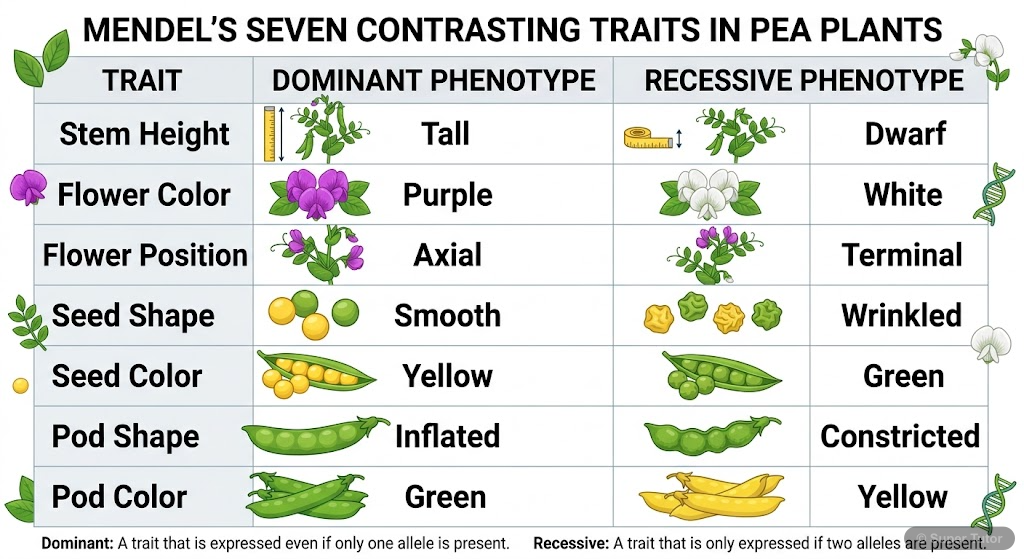
One of 26 illustrations for Principles of Inheritance and Variation in Super Tutor — alongside flashcards, concept maps and practice questions.
The first 8 solutions are open to read. The other 8 are free with a Super Tutor account.
EXERCISES — Principles of Inheritance and Variation
1Mention the advantages of selecting pea plant for experiment by Mendel.Show solution
Given: Mendel chose the garden pea (Pisum sativum) for his experiments on inheritance.
Advantages of selecting pea plant:
- Availability of contrasting characters: Pea plants have several sharply contrasting (discontinuous) characters such as tall/dwarf, round/wrinkled seeds, yellow/green seeds, etc., making it easy to distinguish traits.
- Short life span: Pea plants complete their life cycle in one season, allowing several generations to be studied in a short time.
- Bisexual flowers: The flowers are bisexual (hermaphrodite), so self-pollination occurs naturally, making it easy to maintain pure lines.
- Easy cross-pollination: Cross-pollination can be carried out easily by emasculation (removal of anthers) and artificial pollination.
- Large number of offspring: Each plant produces a large number of seeds, providing statistically significant data.
- Easy to grow: Pea plants are easy to cultivate and require little maintenance.
- Availability of pure breeding varieties: Pure breeding (true breeding) varieties were readily available in the market.
Conclusion: These features made pea plants an ideal experimental organism for studying the principles of inheritance.
2Differentiate between the following — (a) Dominance and Recessive (b) Homozygous and Heterozygous (c) Monohybrid and Dihybrid.Show solution
(a) Dominance and Recessive:
| Feature | Dominant | Recessive |
|---|---|---|
| Definition | The allele that expresses itself in both homozygous and heterozygous conditions. | The allele that expresses itself only in homozygous condition. |
| Expression | Expressed in generation (heterozygous). | Suppressed in ; reappears in . |
| Notation | Represented by capital letter (e.g., ). | Represented by small letter (e.g., ). |
| Example | Tallness () in pea. | Dwarfness () in pea. |
(b) Homozygous and Heterozygous:
| Feature | Homozygous | Heterozygous |
|---|---|---|
| Definition | An organism having two identical alleles for a trait at a locus. | An organism having two different alleles for a trait at a locus. |
| Gametes produced | Only one type of gamete. | Two types of gametes. |
| Breeding | Breeds true (pure breeding). | Does not breed true. |
| Example | (pure tall) or (pure dwarf). | (hybrid tall). |
(c) Monohybrid and Dihybrid:
| Feature | Monohybrid | Dihybrid |
|---|---|---|
| Definition | A cross between parents differing in only one pair of contrasting characters. | A cross between parents differing in two pairs of contrasting characters. |
| phenotypic ratio | ||
| genotypic ratio | ||
| Example | Tall () × Dwarf () | Tall Yellow () × Dwarf Green () |
3A diploid organism is heterozygous for 4 loci, how many types of gametes can be produced?Show solution
Given: A diploid organism is heterozygous for 4 loci.
Formula used: Number of types of gametes , where = number of heterozygous loci.
Working:
Explanation: For each heterozygous locus (e.g., ), two types of alleles ( or ) can go into a gamete. For 4 such loci, the total combinations are .
Answer: The organism can produce 16 types of gametes.
4Explain the Law of Dominance using a monohybrid cross.Show solution
Law of Dominance: In a cross between two homozygous parents differing in one character, the character that appears in the generation is called the dominant character, and the one that is suppressed is called the recessive character. When two different alleles are present together, only the dominant allele expresses itself.
Monohybrid Cross (Tall × Dwarf):
- Parents: Pure Tall () × Pure Dwarf ()
- Gametes: and
Generation:
All plants are tall () — the dominant character (tallness) is expressed and dwarfness is suppressed.
Generation (Self-fertilisation of ):
- Genotypic ratio:
- Phenotypic ratio: Tall : Dwarf
Conclusion: In , only tallness (dominant) is expressed. In , both tall and dwarf plants appear in 3:1 ratio. The recessive character (dwarfness) reappears in in homozygous condition (), demonstrating the Law of Dominance.
5Define and design a test-cross.Show solution
Definition: A test-cross is a cross between an organism showing a dominant phenotype (but of unknown genotype — either homozygous dominant or heterozygous ) with a homozygous recessive individual (). It is used to determine whether the dominant phenotype individual is homozygous or heterozygous.
Design of Test-Cross:
Case 1: If the dominant parent is homozygous ()
- Offspring: All tall ()
- Phenotypic ratio: 100% Tall : 0% Dwarf
Case 2: If the dominant parent is heterozygous ()
- Offspring: 50% Tall () : 50% Dwarf ()
- Phenotypic ratio:
Conclusion: If all offspring show dominant phenotype → parent was homozygous. If offspring show 1:1 ratio of dominant to recessive → parent was heterozygous. Thus, a test-cross helps in determining the genotype of an organism.
6Using a Punnett Square, workout the distribution of phenotypic features in the first filial generation after a cross between a homozygous female and a heterozygous male for a single locus.Show solution
Given:
- Homozygous female: (homozygous dominant) — assuming dominant homozygous
- Heterozygous male:
Cross: (female) (male)
Gametes:
- Female gametes: ,
- Male gametes: ,
Punnett Square:
| (male) | (male) | |
|---|---|---|
| (female) | ||
| (female) |
Results:
- Genotypes:
- Phenotypes: All offspring show the dominant phenotype
Phenotypic ratio: 100% dominant phenotype (no recessive phenotype)
Conclusion: Since individuals and individuals both express the dominant character, all offspring in will show the dominant phenotype only. There is no recessive phenotype in the offspring.
7When a cross is made between tall plant with yellow seeds (TtYy) and tall plant with green seed (Ttyy), what proportions of phenotype in the offspring could be expected to be (a) tall and green. (b) dwarf and green.Show solution
Given:
- Parent 1: Tall, Yellow seeds —
- Parent 2: Tall, Green seeds —
Gametes:
- produces: (each with frequency )
- produces: (each with frequency )
Method: Consider each gene separately.
For height ():
- Tall () =
- Dwarf () =
For seed colour ():
- Yellow () =
- Green () =
Expected phenotypic proportions:
(a) Tall and Green:
Answer (a): (i.e., 3 out of 8 offspring will be tall and green)
(b) Dwarf and Green:
Answer (b): (i.e., 1 out of 8 offspring will be dwarf and green)
Overall phenotypic ratio: Tall Yellow : Tall Green : Dwarf Yellow : Dwarf Green
8Two heterozygous parents are crossed. If the two loci are linked what would be the distribution of phenotypic features in F₁ generation for a dihybrid cross?Show solution
Given: Two heterozygous parents () are crossed. The two loci are linked (present on the same chromosome).
Concept: When genes are linked (present on the same chromosome), they do not assort independently. They tend to be inherited together.
Case: Complete Linkage
If the genes are completely linked (no crossing over), the parental combinations are maintained.
Assuming coupling arrangement:
- Gametes produced: only and (parental types)
Phenotypic ratio:
- phenotype (): 3
- phenotype (): 1
Phenotypic ratio = 3:1 (instead of the expected 9:3:3:1 for unlinked genes)
Conclusion: When two loci are completely linked, the (here of the dihybrid) generation shows only two phenotypic classes in a 3:1 ratio — the parental combinations ( and ). The new recombinant phenotypes ( and ) are absent or appear in very low frequency (only if crossing over occurs). This is in contrast to the 9:3:3:1 ratio seen when genes are on different chromosomes (independent assortment).
Free with a Super Tutor account
Free with a Super Tutor account
Free with a Super Tutor account
Free with a Super Tutor account
Free with a Super Tutor account
Free with a Super Tutor account
Free with a Super Tutor account
Free with a Super Tutor account
8 more solved questions in Principles of Inheritance and Variation
They are free with a Super Tutor account, along with practice quizzes and flashcards for this chapter. Free to start, no card needed.
Frequently Asked Questions
What are the important topics in Principles of Inheritance and Variation for Mizoram Board Class 12 Biology?
Are these NCERT Solutions for Principles of Inheritance and Variation free?
How should I revise Principles of Inheritance and Variation for the Mizoram Board Class 12 board exam?
Sources & Official References
Content is aligned to the official syllabus. Refer to the board website for the latest curriculum.
More resources for Principles of Inheritance and Variation
Practice Quiz
Test yourself with a quick quiz
Important Questions
Exam-style questions with answers
Revision Notes
Key points for last-minute revision
Formula Sheet
The chapter's formulas in one place
Chapter Summary
Understand the chapter at a glance
Concept Maps
See how topics connect
Study Plan
Step-by-step plan for this chapter
Flashcards
Quick-fire cards for active recall
Syllabus
What topics to cover
For serious students
Get the full Principles of Inheritance and Variation chapter — start free.
Quizzes, flashcards, an AI doubt solver and a study plan for Mizoram Board Class 12 Biology. Free to start, no card needed.