Organisms and Populations — Practice Quiz
Mizoram Board · Class 12 · Biology
Try a 4-question quiz on Organisms and Populations for Mizoram Board Class 12 Biology: tap an answer to check it and see why.
Interactive on Super Tutor
Studying Organisms and Populations? Get the full interactive chapter.
Quizzes, flashcards, AI doubt-solver and a step-by-step study plan — built for practice quiz and more.
Free trial, no card needed.
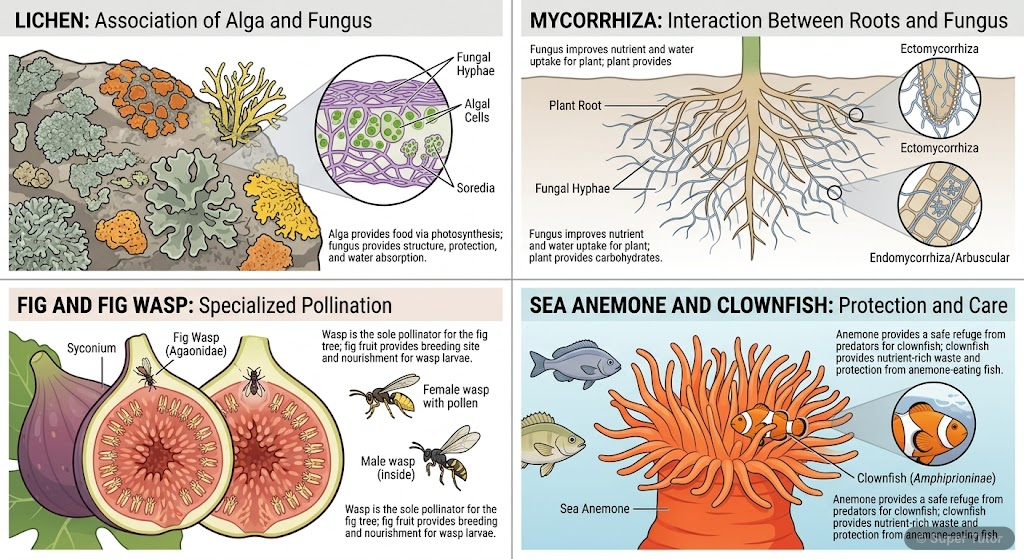
One of 13 illustrations for Organisms and Populations in Super Tutor — alongside flashcards, concept maps and practice questions.
Quick Quiz: Organisms and Populations
0/4Tap an answer to check it instantly. No sign-up needed for these 4.
What is the term used for the maximum number of individuals that a habitat can support?
In exponential growth, the population grows in a _______ pattern.
The intrinsic rate of natural increase is represented by which symbol?
In which type of interaction do both species benefit?
Sample Questions
Which of the following are examples of population attributes? (Select all correct answers)
Show answer
Birth rate, Death rate, Sex ratio, Age distribution
Population attributes are characteristics that apply only to groups, not individuals. Birth rate, death rate, sex ratio, and age distribution are all population-level attributes. Individual height is a characteristic of an individual organism, not a population attribute.
Which factors contribute to an increase in population density? (Select all correct answers)
Show answer
Natality, Immigration
Population density increases due to natality (births) and immigration (individuals moving into the habitat). Mortality (deaths) and emigration (individuals leaving the habitat) decrease population density.
The age pyramid of a growing population has a _______ shape.
Show answer
Broad base
A growing population has many young individuals, creating a broad base in the age pyramid. A narrow base indicates a declining population, while equal width suggests a stable population.
Cuscuta is an example of which type of parasite?
Show answer
Parasitic plant
Cuscuta is described as a parasitic plant that grows on hedge plants and derives nutrition from the host plant. It has lost its chlorophyll and leaves during evolution, which fits the parasitic plant category. It is not an ectoparasite or endoparasite as those terms refer to parasites living on the outside or inside of animal hosts.
+46 more questions on Organisms and Populations (Mizoram Board Class 12 Biology)
Practise AllFrequently Asked Questions
What are the important topics in Organisms and Populations for Mizoram Board Class 12 Biology?
How many practice questions are there for Organisms and Populations?
Sources & Official References
Content is aligned to the official syllabus. Refer to the board website for the latest curriculum.
More resources for Organisms and Populations
Important Questions
Exam-style questions with answers
Revision Notes
Key points for last-minute revision
Formula Sheet
The chapter's formulas in one place
Chapter Summary
Understand the chapter at a glance
Concept Maps
See how topics connect
Study Plan
Step-by-step plan for this chapter
Flashcards
Quick-fire cards for active recall
Syllabus
What topics to cover
NCERT Solutions
Every textbook question solved step by step
For serious students
Get the full Organisms and Populations chapter — start free.
Quizzes, flashcards, an AI doubt solver and a study plan for Mizoram Board Class 12 Biology. Free to start, no card needed.