Chapter 5 of 11
NCERT Solutions

Business Environment

Mizoram Board · Class 12 · Business Studies

NCERT Solutions for Business Environment — Mizoram Board Class 12 Business Studies.

48 questions20 flashcards5 concepts

Interactive on Super Tutor

Studying Business Environment? Get the full interactive chapter.

Quizzes, flashcards, AI doubt-solver and a step-by-step study plan — built for ncert solutions and more.

1,000+ Class 12 students started this chapter today

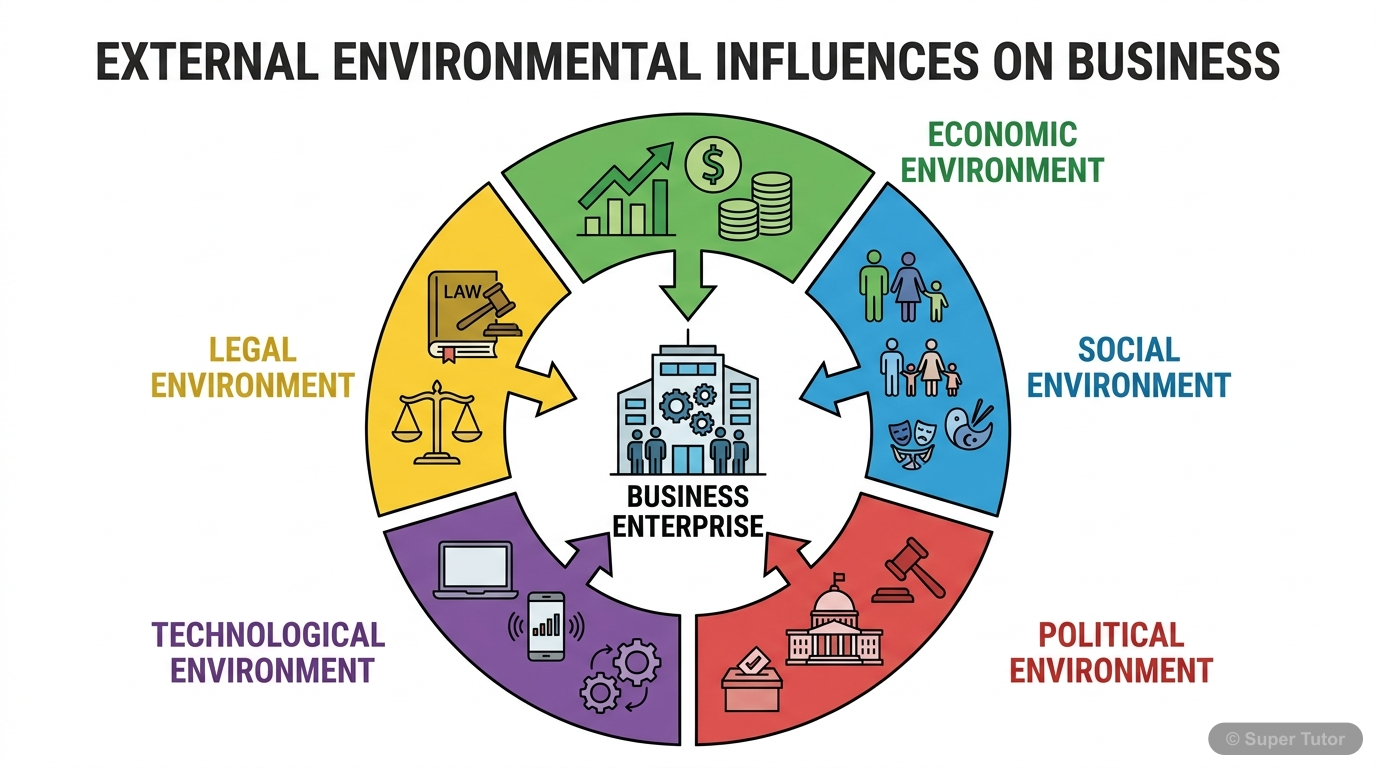
A diagram illustrating the various external forces that constitute the business environment, showing how they surround and influence a central business enterprise.
Super Tutor

Super Tutor has 11+ illustrations like this for Business Environment alone — flashcards, concept maps, and step-by-step visuals.

See them all
14 Questions Solved · 3 Sections

Very Short Answer Type

1What is meant by business environment?Show solution
Business Environment — Meaning:

The term business environment refers to the totality of all individuals, institutions and other forces that are outside a business enterprise but that potentially affect its performance.

In other words, it is the sum total of all external forces — specific as well as general — that surround and influence the functioning of a business firm.

Key features of the definition:
- It includes all external forces (economic, social, political, legal, technological).
- These forces are outside the control of the business.
- They have a direct or indirect impact on business decisions and performance.

Example: Changes in government tax policy, consumer preferences, technological innovations, etc., all form part of the business environment.
2How does understanding of business environment help in improving performance of a business?Show solution
Understanding Business Environment and Performance Improvement:

Understanding the business environment helps in improving performance in the following ways:

1. Identification of Opportunities: A firm that continuously monitors its environment can identify emerging opportunities (e.g., a new market segment) and exploit them before competitors — gaining first-mover advantage.

2. Early Warning Signals: Understanding the environment helps managers detect threats (e.g., entry of a new competitor, change in consumer taste) early and take corrective action in time.

3. Coping with Rapid Changes: Awareness of environmental changes (technological, legal, economic) enables firms to adapt quickly, thereby maintaining or improving their competitive position.

4. Assistance in Planning and Policy: Environmental analysis provides the necessary information base for formulating realistic plans and policies aligned with external realities.

5. Improving Overall Performance: When a business aligns its strategies with environmental realities, it operates more efficiently and effectively, leading to better performance.

Conclusion: Thus, a thorough understanding of the business environment enables managers to make informed decisions, which ultimately improves the performance of the enterprise.
3Give an example to show that a business firm operates within numerous inter-related factors constituting the business environment.Show solution
Inter-relatedness of Business Environment — Example:

Given Concept: The various dimensions of business environment are not isolated; they are closely inter-related and influence each other.

Example:

Suppose the Government of India (Political environment) decides to promote digital payments by reducing taxes on digital transactions (Economic environment). This encourages companies to develop new payment apps and software (Technological environment). Society gradually shifts its attitude towards cashless transactions (Social environment). New laws are enacted to regulate data privacy in digital payments (Legal environment).

This example clearly shows how a single policy decision in the political environment triggers changes in the economic, technological, social and legal environments simultaneously.

Conclusion: All dimensions of business environment are inter-related and a change in one dimension affects the others, making it essential for businesses to monitor all dimensions together.
4Krishna Furnishers Mart started its operations in the year 1954 and emerged as the market leader in the industry because of their original designs and efficiency in operations. They had a steady demand for their products but over the years, they found their market share declining because of new entrants in the field. The firm decided to review their operations and decided that in order to meet the competition, they need to study and analyze the market trends and then design and develop their products accordingly. List any two impacts of changes in business environment on Krishna Furnishers Mart's operations.Show solution
Two Impacts of Changes in Business Environment on Krishna Furnishers Mart:

1. Increase in Competition:
With the entry of new players in the furniture market, Krishna Furnishers Mart faced intense competition. Its market share declined as customers now had more choices. This forced the firm to review and improve its operations to remain competitive.

2. Market Orientation:
The firm realised that it could no longer rely solely on its traditional designs and operational efficiency. It had to shift from a production-oriented approach to a market-oriented approach — studying market trends, understanding customer preferences, and designing products accordingly to meet the demands of the changing market.

Conclusion: Changes in the business environment (entry of new competitors) compelled Krishna Furnishers Mart to become more competitive and market-driven in its operations.
5Name any two Specific forces of business environment affecting business.Show solution
Two Specific Forces of Business Environment:

Specific forces are those that directly and immediately affect the day-to-day operations of a business. They include:

1. Investors/Shareholders: They provide capital to the business. Their confidence, expectations of returns, and investment decisions directly affect the financial health of the firm.

2. Competitors: Rival firms in the same industry directly affect a business's pricing, product development, marketing strategies, and market share.

*(Other examples of specific forces: Suppliers, Customers, Employees, Media)*

Short Answer Type

1Why it is important for business enterprises to understand their environment? Explain.Show solution
Importance of Understanding Business Environment:

It is important for business enterprises to understand their environment for the following reasons:

1. Identification of Opportunities and First-Mover Advantage:
By scanning the environment, a firm can identify emerging opportunities (e.g., growing demand for organic food) and exploit them before competitors, thereby gaining a first-mover advantage.

2. Identification of Threats and Early Warning Signals:
Environmental understanding helps managers detect potential threats (e.g., entry of a foreign competitor, change in government policy) early, so that timely corrective measures can be taken.

3. Coping with Rapid Changes:
The business environment is dynamic and changes rapidly (e.g., technological innovations, changing consumer preferences). Understanding these changes helps firms adapt their strategies and remain relevant.

4. Assistance in Planning and Policy Formulation:
Environmental analysis provides crucial information about external factors, which helps managers formulate realistic and effective plans and policies. For example, knowledge of an upcoming recession helps a firm plan its inventory and pricing strategy.

5. Improving Performance:
When a business continuously monitors and responds to its environment, it can align its resources and capabilities with external opportunities, leading to improved efficiency and overall performance.

Conclusion: A thorough understanding of the business environment is essential for survival, growth and long-term success of any business enterprise.
2Explain the following terms: a. Liberalisation b. Privatisation c. GlobalisationShow solution
a. Liberalisation:

Meaning: Liberalisation refers to the freeing of the Indian industry from the shackles of the licensing system and other unnecessary government controls and restrictions.

Key measures under Liberalisation (1991):
- Abolition of industrial licensing for most industries.
- Freedom to expand production capacity.
- Removal of restrictions on the movement of goods and services.
- Reduction in import duties and simplification of export-import procedures.
- Freedom to fix prices of goods and services.

Effect: It gave Indian businesses greater freedom to operate, expand and compete.

---

b. Privatisation:

Meaning: Privatisation refers to the reduction of the role of the public sector and the increase in the role of the private sector in the economy.

Key measures under Privatisation (1991):
- Reduction in the number of industries reserved exclusively for the public sector (from 17 to 3).
- Disinvestment of government equity in public sector undertakings (PSUs).
- Encouraging private sector participation in areas previously reserved for the government.

Effect: It improved efficiency and accountability in industries as private firms are profit-driven and more competitive.

---

c. Globalisation:

Meaning: Globalisation refers to the integration of the Indian economy with the world economy by encouraging foreign private participation in industrial development and removing barriers to international trade and investment.

Key measures under Globalisation (1991):
- Allowing Foreign Direct Investment (FDI) in various sectors.
- Reduction of import tariffs and removal of quantitative restrictions.
- Making the rupee convertible on the current account.
- Encouraging Indian firms to invest abroad.

Effect: It exposed Indian businesses to global competition and also opened up vast international markets for Indian goods and services.
3National Digital Library of India (NDL India) works towards developing a framework of virtual repository of learning resources with a single-window search facility. It provides support to all academic levels including researchers, life-long learners and differently-abled learners free of cost. State the dimensions of business environment highlighted above.Show solution
Dimensions of Business Environment Highlighted:

The given case highlights the following dimensions of business environment:

1. Technological Environment:
NDL India uses digital technology to create a virtual repository of learning resources with a single-window search facility. This reflects the use of scientific advancements and digital innovations to deliver educational services — a key feature of the technological environment.

2. Social Environment:
NDL India provides free support to all academic levels including researchers, life-long learners and differently-abled learners. This reflects the social values of inclusivity, equity and social responsibility — core elements of the social environment.

Conclusion: The case of NDL India highlights both the Technological dimension (use of digital platforms and virtual repositories) and the Social dimension (serving diverse sections of society including the differently-abled, free of cost) of the business environment.
4State the impact of demonetization on interest rates, private wealth and real estate.Show solution
Impact of Demonetisation on Interest Rates, Private Wealth and Real Estate:

1. Impact on Interest Rates (Money/Interest Rates):
- After demonetisation, there was a decline in cash transactions as people deposited their old currency notes in banks.
- Bank deposits increased significantly, leading to greater liquidity with banks.
- This resulted in an increase in financial savings and a general tendency for interest rates to soften (decline) as banks had more funds available to lend.

2. Impact on Private Wealth:
- Private wealth declined after demonetisation.
- This was because some high-denomination demonetised notes (₹500 and ₹1,000) were not returned to the banking system (i.e., black money was destroyed).
- Additionally, real estate prices fell, which reduced the asset value held by private individuals, thereby reducing overall private wealth.

3. Impact on Real Estate:
- Real estate prices declined significantly after demonetisation.
- This was because a large portion of real estate transactions in India involved cash (often black money). With the withdrawal of high-denomination notes, the availability of unaccounted cash reduced sharply.
- As a result, demand for real estate fell, leading to a fall in property prices.

Conclusion: Demonetisation had a significant impact on the financial sector by increasing bank deposits and reducing cash transactions, while simultaneously reducing private wealth and real estate prices due to the elimination of unaccounted money.

Long Answer Type

1How would you characterize business environment? Explain with examples, the difference between general and specific environment.Show solution
Characteristics of Business Environment:

Business environment can be characterised by the following features:

1. Totality of External Forces:
Business environment is the sum total of all forces external to a business firm. It includes everything outside the organisation that can affect it — competitors, customers, government, technology, social trends, etc.

2. Specific and General Forces:
Business environment includes both specific forces (directly affecting a firm, e.g., customers, suppliers) and general forces (indirectly affecting all firms, e.g., social, political, economic conditions).

3. Inter-relatedness:
The various elements of business environment are closely related to each other. A change in one element affects others. For example, a change in technology (technological environment) may lead to changes in consumer preferences (social environment) and government regulations (legal environment).

4. Dynamic Nature:
Business environment is not static; it keeps changing continuously. New technologies emerge, consumer tastes change, governments change policies — all making the environment dynamic.

5. Uncertainty:
It is difficult to predict the future changes in the business environment with certainty. For example, no one can predict exactly when a new technology will emerge or when a government will change its policy.

6. Complexity:
Business environment consists of numerous inter-related and dynamic conditions and forces. It is often difficult to understand the full impact of environmental changes on a business.

7. Relativity:
Business environment is a relative concept — it differs from country to country, region to region, and even from business to business. For example, the business environment for a firm in India is different from that in the USA.

---

Difference between General and Specific Environment:

| Basis | General Environment | Specific Environment |
|---|---|---|
| Meaning | Indirect forces that affect all businesses in general | Direct forces that affect a particular business specifically |
| Impact | Indirect and long-term impact | Direct and immediate impact |
| Control | Cannot be controlled by any single firm | Can be partially influenced by the firm |
| Examples | Economic conditions, social trends, political stability, legal framework, technological changes | Customers, suppliers, investors, competitors, employees |

Example of General Environment:
When the Government of India increased the Goods and Services Tax (GST) rate on certain goods, it affected all businesses dealing in those goods — this is a general (economic/legal) environmental force.

Example of Specific Environment:
When a major supplier of raw material to a textile company raises its prices, it directly affects that particular textile company — this is a specific environmental force.

Conclusion: Both general and specific environments are important for a business. While general environment sets the broad context, specific environment directly shapes day-to-day business decisions.
2How would you argue that the success of a business enterprise is significantly influenced by its environment?Show solution
Success of Business Enterprise is Significantly Influenced by its Environment:

The success of a business enterprise depends not only on its internal strengths but also significantly on how well it understands and responds to its external environment. The following points establish this argument:

1. Identification of Opportunities:
A business that continuously scans its environment can identify new opportunities and exploit them before competitors. For example, when the Indian government promoted digital payments after demonetisation, companies like Paytm quickly identified this opportunity and expanded rapidly, achieving enormous success.

2. Early Detection of Threats:
Environmental awareness helps businesses detect threats early. For example, a firm that monitors changes in consumer preferences can redesign its products before losing market share. Kodak's failure to adapt to the digital photography revolution (technological environment) led to its downfall — showing how ignoring the environment can lead to failure.

3. Adapting to Rapid Changes:
The business environment changes rapidly. Firms that adapt to these changes survive and grow, while those that do not, fail. For example, Nokia's inability to adapt to the smartphone revolution (technological environment) led to its decline, while Samsung adapted and became a global leader.

4. Effective Planning and Policy:
Environmental analysis provides the information base for strategic planning. A firm aware of an upcoming economic recession can plan its inventory, pricing and staffing accordingly, thereby minimising losses.

5. Competitive Advantage:
Firms that understand their competitive environment (specific forces like competitors, customers) can develop strategies to gain a competitive edge. For example, Amazon's understanding of changing consumer preferences for online shopping helped it become the world's largest e-commerce company.

6. Regulatory Compliance:
Understanding the legal environment ensures that a business complies with laws and avoids penalties. For example, a firm aware of environmental regulations can invest in pollution control measures in advance, avoiding legal action.

7. Resource Mobilisation:
Understanding the economic environment (interest rates, inflation, availability of credit) helps a firm plan its finances effectively, ensuring adequate resources for operations and growth.

Conclusion: The success of a business enterprise is significantly influenced by its environment. A firm that proactively monitors, understands and responds to its environment is better positioned to exploit opportunities, counter threats, and achieve long-term success.
3Explain, with examples, the various dimensions of business environment.Show solution
Various Dimensions of Business Environment:

Business environment consists of five important dimensions:

---

1. Economic Environment:

Meaning: It includes all economic forces that affect business operations such as interest rates, inflation rates, changes in disposable income of people, stock market indices and the value of the rupee.

Example: When the Reserve Bank of India (RBI) reduces interest rates, borrowing becomes cheaper for businesses, encouraging investment and expansion. Similarly, when people's disposable income rises, demand for consumer goods increases, benefiting businesses.

---

2. Social Environment:

Meaning: It includes social forces like traditions, values, social trends, society's expectations from business, demographic factors, etc.

Example: The growing health consciousness among Indian consumers (social trend) has led to increased demand for organic food, sugar-free products and fitness equipment. Companies like Patanjali capitalised on this social trend and achieved rapid growth.

---

3. Technological Environment:

Meaning: It includes forces relating to scientific improvements and innovations which provide new ways of producing goods and services and new methods and techniques of operating a business.

Example: The development of the internet and smartphones has revolutionised the retail industry. Companies like Flipkart and Amazon have used technology to create entirely new business models (e-commerce), disrupting traditional brick-and-mortar retail.

---

4. Political Environment:

Meaning: It includes political conditions such as general stability and peace in the country and specific attitudes that elected government representatives hold toward business.

Example: A stable government with pro-business policies (e.g., 'Make in India' initiative) encourages domestic and foreign investment. Conversely, political instability or frequent changes in government policies create uncertainty and discourage investment.

---

5. Legal Environment:

Meaning: It includes various legislations passed by the government, administrative orders issued by government authorities, court judgments and decisions rendered by various commissions and agencies at every level of government.

Example: The introduction of the Consumer Protection Act requires businesses to ensure product quality and fair trade practices. The Goods and Services Tax (GST) Act has changed the way businesses handle taxation. Non-compliance with these laws can result in penalties and legal action.

---

Conclusion: All five dimensions of business environment — economic, social, technological, political and legal — are inter-related and together shape the context in which a business operates. A successful business must continuously monitor all these dimensions to make informed decisions.
4The Government of India announced Demonetization of ₹500 and ₹1,000 currency notes with effect from the midnight of November 8, 2016. As a result, the existing ₹500 and ₹1,000 currency notes ceased to be legal tender from that date. New currency notes of the denomination of ₹500 and ₹2,000 were issued by Reserve Bank of India after the announcement. This step resulted in a substantial increase in the awareness about and use of Point of Sale machines, e-wallets, digital cash and other modes of cashless transactions. Also, increased transparency in monetary transactions and disclosure led to a rise in government revenue in the form of tax collection. a. Enumerate the dimensions of business environment highlighted above. b. State the features of Demonetization.Show solution
a. Dimensions of Business Environment Highlighted:

The given case of Demonetisation highlights the following dimensions of business environment:

1. Economic Environment:
Demonetisation directly affected the monetary system of India — withdrawal of ₹500 and ₹1,000 notes as legal tender, issuance of new currency, changes in interest rates, increase in bank deposits, and rise in tax collection are all economic phenomena. The rise in government revenue through increased tax collection is a key economic impact.

2. Technological Environment:
The substantial increase in the use of Point of Sale (PoS) machines, e-wallets, digital cash and other cashless transaction modes reflects the technological dimension. Demonetisation accelerated the adoption of digital payment technologies among new users (RuPay/AEPS).

3. Legal Environment:
The government's announcement that ₹500 and ₹1,000 notes would cease to be legal tender from midnight of November 8, 2016 is a legal measure. The issuance of new currency notes by the RBI is also a legal/regulatory action.

4. Political Environment:
Demonetisation was a major policy decision taken by the elected government of India. It reflects the political will and the attitude of the government towards curbing black money, corruption and counterfeit currency — all aspects of the political environment.

---

b. Features of Demonetisation:

1. Withdrawal of Legal Tender Status:
The existing ₹500 and ₹1,000 currency notes ceased to be legal tender from midnight of November 8, 2016. This meant these notes could no longer be used for transactions.

2. Issuance of New Currency:
New currency notes of ₹500 and ₹2,000 denominations were issued by the Reserve Bank of India to replace the demonetised notes.

3. Impact on Cash Transactions:
There was a significant decline in cash transactions immediately after demonetisation as people faced a shortage of valid currency.

4. Increase in Bank Deposits:
People deposited their old demonetised notes in banks, leading to a substantial increase in bank deposits and financial savings.

5. Promotion of Digital Transactions:
Demonetisation led to a substantial increase in digital transactions — use of PoS machines, e-wallets, UPI, RuPay cards and AEPS increased significantly among new users.

6. Decline in Private Wealth:
Private wealth declined as some high-denomination notes were not returned to the banking system (black money destroyed) and real estate prices fell.

7. Rise in Tax Collection:
Increased transparency in monetary transactions and greater disclosure led to a rise in income tax collection, boosting government revenue.

8. Decline in Real Estate Prices:
Real estate prices declined as the availability of unaccounted cash (commonly used in property transactions) reduced sharply.
5What economic changes were initiated by the Government under the Industrial Policy, 1991? What impact have these changes made on business and industry?Show solution
Economic Changes Initiated under Industrial Policy, 1991:

In July 1991, the Government of India announced a New Industrial Policy as part of economic reforms. The major economic changes initiated were:

1. Liberalisation:
- Industrial licensing was abolished for most industries (except a few related to security, hazardous chemicals, etc.).
- Freedom given to businesses to expand production capacity.
- Reduction in import duties and simplification of export-import procedures.
- Removal of restrictions on the movement of goods and services.
- Prices of most goods were freed from government control.

2. Privatisation:
- The number of industries reserved exclusively for the public sector was drastically reduced from 17 to 3 (atomic energy, defence equipment and railway transport).
- Disinvestment of government equity in public sector undertakings (PSUs) was initiated.
- Private sector was allowed to enter areas previously reserved for the government.

3. Globalisation:
- Foreign Direct Investment (FDI) was allowed in various sectors.
- Import tariffs were reduced and quantitative restrictions on imports were removed.
- The rupee was made convertible on the current account.
- Indian firms were encouraged to invest abroad and access global markets.
- Multinational corporations (MNCs) were allowed to operate in India.

---

Impact of these Changes on Business and Industry:

1. Increasing Competition:
With liberalisation and globalisation, both domestic and foreign firms entered the Indian market. This led to intense competition. Indian firms had to improve quality, reduce costs and innovate to survive. For example, the Indian automobile industry faced competition from global giants like Toyota, Honda and Ford.

2. More Demanding Customers:
With greater choice available, customers became more demanding in terms of quality, price, variety and after-sales service. Businesses had to become more customer-centric.

3. Rapidly Changing Technological Environment:
Globalisation brought new technologies to India. Businesses had to continuously upgrade their technology to remain competitive. For example, the IT sector in India adopted the latest software technologies to compete globally.

4. Necessity for Change:
The new economic environment made it necessary for Indian businesses to change their strategies, structures and processes. Firms that failed to change (e.g., many public sector units) lost market share.

5. Need for Developing Human Resources:
To compete globally, businesses needed skilled and trained employees. This led to increased investment in training and development, and a growing demand for professional managers.

6. Market Orientation:
Businesses shifted from a production-oriented approach to a market-oriented approach — focusing on understanding and satisfying customer needs rather than just producing goods.

7. Loss of Budgetary Support to the Public Sector:
With privatisation and disinvestment, public sector enterprises could no longer rely on government budgetary support. They had to become self-sufficient and competitive, leading to restructuring and improved efficiency in many PSUs.

Conclusion: The economic reforms of 1991 (LPG — Liberalisation, Privatisation and Globalisation) fundamentally transformed the Indian business environment. While they brought challenges like increased competition, they also created enormous opportunities for growth, modernisation and global integration of Indian businesses.

Stuck on a step?

Ask Super Tutor AI to explain any solution on this page in a simpler way — free, 24x7.

Ask a Doubt Free

Frequently Asked Questions

What are the important topics in Business Environment for Mizoram Board Class 12 Business Studies?
Key topics in Business Environment include Business Environment — Complete Chapter Overview, Business Environment — Complete Concept Map, Business Environment — Complete Chapter Overview. These are the concepts Mizoram Board Class 12 examiners draw on most — study them first, then practise related questions.
How to score full marks in Business Environment — Mizoram Board Class 12 Business Studies?
Understand the core concepts first, then work through the 48 practice questions available for this chapter. Revise formulas and definitions regularly, and use flashcards for quick recall before the exam.
Where can I get free NCERT Solutions for Business Environment Class 12 Business Studies?
This page has free step-by-step NCERT Solutions for every exercise question in Business Environment (Mizoram Board Class 12 Business Studies) — written the way examiners award marks: given, formula, working, answer.

Sources & Official References

Content is aligned to the official syllabus. Refer to the board website for the latest curriculum.

For serious students

Get the full Business Environment chapter — for free.

Quizzes, flashcards, AI doubt-solver and a step-by-step study plan for Mizoram Board Class 12 Business Studies.