Chapter 8 of 12
NCERT Solutions

Determination of Income and Employment

Mizoram Board · Class 12 · Economics

NCERT Solutions for Determination of Income and Employment — Mizoram Board Class 12 Economics.

35 questions24 flashcards5 concepts

Interactive on Super Tutor

Studying Determination of Income and Employment? Get the full interactive chapter.

Quizzes, flashcards, AI doubt-solver and a step-by-step study plan — built for ncert solutions and more.

1,000+ Class 12 students started this chapter today

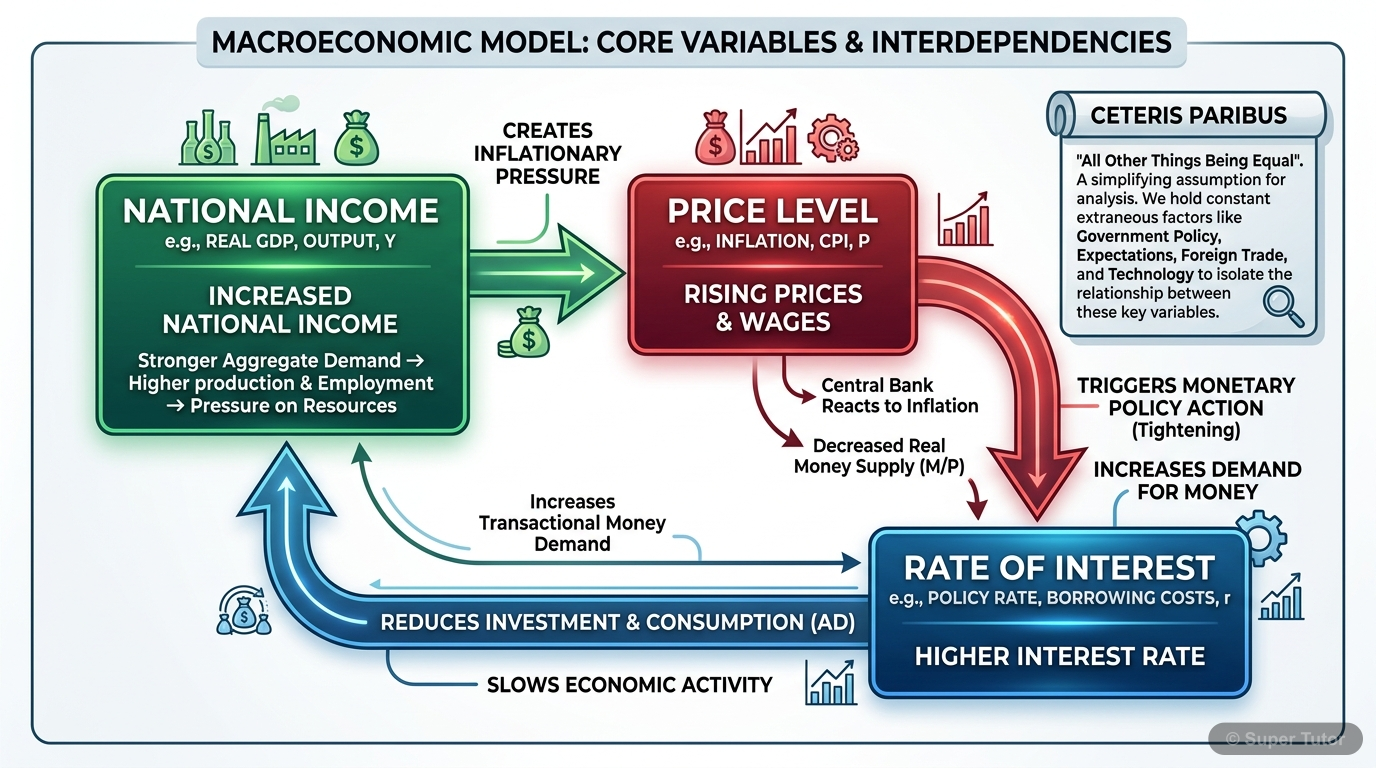
A flowchart illustrating how macroeconomic models simplify the economy by focusing on key variables like national income, price level, and interest rate, and how 'ceteris paribus' is applied to analyz
Super Tutor

Super Tutor has 12+ illustrations like this for Determination of Income and Employment alone — flashcards, concept maps, and step-by-step visuals.

See them all
6 Questions Solved · 1 Section

Determination of Income and Employment — Exercise Questions

1What is marginal propensity to consume? How is it related to marginal propensity to save?Show solution
Given/Concept:
Marginal Propensity to Consume (MPC) measures the responsiveness of consumption to a change in income.

Definition:
Marginal Propensity to Consume (MPC) is defined as the ratio of the change in ex ante consumption (ΔC\Delta C) to the change in income (ΔY\Delta Y). Mathematically:
MPC=ΔCΔYMPC = \frac{\Delta C}{\Delta Y}
It shows how much of every additional rupee of income is spent on consumption. Since consumption increases with income but by less than the increase in income, 0 < MPC < 1.

Relationship between MPC and MPS:
We know that income (YY) is either consumed (CC) or saved (SS):
Y=C+SY = C + S
Taking the change on both sides:
ΔY=ΔC+ΔS\Delta Y = \Delta C + \Delta S
Dividing throughout by ΔY\Delta Y:
1=ΔCΔY+ΔSΔY1 = \frac{\Delta C}{\Delta Y} + \frac{\Delta S}{\Delta Y}
1=MPC+MPS1 = MPC + MPS
MPS=1MPC\therefore MPS = 1 - MPC

Conclusion: MPC and MPS are complementary — they always sum to 1. If MPC = 0.8, then MPS = 0.2. A higher MPC implies a lower MPS and vice versa.
2What is the difference between ex ante investment and ex post investment?Show solution
Ex Ante Investment:
- 'Ex ante' means 'planned' or 'intended'.
- Ex ante investment refers to the amount of investment that firms plan or intend to make during a given period at the beginning of that period.
- It is a desired/planned magnitude and may or may not be realised.
- Example: A firm plans to invest Rs 100 crores in new machinery at the start of the year.

Ex Post Investment:
- 'Ex post' means 'actual' or 'realised'.
- Ex post investment refers to the investment that has actually been made during a given period, including both planned investment and unintended changes in inventories.
- It is always realised at the end of the period.
- Mathematically: Ex post investment=Planned investment+Unintended inventory accumulation/decumulation\text{Ex post investment} = \text{Planned investment} + \text{Unintended inventory accumulation/decumulation}

Key Difference:

| Basis | Ex Ante Investment | Ex Post Investment |
|---|---|---|
| Nature | Planned/Intended | Actual/Realised |
| Timing | Beginning of period | End of period |
| Includes unintended inventory changes | No | Yes |

Equilibrium Condition: The economy is in equilibrium when ex ante investment equals ex ante saving, i.e., when there are no unintended changes in inventories, so ex ante and ex post investment coincide.
3What do you understand by 'parametric shift of a line'? How does a line shift when its (i) slope decreases, and (ii) its intercept increases?Show solution
Parametric Shift of a Line:
A parametric shift refers to a change in the position or slope of a line caused by a change in one of its parameters (i.e., the constants that define the line — its slope or intercept), while the variable on the horizontal axis remains unchanged.

Consider a general linear equation:
Y=a+bXY = a + bX
where aa is the intercept and bb is the slope. A change in aa or bb causes a parametric shift.

(i) When the slope decreases:
- The slope bb represents the steepness of the line.
- If the slope decreases (i.e., bb falls), the line becomes flatter — it rotates downward (clockwise) around the intercept point on the Y-axis.
- The intercept remains the same, but for any given value of XX, the value of YY is now lower (except at the intercept).
- Example: If MPC falls, the consumption function C=Cˉ+bYC = \bar{C} + bY becomes flatter.

(ii) When the intercept increases:
- The intercept aa is the value of YY when X=0X = 0.
- If the intercept increases (i.e., aa rises), the entire line shifts upward in a parallel fashion — the slope remains unchanged but the line moves up.
- Every point on the new line is higher than the corresponding point on the old line by the same amount.
- Example: If autonomous consumption Cˉ\bar{C} increases, the consumption function shifts upward parallelly.

Summary:
- Decrease in slope → line becomes flatter (rotates clockwise around the Y-intercept).
- Increase in intercept → line shifts upward parallelly (no change in slope).
4What is 'effective demand'? How will you derive the autonomous expenditure multiplier when price of final goods and the rate of interest are given?Show solution
Effective Demand:
Effective demand refers to the level of aggregate demand for final goods and services that actually determines the equilibrium level of output and employment in the economy. Under the Keynesian framework, with a given price level and interest rate, the aggregate supply is assumed to be perfectly elastic. Therefore, output is determined solely by aggregate demand. The level of aggregate demand at which the product market is in equilibrium (i.e., aggregate demand = aggregate supply) is called effective demand.

Derivation of the Autonomous Expenditure Multiplier:

Given:
- Price of final goods is constant.
- Rate of interest is given (constant).
- Consumption function: C=Cˉ+cYC = \bar{C} + cY, where Cˉ\bar{C} is autonomous consumption and c=MPCc = MPC.
- Investment is autonomous: I=IˉI = \bar{I}.
- Let total autonomous expenditure: A=Cˉ+IˉA = \bar{C} + \bar{I}.

Step 1: Write the Aggregate Demand (AD) equation.
AD=C+I=Cˉ+cY+Iˉ=A+cYAD = C + I = \bar{C} + cY + \bar{I} = A + cY

Step 2: Equilibrium condition.
At equilibrium, Aggregate Demand = Aggregate Supply (Output):
Y=ADY = AD
Y=A+cYY = A + cY

Step 3: Solve for equilibrium income YY.
YcY=AY - cY = A
Y(1c)=AY(1 - c) = A
Y=11cAY = \frac{1}{1-c} \cdot A

Step 4: Derive the multiplier.
If autonomous expenditure changes by ΔA\Delta A, the change in equilibrium income ΔY\Delta Y is:
ΔY=11cΔA\Delta Y = \frac{1}{1-c} \cdot \Delta A

The Autonomous Expenditure Multiplier is:
k=ΔYΔA=11c=11MPC=1MPS\boxed{k = \frac{\Delta Y}{\Delta A} = \frac{1}{1-c} = \frac{1}{1-MPC} = \frac{1}{MPS}}

Interpretation: Since 0 < c < 1, the multiplier k > 1. This means a unit increase in autonomous expenditure leads to a more-than-proportionate increase in equilibrium income through the multiplier process (successive rounds of spending and income generation).
5Measure the level of ex-ante aggregate demand when autonomous investment and consumption expenditure (A) is Rs 50 crores, and MPS is 0.2 and level of income (Y) is Rs 4000 crores. State whether the economy is in equilibrium or not (cite reasons).Show solution
Given:
- Autonomous expenditure: A=Cˉ+Iˉ=A = \bar{C} + \bar{I} = Rs 50 crores
- Marginal Propensity to Save: MPS=0.2MPS = 0.2
- Therefore, MPC=1MPS=10.2=0.8MPC = 1 - MPS = 1 - 0.2 = 0.8
- Level of income: Y=Y = Rs 4000 crores

Step 1: Write the Aggregate Demand formula.
AD=A+MPC×YAD = A + MPC \times Y

Step 2: Calculate ex-ante Aggregate Demand.
AD=50+0.8×4000AD = 50 + 0.8 \times 4000
AD=50+3200AD = 50 + 3200
AD=Rs 3250 croresAD = \text{Rs } 3250 \text{ crores}

Step 3: Check equilibrium condition.
For equilibrium: AD=AS=YAD = AS = Y

Here, AD=AD = Rs 3250 crores but Y=Y = Rs 4000 crores.

Since AD < Y, i.e., 3250 < 4000, the economy is NOT in equilibrium.

Step 4: Find equilibrium income (for reference).
Y=A1MPC=5010.8=500.2=Rs 250 croresY^* = \frac{A}{1 - MPC} = \frac{50}{1 - 0.8} = \frac{50}{0.2} = \text{Rs } 250 \text{ crores}

Reason for disequilibrium:
Aggregate demand (Rs 3250 crores) is less than aggregate supply/income (Rs 4000 crores). This means there is excess supply in the economy. Firms will face unintended accumulation of inventories. As a result, producers will cut down production, and income will fall until it reaches the equilibrium level of Rs 250 crores.

Conclusion: The economy is not in equilibrium because ex-ante aggregate demand (Rs 3250 crores) \neq income/output (Rs 4000 crores). There is excess supply of Rs 750 crores.
6Explain 'Paradox of Thrift'.Show solution
Paradox of Thrift:

Definition:
The Paradox of Thrift states that if all households in an economy increase their savings (i.e., become more thrifty) simultaneously, the total savings in the economy may not increase — and in fact, the aggregate income of the economy will fall. This is paradoxical because what seems rational and beneficial for an individual (saving more) turns out to be harmful for the economy as a whole.

Explanation with the Keynesian Model:

Suppose all households decide to save more (i.e., MPS increases or autonomous consumption Cˉ\bar{C} falls). This means the consumption function shifts downward.

- A fall in consumption → fall in aggregate demand.
- Fall in aggregate demand → fall in equilibrium output/income (via the multiplier process in reverse).
- As income falls, savings also fall (since S=YCS = Y - C).

Algebraically:
At equilibrium: S=IS = I (ex ante)

If investment Iˉ\bar{I} is autonomous (fixed), then equilibrium saving must also remain equal to Iˉ\bar{I}. So even if households try to save more, the fall in income brings savings back to the original level.

Multiplier Effect:
Let autonomous consumption fall by ΔCˉ\Delta \bar{C} (i.e., people decide to save more).
ΔY=11MPC×(ΔCˉ)\Delta Y = \frac{1}{1 - MPC} \times (-\Delta \bar{C})
Income falls by a multiplied amount. The rise in intended savings is offset by the fall in income.

Diagrammatic Summary:
- Saving function shifts upward (people want to save more at every income level).
- New equilibrium is at a lower level of income.
- Actual savings remain unchanged (equal to autonomous investment).

Conclusion:
The Paradox of Thrift shows that individual rationality does not always lead to social rationality. An individual's attempt to save more is virtuous at the personal level, but if everyone does it simultaneously, it reduces aggregate demand, output, employment, and income — leaving the economy worse off without any net increase in total savings. This is a classic example of the fallacy of composition in macroeconomics.

Stuck on a step?

Ask Super Tutor AI to explain any solution on this page in a simpler way — free, 24x7.

Ask a Doubt Free

Frequently Asked Questions

What are the important topics in Determination of Income and Employment for Mizoram Board Class 12 Economics?
Determination of Income and Employment covers several key topics that are frequently asked in Mizoram Board Class 12 board exams. Focus on the core concepts listed on this page and practise related questions to build confidence.
How to score full marks in Determination of Income and Employment — Mizoram Board Class 12 Economics?
Understand the core concepts first, then work through the 35 practice questions available for this chapter. Revise formulas and definitions regularly, and use flashcards for quick recall before the exam.
Where can I get free NCERT Solutions for Determination of Income and Employment Class 12 Economics?
This page has free step-by-step NCERT Solutions for every exercise question in Determination of Income and Employment (Mizoram Board Class 12 Economics) — written the way examiners award marks: given, formula, working, answer.

Sources & Official References

Content is aligned to the official syllabus. Refer to the board website for the latest curriculum.

For serious students

Get the full Determination of Income and Employment chapter — for free.

Quizzes, flashcards, AI doubt-solver and a step-by-step study plan for Mizoram Board Class 12 Economics.