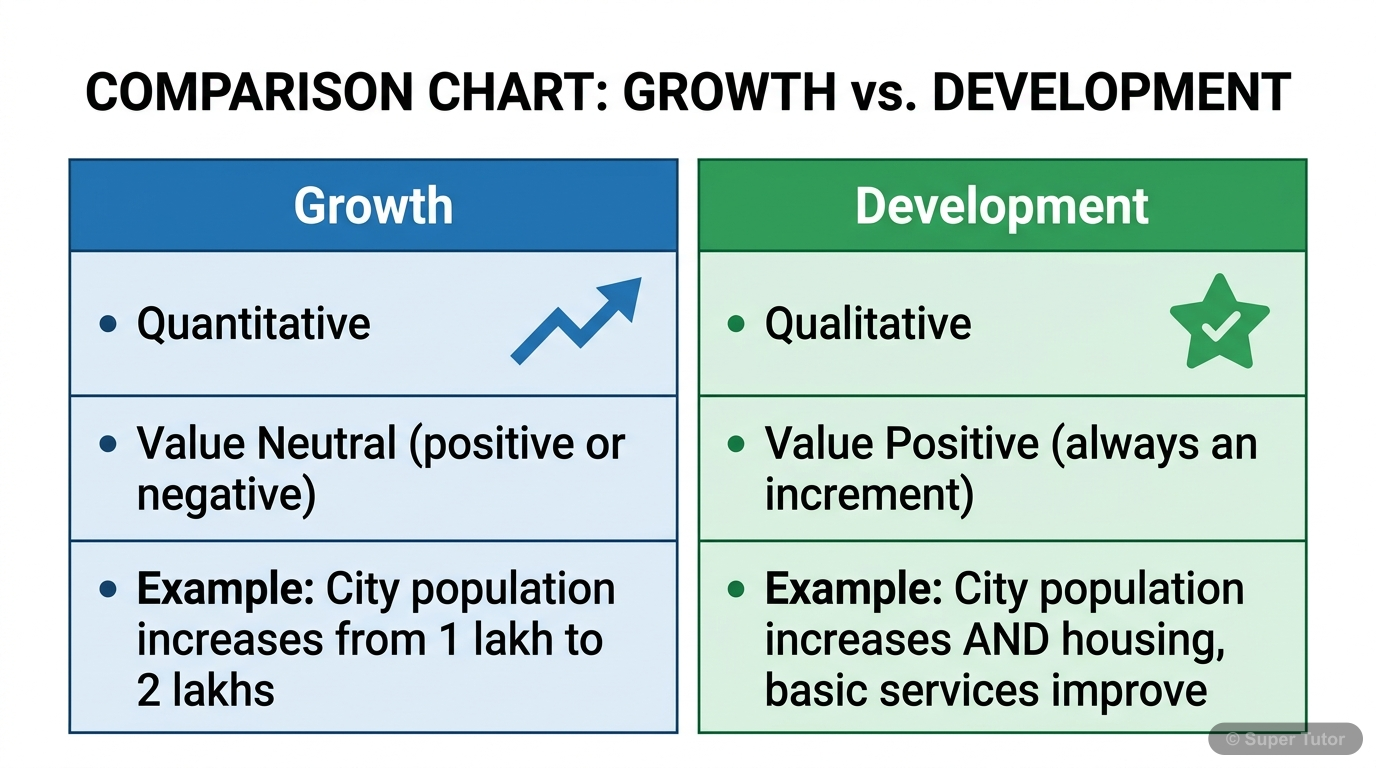
Human Development
Mizoram Board · Class 12 · Geography
NCERT Solutions for Human Development — Mizoram Board Class 12 Geography.
Interactive on Super Tutor
Studying Human Development? Get the full interactive chapter.
Quizzes, flashcards, AI doubt-solver and a step-by-step study plan — built for ncert solutions and more.
1,000+ Class 12 students started this chapter today

This is just one of 9+ visuals inside Super Tutor's Human Development chapter
Explore the full setEXERCISES
1(i)Which one of the following best describes development?
(a) an increase in size
(b) a constant in size
(c) a positive change in quality
(d) a simple change in the qualityShow solution
Justification: Development is not merely a change in size or quantity; it implies a qualitative improvement in conditions. It refers to a positive change in quality of life — encompassing better living standards, greater freedom, improved health, and enhanced capabilities — rather than just a numerical or quantitative increase.
1(ii)Which one of the following scholars introduced the concept of Human Development?
(a) Prof. Amartya Sen
(b) Ellen C. Semple
(c) Dr Mahabub-ul-Haq
(d) RatzelShow solution
Justification: The concept of Human Development was introduced by the Pakistani economist Dr Mahbub-ul-Haq in 1990. He worked in collaboration with Prof. Amartya Sen and others to develop the Human Development Index (HDI), which was first published in the UNDP's Human Development Report in 1990. Ellen C. Semple and Ratzel were geographers associated with environmental determinism, not human development.
2(i)What are the three basic areas of human development?Show solution
The three basic areas (dimensions) of human development are:
1. Health (Long and Healthy Life): Measured by life expectancy at birth. It reflects the ability of people to lead a long and healthy life.
2. Education (Access to Knowledge): Measured by the mean years of schooling and expected years of schooling. It reflects the level of literacy and access to education.
3. Standard of Living (Decent Standard of Living): Measured by Gross National Income (GNI) per capita (PPP in US $). It reflects the economic well-being of people.
These three dimensions together form the basis of the Human Development Index (HDI).
2(ii)Name the four main components of human development.Show solution
The four main components (pillars) of human development are:
1. Equity: Refers to making equal access to opportunities available to everybody, irrespective of gender, race, income, or caste.
2. Sustainability: Refers to the continuity in the availability of opportunities — ensuring that present generations do not compromise the opportunities of future generations.
3. Productivity: Refers to human labour productivity or productivity in terms of human work. People must be enabled to increase their productivity through better nutrition, health, and skills.
4. Empowerment: Refers to the power to people to make choices. This requires increased freedom and capability, and good governance.
2(iii)How are countries classified on the basis of human development index?Show solution
Countries are classified into four groups on the basis of their Human Development Index (HDI) scores (which range from 0 to 1):
| Category | HDI Score Range |
|---|---|
| Very High Human Development | 0.800 and above |
| High Human Development | 0.700 – 0.799 |
| Medium Human Development | 0.550 – 0.699 |
| Low Human Development | Below 0.550 |
- Countries like Norway, Switzerland, and Australia fall in the very high category.
- Countries in Sub-Saharan Africa and those facing civil war or political instability generally fall in the low human development category.
- India falls in the medium human development category.
3(i)What do you understand by the term human development?Show solution
Human Development is a concept that goes beyond the mere increase in a country's income or economic growth. It was introduced by Dr Mahbub-ul-Haq in 1990 and is defined as the process of enlarging people's choices and improving their well-being.
Key aspects of Human Development:
1. It focuses on people as the real wealth of a nation, rather than on goods and services alone.
2. It emphasises that development must translate into better lives for people — longer, healthier, and more fulfilling lives.
3. It is measured through the Human Development Index (HDI), which considers three dimensions:
- Health: Life expectancy at birth.
- Education: Mean years of schooling and expected years of schooling.
- Standard of Living: Per capita income (GNI at PPP).
4. Human development is built on four pillars — equity, sustainability, productivity, and empowerment.
5. It recognises that people need to have access to resources, opportunities, and freedom to lead a dignified life.
In essence, human development is about creating an environment in which people can develop their full potential and lead productive, creative lives in accordance with their needs and interests. It is about expanding choices and enhancing capabilities.
3(ii)What do equity and sustainability refer to within the concept of human development?Show solution
Equity and Sustainability are two of the four important pillars of human development.
---
Equity:
- Equity refers to making equal access to opportunities available to every person in society.
- It means that all individuals — regardless of their gender, race, income level, caste, or religion — should have equal access to education, health services, and economic resources.
- For example, if quality education is available only to the rich or to a particular gender, then development is not equitable.
- Equity ensures that no group of people is discriminated against and that the benefits of development are shared fairly.
---
Sustainability:
- Sustainability refers to the continuity of opportunities across generations.
- It means that the present generation should fulfil its needs without compromising the ability of future generations to meet their own needs.
- Sustainability applies to all resources — natural, financial, and human.
- For example, if forests are over-exploited today, future generations will be deprived of this resource. Similarly, if a country accumulates huge debts, future generations will bear the burden.
- Sustainable human development ensures that the gains made today are not achieved at the cost of tomorrow.
---
In summary, equity ensures fairness in the present distribution of opportunities, while sustainability ensures that these opportunities remain available for future generations as well. Both are essential for meaningful and lasting human development.
Project/ActivityMake a list of the ten most corrupt countries and ten least corrupt countries. Compare their scores on the human development index. What inferences can you draw? (Consult the latest Human Development Report for this.)Show solution
---
Step 1 – List of Ten Most Corrupt Countries (Low CPI Score — Example)
| Country | CPI Score (approx.) | HDI Score (approx.) | HDI Category |
|---|---|---|---|
| Somalia | Very Low | Very Low | Low |
| South Sudan | Very Low | Very Low | Low |
| Syria | Very Low | Low | Low |
| Yemen | Very Low | Low | Low |
| Venezuela | Low | Medium | Medium |
| Libya | Low | Medium | Medium |
| North Korea | Very Low | Low | Low |
| Haiti | Very Low | Low | Low |
| Equatorial Guinea | Low | Low | Low |
| Burundi | Very Low | Very Low | Low |
---
Step 2 – List of Ten Least Corrupt Countries (High CPI Score — Example)
| Country | CPI Score (approx.) | HDI Score (approx.) | HDI Category |
|---|---|---|---|
| Denmark | Very High | Very High | Very High |
| Finland | Very High | Very High | Very High |
| New Zealand | Very High | Very High | Very High |
| Norway | Very High | Very High | Very High |
| Singapore | Very High | Very High | Very High |
| Sweden | Very High | Very High | Very High |
| Switzerland | Very High | Very High | Very High |
| Netherlands | Very High | Very High | Very High |
| Germany | Very High | Very High | Very High |
| Luxembourg | Very High | Very High | Very High |
---
Inferences:
1. Strong positive correlation: Countries with low corruption (high CPI scores) consistently show high HDI scores, while countries with high corruption (low CPI scores) show low HDI scores.
2. Corruption diverts resources: In highly corrupt countries, public funds meant for education, health, and infrastructure are misappropriated, directly reducing human development outcomes.
3. Good governance matters: Least corrupt countries tend to have transparent, accountable governments that invest effectively in social sectors — health, education, and social security — leading to higher human development.
4. Political instability link: Most corrupt countries also suffer from political instability, civil conflict, and poor rule of law, which further hampers human development.
5. Conclusion: Reducing corruption is essential for improving human development. Good governance, transparency, and accountability are prerequisites for achieving high levels of human development.
Stuck on a step?
Ask Super Tutor AI to explain any solution on this page in a simpler way — free, 24x7.
Ask a Doubt FreeFrequently Asked Questions
What are the important topics in Human Development for Mizoram Board Class 12 Geography?
How to score full marks in Human Development — Mizoram Board Class 12 Geography?
Where can I get free NCERT Solutions for Human Development Class 12 Geography?
Sources & Official References
Content is aligned to the official syllabus. Refer to the board website for the latest curriculum.
More resources for Human Development
Important Questions
Practice with board exam-style questions
Syllabus
What topics to cover
Revision Notes
Key points for last-minute revision
Study Plan
Step-by-step plan to ace this chapter
Flashcards
Quick-fire cards for active recall
Formula Sheet
All formulas in one place
Chapter Summary
Understand the chapter at a glance
Practice Quiz
Test yourself with a quick quiz
Concept Maps
See how topics connect visually
For serious students
Get the full Human Development chapter — for free.
Quizzes, flashcards, AI doubt-solver and a step-by-step study plan for Mizoram Board Class 12 Geography.