Chapter 3 of 14
NCERT Solutions

Electrostatic Potential and Capacitance

Mizoram Board · Class 12 · Physics

NCERT Solutions for Electrostatic Potential and Capacitance — Mizoram Board Class 12 Physics.

26 questions22 flashcards5 concepts

Interactive on Super Tutor

Studying Electrostatic Potential and Capacitance? Get the full interactive chapter.

Quizzes, flashcards, AI doubt-solver and a step-by-step study plan — built for ncert solutions and more.

1,000+ Class 12 students started this chapter today

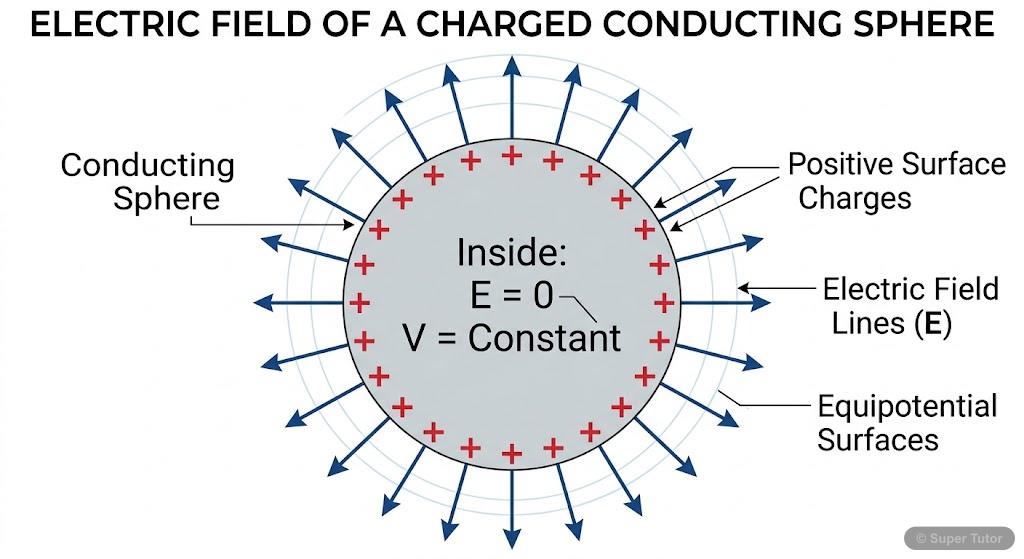
A diagram illustrating key electrostatic properties of a conductor: electric field is zero inside, potential is constant throughout, charge resides on the surface, and electric field lines are perpend
Super Tutor

Super Tutor has 24+ illustrations like this for Electrostatic Potential and Capacitance alone — flashcards, concept maps, and step-by-step visuals.

See them all
11 Questions Solved · 1 Section

EXERCISES — Chapter 2: Electrostatic Potential and Capacitance

2.1Two charges 5×1085 \times 10^{-8} C and 3×10⁸-3 \times 10^{-8} C are located 16 cm apart. At what point(s) on the line joining the two charges is the electric potential zero? Take the potential at infinity to be zero.Show solution
Given:
- q1=5×10⁸q_1 = 5 \times 10^{-8} C (positive charge)
- q2=3×10⁸q_2 = -3 \times 10^{-8} C (negative charge)
- Distance between charges: d=16d = 16 cm =0.16= 0.16 m

Concept: Electric potential due to a point charge is V=14πε0qrV = \dfrac{1}{4\pi\varepsilon_0}\dfrac{q}{r}. By superposition, the net potential is the algebraic sum of potentials due to individual charges.

We look for points where V=0V = 0, i.e., V1+V2=0V_1 + V_2 = 0.

---

Case 1: Point P between the two charges

Let P be at distance xx from q1q_1 (so at distance 16x16 - x from q2q_2).

14πε0(q1x+q216x)=0\frac{1}{4\pi\varepsilon_0}\left(\frac{q_1}{x} + \frac{q_2}{16-x}\right) = 0

5×10⁸x+3×10816x=0\frac{5 \times 10^{-8}}{x} + \frac{-3 \times 10^{-8}}{16 - x} = 0

5x=316x\frac{5}{x} = \frac{3}{16 - x}

5(16x)=3x5(16 - x) = 3x

80=8x    x=10 cm80 = 8x \implies x = 10 \text{ cm}

So one point is 10 cm from q1q_1 (between the charges).

---

Case 2: Point Q outside the two charges (on the side of q2q_2, the smaller charge)

Let Q be at distance yy from q1q_1 (so at distance y16y - 16 from q2q_2), with y > 16 cm.

5×10⁸y+3×10⁸y16=0\frac{5 \times 10^{-8}}{y} + \frac{-3 \times 10^{-8}}{y - 16} = 0

5y=3y16\frac{5}{y} = \frac{3}{y - 16}

5(y16)=3y5(y - 16) = 3y

5y80=3y    2y=80    y=40 cm5y - 80 = 3y \implies 2y = 80 \implies y = 40 \text{ cm}

So another point is 40 cm from q1q_1 (i.e., 24 cm from q2q_2, on the far side of q2q_2).

---

Answer: The electric potential is zero at two points on the line joining the charges:
1. 10 cm from the positive charge (5×1085 \times 10^{-8} C), between the two charges.
2. 40 cm from the positive charge (24 cm from the negative charge), outside the two charges on the side of the negative charge.
2.2A regular hexagon of side 10 cm has a charge 5μ5\,\muC at each of its vertices. Calculate the potential at the centre of the hexagon.Show solution
Given:
- Side of regular hexagon: a=10a = 10 cm =0.1= 0.1 m
- Charge at each vertex: q=5μC=5×10⁶q = 5\,\mu\text{C} = 5 \times 10^{-6} C
- Number of vertices: 6

Key Fact: In a regular hexagon, the distance from each vertex to the centre equals the side length. So r=a=0.1r = a = 0.1 m.

Concept: Potential is a scalar quantity. By the superposition principle:

V=6×14πε0qrV = 6 \times \frac{1}{4\pi\varepsilon_0}\frac{q}{r}

Calculation:

V=6×(9×109)×5×1060.1V = 6 \times (9 \times 10^9) \times \frac{5 \times 10^{-6}}{0.1}

V=6×9×109×5×105V = 6 \times 9 \times 10^9 \times 5 \times 10^{-5}

V=6×45×104V = 6 \times 45 \times 10^4

V=2.7×10⁶ V\boxed{V = 2.7 \times 10^6 \text{ V}}

Answer: The electric potential at the centre of the hexagon is 2.7×1062.7 \times 10^6 V.
2.3Two charges 2μ2\,\muC and 2μ-2\,\muC are placed at points A and B 6 cm apart.
(a) Identify an equipotential surface of the system.
(b) What is the direction of the electric field at every point on this surface?
Show solution
Given:
- qA=+2μq_A = +2\,\muC at point A
- qB=2μq_B = -2\,\muC at point B
- Distance AB = 6 cm

This system constitutes an electric dipole.

---

(a) Identifying the equipotential surface:

For any point P on the perpendicular bisector of AB, the distances from P to A and from P to B are equal: rPA=rPB=rr_{PA} = r_{PB} = r.

The potential at P:
VP=14πε0(qAr+qBr)=14πε0(+2μCr+2μCr)=0V_P = \frac{1}{4\pi\varepsilon_0}\left(\frac{q_A}{r} + \frac{q_B}{r}\right) = \frac{1}{4\pi\varepsilon_0}\left(\frac{+2\,\mu\text{C}}{r} + \frac{-2\,\mu\text{C}}{r}\right) = 0

Since V=0V = 0 for every point on the perpendicular bisector of AB, the plane perpendicular to AB and passing through its midpoint is an equipotential surface with V=0V = 0.

---

(b) Direction of electric field on this surface:

The electric field at every point on an equipotential surface is perpendicular to the equipotential surface.

Since the equipotential surface is the perpendicular bisector plane of AB, the electric field at every point on this surface is directed along the line AB (i.e., from the positive charge A towards the negative charge B, which is the direction of the dipole axis).

Answer:
- (a) The plane perpendicular to AB passing through its midpoint (the perpendicular bisector plane) is the equipotential surface with V=0V = 0.
- (b) The electric field at every point on this surface is directed normal to the plane (i.e., along the line joining A to B, from +2μ+2\,\muC to 2μ-2\,\muC).
2.4A spherical conductor of radius 12 cm has a charge of 1.6×1071.6 \times 10^{-7} C distributed uniformly on its surface. What is the electric field
(a) inside the sphere
(b) just outside the sphere
(c) at a point 18 cm from the centre of the sphere?
Show solution
Given:
- Radius of spherical conductor: R=12R = 12 cm =0.12= 0.12 m
- Charge: Q=1.6×10⁷Q = 1.6 \times 10^{-7} C

---

(a) Electric field inside the sphere:

For a conductor, the electric field inside is zero.

Einside=0\boxed{E_{\text{inside}} = 0}

---

(b) Electric field just outside the sphere:

Just outside a charged conductor, E=σε0E = \dfrac{\sigma}{\varepsilon_0}, which is equivalent to treating the sphere as a point charge:

E=14πε0QR2E = \frac{1}{4\pi\varepsilon_0}\frac{Q}{R^2}

E=9×109×1.6×107(0.12)2E = \frac{9 \times 10^9 \times 1.6 \times 10^{-7}}{(0.12)^2}

E=9×109×1.6×1070.0144E = \frac{9 \times 10^9 \times 1.6 \times 10^{-7}}{0.0144}

E=1.44×1030.0144=1.0×10⁵ N/CE = \frac{1.44 \times 10^3}{0.0144} = 1.0 \times 10^5 \text{ N/C}

Ejust outside=1.0×10⁵ N C1\boxed{E_{\text{just outside}} = 1.0 \times 10^5 \text{ N C}^{-1}}

The field is directed radially outward.

---

(c) Electric field at a point 18 cm from the centre:

Here r=18r = 18 cm =0.18= 0.18 m > R, so we treat the sphere as a point charge:

E=14πε0Qr2E = \frac{1}{4\pi\varepsilon_0}\frac{Q}{r^2}

E=9×109×1.6×107(0.18)2E = \frac{9 \times 10^9 \times 1.6 \times 10^{-7}}{(0.18)^2}

E=1.44×1030.0324=4.44×10⁴ N/CE = \frac{1.44 \times 10^3}{0.0324} = 4.44 \times 10^4 \text{ N/C}

E=4.4×10⁴ N C1\boxed{E = 4.4 \times 10^4 \text{ N C}^{-1}}

The field is directed radially outward.
2.5A parallel plate capacitor with air between the plates has a capacitance of 8 pF (1pF=10121\,\text{pF} = 10^{-12} F). What will be the capacitance if the distance between the plates is reduced by half, and the space between them is filled with a substance of dielectric constant 6?Show solution
Given:
- Initial capacitance (air): C0=8C_0 = 8 pF
- New distance: d=d/2d' = d/2
- Dielectric constant: K=6K = 6

Formula: For a parallel plate capacitor:
C0=ε0AdC_0 = \varepsilon_0 \frac{A}{d}

When the distance is halved and a dielectric of constant KK is inserted:
C=Kε0Ad=Kε0Ad/2=2Kε0Ad=2KC0C' = K \varepsilon_0 \frac{A}{d'} = K \varepsilon_0 \frac{A}{d/2} = 2K \varepsilon_0 \frac{A}{d} = 2K C_0

Calculation:
C=2×6×8 pF=96 pFC' = 2 \times 6 \times 8 \text{ pF} = 96 \text{ pF}

C=96 pF\boxed{C' = 96 \text{ pF}}

Answer: The new capacitance is 96 pF.
2.6Three capacitors each of capacitance 9 pF are connected in series.
(a) What is the total capacitance of the combination?
(b) What is the potential difference across each capacitor if the combination is connected to a 120 V supply?
Show solution
Given:
- C1=C2=C3=9C_1 = C_2 = C_3 = 9 pF
- Supply voltage: V=120V = 120 V
- Connection: Series

---

(a) Total capacitance in series:

1C=1C1+1C2+1C3=19+19+19=39=13\frac{1}{C} = \frac{1}{C_1} + \frac{1}{C_2} + \frac{1}{C_3} = \frac{1}{9} + \frac{1}{9} + \frac{1}{9} = \frac{3}{9} = \frac{1}{3}

C=3 pF\boxed{C = 3 \text{ pF}}

---

(b) Potential difference across each capacitor:

In a series combination, the same charge QQ appears on each capacitor.

Q=CV=3×1012×120=3.6×10¹⁰ CQ = CV = 3 \times 10^{-12} \times 120 = 3.6 \times 10^{-10} \text{ C}

Potential difference across each capacitor:
V1=V2=V3=QC1=3.6×10109×1012=40 VV_1 = V_2 = V_3 = \frac{Q}{C_1} = \frac{3.6 \times 10^{-10}}{9 \times 10^{-12}} = 40 \text{ V}

Verification: V1+V2+V3=40+40+40=120V_1 + V_2 + V_3 = 40 + 40 + 40 = 120 V ✓

Veach=40 V\boxed{V_{\text{each}} = 40 \text{ V}}
2.7Three capacitors of capacitances 2 pF, 3 pF and 4 pF are connected in parallel.
(a) What is the total capacitance of the combination?
(b) Determine the charge on each capacitor if the combination is connected to a 100 V supply.
Show solution
Given:
- C1=2C_1 = 2 pF, C2=3C_2 = 3 pF, C3=4C_3 = 4 pF
- Supply voltage: V=100V = 100 V
- Connection: Parallel

---

(a) Total capacitance in parallel:

C=C1+C2+C3=2+3+4=9 pFC = C_1 + C_2 + C_3 = 2 + 3 + 4 = 9 \text{ pF}

C=9 pF\boxed{C = 9 \text{ pF}}

---

(b) Charge on each capacitor:

In a parallel combination, the voltage across each capacitor equals the supply voltage V=100V = 100 V.

Q1=C1V=2×1012×100=2×10¹⁰ C=200 pCQ_1 = C_1 V = 2 \times 10^{-12} \times 100 = 2 \times 10^{-10} \text{ C} = 200 \text{ pC}

Q2=C2V=3×1012×100=3×10¹⁰ C=300 pCQ_2 = C_2 V = 3 \times 10^{-12} \times 100 = 3 \times 10^{-10} \text{ C} = 300 \text{ pC}

Q3=C3V=4×1012×100=4×10¹⁰ C=400 pCQ_3 = C_3 V = 4 \times 10^{-12} \times 100 = 4 \times 10^{-10} \text{ C} = 400 \text{ pC}

Q1=200 pC,Q2=300 pC,Q3=400 pC\boxed{Q_1 = 200\text{ pC},\quad Q_2 = 300\text{ pC},\quad Q_3 = 400\text{ pC}}
2.8In a parallel plate capacitor with air between the plates, each plate has an area of 6×1036 \times 10^{-3} m² and the distance between the plates is 3 mm. Calculate the capacitance of the capacitor. If this capacitor is connected to a 100 V supply, what is the charge on each plate of the capacitor?Show solution
Given:
- Area of each plate: A=6×10³A = 6 \times 10^{-3}
- Distance between plates: d=3d = 3 mm =3×103= 3 \times 10^{-3} m
- Voltage: V=100V = 100 V
- ε0=8.854×10¹²\varepsilon_0 = 8.854 \times 10^{-12} C² N⁻¹ m⁻²

Formula:
C=ε0AdC = \varepsilon_0 \frac{A}{d}

Calculation of capacitance:
C=8.854×1012×6×1033×103C = \frac{8.854 \times 10^{-12} \times 6 \times 10^{-3}}{3 \times 10^{-3}}

C=8.854×1012×63=8.854×1012×2C = \frac{8.854 \times 10^{-12} \times 6}{3} = 8.854 \times 10^{-12} \times 2

C=17.71×10¹² F17.71 pF\boxed{C = 17.71 \times 10^{-12} \text{ F} \approx 17.71 \text{ pF}}

Calculation of charge:
Q=CV=17.71×1012×100Q = CV = 17.71 \times 10^{-12} \times 100

Q=1.771×10⁹ C1.77 nC\boxed{Q = 1.771 \times 10^{-9} \text{ C} \approx 1.77 \text{ nC}}

Answer: Capacitance 17.71\approx 17.71 pF; Charge on each plate 1.77×10⁹\approx 1.77 \times 10^{-9} C.
2.9Explain what would happen if in the capacitor given in Exercise 2.8, a 3 mm thick mica sheet (of dielectric constant = 6) were inserted between the plates,
(a) while the voltage supply remained connected.
(b) after the supply was disconnected.
Show solution
From Exercise 2.8: C0=17.71C_0 = 17.71 pF, V0=100V_0 = 100 V, Q0=1.771×10⁹Q_0 = 1.771 \times 10^{-9} C

Dielectric constant of mica: K=6K = 6

When a dielectric of constant KK fills the entire space between the plates, the new capacitance is:
C=KC0=6×17.71 pF=106.26 pFC = KC_0 = 6 \times 17.71 \text{ pF} = 106.26 \text{ pF}

---

(a) While the voltage supply remains connected (VV = constant = 100 V):

- The voltage across the capacitor remains fixed at V=100V = 100 V.
- The new capacitance: C=KC0=6×17.71=106.26C = KC_0 = 6 \times 17.71 = 106.26 pF
- The new charge:
Q=CV=106.26×1012×100=1.0626×10⁸ CQ = CV = 106.26 \times 10^{-12} \times 100 = 1.0626 \times 10^{-8} \text{ C}
- The electric field between the plates: E=V/d=100/(3×103)=3.33×104E = V/d = 100/(3\times10^{-3}) = 3.33 \times 10^4 V/m (unchanged, since VV and dd are unchanged).

Summary: Capacitance increases 6-fold to ~106.26 pF; charge increases 6-fold to ~1.06×1081.06 \times 10^{-8} C; voltage remains 100 V; electric field remains the same.

---

(b) After the supply is disconnected (QQ = constant = 1.771×1091.771 \times 10^{-9} C):

- The charge on the plates remains fixed (no path for charge to flow).
- The new capacitance: C=KC0=106.26C = KC_0 = 106.26 pF
- The new voltage:
V=QC=1.771×109106.26×1012=100616.7 VV' = \frac{Q}{C} = \frac{1.771 \times 10^{-9}}{106.26 \times 10^{-12}} = \frac{100}{6} \approx 16.7 \text{ V}
- The new electric field:
E=Vd=16.73×1035.56×103 V/mE' = \frac{V'}{d} = \frac{16.7}{3 \times 10^{-3}} \approx 5.56 \times 10^3 \text{ V/m}

Summary: Capacitance increases 6-fold to ~106.26 pF; charge remains 1.771×1091.771 \times 10^{-9} C; voltage decreases to ~16.7 V; electric field decreases to ~5.56×1035.56 \times 10^3 V/m.
2.10A 12 pF capacitor is connected to a 50 V battery. How much electrostatic energy is stored in the capacitor?Show solution
Given:
- Capacitance: C=12C = 12 pF =12×1012= 12 \times 10^{-12} F
- Voltage: V=50V = 50 V

Formula: Energy stored in a capacitor:
U=12CV2U = \frac{1}{2}CV^2

Calculation:
U=12×12×1012×(50)2U = \frac{1}{2} \times 12 \times 10^{-12} \times (50)^2

U=12×12×1012×2500U = \frac{1}{2} \times 12 \times 10^{-12} \times 2500

U=12×3×108U = \frac{1}{2} \times 3 \times 10^{-8}

U=1.5×10⁸ J\boxed{U = 1.5 \times 10^{-8} \text{ J}}

Answer: The electrostatic energy stored in the capacitor is 1.5×1081.5 \times 10^{-8} J.
2.11A 600 pF capacitor is charged by a 200 V supply. It is then disconnected from the supply and is connected to another uncharged 600 pF capacitor. How much electrostatic energy is lost in the process?Show solution
Given:
- C1=C2=600C_1 = C_2 = 600 pF =600×1012= 600 \times 10^{-12} F
- Initial voltage: V=200V = 200 V
- C2C_2 is initially uncharged.

---

Step 1: Initial energy stored in C1C_1:

Ui=12C1V2=12×600×1012×(200)2U_i = \frac{1}{2}C_1 V^2 = \frac{1}{2} \times 600 \times 10^{-12} \times (200)^2

Ui=12×600×1012×4×104=1.2×10⁵ JU_i = \frac{1}{2} \times 600 \times 10^{-12} \times 4 \times 10^4 = 1.2 \times 10^{-5} \text{ J}

---

Step 2: Common voltage after connection:

Initial charge on C1C_1: Q=C1V=600×1012×200=1.2×10⁷Q = C_1 V = 600 \times 10^{-12} \times 200 = 1.2 \times 10^{-7} C

When connected to uncharged C2C_2, charge redistributes. By conservation of charge:
Q=(C1+C2)VQ = (C_1 + C_2)V'

V=QC1+C2=1.2×107600×1012+600×1012=1.2×1071.2×109=100 VV' = \frac{Q}{C_1 + C_2} = \frac{1.2 \times 10^{-7}}{600 \times 10^{-12} + 600 \times 10^{-12}} = \frac{1.2 \times 10^{-7}}{1.2 \times 10^{-9}} = 100 \text{ V}

---

Step 3: Final energy stored in both capacitors:

Uf=12(C1+C2)V2=12×1200×1012×(100)2U_f = \frac{1}{2}(C_1 + C_2)V'^2 = \frac{1}{2} \times 1200 \times 10^{-12} \times (100)^2

Uf=12×1200×1012×104=6×10⁶ JU_f = \frac{1}{2} \times 1200 \times 10^{-12} \times 10^4 = 6 \times 10^{-6} \text{ J}

---

Step 4: Energy lost:

ΔU=UiUf=1.2×1056×106=12×1066×106\Delta U = U_i - U_f = 1.2 \times 10^{-5} - 6 \times 10^{-6} = 12 \times 10^{-6} - 6 \times 10^{-6}

ΔU=6×10⁶ J=6μJ\boxed{\Delta U = 6 \times 10^{-6} \text{ J} = 6\,\mu\text{J}}

Answer: The electrostatic energy lost in the process is 6×1066 \times 10^{-6} J. This energy is dissipated as heat (and electromagnetic radiation) in the connecting wires during the transient current flow.

Stuck on a step?

Ask Super Tutor AI to explain any solution on this page in a simpler way — free, 24x7.

Ask a Doubt Free

Frequently Asked Questions

What are the important topics in Electrostatic Potential and Capacitance for Mizoram Board Class 12 Physics?
Electrostatic Potential and Capacitance covers several key topics that are frequently asked in Mizoram Board Class 12 board exams. Focus on the core concepts listed on this page and practise related questions to build confidence.
How to score full marks in Electrostatic Potential and Capacitance — Mizoram Board Class 12 Physics?
Understand the core concepts first, then work through the 26 practice questions available for this chapter. Revise formulas and definitions regularly, and use flashcards for quick recall before the exam.
Where can I get free NCERT Solutions for Electrostatic Potential and Capacitance Class 12 Physics?
This page has free step-by-step NCERT Solutions for every exercise question in Electrostatic Potential and Capacitance (Mizoram Board Class 12 Physics) — written the way examiners award marks: given, formula, working, answer.

Sources & Official References

Content is aligned to the official syllabus. Refer to the board website for the latest curriculum.

For serious students

Get the full Electrostatic Potential and Capacitance chapter — for free.

Quizzes, flashcards, AI doubt-solver and a step-by-step study plan for Mizoram Board Class 12 Physics.