Reconstitution of a Partnership Firm – Retirement/Death of a Partner — Syllabus
Madhya Pradesh Board · Class 12 · Accountancy
What Reconstitution of a Partnership Firm – Retirement/Death of a Partner covers in Madhya Pradesh Board Class 12 Accountancy: 4 topics, for the 2026-27.
Interactive on Super Tutor
Studying Reconstitution of a Partnership Firm – Retirement/Death of a Partner? Get the full interactive chapter.
Quizzes, flashcards, AI doubt-solver and a step-by-step study plan — built for syllabus and more.
Free trial, no card needed.
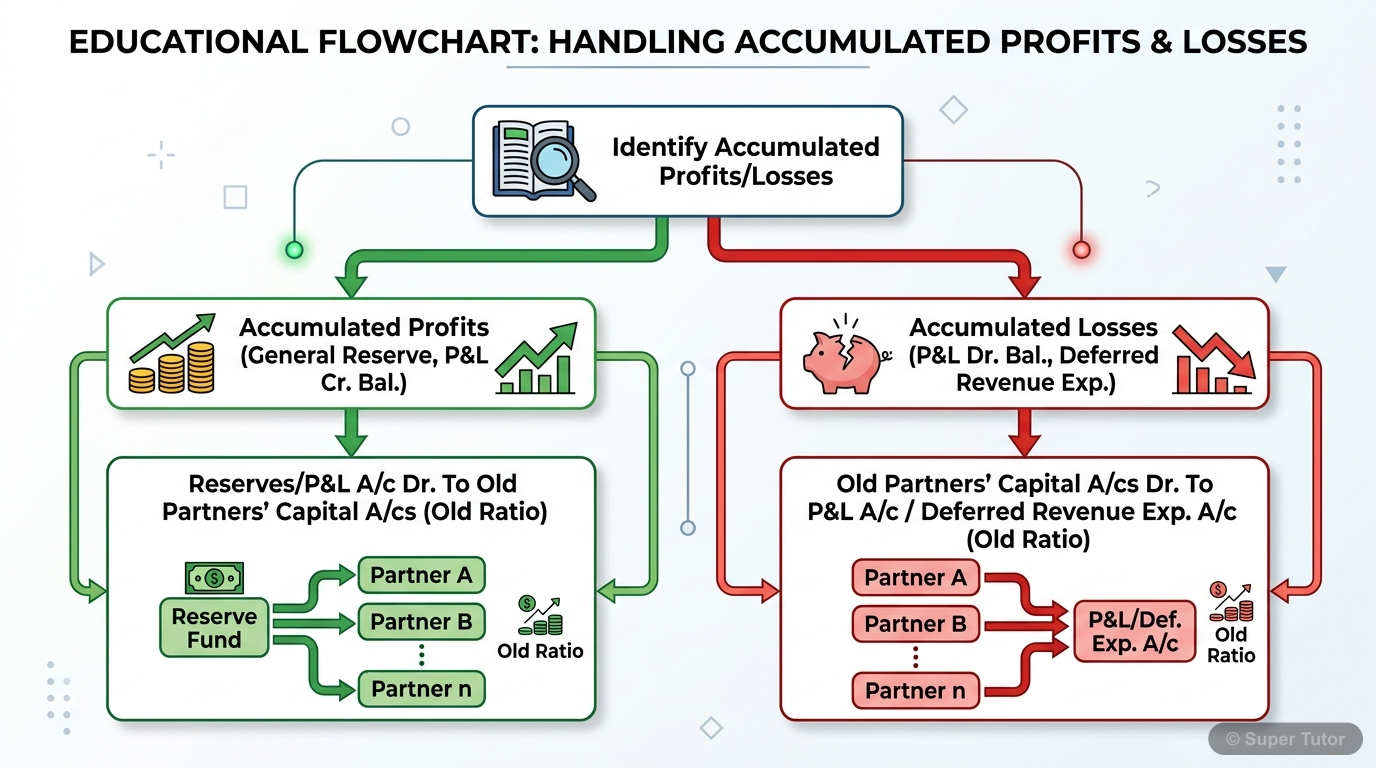
One of 10 illustrations for Reconstitution of a Partnership Firm – Retirement/Death of a Partner in Super Tutor — alongside flashcards, concept maps and practice questions.
Topics in Reconstitution of a Partnership Firm – Retirement/Death of a Partner
1. Core Meaning and Accounting Areas
- Retirement or death of a partner ends the old partnership deed and creates a new arrangement among the remaining partners.
- The amount due to the outgoing partner or legal representatives is calculated after all adjustments.
- The main accounting areas involved are: ascertainment of new profit sharing ratio and gaining ratio; treatment of goodwill; revaluation of assets and liabilities; adjustment of unrecorded assets and l
2. Amount Due to Retiring or Deceased Partner
- The sum due includes credit balance of capital account, credit balance of current account, share of goodwill, share of accumulated profits, share in gain of revaluation, share of profits up to the dat
- Deductions include debit balance of current account, share of goodwill written off, share of accumulated losses, share of loss on revaluation, share of loss up to the date, drawings up to date, and in
- Credit balance items increase the amount due; debit balance items reduce it.
3. New Profit Sharing Ratio and Gaining Ratio
- New profit sharing ratio is the ratio in which the remaining partners share future profits after retirement or death.
- New share of a continuing partner equals his own old share plus the share acquired from the outgoing partner.
- If continuing partners acquire the outgoing partner’s share in the old ratio, no separate calculation of new ratio is needed.
4. Treatment of Goodwill and Hidden Goodwill
- The outgoing partner is entitled to his or her share of goodwill because goodwill is earned by the firm with the efforts of all partners.
- The goodwill share of the outgoing partner is compensated by the continuing partners in their gaining ratio.
- If goodwill does not appear in the books, the gaining partners’ capital accounts are debited individually and the outgoing partner’s capital account is credited.
Key Concepts
Central concept: Reconstitution of a partnership firm on retirement or death of a partner
Work through every topic in Reconstitution of a Partnership Firm – Retirement/Death of a Partner with notes and quizzes
Start This ChapterFrequently Asked Questions
What are the important topics in Reconstitution of a Partnership Firm – Retirement/Death of a Partner for Madhya Pradesh Board Class 12 Accountancy?
How should I revise Reconstitution of a Partnership Firm – Retirement/Death of a Partner for the Madhya Pradesh Board Class 12 board exam?
Sources & Official References
Content is aligned to the official syllabus. Refer to the board website for the latest curriculum.
More resources for Reconstitution of a Partnership Firm – Retirement/Death of a Partner
Practice Quiz
Test yourself with a quick quiz
Important Questions
Exam-style questions with answers
Revision Notes
Key points for last-minute revision
Formula Sheet
The chapter's formulas in one place
Chapter Summary
Understand the chapter at a glance
Concept Maps
See how topics connect
Study Plan
Step-by-step plan for this chapter
Flashcards
Quick-fire cards for active recall
NCERT Solutions
Every textbook question solved step by step
For serious students
Get the full Reconstitution of a Partnership Firm – Retirement/Death of a Partner chapter — start free.
Quizzes, flashcards, an AI doubt solver and a study plan for Madhya Pradesh Board Class 12 Accountancy. Free to start, no card needed.