Relations and Functions — NCERT Solutions
Nagaland Board · Class 12 · Mathematics
NCERT Solutions for Relations and Functions, Nagaland Board Class 12 Mathematics: 49 textbook questions solved step by step.
Interactive on Super Tutor
Studying Relations and Functions? Get the full interactive chapter.
Quizzes, flashcards, AI doubt-solver and a step-by-step study plan — built for NCERT solutions and more.
Free trial, no card needed.
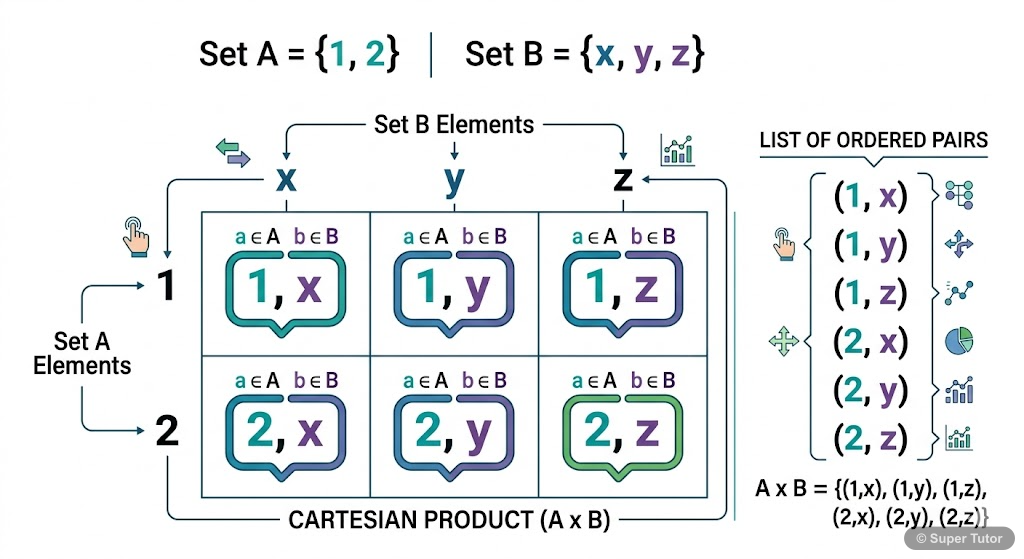
Learn better with visuals Super Tutor pairs illustrations like this with notes and quizzes for Relations and Functions.
The first 25 solutions are open to read. The other 24 are free with a Super Tutor account.
Exercise 1.1
1(i)Determine whether the relation R in the set defined as is reflexive, symmetric and transitive.Show solution
Given: , , i.e., .
Listing R:
Reflexive: For reflexivity, for all , i.e., , which is not in . For example, . Hence R is not reflexive.
Symmetric: but , so . Hence R is not symmetric.
Transitive: We need: if and , then . Check: and . Is ? . So . Hence R is not transitive.
Conclusion: R is neither reflexive, nor symmetric, nor transitive.
1(ii)Determine whether the relation R in the set of natural numbers defined as is reflexive, symmetric and transitive.Show solution
Given:
Listing R:
Reflexive: since . Hence R is not reflexive.
Symmetric: but since . Hence R is not symmetric.
Transitive: We need and . The pairs in R have second elements , none of which is less than 4, so no pair exists in R for any . The condition is vacuously satisfied. Hence R is transitive.
Conclusion: R is neither reflexive nor symmetric, but it is transitive.
1(iii)Determine whether the relation R in the set defined as is reflexive, symmetric and transitive.Show solution
Given: on .
Reflexive: Every element divides itself, so for all . Hence R is reflexive.
Symmetric: (since 2 is divisible by 1) but (since 1 is not divisible by 2). Hence R is not symmetric.
Transitive: Suppose and , i.e., and . Then , so . Hence R is transitive.
Conclusion: R is reflexive and transitive but not symmetric.
1(iv)Determine whether the relation R in the set of all integers defined as is reflexive, symmetric and transitive.Show solution
Given: on .
Reflexive: For any , , so . Hence R is reflexive.
Symmetric: If , then , so , giving . Hence R is symmetric.
Transitive: If and , then and . So , giving . Hence R is transitive.
Conclusion: R is reflexive, symmetric and transitive, hence an equivalence relation.
1(v)(a)Determine whether the relation in the set A of human beings in a town is reflexive, symmetric and transitive.Show solution
Reflexive: Any person works at the same place as themselves, so . Hence R is reflexive.
Symmetric: If and work at the same place, then and work at the same place. So . Hence R is symmetric.
Transitive: If and work at the same place, and and work at the same place, then and work at the same place. Hence R is transitive.
Conclusion: R is an equivalence relation.
1(v)(b)Determine whether the relation in the set A of human beings in a town is reflexive, symmetric and transitive.Show solution
Reflexive: lives in the same locality as , so . Hence R is reflexive.
Symmetric: If and live in the same locality, then and live in the same locality. Hence R is symmetric.
Transitive: If live in the same locality and live in the same locality, then live in the same locality. Hence R is transitive.
Conclusion: R is an equivalence relation.
1(v)(c)Determine whether the relation in the set A of human beings in a town is reflexive, symmetric and transitive.Show solution
Reflexive: cannot be 7 cm taller than itself, so . Hence R is not reflexive.
Symmetric: If is exactly 7 cm taller than , then is 7 cm shorter than , not taller. So . Hence R is not symmetric.
Transitive: If is 7 cm taller than , and is 7 cm taller than , then is 14 cm taller than , not 7 cm. So and . Hence R is not transitive.
Conclusion: R is neither reflexive, nor symmetric, nor transitive.
1(v)(d)Determine whether the relation in the set A of human beings in a town is reflexive, symmetric and transitive.Show solution
Reflexive: cannot be the wife of herself/himself, so . Hence R is not reflexive.
Symmetric: If is the wife of , then is the husband of , not the wife. So . Hence R is not symmetric.
Transitive: If is the wife of , then is male, so cannot be the wife of anyone. The condition and never holds. Hence the condition is vacuously true, so R is transitive.
Conclusion: R is transitive but neither reflexive nor symmetric.
1(v)(e)Determine whether the relation in the set A of human beings in a town is reflexive, symmetric and transitive.Show solution
Reflexive: cannot be the father of himself, so . Hence R is not reflexive.
Symmetric: If is the father of , then is the child of , not the father. So . Hence R is not symmetric.
Transitive: If is the father of , and is the father of , then is the grandfather of , not the father. So and . Hence R is not transitive.
Conclusion: R is neither reflexive, nor symmetric, nor transitive.
2Show that the relation R in the set of real numbers, defined as is neither reflexive nor symmetric nor transitive.Show solution
Not Reflexive: Take . Then requires , which is false. So . Hence R is not reflexive.
Not Symmetric: Take . Then is true, so . But is false, so . Hence R is not symmetric.
Not Transitive: Take .
- ? . Yes.
- ? . Yes.
- ? . No.
So and but . Hence R is not transitive.
Conclusion: R is neither reflexive, nor symmetric, nor transitive.
3Check whether the relation R defined in the set as is reflexive, symmetric or transitive.Show solution
Given: , .
Listing R:
Reflexive: since . Hence R is not reflexive.
Symmetric: but since . Hence R is not symmetric.
Transitive: and , but since . Hence R is not transitive.
Conclusion: R is neither reflexive, nor symmetric, nor transitive.
4Show that the relation R in defined as , is reflexive and transitive but not symmetric.Show solution
Reflexive: For any , is always true. So for all . Hence R is reflexive.
Not Symmetric: Take . Then , so . But is false, so . Hence R is not symmetric.
Transitive: Let and , i.e., and . Then , so . Hence R is transitive.
Conclusion: R is reflexive and transitive but not symmetric.
5Check whether the relation R in defined by is reflexive, symmetric or transitive.Show solution
Not Reflexive: Take . Then requires , which is false. So . Hence R is not reflexive.
Not Symmetric: Take . Then , so . But is false, so . Hence R is not symmetric.
Not Transitive: Take .
- ? . Yes.
- ? . Yes.
- ? . No.
Hence R is not transitive.
Conclusion: R is neither reflexive, nor symmetric, nor transitive.
6Show that the relation R in the set given by is symmetric but neither reflexive nor transitive.Show solution
Given: , .
Not Reflexive: . Hence R is not reflexive.
Symmetric: , and . Hence R is symmetric.
Not Transitive: and , but . Hence R is not transitive.
Conclusion: R is symmetric but neither reflexive nor transitive.
7Show that the relation R in the set A of all the books in a library of a college, given by is an equivalence relation.Show solution
Reflexive: Any book has the same number of pages as itself. So for all . Hence R is reflexive.
Symmetric: If and have the same number of pages, then and have the same number of pages. So . Hence R is symmetric.
Transitive: If and have the same number of pages, and and have the same number of pages, then and have the same number of pages. So and . Hence R is transitive.
Conclusion: Since R is reflexive, symmetric and transitive, R is an equivalence relation.
8Show that the relation R in the set given by , is an equivalence relation. Show that all the elements of are related to each other and all the elements of are related to each other. But no element of is related to any element of .Show solution
Reflexive: For any , , which is even. So . Hence R is reflexive.
Symmetric: If , then is even. Since , is also even, so . Hence R is symmetric.
Transitive: If and , then and are both even, meaning and are both even. Then is even, so is even, giving . Hence R is transitive.
Therefore, R is an equivalence relation.
Elements of : (even), (even), (even). So all elements of are related to each other.
Elements of : (even). So 2 and 4 are related to each other.
Cross-check: For and : — all odd. So no element of is related to any element of .
9(i)Show that the relation in the set is an equivalence relation. Find the set of all elements related to 1.Show solution
Given: , .
Reflexive: For any , , a multiple of 4. So . Hence R is reflexive.
Symmetric: If , then . Since , we have , so . Hence R is symmetric.
Transitive: If and , then and . So , giving , so . Hence R is transitive.
Therefore, R is an equivalence relation.
Set of elements related to 1: We need to be a multiple of 4, i.e., , so (within ).
9(ii)Show that the relation in the set is an equivalence relation. Find the set of all elements related to 1.Show solution
Given: on .
Reflexive: For any , , so . Hence R is reflexive.
Symmetric: If , then , so , giving . Hence R is symmetric.
Transitive: If and , then and , so , giving . Hence R is transitive.
Therefore, R is an equivalence relation.
Set of elements related to 1: We need . So the only element related to 1 is 1 itself.
10Give an example of a relation which is (i) Symmetric but neither reflexive nor transitive. (ii) Transitive but neither reflexive nor symmetric. (iii) Reflexive and symmetric but not transitive. (iv) Reflexive and transitive but not symmetric. (v) Symmetric and transitive but not reflexive.Show solution
(i) Symmetric but neither reflexive nor transitive:
Let and .
- Not reflexive: .
- Symmetric: . ✓
- Not transitive: and but .
(ii) Transitive but neither reflexive nor symmetric:
Let and .
- Not reflexive: .
- Not symmetric: but .
- Transitive: . ✓
(iii) Reflexive and symmetric but not transitive:
Let and .
- Reflexive: . ✓
- Symmetric: For every , . ✓
- Not transitive: and but .
(iv) Reflexive and transitive but not symmetric:
Let on .
- Reflexive: . ✓
- Transitive: and . ✓
- Not symmetric: but .
(v) Symmetric and transitive but not reflexive:
Let and .
- Not reflexive: .
- Symmetric: . ✓
- Transitive: ✓; ✓.
11Show that the relation in the set A of points in a plane is an equivalence relation. Further, show that the set of all points related to a point is the circle passing through P with origin as centre.Show solution
Let denote the origin. For any point in the plane, let denote the distance of from .
Reflexive: for any point , so . Hence R is reflexive.
Symmetric: If , then , so , giving . Hence R is symmetric.
Transitive: If and , then and , so , giving . Hence R is transitive.
Therefore, R is an equivalence relation.
Set of all points related to : The set of all points such that is , i.e., all points at distance from the origin. This is precisely the circle with centre at the origin and radius , which passes through .
12Show that the relation defined in the set A of all triangles is an equivalence relation. Consider right angle triangles (sides 3,4,5), (sides 5,12,13) and (sides 6,8,10). Which triangles among , and are related?Show solution
Reflexive: Every triangle is similar to itself. So for all . Hence R is reflexive.
Symmetric: If is similar to , then is similar to . So . Hence R is symmetric.
Transitive: If is similar to and is similar to , then is similar to . Hence R is transitive.
Therefore, R is an equivalence relation.
Which triangles are related?
Check if (sides 3,4,5) and (sides 6,8,10) are similar:
The ratios of corresponding sides are equal, so . Hence .
Check and (sides 5,12,13): , so and are not similar.
Check and : , so and are not similar.
Conclusion: and are related to each other.
13Show that the relation defined in the set A of all polygons is an equivalence relation. What is the set of all elements in A related to the right angle triangle T with sides 3, 4 and 5?Show solution
Reflexive: Any polygon has the same number of sides as itself. So . Hence R is reflexive.
Symmetric: If and have the same number of sides, then and have the same number of sides. So . Hence R is symmetric.
Transitive: If and have the same number of sides, and and have the same number of sides, then and have the same number of sides. Hence R is transitive.
Therefore, R is an equivalence relation.
Set of elements related to triangle T: The triangle T has 3 sides. The set of all elements related to T is the set of all polygons having 3 sides, i.e., the set of all triangles in A.
14Let L be the set of all lines in XY plane and R be the relation in L defined as . Show that R is an equivalence relation. Find the set of all lines related to the line .Show solution
Reflexive: Every line is parallel to itself (a line is considered parallel to itself). So for all L. Hence R is reflexive.
Symmetric: If , then . So . Hence R is symmetric.
Transitive: If and , then . Hence R is transitive.
Therefore, R is an equivalence relation.
Set of lines related to : The given line has slope 2. All lines parallel to it also have slope 2 and are of the form , where .
15Let be the relation in the set given by . Choose the correct answer.Show solution
Correct Answer: (B) R is reflexive and transitive but not symmetric.
Reflexive: . ✓ R is reflexive.
Not Symmetric: but . So R is not symmetric.
Transitive: Check all pairs:
- ✓
- ✓
- ✓
- ✓
All required pairs are present. R is transitive.
Hence option (B) is correct.
16Let be the relation in the set given by . Choose the correct answer.Show solution
Correct Answer: (C) .
Verification of each option:
For : we need and .
(A) : , but . ✗
(B) : , . ✗
(C) : , ✓, and ✓. So . ✓
(D) : ✓, but . ✗
Hence option (C) is correct.
Exercise 1.2
Free with a Super Tutor account
Free with a Super Tutor account
Free with a Super Tutor account
Free with a Super Tutor account
Free with a Super Tutor account
Free with a Super Tutor account
Free with a Super Tutor account
Free with a Super Tutor account
Free with a Super Tutor account
Free with a Super Tutor account
Free with a Super Tutor account
Free with a Super Tutor account
Free with a Super Tutor account
Free with a Super Tutor account
Free with a Super Tutor account
Free with a Super Tutor account
Free with a Super Tutor account
Miscellaneous Exercise on Chapter 1
Free with a Super Tutor account
Free with a Super Tutor account
Free with a Super Tutor account
Free with a Super Tutor account
Free with a Super Tutor account
Free with a Super Tutor account
Free with a Super Tutor account
24 more solved questions in Relations and Functions
They are free with a Super Tutor account, along with practice quizzes and flashcards for this chapter. Free to start, no card needed.
Frequently Asked Questions
What are the important topics in Relations and Functions for Nagaland Board Class 12 Mathematics?
Are these NCERT Solutions for Relations and Functions free?
How should I revise Relations and Functions for the Nagaland Board Class 12 board exam?
Sources & Official References
Content is aligned to the official syllabus. Refer to the board website for the latest curriculum.
More resources for Relations and Functions
Practice Quiz
Test yourself with a quick quiz
Important Questions
Exam-style questions with answers
Revision Notes
Key points for last-minute revision
Formula Sheet
The chapter's formulas in one place
Chapter Summary
Understand the chapter at a glance
Concept Maps
See how topics connect
Study Plan
Step-by-step plan for this chapter
Flashcards
Quick-fire cards for active recall
Syllabus
What topics to cover
For serious students
Get the full Relations and Functions chapter — start free.
Quizzes, flashcards, an AI doubt solver and a study plan for Nagaland Board Class 12 Mathematics. Free to start, no card needed.