Contemporary South Asia — Flashcards
Nagaland Board · Class 12 · Political Science
68 flashcards for Contemporary South Asia (Nagaland Board Class 12 Political Science) to test yourself on key terms and facts.
Interactive on Super Tutor
Studying Contemporary South Asia? Get the full interactive chapter.
Quizzes, flashcards, AI doubt-solver and a step-by-step study plan — built for flashcards and more.
Free trial, no card needed.
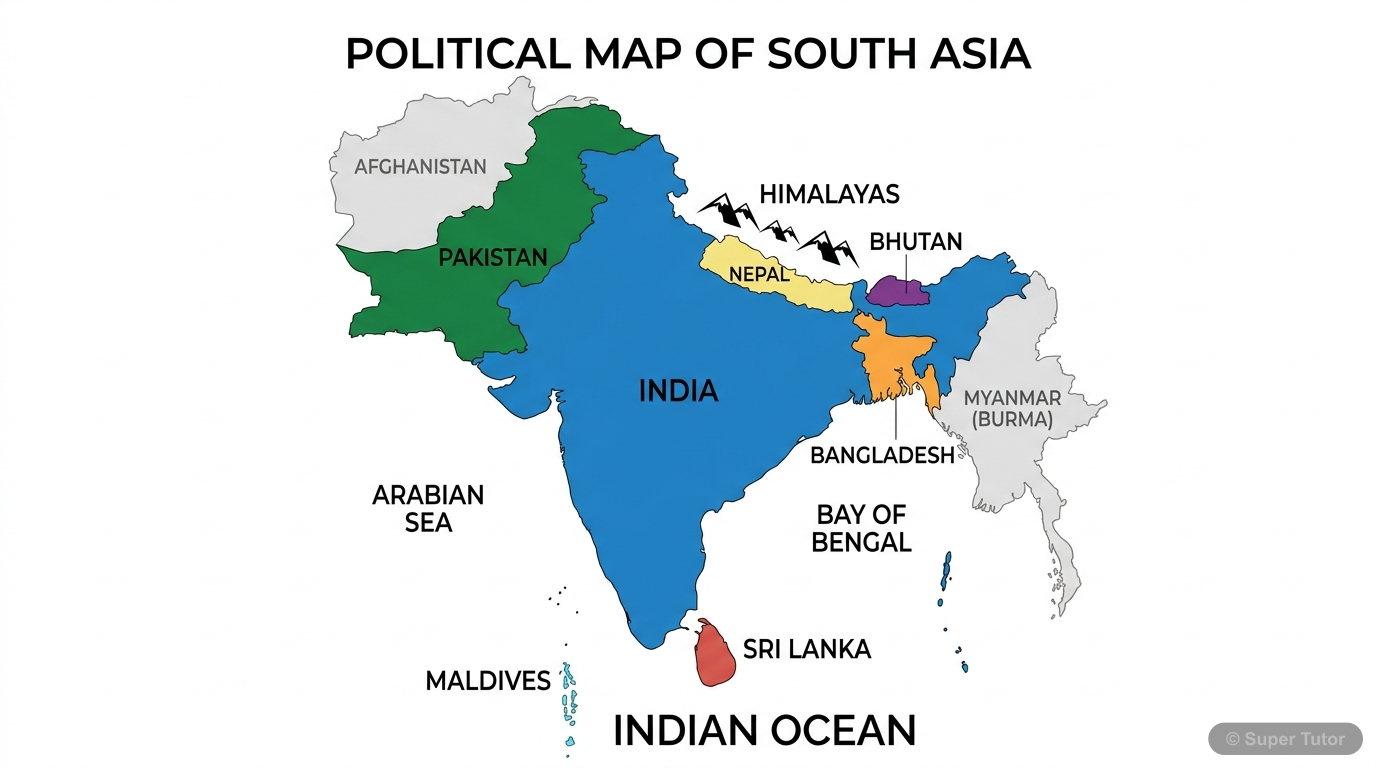
Learn better with visuals Super Tutor pairs illustrations like this with notes and quizzes for Contemporary South Asia.
इस अध्याय की परिभाषा में दक्षिण एशिया में कौन से देश शामिल हैं?
Answer
दक्षिण एशिया में सात देश शामिल हैं: बांग्लादेश, भूटान, भारत, मालदीव, नेपाल, पाकिस्तान और श्रीलंका। चीन एक महत्वपूर्ण क्षेत्रीय खिलाड़ी है, लेकिन इस परिभाषा में यह दक्षिण एशिया का हिस्सा नहीं है।…
What countries are included in South Asia in this chapter's definition?
Answer
South Asia includes seven countries: Bangladesh, Bhutan, India, the Maldives, Nepal, Pakistan, and Sri Lanka. China is an important regional player, but it is not part of South Asia in this definition…
Why is South Asia seen as one geopolitical space despite its diversity?
Answer
The region has strong diversity in language, culture, and politics, yet it forms one geopolitical space because the countries are connected by geography, history, and repeated political and economic i…
विविधता के बावजूद दक्षिण एशिया को एक भू-राजनीतिक क्षेत्र के रूप में क्यों देखा जाता है?
Answer
इस क्षेत्र में भाषा, संस्कृति और राजनीति में मजबूत विविधता है, फिर भी यह एक भू-राजनीतिक क्षेत्र बनाता है क्योंकि देश भूगोल, इतिहास और बार-बार होने वाली राजनीतिक और आर्थिक बातचीत से जुड़े हुए हैं।…
भारत को दक्षिण एशिया का केंद्रीय देश क्या बनाता है?
Answer
भारत दक्षिण एशिया का सबसे बड़ा देश है और यह मध्य में स्थित है। यह अधिकांश अन्य दक्षिण एशियाई राज्यों की सीमा से लगा हुआ है, इसलिए कई क्षेत्रीय विवाद और सहयोग के प्रयास भारत से जुड़े हैं।…
What makes India a central country in South Asia?
Answer
India is the largest South Asian country and is centrally located. It borders most of the other South Asian states, so many regional disputes and cooperation efforts involve India.
How are India and Sri Lanka similar in their democratic experience?
Answer
Both India and Sri Lanka have successfully operated democratic systems since independence. Sri Lanka's main challenge has been ethnic conflict, not military rule or monarchy.
भारत और श्रीलंका अपने लोकतांत्रिक अनुभव में कैसे समान हैं?
Answer
भारत और श्रीलंका दोनों ने स्वतंत्रता के बाद से सफलतापूर्वक लोकतांत्रिक व्यवस्था का संचालन किया है। श्रीलंका के लिए मुख्य चुनौती सैन्य शासन या राजशाही नहीं, बल्कि जातीय संघर्ष रहा है।…
+60 more flashcards
Practise AllFrequently Asked Questions
What are the important topics in Contemporary South Asia for Nagaland Board Class 12 Political Science?
How many flashcards are available for Contemporary South Asia?
How should I revise Contemporary South Asia for the Nagaland Board Class 12 board exam?
Sources & Official References
Content is aligned to the official syllabus. Refer to the board website for the latest curriculum.
More resources for Contemporary South Asia
Practice Quiz
Test yourself with a quick quiz
Important Questions
Exam-style questions with answers
Revision Notes
Key points for last-minute revision
Chapter Summary
Understand the chapter at a glance
Concept Maps
See how topics connect
Study Plan
Step-by-step plan for this chapter
Syllabus
What topics to cover
NCERT Solutions
Every textbook question solved step by step
For serious students
Get the full Contemporary South Asia chapter — start free.
Quizzes, flashcards, an AI doubt solver and a study plan for Nagaland Board Class 12 Political Science. Free to start, no card needed.