India’s external relations — NCERT Solutions
Nagaland Board · Class 12 · Political Science
NCERT Solutions for India’s external relations, Nagaland Board Class 12 Political Science: 13 textbook questions solved step by step.
Interactive on Super Tutor
Studying India’s external relations? Get the full interactive chapter.
Quizzes, flashcards, AI doubt-solver and a step-by-step study plan — built for NCERT solutions and more.
Free trial, no card needed.
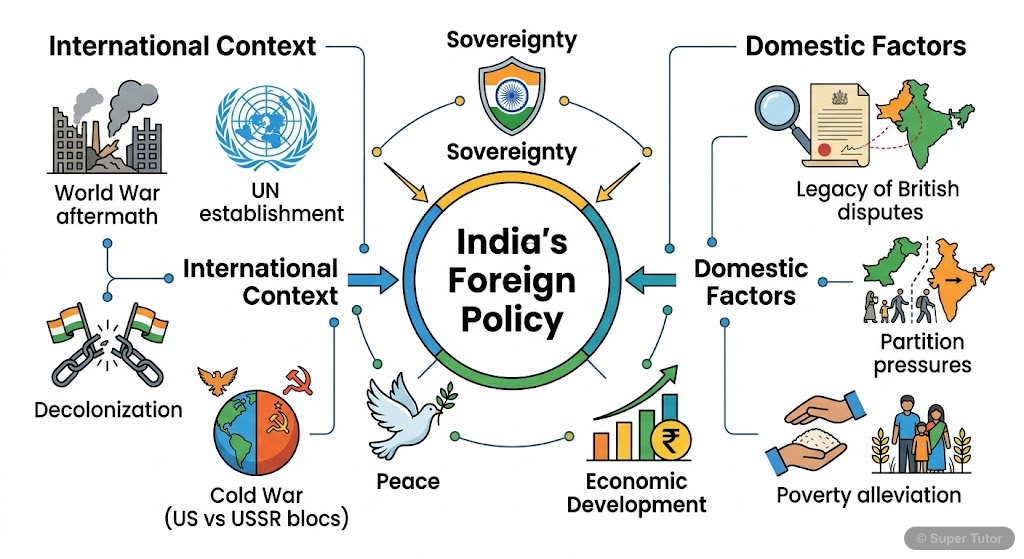
One of 9 illustrations for India’s external relations in Super Tutor — alongside flashcards, concept maps and practice questions.
The first 7 solutions are open to read. The other 6 are free with a Super Tutor account.
NCERT Exercise Solutions
1Write 'true' or 'false' against each of these statements.
(a) Non-alignment allowed India to gain assistance both from USA and USSR.
(b) India's relationship with her neighbours has been strained from the beginning.
(c) The cold war has affected the relationship between India and Pakistan.
(d) The treaty of Peace and Friendship in 1971 was the result of India's closeness to USA.Show solution
(a) True.
Non-alignment meant India did not join either the US-led NATO bloc or the Soviet-led Warsaw Pact. This independent stance allowed India to receive economic and technical assistance from both superpowers — for example, the Soviet Union helped build the Bhilai Steel Plant while the USA provided food aid under PL-480.
(b) False.
India's relationship with her neighbours was not strained from the very beginning. India had cordial relations with many neighbours initially. Tensions developed gradually — for instance, the conflict with Pakistan arose mainly over the Kashmir issue, and the conflict with China emerged in the late 1950s over border disputes.
(c) True.
The Cold War rivalry between the USA and USSR deeply influenced India–Pakistan relations. Pakistan joined US-sponsored military alliances (SEATO and CENTO), which brought American military aid to Pakistan. This altered the regional balance of power and heightened India's security concerns, straining India–Pakistan relations.
(d) False.
The Indo-Soviet Treaty of Peace, Friendship and Cooperation (1971) was the result of India's closeness to the USSR, not the USA. It was signed because the USA and China were both supporting Pakistan during the Bangladesh crisis, and India needed diplomatic and military backing from the Soviet Union.
2Match the following:
(a) The goal of India's foreign policy in the period 1950–1964
(b) Panchsheel
(c) Bandung Conference
(d) Dalai Lama
i. Tibetan spiritual leader who crossed over to India
ii. Preservation of territorial integrity, sovereignty and economic development
iii. Five principles of peaceful coexistence
iv. Led to the establishment of NAMShow solution
The correct matching is:
| Column A | Column B |
|---|---|
| (a) The goal of India's foreign policy in the period 1950–1964 | (ii) Preservation of territorial integrity, sovereignty and economic development |
| (b) Panchsheel | (iii) Five principles of peaceful coexistence |
| (c) Bandung Conference | (iv) Led to the establishment of NAM |
| (d) Dalai Lama | (i) Tibetan spiritual leader who crossed over to India |
Brief Explanations:
- (a) → (ii): Nehru's foreign policy aimed at protecting India's sovereignty, maintaining territorial integrity, and focusing on economic development through peaceful means.
- (b) → (iii): Panchsheel (1954), signed between India and China, outlined five principles: mutual respect for sovereignty, mutual non-aggression, mutual non-interference, equality and mutual benefit, and peaceful coexistence.
- (c) → (iv): The Bandung Conference (1955) of Afro-Asian nations laid the ideological groundwork that eventually led to the formal establishment of the Non-Aligned Movement (NAM) in 1961.
- (d) → (i): The Dalai Lama, the spiritual and political leader of Tibet, fled to India in 1959 after China suppressed the Tibetan uprising and was granted political asylum by India.
3Why did Nehru regard conduct of foreign relations as an essential indicator of independence? State any two reasons with examples to support your reading.Show solution
Given/Context: Jawaharlal Nehru was India's first Prime Minister and also served as the External Affairs Minister. He personally shaped India's foreign policy.
Nehru regarded the conduct of foreign relations as an essential indicator of independence for the following reasons:
Reason 1: Assertion of Sovereignty and Self-Respect
For a nation that had just emerged from nearly two centuries of colonial rule, the ability to independently decide its own foreign policy was proof of genuine freedom. Nehru believed that if India simply followed the dictates of any foreign power in international matters, it would be a continuation of colonial subjugation in a new form.
- Example: Nehru refused to align India with either the USA or the USSR during the Cold War, despite pressure from both sides. By choosing Non-Alignment, India demonstrated that it would chart its own independent course in world affairs, free from external dictation.
Reason 2: Protecting National Interest and Enabling Economic Development
Nehru understood that foreign policy was directly linked to India's economic development. An independent foreign policy would allow India to receive aid and technology from multiple sources without being bound to any one power's conditions.
- Example: India received economic assistance from both the USA (food aid under PL-480, assistance for IIT Kanpur) and the USSR (help in building public sector units like the Bhilai Steel Plant). This was only possible because India's independent foreign policy kept both superpowers engaged with India.
Conclusion: Thus, for Nehru, the conduct of foreign relations was not merely a diplomatic exercise but a demonstration of India's hard-won freedom and a tool for securing its national interests.
4"The conduct of foreign affairs is an outcome of a two-way interaction between domestic compulsions and prevailing international climate". Take one example from India's external relations in the 1960s to substantiate your answer.Show solution
Concept: The statement means that a country's foreign policy is shaped both by its internal needs and pressures (domestic compulsions) and by the global situation at the time (international climate). Neither factor alone determines foreign policy.
Example: The Indo-Soviet Treaty of 1971 (rooted in the 1960s context) / India–China War 1962 and its aftermath
The best example from the 1960s is India's response to the Sino-Indian War of 1962 and its subsequent foreign policy realignment.
Domestic Compulsion:
The humiliating defeat in the 1962 war with China exposed India's military weakness. Domestically, there was enormous pressure on the government to modernise the armed forces and strengthen national security. India urgently needed military equipment and financial resources that it could not generate on its own.
International Climate:
The 1960s were the height of the Cold War. The USA and USSR were competing for influence in Asia. China had aligned with the USSR initially but the Sino-Soviet split created new equations. Pakistan had joined US military alliances, making the USA reluctant to fully support India against China.
Two-Way Interaction:
- The domestic need for military modernisation pushed India to seek arms from abroad.
- The international climate (Cold War competition) meant both the USA and USSR were willing to supply arms to India to gain influence.
- India received military assistance from both superpowers after 1962, which was only possible because of its non-aligned status.
- However, as the USA tilted towards Pakistan, India gradually moved closer to the USSR, culminating in the 1971 Treaty.
Conclusion: Thus, India's foreign policy in the 1960s was clearly shaped by the two-way interaction between domestic compulsions (military weakness, security needs) and the international climate (Cold War rivalry, Sino-Soviet split, US–Pakistan alliance).
5Identify any two aspects of India's foreign policy that you would like to retain and two that you would like to change, if you were to become a decision maker. Give reasons to support your position.Show solution
Note: This is an opinion-based question. The following is a model answer that a student can adapt.
Two Aspects I Would Like to RETAIN:
1. Non-Alignment / Strategic Autonomy
- Reason: The principle of not joining any military bloc and maintaining an independent foreign policy has served India well. It has allowed India to pursue its national interest without being bound by the strategic compulsions of any superpower. In today's multipolar world, strategic autonomy allows India to engage with the USA, Russia, China, and others on its own terms. This principle should be retained and updated as 'multi-alignment.'
2. Commitment to Peaceful Resolution of Disputes and International Peace
- Reason: India's consistent support for the United Nations, international law, and peaceful settlement of disputes has given it moral credibility in the world. This has helped India gain support in international forums and build soft power. Abandoning this would damage India's global image.
Two Aspects I Would Like to CHANGE:
1. Excessive Caution / Hesitation in Using Military Power
- Reason: India's restrained response to repeated provocations (e.g., cross-border terrorism) has sometimes been perceived as weakness. As a decision maker, I would adopt a more assertive security doctrine that clearly communicates consequences for hostile acts, while still preferring peaceful means.
2. Slow Pace of Improving Relations with Neighbours (SAARC)
- Reason: India's neighbourhood policy has not been effective enough. Relations with Pakistan remain tense, and smaller neighbours like Nepal and Sri Lanka have sometimes felt dominated by India. I would invest more in economic diplomacy, connectivity projects, and people-to-people contact to build genuine goodwill in the neighbourhood, making SAARC more effective.
Conclusion: A good foreign policy must balance continuity (retaining proven principles) with change (adapting to new realities).
6(a)Write a short note on India's Nuclear Policy.Show solution
India's Nuclear Policy
Background:
India's nuclear policy has evolved over decades, shaped by its security environment and its commitment to global disarmament.
Key Features:
- Peaceful Use Initially: India's nuclear programme began under Homi J. Bhabha with the stated goal of using nuclear energy for peaceful purposes — electricity generation and scientific research. India signed no treaty that would prevent it from developing nuclear weapons.
- Opposition to Discriminatory Treaties: India consistently opposed the Nuclear Non-Proliferation Treaty (NPT, 1968) and the Comprehensive Test Ban Treaty (CTBT) on the grounds that they were discriminatory — they allowed the five permanent members of the UN Security Council to keep their nuclear weapons while preventing others from developing them. India argued for universal, non-discriminatory disarmament.
- Pokhran-I (1974 — Smiling Buddha): India conducted its first nuclear test in 1974 under Prime Minister Indira Gandhi, describing it as a 'peaceful nuclear explosion.' This demonstrated India's nuclear capability.
- Pokhran-II (1998 — Operation Shakti): India conducted five nuclear tests in May 1998 under Prime Minister Atal Bihari Vajpayee and declared itself a nuclear weapons state. This led to international sanctions but also forced the world to acknowledge India's nuclear status.
- No First Use (NFU) Policy: India adopted a 'No First Use' policy — India will not be the first to use nuclear weapons in a conflict. Nuclear weapons are seen as a deterrent, not a weapon of war.
- Civilian Nuclear Agreement (2008): The Indo-US Civil Nuclear Deal (123 Agreement) recognised India as a responsible nuclear state and allowed India to access civilian nuclear technology and fuel from the international market.
Conclusion: India's nuclear policy reflects a balance between its security needs, its desire for global disarmament, and its commitment to responsible nuclear stewardship.
6(b)Write a short note on Consensus in foreign policy matters.Show solution
Consensus in Foreign Policy Matters
Meaning:
Consensus in foreign policy means that the broad principles and major decisions of a country's external relations are agreed upon by all major political parties and stakeholders, transcending partisan differences.
India's Experience:
- Nehru's Legacy as a Foundation: The basic framework of India's foreign policy — Non-Alignment, Panchsheel, support for decolonisation, and peaceful coexistence — was laid by Nehru and has been broadly accepted by all subsequent governments, regardless of their political ideology.
- Bipartisan Support: Even when opposition parties criticised specific decisions of the ruling government, they rarely challenged the fundamental principles of India's foreign policy. For example, the commitment to strategic autonomy has been maintained by governments of different political persuasions — Congress, Janata Party, BJP-led coalitions.
- Nuclear Policy: The decision to conduct nuclear tests in 1998 by the BJP-led government was broadly supported across party lines, reflecting a national consensus on India's right to be a nuclear power.
- Importance of Consensus:
- It provides continuity and predictability to India's foreign policy, making India a reliable partner for other nations.
- It prevents foreign policy from becoming a tool of domestic political competition.
- It ensures that major foreign policy decisions have democratic legitimacy.
- Limitations: Consensus can sometimes lead to status quo and prevent necessary reforms or bold new initiatives in foreign policy.
Conclusion: The broad consensus on foreign policy has been one of India's strengths, ensuring that its international commitments remain stable across changes in government.
Free with a Super Tutor account
Free with a Super Tutor account
Free with a Super Tutor account
(a) Why does Nehru want to keep off military blocs?
Free with a Super Tutor account
Free with a Super Tutor account
Free with a Super Tutor account
6 more solved questions in India’s external relations
They are free with a Super Tutor account, along with practice quizzes and flashcards for this chapter. Free to start, no card needed.
Frequently Asked Questions
What are the important topics in India’s external relations for Nagaland Board Class 12 Political Science?
Are these NCERT Solutions for India’s external relations free?
How should I revise India’s external relations for the Nagaland Board Class 12 board exam?
Sources & Official References
Content is aligned to the official syllabus. Refer to the board website for the latest curriculum.
More resources for India’s external relations
Practice Quiz
Test yourself with a quick quiz
Important Questions
Exam-style questions with answers
Revision Notes
Key points for last-minute revision
Chapter Summary
Understand the chapter at a glance
Concept Maps
See how topics connect
Study Plan
Step-by-step plan for this chapter
Flashcards
Quick-fire cards for active recall
Syllabus
What topics to cover
For serious students
Get the full India’s external relations chapter — start free.
Quizzes, flashcards, an AI doubt solver and a study plan for Nagaland Board Class 12 Political Science. Free to start, no card needed.