Social Institutions: Continuity and Change
Odisha Board · Class 12 · Sociology
Complete topic list for Social Institutions: Continuity and Change in Odisha Board Class 12 Sociology. Key concepts, sub-topics, and what to focus on for board exams.
Interactive on Super Tutor
Studying Social Institutions: Continuity and Change? Get the full interactive chapter.
Quizzes, flashcards, AI doubt-solver and a step-by-step study plan — built for syllabus and more.
1,000+ Class 12 students started this chapter today
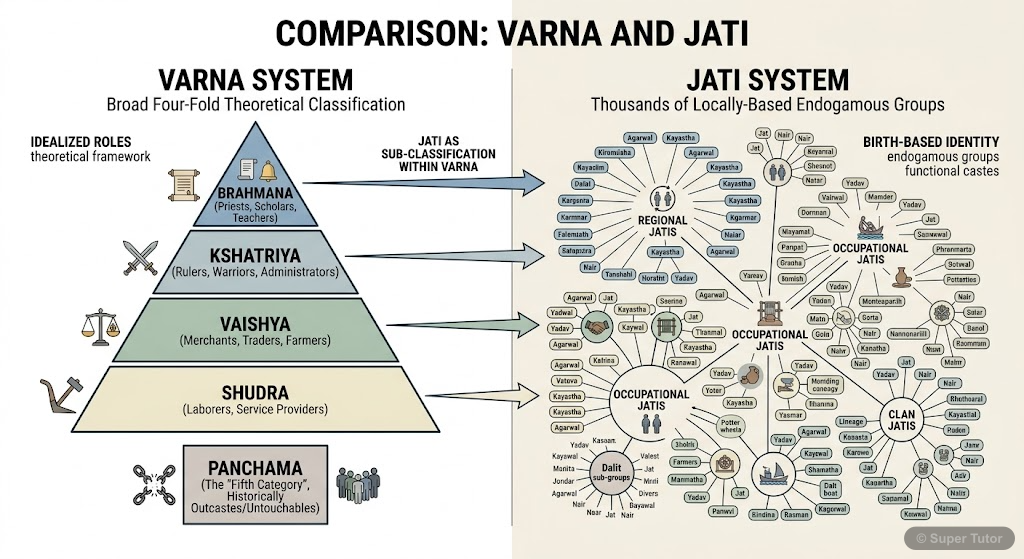
Learn better with visuals Super Tutor has hundreds of illustrations like this across every chapter — all free to try.
Get startedTopics in Social Institutions: Continuity and Change
Understanding Social Institutions
- Social institutions are organized systems of social relationships that fulfill basic societal needs
- They provide structure, stability, and continuity to society across generations
- In India, caste, tribe, and family are the three most significant social institutions
Caste System: Structure and Evolution
- Caste is unique to the Indian subcontinent, though similar systems exist elsewhere
- The term 'caste' comes from Portuguese 'casta' meaning pure breed
- Two main concepts: Varna (four-fold division) and Jati (local sub-classifications)
Traditional Features of Caste System
- Birth-based membership: cannot choose, change, or leave one's caste
- Endogamous marriage rules: must marry within caste group
- Food restrictions: rules about what to eat and with whom to share food
Colonial Impact on Caste
- British colonial period (1800-1947) significantly transformed caste
- Some scholars argue modern caste is more colonial product than ancient tradition
- British conducted detailed surveys of 'customs and manners' of castes
Key Concepts
Central concept: Social Institutions in India — Caste, Tribe, and Family
Frequently Asked Questions
What are the important topics in Social Institutions: Continuity and Change for Odisha Board Class 12 Sociology?
How to score full marks in Social Institutions: Continuity and Change — Odisha Board Class 12 Sociology?
Sources & Official References
Content is aligned to the official syllabus. Refer to the board website for the latest curriculum.
More resources for Social Institutions: Continuity and Change
Important Questions
Practice with board exam-style questions
Revision Notes
Key points for last-minute revision
Study Plan
Step-by-step plan to ace this chapter
Flashcards
Quick-fire cards for active recall
Formula Sheet
All formulas in one place
Chapter Summary
Understand the chapter at a glance
Practice Quiz
Test yourself with a quick quiz
Concept Maps
See how topics connect visually
NCERT Solutions
Every textbook question solved step by step
For serious students
Get the full Social Institutions: Continuity and Change chapter — for free.
Quizzes, flashcards, AI doubt-solver and a step-by-step study plan for Odisha Board Class 12 Sociology.