Social Institutions: Continuity and Change
Odisha Board · Class 12 · Sociology
Flashcards for Social Institutions: Continuity and Change — Odisha Board Class 12 Sociology. Quick Q&A cards covering key concepts, definitions, and formulas.
Interactive on Super Tutor
Studying Social Institutions: Continuity and Change? Get the full interactive chapter.
Quizzes, flashcards, AI doubt-solver and a step-by-step study plan — built for flashcards and more.
1,000+ Class 12 students started this chapter today
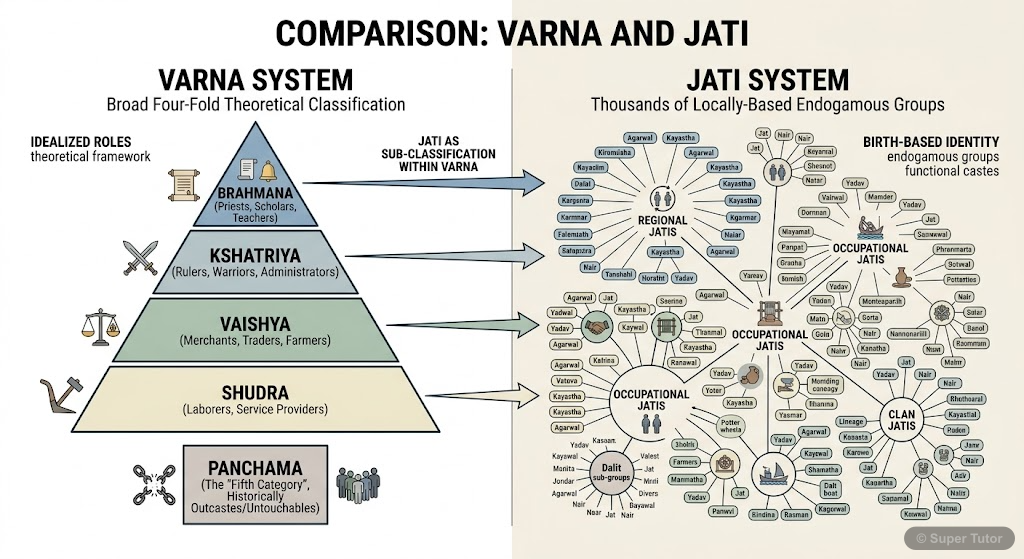
Learn better with visuals Super Tutor has hundreds of illustrations like this across every chapter — all free to try.
Get startedWhat are the two distinct Sanskrit terms used to refer to the caste system, and what do they mean?
Answer
Varna and Jati. Varna literally means 'colour' and refers to the four-fold division of society (Brahmana, Kshatriya, Vaishya, Shudra). Jati is a generic term meaning 'species' or 'kinds' and refers to…
List the six main defining features of the traditional caste system.
Answer
1. Determined by birth - cannot be changed 2. Endogamous marriage rules - marry within caste 3. Food restrictions and sharing rules 4. Hierarchical system with rank and status 5. Segmental organizatio…
What is Sanskritisation according to M.N. Srinivas?
Answer
Sanskritisation is a process whereby members of a lower caste attempt to raise their social status by adopting the ritual, domestic, and social practices of higher castes. This concept was coined by s…
Define 'Dominant Caste' and give examples from different Indian states.
Answer
Dominant caste refers to castes with large populations who were granted land rights after Independence. Examples include: Yadavs (Bihar, UP), Vokkaligas (Karnataka), Reddys and Khammas (Andhra Pradesh…
How did the British colonial administration impact the caste system?
Answer
The British made caste more rigid through: 1. Systematic census operations (especially 1901 Census under Herbert Risley) 2. Official recording of caste hierarchies 3. Creating 'Scheduled Castes' and '…
Who was Jotirao Govindrao Phule and what was his contribution to caste reform?
Answer
Jotirao Phule (1827-1890) was a social reformer who denounced the injustice of the caste system and its rules of purity and pollution. In 1873, he founded the Satyashodhak Samaj (Truth Seekers Society…
Explain the paradox of caste becoming 'invisible' for upper castes in contemporary India.
Answer
Upper caste urban middle classes benefited from their caste status to access quality education and jobs. Once established, subsequent generations believe their success is due to merit alone, not caste…
What are the 'permanent traits' used to classify Indian tribes?
Answer
Permanent traits include: 1. Region - 85% live in 'middle India' belt 2. Language - categorized into Indo-Aryan, Dravidian, Austric, and Tibeto-Burman groups 3. Physical characteristics - Negrito, Aus…
+17 more flashcards available
Practice AllFrequently Asked Questions
What are the important topics in Social Institutions: Continuity and Change for Odisha Board Class 12 Sociology?
How to score full marks in Social Institutions: Continuity and Change — Odisha Board Class 12 Sociology?
How many flashcards are available for Social Institutions: Continuity and Change?
Sources & Official References
Content is aligned to the official syllabus. Refer to the board website for the latest curriculum.
More resources for Social Institutions: Continuity and Change
Important Questions
Practice with board exam-style questions
Syllabus
What topics to cover
Revision Notes
Key points for last-minute revision
Study Plan
Step-by-step plan to ace this chapter
Formula Sheet
All formulas in one place
Chapter Summary
Understand the chapter at a glance
Practice Quiz
Test yourself with a quick quiz
Concept Maps
See how topics connect visually
NCERT Solutions
Every textbook question solved step by step
For serious students
Get the full Social Institutions: Continuity and Change chapter — for free.
Quizzes, flashcards, AI doubt-solver and a step-by-step study plan for Odisha Board Class 12 Sociology.