Linear Inequalities — Important Questions
Punjab Board · Class 11 · Mathematics
45 important questions from Linear Inequalities for Punjab Board Class 11 Mathematics, with answers. Includes multiple choice questions.
Interactive on Super Tutor
Studying Linear Inequalities? Get the full interactive chapter.
Quizzes, flashcards, AI doubt-solver and a step-by-step study plan — built for important questions and more.
Free trial, no card needed.
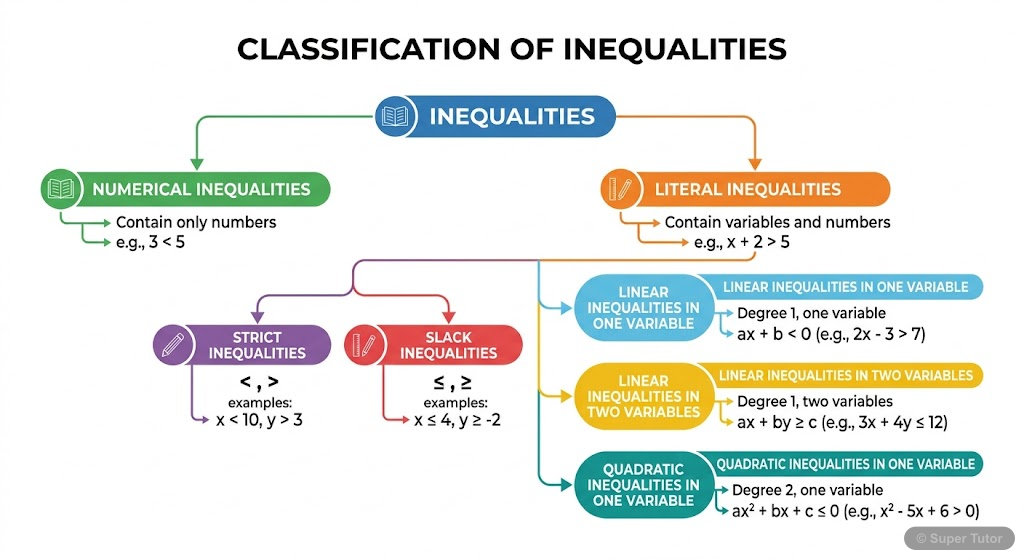
Learn better with visuals Super Tutor pairs illustrations like this with notes and quizzes for Linear Inequalities.
Important Questions from Linear Inequalities
A student scored 70 and 80 in two tests. What is the minimum score needed in the third test so that the average is strictly greater than 75?
Show answer
76
Step 1: Let x = score in third test. Average of three tests = (70 + 80 + x)/3. Step 2: We need average strictly greater than 75: (70 + 80 + x)/3 > 75. Step 3: Multiply both sides by 3: 70 + 80 + x > 225 → 150 + x > 225. Step 4: Subtract 150: x > 75. So x must be STRICTLY greater than 75. Since scores are integers, the MINIMUM integer value satisfying x > 75 is x = 76. Common mistake: Writing x ≥ 75 (which would be for average ≥ 75, not average > 75). The word 'strictly greater' means we cannot include 75.
For what values of x is the inequality (x-2)/(x+3) > 0 satisfied? (Assume x ≠ -3)
Show answer
x < -3 or x > 2
Step 1: For a fraction to be positive, numerator and denominator must have the SAME sign. Critical points are x = 2 (numerator = 0) and x = -3 (denominator = 0). Step 2: Case 1 — Both positive: (x-2) > 0 AND (x+3) > 0 → x > 2 AND x > -3 → x > 2. Step 3: Case 2 — Both negative: (x-2) < 0 AND (x+3) < 0 → x < 2 AND x < -3 → x < -3. Step 4: Combining: x < -3 OR x > 2. At x = 2, the expression equals 0, which does NOT satisfy > 0. At x = -3, the expression is undefined. Common mistake: Students often take -3 < x < 2 (sign between the roots), which actually makes the fraction negative.
Temperature in Celsius must be kept between 20°C and 30°C. Using F = (9/5)C + 32, which Fahrenheit range corresponds to this?
Show answer
68°F < F < 86°F
Step 1: We have 20 < C < 30 (strictly between, so both endpoints excluded). Step 2: Substitute C = (5/9)(F-32) in the inequality: 20 < (5/9)(F-32) < 30. Step 3: Multiply all parts by 9/5 (positive, no sign change): 20 × (9/5) < (F-32) < 30 × (9/5) → 36 < F - 32 < 54. Step 4: Add 32 to all parts: 36 + 32 < F < 54 + 32 → 68 < F < 86. So 68°F < F < 86°F. Note: Both endpoints are STRICTLY excluded because the original inequality used strict < signs. Common mistake: Using ≤ instead of < in the final answer.
Find all pairs of consecutive even integers, both greater than 5, such that their sum is less than 23. How many such pairs exist?
Show answer
3 pairs
Step 1: Let x be the smaller even integer. The consecutive even integers are x and x+2. Step 2: Conditions: (i) x > 5, so the smallest even integer x ≥ 6. (ii) Sum < 23: x + (x+2) < 23 → 2x + 2 < 23 → 2x < 21 → x < 10.5. Step 3: From (i) and (ii): 5 < x < 10.5, and x must be an even integer, so x ∈ {6, 8, 10}. Step 4: The pairs are: (6,8), (8,10), (10,12). Verify (10,12): 10 > 5 ✓, 12 > 5 ✓, sum = 22 < 23 ✓. Check (12,14): 12+14=26 ≮ 23 ✗. So exactly 3 pairs exist. Common mistake: Forgetting that BOTH integers must be greater than 5, or using odd numbers instead of even.
+41 more questions on Linear Inequalities (Punjab Board Class 11 Mathematics)
Practise AllFrequently Asked Questions
What are the important topics in Linear Inequalities for Punjab Board Class 11 Mathematics?
How many important questions are there in Linear Inequalities?
Sources & Official References
Content is aligned to the official syllabus. Refer to the board website for the latest curriculum.
More resources for Linear Inequalities
For serious students
Get the full Linear Inequalities chapter — start free.
Quizzes, flashcards, an AI doubt solver and a study plan for Punjab Board Class 11 Mathematics. Free to start, no card needed.