Trigonometric Functions — Syllabus
Punjab Board · Class 11 · Mathematics
What Trigonometric Functions covers in Punjab Board Class 11 Mathematics: 4 topics, for the 2026-27 session. Topics include Angles – Degree and Radian.
Interactive on Super Tutor
Studying Trigonometric Functions? Get the full interactive chapter.
Quizzes, flashcards, AI doubt-solver and a step-by-step study plan — built for syllabus and more.
Free trial, no card needed.
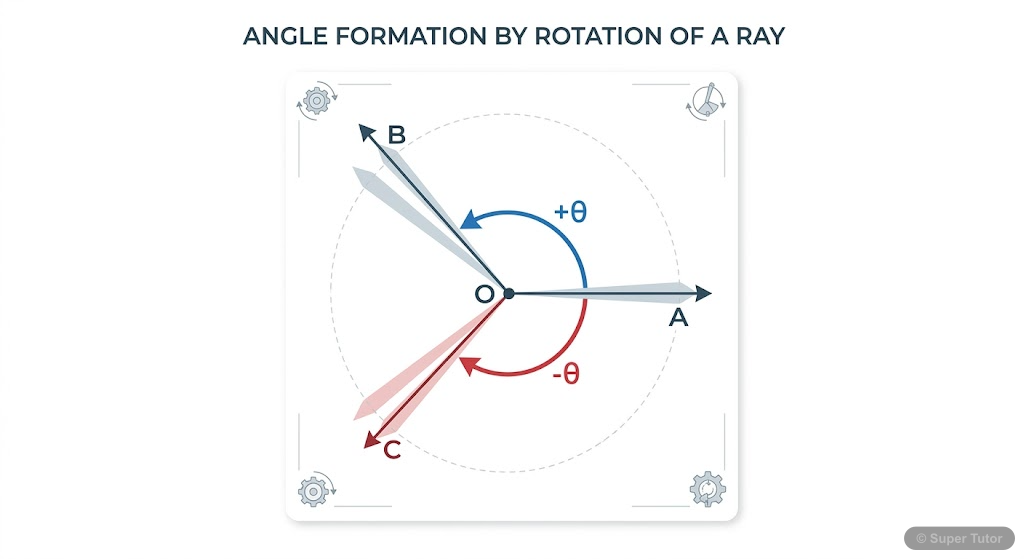
One of 11 illustrations for Trigonometric Functions in Super Tutor — alongside flashcards, concept maps and practice questions.
Topics in Trigonometric Functions
Angles – Degree and Radian Measure
- An angle is the measure of rotation of a ray from its initial position (initial side) to its final position (terminal side). The fixed point is called the vertex.
- Anticlockwise rotation gives a POSITIVE angle. Clockwise rotation gives a NEGATIVE angle.
- One complete revolution = 360° = 2π radians.
Trigonometric Functions via Unit Circle
- A unit circle has centre at origin O and radius = 1. For any point P(a, b) on the unit circle with angle AOP = x radians (measured from positive x-axis), we DEFINE: cos x = a (x-coordinate) and sin x
- Since P lies on the unit circle: a² + b² = 1, giving the fundamental identity: sin²x + cos²x = 1.
- The other four functions are defined as: tan x = sin x / cos x, cot x = cos x / sin x, sec x = 1 / cos x, cosec x = 1 / sin x.
Signs and Values of Trig Functions in All Quadrants
- Quadrant I (0 < x < π/2): ALL trig functions are POSITIVE.
- Quadrant II (π/2 < x < π): Only SIN and COSEC are positive. All others are negative.
- Quadrant III (π < x < 3π/2): Only TAN and COT are positive. All others are negative.
Trigonometric Identities – Sum and Difference Formulas
- These are the MOST IMPORTANT formulas in this chapter. Virtually every proof and evaluation question uses them.
- Core Sum Formulas: sin(x+y) = sin x cos y + cos x sin y. cos(x+y) = cos x cos y – sin x sin y. tan(x+y) = (tan x + tan y)/(1 – tan x tan y).
- Core Difference Formulas: sin(x–y) = sin x cos y – cos x sin y. cos(x–y) = cos x cos y + sin x sin y. tan(x–y) = (tan x – tan y)/(1 + tan x tan y).
Key Concepts
Work through every topic in Trigonometric Functions with notes and quizzes
Start This ChapterFrequently Asked Questions
What are the important topics in Trigonometric Functions for Punjab Board Class 11 Mathematics?
How should I revise Trigonometric Functions for Class 11 exams?
Sources & Official References
Content is aligned to the official syllabus. Refer to the board website for the latest curriculum.
More resources for Trigonometric Functions
Practice Quiz
Test yourself with a quick quiz
Important Questions
Exam-style questions with answers
Revision Notes
Key points for last-minute revision
Formula Sheet
The chapter's formulas in one place
Chapter Summary
Understand the chapter at a glance
Concept Maps
See how topics connect
Flashcards
Quick-fire cards for active recall
For serious students
Get the full Trigonometric Functions chapter — start free.
Quizzes, flashcards, an AI doubt solver and a study plan for Punjab Board Class 11 Mathematics. Free to start, no card needed.