Inverse Trigonometric Functions — Chapter Summary
Punjab Board · Class 12 · Mathematics
Summary of Inverse Trigonometric Functions for Punjab Board Class 12 Mathematics. Part of the Punjab Board Class 12 Mathematics syllabus.
Interactive on Super Tutor
Studying Inverse Trigonometric Functions? Get the full interactive chapter.
Quizzes, flashcards, AI doubt-solver and a step-by-step study plan — built for chapter summary and more.
Free trial, no card needed.
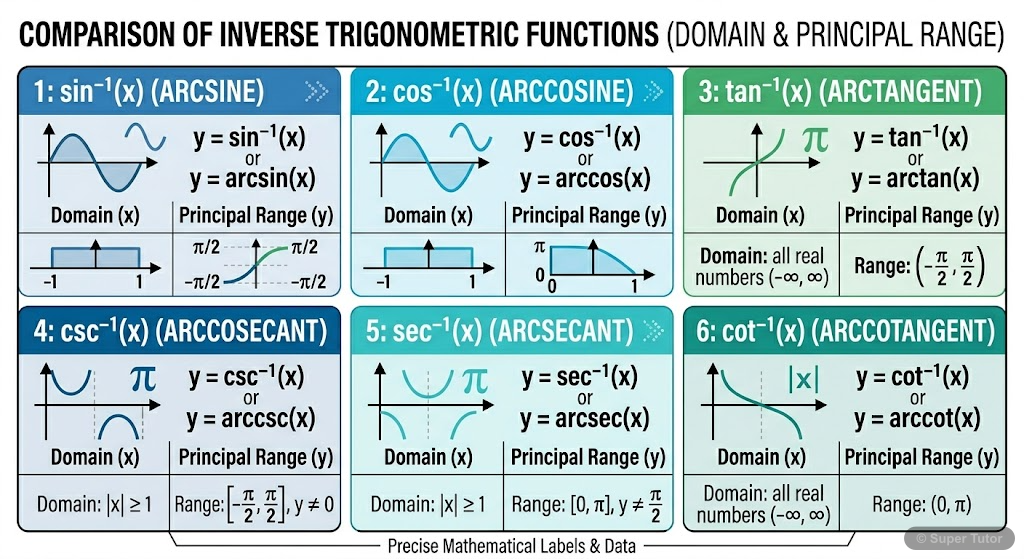
One of 12 illustrations for Inverse Trigonometric Functions in Super Tutor — alongside flashcards, concept maps and practice questions.
Overview
Inverse trigonometric functions are the reverse operations of the standard trigonometric functions. While trigonometric functions like sin, cos, and tan take angles as inputs and return ratios, inverse trigonometric functions take ratios as inputs and return angles. This chapter explores how to crea
Key Concepts
Trigonometric functions like sin
Trigonometric functions like sin, cos, tan are not one-one and onto over their entire domains. For example, sin(π/6) = sin(5π/6) = 1/2, meaning multip
The function sin⁻¹
The function sin⁻¹: [-1, 1] → [-π/2, π/2] is the principal value branch of the inverse sine function. If y = sin⁻¹(x), then sin(y) = x and -π/2 ≤ y ≤
The function cos⁻¹
The function cos⁻¹: [-1, 1] → [0, π] is the principal value branch of the inverse cosine function. If y = cos⁻¹(x), then cos(y) = x and 0 ≤ y ≤ π. For
The function tan⁻¹
The function tan⁻¹: ℝ → (-π/2, π/2) is the principal value branch of the inverse tangent function. If y = tan⁻¹(x), then tan(y) = x and -π/2 < y < π/2
cot⁻¹
cot⁻¹: ℝ → (0, π) with the property that cot⁻¹(x) + tan⁻¹(x) = π/2. sec⁻¹: ℝ - (-1, 1) → [0, π] - {π/2} with sec⁻¹(x) = cos⁻¹(1/x). cosec⁻¹: ℝ - (-1,
Learning Objectives
- Understand why inverse trigonometric functions need domain restrictions
- Learn the principal value branches of all six inverse trigonometric functions
- Identify domains and ranges of inverse trigonometric functions
- Graph inverse trigonometric functions and understand reflection properties
- Apply properties and relationships between inverse trigonometric functions
Frequently Asked Questions
What are the important topics in Inverse Trigonometric Functions for Punjab Board Class 12 Mathematics?
How should I revise Inverse Trigonometric Functions for the Punjab Board Class 12 board exam?
Sources & Official References
Content is aligned to the official syllabus. Refer to the board website for the latest curriculum.
More resources for Inverse Trigonometric Functions
For serious students
Get the full Inverse Trigonometric Functions chapter — start free.
Quizzes, flashcards, an AI doubt solver and a study plan for Punjab Board Class 12 Mathematics. Free to start, no card needed.