Determinants — Important Questions
Punjab Board · Class 12 · Mathematics
44 important questions from Determinants for Punjab Board Class 12 Mathematics, with answers. Includes multiple choice questions.
Interactive on Super Tutor
Studying Determinants? Get the full interactive chapter.
Quizzes, flashcards, AI doubt-solver and a step-by-step study plan — built for important questions and more.
Free trial, no card needed.
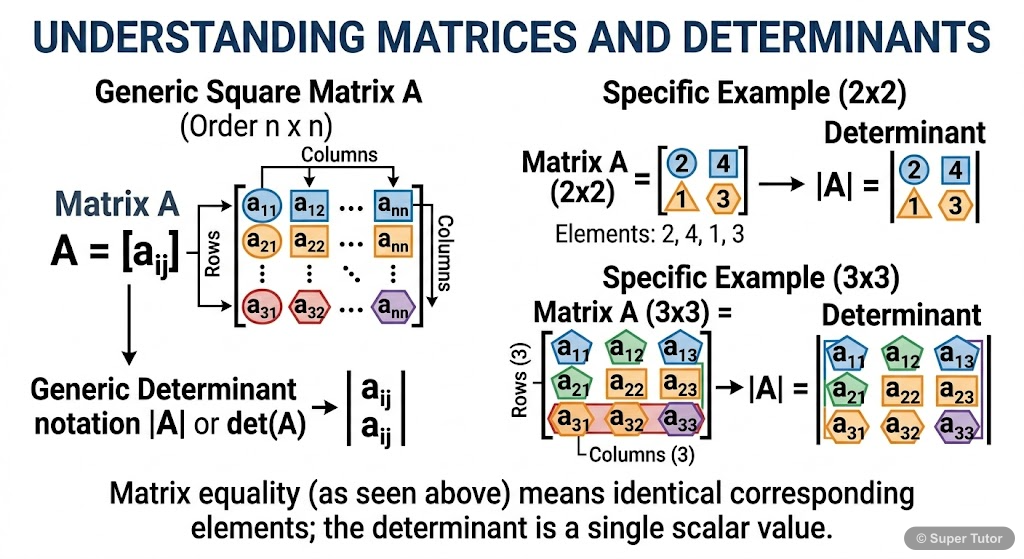
Learn better with visuals Super Tutor pairs illustrations like this with notes and quizzes for Determinants.
Important Questions from Determinants
If A = [[1,2],[3,4]], then what is A · adj(A)?
Show answer
[[−2,0],[0,−2]]
Step 1: By Theorem 1, A·(adj A) = |A|·I for any square matrix A. Step 2: Calculate |A| = (1)(4) - (2)(3) = 4 - 6 = -2. Step 3: Therefore A·(adj A) = |A|·I = -2 · [[1,0],[0,1]] = [[-2,0],[0,-2]]. Step 4: Verification - adj A for a 2×2 matrix [[a,b],[c,d]] is [[d,-b],[-c,a]]. So adj A = [[4,-2],[-3,1]]. Step 5: A·(adj A) = [[1,2],[3,4]]·[[4,-2],[-3,1]] = [[4-6,-2+2],[12-12,-6+4]] = [[-2,0],[0,-2]] ✓. Common mistake: confusing A·adj(A) with adj(A)·A or computing the wrong determinant.
The value of the determinant |[sin²A, cotA, 1],[sin²B, cotB, 1],[sin²C, cotC, 1]| where A, B, C are angles of a triangle is:
If A is a 3×3 non-singular matrix, what is A^(-1) in terms of adj(A) and |A|? Also, if |A|= -3, what is |A^(-1)|?
Show answer
A^(-1) = adj(A)/|A| and |A^(-1)| = -1/3
Step 1: From the theory of inverses, for a non-singular matrix A, the inverse is A^(-1) = (1/|A|) · adj(A). Step 2: Now we need |A^(-1)|. Using the property |AB| = |A||B|, and knowing A·A^(-1) = I: |A·A^(-1)| = |I| = 1, so |A|·|A^(-1)| = 1. Step 3: Therefore |A^(-1)| = 1/|A|. Step 4: Given |A| = -3, we get |A^(-1)| = 1/(-3) = -1/3. Step 5: Note: det is a real number that can be negative, so |A^(-1)| = -1/3 is correct. Common mistake: students sometimes think |A^(-1)| must be positive or compute it as 1/|A|² = 1/9.
The value of the determinant |[x+1, x+2, x+a],[x+2, x+3, x+b],[x+3, x+4, x+c]| = 0, given that a, b, c are in A.P. Which statement best explains this?
Show answer
Because R2 - R1 = R3 - R2, making R1, R2, R3 linearly dependent
Step 1: Since a, b, c are in A.P., we have b-a = c-b, i.e., 2b = a+c. Step 2: Apply R2→R2-R1 and R3→R3-R2: New R2 = [1,1,b-a] and New R3 = [1,1,c-b]. Step 3: Since a,b,c are in A.P., b-a = c-b (common difference d). So new R2 = [1,1,d] and new R3 = [1,1,d]. Step 4: Now R2 = R3 (two identical rows). By a fundamental property of determinants, if two rows are identical, the determinant is zero. Step 5: This means the three original rows are linearly dependent whenever a, b, c are in A.P. The determinant is always 0 under this condition.
+40 more questions on Determinants (Punjab Board Class 12 Mathematics)
Practise AllFrequently Asked Questions
What are the important topics in Determinants for Punjab Board Class 12 Mathematics?
How many important questions are there in Determinants?
Sources & Official References
Content is aligned to the official syllabus. Refer to the board website for the latest curriculum.
More resources for Determinants
For serious students
Get the full Determinants chapter — start free.
Quizzes, flashcards, an AI doubt solver and a study plan for Punjab Board Class 12 Mathematics. Free to start, no card needed.