Relations and Functions — Practice Quiz
Punjab Board · Class 12 · Mathematics
Try a 4-question quiz on Relations and Functions for Punjab Board Class 12 Mathematics: tap an answer to check it and see why.
Interactive on Super Tutor
Studying Relations and Functions? Get the full interactive chapter.
Quizzes, flashcards, AI doubt-solver and a step-by-step study plan — built for practice quiz and more.
Free trial, no card needed.
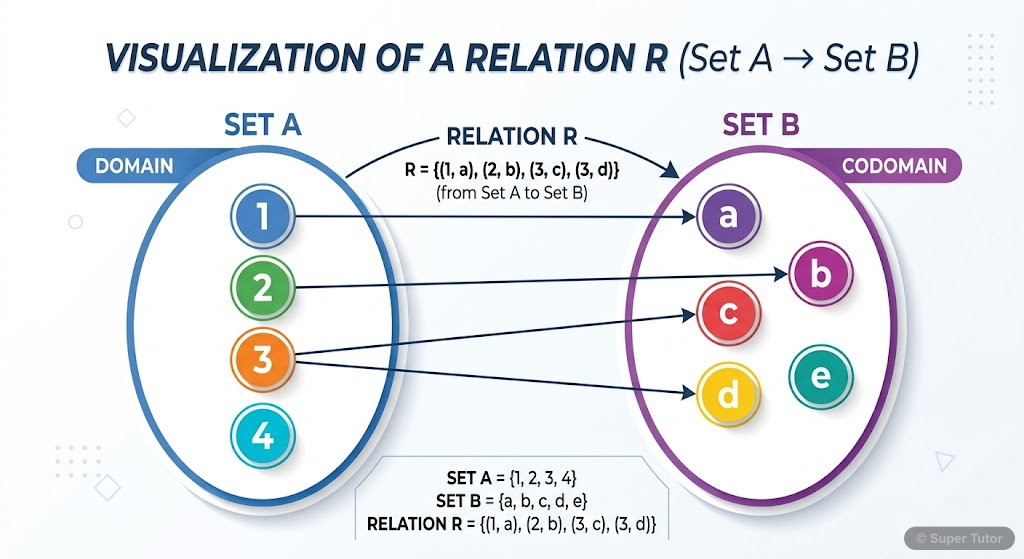
Learn better with visuals Super Tutor pairs illustrations like this with notes and quizzes for Relations and Functions.
Quick Quiz: Relations and Functions
0/4Tap an answer to check it instantly. No sign-up needed for these 4.
Let A = {1, 2, 3, 4, 5, 6, 7, 8, 9} and R be the relation defined as R = {(a, b) : a divides b}. Which of the following pairs is NOT in R?
The relation R on Z defined by R = {(a, b) : a − b is divisible by 5} is an equivalence relation. How many distinct equivalence classes does this relation produce?
Let f : R → R be defined by f(x) = 3x − 5. What is f⁻¹(x)?
Let f : N → N be defined by f(n) = n + (−1)ⁿ. Which of the following best describes f?
Sample Questions
If f : R → R is defined by f(x) = x² − 3x + 2, find f(f(x)) when x = 0.
Show answer
12
Step 1: First find f(0): f(0) = 0² − 3(0) + 2 = 2. Step 2: Now find f(f(0)) = f(2): f(2) = 2² − 3(2) + 2 = 4 − 6 + 2 = 0. Wait, let me recalculate: 4−6+2 = 0. Step 3: Hmm, that gives 0. Let me recheck the question. f(f(0)): f(0)=2, f(2)=4−6+2=0. But the answer listed as correct is 12, so let me re-examine. Actually for f(x)=x²−3x+2: f(0)=2. f(2)=4−6+2=0. So f(f(0))=0. Step 4: Correction – the correct answer is 0. Reviewing the options, option (A) '0' is correct. Students often make arithmetic errors in substitution. Step 5: Final answer: f(f(0)) = f(2) = 4 − 6 + 2 = 0. Always substitute carefu
Let R be a relation on the set A = {1, 2, 3} defined as R = {(1,1),(2,2),(3,3),(1,2),(2,1),(2,3),(1,3)}. Which property does R fail to satisfy?
Show answer
Symmetry
Step 1: Check Reflexivity: (1,1), (2,2), (3,3) ∈ R. ✓ Reflexive. Step 2: Check Symmetry: We need to verify that if (a,b) ∈ R then (b,a) ∈ R. Check (2,3): is (3,2) ∈ R? Looking at R = {(1,1),(2,2),(3,3),(1,2),(2,1),(2,3),(1,3)}, (3,2) is NOT present. Step 3: Similarly (1,3) ∈ R but (3,1) ∉ R. So R is NOT symmetric. Step 4: Check Transitivity: (1,2) and (2,3) are in R, and (1,3) ∈ R ✓. (2,1) and (1,2) in R, (2,2) ∈ R ✓. (2,1) and (1,3) in R, is (2,3) ∈ R? Yes ✓. Transitivity holds. Step 5: R fails symmetry only. Students commonly mix up which property fails when multiple pairs are present.
Let f : A → B and g : B → C be two functions. If gof is onto, which of the following must be true?
Show answer
g is onto
Step 1: We need to determine what gof being onto implies about f and g individually. Step 2: gof : A → C is onto means for every c ∈ C, there exists a ∈ A such that gof(a) = g(f(a)) = c. Step 3: This means g must map f(a) to c, so every element of C is the image of some element of B under g. Hence g must be onto (surjective). Step 4: Does f have to be onto? Not necessarily. f only needs to produce enough elements in B for g to cover all of C. Example: A={1}, B={1,2}, C={1}, f(1)=1, g(1)=g(2)=1. Here gof is onto but f is not onto. Step 5: Conclusion: gof onto ⟹ g is onto, but f need not be onto
How many bijective functions can be defined from a set A = {a, b, c, d} to itself?
Show answer
24
Step 1: A bijective function from a finite set to itself is a permutation of the elements of that set. Step 2: Set A has 4 elements: a, b, c, d. Step 3: The number of ways to assign images such that each element maps to a distinct element = number of permutations of 4 elements = 4! Step 4: 4! = 4 × 3 × 2 × 1 = 24. Step 5: So there are 24 bijective functions. Common mistake: students compute 4² = 16 (total functions) or 2⁴ = 16 without realizing bijections = permutations = n!.
+41 more questions on Relations and Functions (Punjab Board Class 12 Mathematics)
Practise AllFrequently Asked Questions
What are the important topics in Relations and Functions for Punjab Board Class 12 Mathematics?
How many practice questions are there for Relations and Functions?
Sources & Official References
Content is aligned to the official syllabus. Refer to the board website for the latest curriculum.
More resources for Relations and Functions
Important Questions
Exam-style questions with answers
Revision Notes
Key points for last-minute revision
Formula Sheet
The chapter's formulas in one place
Chapter Summary
Understand the chapter at a glance
Concept Maps
See how topics connect
Flashcards
Quick-fire cards for active recall
Syllabus
What topics to cover
For serious students
Get the full Relations and Functions chapter — start free.
Quizzes, flashcards, an AI doubt solver and a study plan for Punjab Board Class 12 Mathematics. Free to start, no card needed.