Number System — Important Questions
Punjab Board · Class 9 · Mathematics
43 important questions from Number System for Punjab Board Class 9 Mathematics, with answers. Includes multiple choice questions.
Interactive on Super Tutor
Studying Number System? Get the full interactive chapter.
Quizzes, flashcards, AI doubt-solver and a step-by-step study plan — built for important questions and more.
Free trial, no card needed.
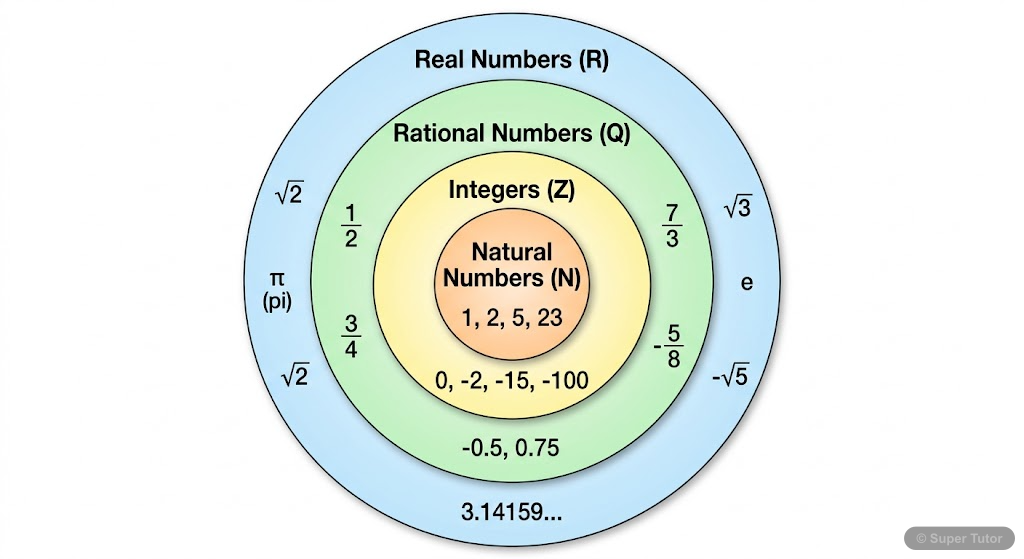
Learn better with visuals Super Tutor pairs illustrations like this with notes and quizzes for Number System.
Important Questions from Number System
What is the value of (√5 + √3)(√5 - √3)?
Show answer
2
Step 1: We need to simplify (√5 + √3)(√5 - √3). Step 2: This is of the form (a + b)(a - b) = a² - b², where a = √5 and b = √3. Step 3: Apply the identity: (√5)² - (√3)² = 5 - 3 = 2. Step 4: The result is 2, which is a rational number! This shows that the product of two irrational numbers can sometimes be rational. Step 5: Common mistake — students often try to expand term by term and make errors. Always look for the (a+b)(a-b) = a²-b² pattern first. The answer is 2.
Rationalise the denominator of 1/(√7 - √6). What is the result?
Show answer
√7 + √6
Step 1: To rationalise 1/(√7 - √6), multiply numerator and denominator by the conjugate (√7 + √6). Step 2: Numerator becomes: 1 × (√7 + √6) = √7 + √6. Step 3: Denominator becomes: (√7 - √6)(√7 + √6) = (√7)² - (√6)² = 7 - 6 = 1. Step 4: So the result = (√7 + √6)/1 = √7 + √6. Step 5: The key insight is that (√7 - √6)(√7 + √6) = 7 - 6 = 1, making the denominator 1. This is a special case where the denominator becomes exactly 1 after rationalisation. Common mistake: students choose (√7 + √6)/13, confusing this with cases where the denominator gives a value like 49 - 36 = 13.
If x = 2 + √3, what is the value of x + 1/x?
Show answer
4
Step 1: Given x = 2 + √3, we need to find x + 1/x. Step 2: First find 1/x = 1/(2 + √3). Rationalise by multiplying by (2 - √3)/(2 - √3). Step 3: 1/x = (2 - √3)/((2 + √3)(2 - √3)) = (2 - √3)/(4 - 3) = (2 - √3)/1 = 2 - √3. Step 4: Now compute x + 1/x = (2 + √3) + (2 - √3) = 2 + √3 + 2 - √3 = 4. Step 5: The irrational parts cancel out perfectly, giving a rational answer of 4. This demonstrates an important property: when x = a + √b, then 1/x = a - √b (after rationalisation when a² - b = 1), and x + 1/x = 2a. Here 2a = 2×2 = 4. ✓
What is the simplified value of (2²/³ × 2¹/³)?
Show answer
2
Step 1: We need to simplify 2^(2/3) × 2^(1/3). Step 2: Use the law of exponents: a^m × a^n = a^(m+n). Here the base is the same (base = 2). Step 3: Add the exponents: 2/3 + 1/3 = 3/3 = 1. Step 4: So 2^(2/3) × 2^(1/3) = 2^1 = 2. Step 5: Common mistake — students multiply the exponents (2/3 × 1/3 = 2/9) instead of adding them. The rule a^m × a^n = a^(m+n) applies when multiplying same bases. Multiplying exponents (a^m)^n = a^(mn) applies when raising a power to another power. The answer is 2.
+39 more questions on Number System (Punjab Board Class 9 Mathematics)
Practise AllFrequently Asked Questions
What are the important topics in Number System for Punjab Board Class 9 Mathematics?
How many important questions are there in Number System?
Sources & Official References
Content is aligned to the official syllabus. Refer to the board website for the latest curriculum.
More resources for Number System
For serious students
Get the full Number System chapter — start free.
Quizzes, flashcards, an AI doubt solver and a study plan for Punjab Board Class 9 Mathematics. Free to start, no card needed.