A letter to God — NCERT Solutions
Rajasthan Board · Class 10 · English
NCERT Solutions for A letter to God, Rajasthan Board Class 10 English: 32 textbook questions solved step by step.
Interactive on Super Tutor
Studying A letter to God? Get the full interactive chapter.
Quizzes, flashcards, AI doubt-solver and a step-by-step study plan — built for NCERT solutions and more.
Free trial, no card needed.
One of 8 illustrations for A letter to God in Super Tutor — alongside flashcards, concept maps and practice questions.
The first 16 solutions are open to read. The other 16 are free with a Super Tutor account.
Oral Comprehension Check – I (After first section)
1What did Lencho hope for?Show solution
Given: Lencho is a farmer whose fields need water.
Answer: Lencho hoped for rain. He had been watching the sky towards the north-east all morning, hoping that a good downpour or at least a shower would come and water his ripe cornfields, ensuring a good harvest.
2Why did Lencho say the raindrops were like 'new coins'?Show solution
Given: Lencho is a farmer who depends entirely on his crop for his livelihood.
Answer: Lencho compared the raindrops to 'new coins' because, for a farmer, rain means a good harvest, and a good harvest means money and prosperity. Just as new coins represent wealth, the raindrops represented future income and financial well-being for Lencho and his family. The large drops were like ten-cent coins and the small drops were like five-cent coins.
3How did the rain change? What happened to Lencho's fields?Show solution
Given: It had started raining, which Lencho initially welcomed.
Answer: The rain suddenly changed into a hailstorm. Very large hailstones began to fall along with the rain. The hail rained down on the valley for an hour, completely destroying Lencho's fields. The corn was totally ruined, the flowers were beaten off the plants, and the field was left covered with a sheet of white (hailstones), as if covered with salt. Not a leaf remained on the trees.
4What were Lencho's feelings when the hail stopped?Show solution
Given: The hailstorm has destroyed Lencho's entire crop.
Answer: When the hail stopped, Lencho's soul was filled with grief and sorrow. His heart was heavy with sadness because all his hard work had come to nothing. He said, 'The hail has left nothing. This year we will have no corn.' He was deeply distressed, knowing that his family would go hungry that year. He felt helpless and devastated.
Oral Comprehension Check – II (After second section)
1Who or what did Lencho have faith in? What did he do?Show solution
Given: Lencho's crop has been destroyed and he has no means of support.
Answer: Lencho had complete and unshakeable faith in God. He believed that God's eyes see everything, even what is deep in one's conscience. Acting on this faith, he sat down on the following Sunday at daybreak and wrote a letter directly to God, asking Him for a hundred pesos so that he could sow his field again and support his family until the next harvest. He then carried the letter to town and posted it.
2Who read the letter?Show solution
Given: Lencho posted a letter addressed 'To God'.
Answer: First, one of the post office employees (who was also a postman) found the letter and, laughing heartily, took it to his boss. Then the postmaster read the letter. The postmaster, though he initially laughed, soon turned serious and was deeply moved by Lencho's unshakeable faith in God.
3What did the postmaster do then?Show solution
Given: The postmaster has read Lencho's letter asking God for a hundred pesos.
Answer: The postmaster, not wanting to shake Lencho's faith in God, decided to answer the letter. He collected money from his employees, gave part of his own salary, and asked several friends to contribute 'for an act of charity'. Though he could not gather the full hundred pesos, he managed to collect a little more than half (seventy pesos). He put the money in an envelope addressed to Lencho and included a letter signed with a single word: 'God'.
Oral Comprehension Check – III (After third section)
1Was Lencho surprised to find a letter for him with money in it?Show solution
Given: Lencho had written to God asking for a hundred pesos.
Answer: No, Lencho showed not the slightest surprise on seeing the money. Such was his absolute confidence and unshakeable faith in God that he fully expected God to send him the money. He had no doubt whatsoever that God would answer his letter, so receiving the money did not surprise him at all.
2What made him angry?Show solution
Given: Lencho received an envelope containing money from 'God'.
Answer: Lencho became angry when he counted the money and found that it was only seventy pesos, whereas he had asked for a hundred pesos. He was convinced that God could not have made a mistake and could not have denied him what he had requested. Therefore, he concluded that someone at the post office must have stolen the remaining thirty pesos. This made him very angry, and he immediately wrote a second letter to God, calling the post office employees 'a bunch of crooks'.
Thinking about the Text
1Who does Lencho have complete faith in? Which sentences in the story tell you this?Show solution
Given: The story 'A Letter to God' by G.L. Fuentes.
Answer: Lencho has complete and unshakeable faith in God.
The following sentences from the story illustrate this:
- '...there was a single hope: help from God.' — Even after losing everything, Lencho's only hope was God.
- 'All through the night, Lencho thought only of his one hope: the help of God, whose eyes, as he had been instructed, see everything, even what is deep in one's conscience.' — This shows his deep belief that God is all-seeing and all-knowing.
- 'It was nothing less than a letter to God.' — He directly wrote to God, showing he believed God would respond.
- 'God could not have made a mistake, nor could he have denied Lencho what he had requested.' — Even when the full amount did not arrive, Lencho did not doubt God; instead he blamed the post office employees.
These sentences collectively show that Lencho's faith in God was absolute and unquestioning.
2Why does the postmaster send money to Lencho? Why does he sign the letter 'God'?Show solution
Given: The postmaster has read Lencho's letter to God.
Answer:
Why he sends money: The postmaster was deeply moved by Lencho's extraordinary and unshakeable faith in God. He did not want to shake or destroy that faith. He felt it would be wrong to let such a sincere believer lose his trust in God. So, out of goodwill and as an act of charity, he collected money from his employees, contributed from his own salary, and gathered contributions from friends to send Lencho as much money as he could.
Why he signs 'God': The postmaster signed the letter 'God' because the letter was a reply to Lencho's letter which was addressed to God. If he had signed his own name, Lencho would have known it was not from God and his faith would have been shattered. To preserve Lencho's faith and make the gesture meaningful, the postmaster signed the letter with the single word 'God'.
3Did Lencho try to find out who had sent the money to him? Why/Why not?Show solution
Given: Lencho received an envelope with money signed 'God'.
Answer: No, Lencho did not try to find out who had sent the money to him.
Reason: Lencho had absolute, unquestioning faith in God. He had written the letter to God and fully expected God to reply. When he received the money, it simply confirmed what he already believed — that God had answered his prayer. It never occurred to him to question or investigate the source of the money, because in his mind there was no doubt: it had come from God. His faith was so strong and simple that he accepted it as a matter of course.
4Who does Lencho think has taken the rest of the money? What is the irony in the situation?Show solution
Given: Lencho asked for 100 pesos but received only 70 pesos.
Answer:
Who Lencho thinks stole the money: Lencho believed that the post office employees had stolen the remaining thirty pesos. In his second letter to God, he wrote: 'don't send it to me through the mail because the post office employees are a bunch of crooks.'
The Irony: The irony of the situation is that the very people whom Lencho calls 'a bunch of crooks' are actually the ones who helped him. It was the postmaster and his employees who, out of pure kindness and charity, collected money from their own pockets and salaries to send to Lencho. They were the ones who went out of their way to protect his faith in God. Yet Lencho, without any evidence, accuses these generous and kind-hearted people of being thieves. The people who did him the greatest good are the ones he suspects of wrongdoing — this is the unexpected and deeply ironic twist in the story.
5Are there people like Lencho in the real world? What kind of a person would you say he is? You may select appropriate words from the box to answer the question.
greedy naive stupid ungrateful selfish comical unquestioningShow solution
Given: The character of Lencho as portrayed in the story.
Answer: Yes, there are people like Lencho in the real world — people who have deep, simple, unquestioning faith in God or a higher power.
Lencho can be described using the following words:
- Naive: He is simple and innocent in his belief. He literally writes a letter to God and expects a reply, without questioning whether this is possible.
- Unquestioning: His faith in God is absolute and he never doubts God for a moment. He accepts without question that God will help him.
- Ungrateful: He is ungrateful towards the postmaster and his employees who genuinely helped him. Instead of being thankful, he accuses them of stealing.
- Comical: His actions — writing to God, accusing the post office of theft — have a comical quality, though they arise from genuine distress.
Overall, Lencho is a man of deep but blind faith. While his trust in God is admirable, his readiness to accuse innocent, kind people without any proof shows a lack of wisdom and gratitude. He is a simple, hardworking farmer whose faith, though touching, leads him to an ironic and unjust conclusion.
6There are two kinds of conflict in the story: between humans and nature, and between humans themselves. How are these conflicts illustrated?Show solution
Given: The story 'A Letter to God'.
Answer:
1. Conflict between Humans and Nature:
This conflict is the central crisis of the story. Lencho is a farmer who is entirely dependent on nature for his livelihood. He hopes for rain to ensure a good harvest. Nature initially seems to cooperate — it begins to rain. However, the rain suddenly turns into a violent hailstorm that destroys his entire crop. The field is left covered with hailstones 'like a plague of locusts'. All his hard work is ruined in a matter of minutes. This illustrates the helplessness of human beings against the forces of nature, and how a farmer's entire year of effort can be wiped out by a single natural event.
2. Conflict between Humans:
This conflict is more subtle and ironic. It arises at the end of the story. The postmaster and his employees are kind, generous people who collect money out of their own pockets to help a stranger maintain his faith. However, Lencho, upon receiving less than the amount he asked for, immediately suspects the post office employees of theft. He writes to God calling them 'a bunch of crooks'. This creates a conflict between Lencho's unfounded suspicion and the genuine goodwill of the postal workers. The irony is that the conflict is entirely one-sided and unjust — the 'opponents' Lencho imagines are actually his benefactors.
Thinking about Language – I (Storm Names)
1A violent tropical storm in which strong winds move in a circle: __ __ c _ __ __ __Show solution
Answer: cyclone
A cyclone is a violent tropical storm in which strong winds move in a circle around a calm central area.
Free with a Super Tutor account
Free with a Super Tutor account
Free with a Super Tutor account
Free with a Super Tutor account
Free with a Super Tutor account
Thinking about Language – II (Meanings of 'Hope')
1. Will you get the subjects you want to study in college? I hope so.
2. I hope you don't mind my saying this, but I don't like the way you are arguing.
3. This discovery will give new hope to HIV/AIDS sufferers.
4. We were hoping against hope that the judges would not notice our mistakes.
5. I called early in the hope of speaking to her before she went to school.
6. Just when everybody had given up hope, the fishermen came back, seven days after the cyclone.
Free with a Super Tutor account
Thinking about Language – III (Relative Clauses)
1. I often go to Mumbai. Mumbai is the commercial capital of India. (which)
Free with a Super Tutor account
Free with a Super Tutor account
Free with a Super Tutor account
Free with a Super Tutor account
Free with a Super Tutor account
Thinking about Language – IV (Using Negatives for Emphasis)
1. The trees lost all their leaves.
Free with a Super Tutor account
Free with a Super Tutor account
Free with a Super Tutor account
Thinking about Language – V (Metaphors)
| Object | Metaphor | Quality or Feature Compared |
|---|---|---|
| Cloud | Huge mountains of clouds | The mass or 'hugeness' of mountains |
| Raindrops | | |
| Hailstones | | |
| Locusts | | |
| | | An epidemic (a disease) that spreads very rapidly and leaves many people dead |
| | An ox of a man | |
Free with a Super Tutor account
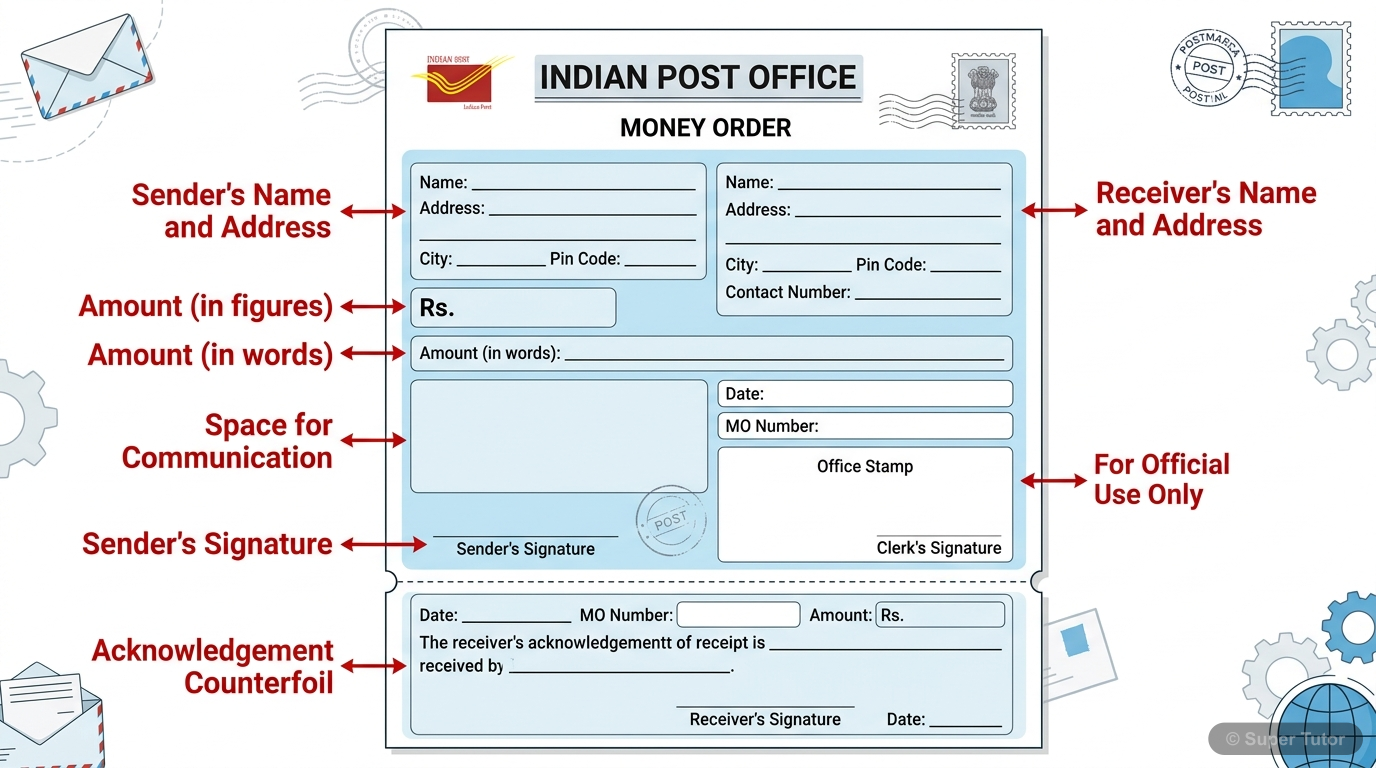
Money Order Form Activity
(i) In addition to the sender, the form has to be signed by the _______________
(ii) The 'Acknowledgement' section of the form is sent back by the post office to the _______________ after the _______________ signs it.
(iii) The 'Space for Communication' section is used for _______________
(iv) The form has six sections. The sender needs to fill out _______________ sections and the receiver _______________.
Free with a Super Tutor account
16 more solved questions in A letter to God
They are free with a Super Tutor account, along with practice quizzes and flashcards for this chapter. Free to start, no card needed.
Frequently Asked Questions
What are the important topics in A letter to God for Rajasthan Board Class 10 English?
Are these NCERT Solutions for A letter to God free?
How should I revise A letter to God for the Rajasthan Board Class 10 board exam?
Sources & Official References
Content is aligned to the official syllabus. Refer to the board website for the latest curriculum.
More resources for A letter to God
Practice Quiz
Test yourself with a quick quiz
Important Questions
Exam-style questions with answers
Revision Notes
Key points for last-minute revision
Chapter Summary
Understand the chapter at a glance
Concept Maps
See how topics connect
Study Plan
Step-by-step plan for this chapter
Flashcards
Quick-fire cards for active recall
Syllabus
What topics to cover
For serious students
Get the full A letter to God chapter — start free.
Quizzes, flashcards, an AI doubt solver and a study plan for Rajasthan Board Class 10 English. Free to start, no card needed.