Chapter 4 of 13
NCERT Solutions

Principles of Inheritance and Variation

Rajasthan Board · Class 12 · Biology

NCERT Solutions for Principles of Inheritance and Variation — Rajasthan Board Class 12 Biology.

40 questions48 flashcards5 concepts

Interactive on Super Tutor

Studying Principles of Inheritance and Variation? Get the full interactive chapter.

Quizzes, flashcards, AI doubt-solver and a step-by-step study plan — built for ncert solutions and more.

1,000+ Class 12 students started this chapter today

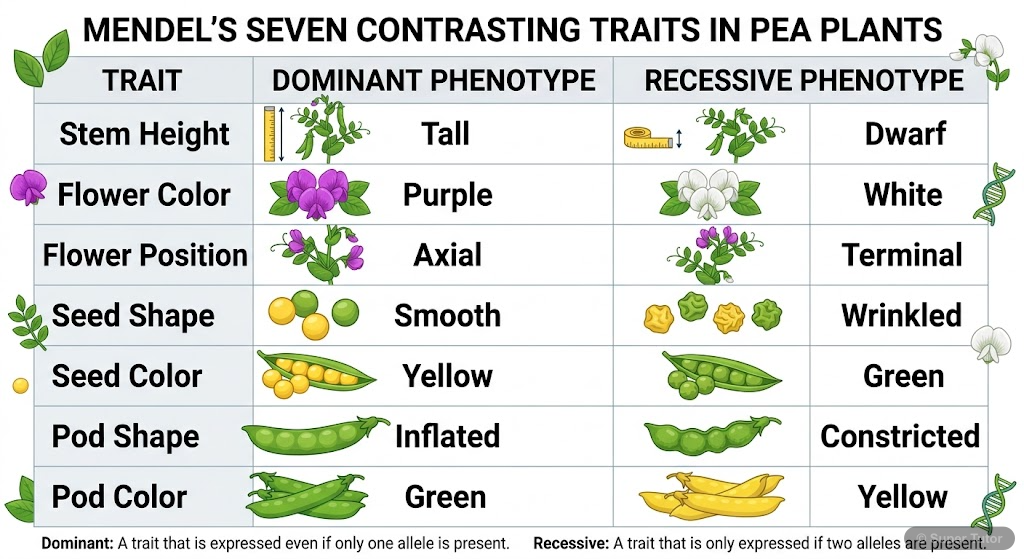
A comparison chart illustrating Mendel's seven pairs of contrasting traits in pea plants, showing both dominant and recessive phenotypes for each trait.
Super Tutor

Learn better with visuals Super Tutor has hundreds of illustrations like this across every chapter — all free to try.

Get started
16 Questions Solved · 1 Section

EXERCISES — Principles of Inheritance and Variation

1Mention the advantages of selecting pea plant for experiment by Mendel.Show solution
Given: Mendel chose the garden pea (*Pisum sativum*) for his experiments on inheritance.

Advantages of selecting pea plant:

1. Availability of contrasting characters: Pea plants have several sharply contrasting (discontinuous) characters such as tall/dwarf, round/wrinkled seeds, yellow/green seeds, etc., making it easy to distinguish traits.

2. Short life span: Pea plants complete their life cycle in one season, allowing several generations to be studied in a short time.

3. Bisexual flowers: The flowers are bisexual (hermaphrodite), so self-pollination occurs naturally, making it easy to maintain pure lines.

4. Easy cross-pollination: Cross-pollination can be carried out easily by emasculation (removal of anthers) and artificial pollination.

5. Large number of offspring: Each plant produces a large number of seeds, providing statistically significant data.

6. Easy to grow: Pea plants are easy to cultivate and require little maintenance.

7. Availability of pure breeding varieties: Pure breeding (true breeding) varieties were readily available in the market.

Conclusion: These features made pea plants an ideal experimental organism for studying the principles of inheritance.
2Differentiate between the following — (a) Dominance and Recessive (b) Homozygous and Heterozygous (c) Monohybrid and Dihybrid.Show solution
(a) Dominance and Recessive:

| Feature | Dominant | Recessive |
|---|---|---|
| Definition | The allele that expresses itself in both homozygous and heterozygous conditions. | The allele that expresses itself only in homozygous condition. |
| Expression | Expressed in F1F_1 generation (heterozygous). | Suppressed in F1F_1; reappears in F2F_2. |
| Notation | Represented by capital letter (e.g., TT). | Represented by small letter (e.g., tt). |
| Example | Tallness (TT) in pea. | Dwarfness (tt) in pea. |

(b) Homozygous and Heterozygous:

| Feature | Homozygous | Heterozygous |
|---|---|---|
| Definition | An organism having two identical alleles for a trait at a locus. | An organism having two different alleles for a trait at a locus. |
| Gametes produced | Only one type of gamete. | Two types of gametes. |
| Breeding | Breeds true (pure breeding). | Does not breed true. |
| Example | TTTT (pure tall) or tttt (pure dwarf). | TtTt (hybrid tall). |

(c) Monohybrid and Dihybrid:

| Feature | Monohybrid | Dihybrid |
|---|---|---|
| Definition | A cross between parents differing in only one pair of contrasting characters. | A cross between parents differing in two pairs of contrasting characters. |
| F2F_2 phenotypic ratio | 3:13:1 | 9:3:3:19:3:3:1 |
| F2F_2 genotypic ratio | 1:2:11:2:1 | 1:2:1:2:4:2:1:2:11:2:1:2:4:2:1:2:1 |
| Example | Tall (TTTT) × Dwarf (tttt) | Tall Yellow (TTYYTTYY) × Dwarf Green (ttyyttyy) |
3A diploid organism is heterozygous for 4 loci, how many types of gametes can be produced?Show solution
Given: A diploid organism is heterozygous for 4 loci.

Formula used: Number of types of gametes =2n= 2^n, where nn = number of heterozygous loci.

Working:
Number of types of gametes=2n=24=16\text{Number of types of gametes} = 2^n = 2^4 = 16

Explanation: For each heterozygous locus (e.g., AaAa), two types of alleles (AA or aa) can go into a gamete. For 4 such loci, the total combinations are 2×2×2×2=162 \times 2 \times 2 \times 2 = 16.

Answer: The organism can produce 16 types of gametes.
4Explain the Law of Dominance using a monohybrid cross.Show solution
Law of Dominance: In a cross between two homozygous parents differing in one character, the character that appears in the F1F_1 generation is called the dominant character, and the one that is suppressed is called the recessive character. When two different alleles are present together, only the dominant allele expresses itself.

Monohybrid Cross (Tall × Dwarf):

- Parents: Pure Tall (TTTT) × Pure Dwarf (tttt)
- Gametes: TT and tt

F1F_1 Generation:
TT×ttTt (all tall)TT \times tt \rightarrow Tt \text{ (all tall)}

All F1F_1 plants are tall (TtTt) — the dominant character (tallness) is expressed and dwarfness is suppressed.

F2F_2 Generation (Self-fertilisation of F1F_1):

Tt×TtTt \times Tt

| | TT | tt |
|---|---|---|
| TT | TTTT | TtTt |
| tt | TtTt | tttt |

- Genotypic ratio: TT:Tt:tt=1:2:1TT : Tt : tt = 1:2:1
- Phenotypic ratio: Tall : Dwarf =3:1= 3:1

Conclusion: In F1F_1, only tallness (dominant) is expressed. In F2F_2, both tall and dwarf plants appear in 3:1 ratio. The recessive character (dwarfness) reappears in F2F_2 in homozygous condition (tttt), demonstrating the Law of Dominance.
5Define and design a test-cross.Show solution
Definition: A test-cross is a cross between an organism showing a dominant phenotype (but of unknown genotype — either homozygous dominant TTTT or heterozygous TtTt) with a homozygous recessive individual (tttt). It is used to determine whether the dominant phenotype individual is homozygous or heterozygous.

Design of Test-Cross:

Case 1: If the dominant parent is homozygous (TTTT)

TT×ttTT \times tt

| | TT | TT |
|---|---|---|
| tt | TtTt | TtTt |
| tt | TtTt | TtTt |

- Offspring: All tall (TtTt)
- Phenotypic ratio: 100% Tall : 0% Dwarf

Case 2: If the dominant parent is heterozygous (TtTt)

Tt×ttTt \times tt

| | TT | tt |
|---|---|---|
| tt | TtTt | tttt |
| tt | TtTt | tttt |

- Offspring: 50% Tall (TtTt) : 50% Dwarf (tttt)
- Phenotypic ratio: 1:11:1

Conclusion: If all offspring show dominant phenotype → parent was homozygous. If offspring show 1:1 ratio of dominant to recessive → parent was heterozygous. Thus, a test-cross helps in determining the genotype of an organism.
6Using a Punnett Square, workout the distribution of phenotypic features in the first filial generation after a cross between a homozygous female and a heterozygous male for a single locus.Show solution
Given:
- Homozygous female: AAAA (homozygous dominant) — assuming dominant homozygous
- Heterozygous male: AaAa

Cross: AAAA (female) ×\times AaAa (male)

Gametes:
- Female gametes: AA, AA
- Male gametes: AA, aa

Punnett Square:

| | AA (male) | aa (male) |
|---|---|---|
| AA (female) | AAAA | AaAa |
| AA (female) | AAAA | AaAa |

Results:
- Genotypes: AA:Aa=2:2=1:1AA : Aa = 2:2 = 1:1
- Phenotypes: All offspring show the dominant phenotype

Phenotypic ratio: 100% dominant phenotype (no recessive phenotype)

Conclusion: Since AAAA individuals and AaAa individuals both express the dominant character, all offspring in F1F_1 will show the dominant phenotype only. There is no recessive phenotype in the offspring.
7When a cross is made between tall plant with yellow seeds (TtYy) and tall plant with green seed (Ttyy), what proportions of phenotype in the offspring could be expected to be (a) tall and green. (b) dwarf and green.Show solution
Given:
- Parent 1: Tall, Yellow seeds — TtYyTtYy
- Parent 2: Tall, Green seeds — TtyyTtyy

Gametes:
- TtYyTtYy produces: TY,Ty,tY,tyTY, Ty, tY, ty (each with frequency 14\frac{1}{4})
- TtyyTtyy produces: Ty,tyTy, ty (each with frequency 12\frac{1}{2})

Method: Consider each gene separately.

For height (Tt×TtTt \times Tt):
Tt×TtTT:Tt:tt=1:2:1Tt \times Tt \rightarrow TT : Tt : tt = 1:2:1
- Tall (TT+TtTT + Tt) = 34\frac{3}{4}
- Dwarf (tttt) = 14\frac{1}{4}

For seed colour (Yy×yyYy \times yy):
Yy×yyYy:yy=1:1Yy \times yy \rightarrow Yy : yy = 1:1
- Yellow (YyYy) = 12\frac{1}{2}
- Green (yyyy) = 12\frac{1}{2}

Expected phenotypic proportions:

(a) Tall and Green:
P(Tall)×P(Green)=34×12=38P(\text{Tall}) \times P(\text{Green}) = \frac{3}{4} \times \frac{1}{2} = \frac{3}{8}

Answer (a): 38\dfrac{3}{8} (i.e., 3 out of 8 offspring will be tall and green)

(b) Dwarf and Green:
P(Dwarf)×P(Green)=14×12=18P(\text{Dwarf}) \times P(\text{Green}) = \frac{1}{4} \times \frac{1}{2} = \frac{1}{8}

Answer (b): 18\dfrac{1}{8} (i.e., 1 out of 8 offspring will be dwarf and green)

Overall phenotypic ratio: Tall Yellow : Tall Green : Dwarf Yellow : Dwarf Green =3:3:1:1= 3:3:1:1
8Two heterozygous parents are crossed. If the two loci are linked what would be the distribution of phenotypic features in F₁ generation for a dihybrid cross?Show solution
Given: Two heterozygous parents (AaBb×AaBbAaBb \times AaBb) are crossed. The two loci are linked (present on the same chromosome).

Concept: When genes are linked (present on the same chromosome), they do not assort independently. They tend to be inherited together.

Case: Complete Linkage

If the genes are completely linked (no crossing over), the parental combinations are maintained.

Assuming coupling arrangement: AB/ab×AB/abAB/ab \times AB/ab

- Gametes produced: only ABAB and abab (parental types)

| | ABAB | abab |
|---|---|---|
| ABAB | AABBAABB | AaBbAaBb |
| abab | AaBbAaBb | aabbaabb |

Phenotypic ratio:
- ABAB phenotype (AABB+AaBbAABB + AaBb): 3
- abab phenotype (aabbaabb): 1

Phenotypic ratio = 3:1 (instead of the expected 9:3:3:1 for unlinked genes)

Conclusion: When two loci are completely linked, the F1F_1 (here F2F_2 of the dihybrid) generation shows only two phenotypic classes in a 3:1 ratio — the parental combinations (ABAB and abab). The new recombinant phenotypes (AbAb and aBaB) are absent or appear in very low frequency (only if crossing over occurs). This is in contrast to the 9:3:3:1 ratio seen when genes are on different chromosomes (independent assortment).
9Briefly mention the contribution of T.H. Morgan in genetics.Show solution
T.H. Morgan's Contributions to Genetics:

Thomas Hunt Morgan (1866–1945) worked with the fruit fly *Drosophila melanogaster* and made the following major contributions:

1. Chromosomal Theory of Inheritance: Morgan and his colleagues provided experimental evidence that genes are located on chromosomes, supporting and extending the Chromosomal Theory of Inheritance proposed by Sutton and Boveri.

2. Linkage: Morgan discovered that genes located on the same chromosome tend to be inherited together. He called this phenomenon linkage. He found that Mendel's Law of Independent Assortment does not hold for linked genes.

3. Sex-linked Inheritance: Morgan demonstrated sex-linked inheritance by studying the white-eye mutation in *Drosophila*. He showed that the gene for eye colour is located on the X chromosome.

4. Genetic Recombination: Morgan observed that linked genes can separate due to crossing over (exchange of segments between homologous chromosomes during meiosis), leading to recombinant offspring.

5. Genetic Mapping: Based on the frequency of recombination between genes, Morgan and his student Alfred Sturtevant constructed the first genetic (linkage) maps, showing the relative positions of genes on chromosomes. The unit of genetic map distance is called Morgan or centimorgan (cM).

6. Nobel Prize: Morgan was awarded the Nobel Prize in Physiology or Medicine in 1933 for his discoveries concerning the role of chromosomes in heredity.
10What is pedigree analysis? Suggest how such an analysis can be useful.Show solution
Pedigree Analysis:

Pedigree analysis is the study of the inheritance of a trait in a family over several generations. It is represented as a pedigree chart — a diagrammatic representation of the inheritance pattern of a trait in a family, using standard symbols:
- Square (\square) = Male
- Circle (\bigcirc) = Female
- Filled symbol = Affected individual
- Horizontal line = Mating
- Vertical line = Offspring

Usefulness of Pedigree Analysis:

1. Determining the nature of a trait: It helps to determine whether a trait is dominant or recessive, autosomal or sex-linked.

2. Genetic counselling: It is used to predict the probability of a genetic disorder appearing in future generations of a family. This helps couples make informed reproductive decisions.

3. Carrier detection: It helps identify carriers of recessive genetic disorders (individuals who carry one copy of a defective gene but do not show symptoms).

4. Understanding inheritance patterns: It helps in understanding the mode of inheritance of genetic disorders such as haemophilia, colour blindness, sickle-cell anaemia, etc.

5. Medical diagnosis: It assists physicians in diagnosing hereditary diseases and planning appropriate treatment.

Conclusion: Pedigree analysis is a powerful tool in human genetics for tracing the inheritance of traits and genetic disorders across generations.
11How is sex determined in human beings?Show solution
Sex Determination in Human Beings:

Chromosomal Basis:
In humans, sex is determined by the sex chromosomes. Humans have 46 chromosomes (23 pairs):
- 22 pairs are autosomes (same in both sexes)
- 1 pair are sex chromosomes (differ between sexes)

Female: 44 autosomes + XX \Rightarrow 44A + XX (total 46 chromosomes)

Male: 44 autosomes + XY \Rightarrow 44A + XY (total 46 chromosomes)

Mechanism:
- Females produce only one type of egg (ovum): all eggs carry one X chromosome → homogametic
- Males produce two types of sperms: 50% carry X chromosome and 50% carry Y chromosome → heterogametic

At fertilisation:
Egg(X)+Sperm(X)XX (Female child)\text{Egg}(X) + \text{Sperm}(X) \rightarrow XX \text{ (Female child)}
Egg(X)+Sperm(Y)XY (Male child)\text{Egg}(X) + \text{Sperm}(Y) \rightarrow XY \text{ (Male child)}

Probability: There is a 50% chance of a male child and 50% chance of a female child.

Key Point: The sex of the child is determined by the father (which type of sperm fertilises the egg), not the mother, since the mother can only contribute an X chromosome.

Conclusion: Sex determination in humans is of the XX-XY type, where the presence of Y chromosome determines maleness. The Y chromosome carries the SRY gene (Sex-determining Region of Y), which triggers male development.
12A child has blood group O. If the father has blood group A and mother blood group B, work out the genotypes of the parents and the possible genotypes of the other offsprings.Show solution
Given:
- Child's blood group: O
- Father's blood group: A
- Mother's blood group: B

Concept: ABO blood groups are controlled by gene II with three alleles: IAI^A, IBI^B, and ii.
- Blood group A: IAIAI^A I^A or IAiI^A i
- Blood group B: IBIBI^B I^B or IBiI^B i
- Blood group AB: IAIBI^A I^B
- Blood group O: iiii

Step 1: Determine genotypes of parents.

The child has blood group O, so the child's genotype is iiii.
The child must have received one ii allele from the father and one ii allele from the mother.

- Father has blood group A and must carry ii allele → Father's genotype: IAiI^A i
- Mother has blood group B and must carry ii allele → Mother's genotype: IBiI^B i

Step 2: Work out possible genotypes of other offspring.

Cross: IAiI^A i (Father) ×\times IBiI^B i (Mother)

| | IBI^B | ii |
|---|---|---|
| IAI^A | IAIBI^A I^B | IAiI^A i |
| ii | IBiI^B i | iiii |

Possible genotypes and phenotypes of offspring:

| Genotype | Blood Group | Proportion |
|---|---|---|
| IAIBI^A I^B | AB | 14\frac{1}{4} |
| IAiI^A i | A | 14\frac{1}{4} |
| IBiI^B i | B | 14\frac{1}{4} |
| iiii | O | 14\frac{1}{4} |

Conclusion:
- Father's genotype: IAiI^A i
- Mother's genotype: IBiI^B i
- Other offspring can have blood groups A, B, AB, or O in equal proportions (1:1:1:1).
13Explain the following terms with example — (a) Co-dominance (b) Incomplete dominanceShow solution
(a) Co-dominance:

Definition: Co-dominance is a phenomenon in which both alleles of a gene are simultaneously and equally expressed in the heterozygous condition. Neither allele is dominant over the other; both contribute to the phenotype.

Example: ABO Blood Group System

In humans, the ABO blood group is controlled by gene II with alleles IAI^A, IBI^B, and ii.
- IAI^A codes for antigen A on RBCs
- IBI^B codes for antigen B on RBCs
- ii codes for no antigen

When both IAI^A and IBI^B alleles are present together (genotype IAIBI^A I^B), both antigens A and B are produced on the surface of RBCs, resulting in blood group AB.

Neither IAI^A nor IBI^B is dominant over the other — both are expressed equally. This is co-dominance.

---

(b) Incomplete Dominance:

Definition: Incomplete dominance is a phenomenon in which neither of the two alleles is completely dominant over the other. The heterozygous condition shows an intermediate (blended) phenotype between the two homozygous parents.

**Example: Flower colour in Snapdragon (*Antirrhinum majus*)

- Pure red flower (RRRR) × Pure white flower (rrrr)
- F1F_1 offspring: All
pink (RrRr) — intermediate phenotype
- F2F_2 (self-fertilisation of F1F_1):

Rr×RrRR:Rr:rr=1:2:1Rr \times Rr \rightarrow RR : Rr : rr = 1:2:1

| Genotype | Phenotype |
|---|---|
| RRRR | Red |
| RrRr | Pink (intermediate) |
| rrrr | White |

-
Phenotypic ratio in F2F_2: Red : Pink : White =1:2:1= 1:2:1
- The genotypic ratio and phenotypic ratio are the same (1:2:11:2:1), unlike complete dominance.

Conclusion:** In incomplete dominance, the F1F_1 phenotype is intermediate, and the original parental phenotypes reappear in F2F_2 along with the intermediate form.
14What is point mutation? Give one example.Show solution
Point Mutation:

Definition: A point mutation is a mutation that involves a change (substitution, insertion, or deletion) of a single base pair (nucleotide) in the DNA sequence of a gene. It is the simplest type of mutation.

Types:
- Substitution: One base pair is replaced by another.
- Insertion: A base pair is added.
- Deletion: A base pair is removed.

Example: Sickle-cell Anaemia

Sickle-cell anaemia is caused by a point mutation in the gene coding for the beta-chain of haemoglobin.

- In the normal beta-globin gene, the codon at the 6th position is GAG (codes for glutamic acid).
- Due to a single base substitution, GAG is changed to GTG (codes for valine).

Normal: GAGGlutamic acid (hydrophilic)\text{Normal: } \ldots GAG \ldots \rightarrow \text{Glutamic acid (hydrophilic)}
Mutant: GTGValine (hydrophobic)\text{Mutant: } \ldots GTG \ldots \rightarrow \text{Valine (hydrophobic)}

This single amino acid change (glutamic acid → valine) causes the haemoglobin molecules to aggregate under low oxygen conditions, distorting the RBCs into a sickle shape, leading to sickle-cell anaemia.

Conclusion: A change in just one base pair can have a profound effect on the structure and function of a protein, causing a serious genetic disorder.
15Who had proposed the chromosomal theory of the inheritance?Show solution
Chromosomal Theory of Inheritance:

The Chromosomal Theory of Inheritance was proposed by Walter Sutton and Theodor Boveri independently in 1902.

- Walter Sutton (an American student) observed that chromosomes occur in pairs (homologous pairs) and that the behaviour of chromosomes during meiosis parallels the behaviour of Mendel's 'factors' (genes).
- Theodor Boveri (a German biologist) also independently proposed that chromosomes carry the hereditary information.

Together, their work is known as the Sutton-Boveri Theory or the Chromosomal Theory of Inheritance.

Key observations that supported the theory:
1. Chromosomes occur in pairs, just like Mendel's factors (alleles).
2. Chromosomes segregate during meiosis, similar to the segregation of alleles.
3. Different pairs of chromosomes assort independently during meiosis, similar to the independent assortment of different gene pairs.

Later support: T.H. Morgan's experiments with *Drosophila* provided experimental evidence confirming that genes are located on chromosomes.
16Mention any two autosomal genetic disorders with their symptoms.Show solution
Two Autosomal Genetic Disorders:

(1) Sickle-cell Anaemia (Autosomal Recessive)

- Cause: Caused by a point mutation in the gene coding for the beta-chain of haemoglobin. The mutant allele HbsHb^s codes for abnormal haemoglobin (HbS) instead of normal haemoglobin (HbA).
- Inheritance: Autosomal recessive — the disease manifests only in homozygous condition (HbsHbsHb^s Hb^s). Heterozygous individuals (HbAHbsHb^A Hb^s) are carriers (sickle-cell trait).
- Symptoms:
- RBCs become sickle-shaped (crescent-shaped) under low oxygen conditions.
- Anaemia (reduced oxygen-carrying capacity of blood).
- Pain in joints and abdomen.
- Weakness and fatigue.
- Blockage of blood vessels leading to organ damage.

(2) Phenylketonuria (PKU) (Autosomal Recessive)

- Cause: Caused by a mutation in the gene coding for the enzyme phenylalanine hydroxylase, which converts phenylalanine to tyrosine. In the absence of this enzyme, phenylalanine accumulates in the body.
- Inheritance: Autosomal recessive.
- Symptoms:
- Accumulation of phenylalanine and its derivatives in the body.
- Severe intellectual disability (mental retardation).
- Reduced pigmentation of skin and hair (fair skin, blue eyes) due to reduced melanin synthesis.
- Seizures and neurological problems.
- Musty odour in urine and sweat.

Conclusion: Both disorders are autosomal recessive, meaning both copies of the defective gene must be present for the disease to manifest.

Stuck on a step?

Ask Super Tutor AI to explain any solution on this page in a simpler way — free, 24x7.

Ask a Doubt Free

Frequently Asked Questions

What are the important topics in Principles of Inheritance and Variation for Rajasthan Board Class 12 Biology?
Principles of Inheritance and Variation covers several key topics that are frequently asked in Rajasthan Board Class 12 board exams. Focus on the core concepts listed on this page and practise related questions to build confidence.
How to score full marks in Principles of Inheritance and Variation — Rajasthan Board Class 12 Biology?
Understand the core concepts first, then work through the 40 practice questions available for this chapter. Revise formulas and definitions regularly, and use flashcards for quick recall before the exam.
Where can I get free NCERT Solutions for Principles of Inheritance and Variation Class 12 Biology?
This page has free step-by-step NCERT Solutions for every exercise question in Principles of Inheritance and Variation (Rajasthan Board Class 12 Biology) — written the way examiners award marks: given, formula, working, answer.

Sources & Official References

Content is aligned to the official syllabus. Refer to the board website for the latest curriculum.

For serious students

Get the full Principles of Inheritance and Variation chapter — for free.

Quizzes, flashcards, AI doubt-solver and a step-by-step study plan for Rajasthan Board Class 12 Biology.