Chapter 6 of 14
NCERT Solutions

Dual Nature of Radiation and Matter

Rajasthan Board · Class 12 · Physics

NCERT Solutions for Dual Nature of Radiation and Matter — Rajasthan Board Class 12 Physics.

32 questions20 flashcards5 concepts

Interactive on Super Tutor

Studying Dual Nature of Radiation and Matter? Get the full interactive chapter.

Quizzes, flashcards, AI doubt-solver and a step-by-step study plan — built for ncert solutions and more.

1,000+ Class 12 students started this chapter today

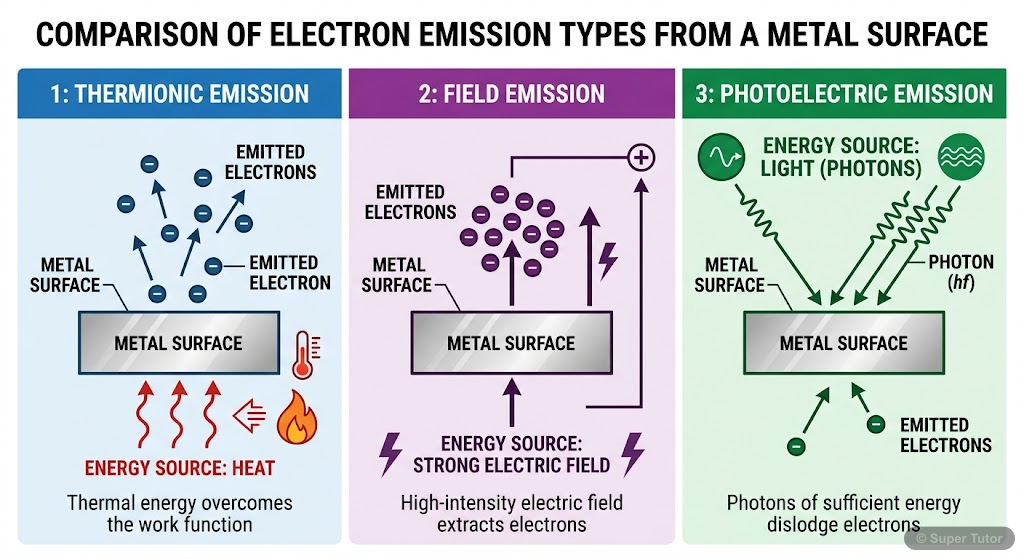
An infographic comparing the three main types of electron emission: Thermionic emission, Field emission, and Photoelectric emission, highlighting the energy source for each.
Super Tutor

Learn better with visuals Super Tutor has hundreds of illustrations like this across every chapter — all free to try.

Get started
11 Questions Solved · 1 Section

EXERCISES

11.1Find the (a) maximum frequency, and (b) minimum wavelength of X-rays produced by 30 kV electrons.Show solution
Given: Accelerating voltage, V=30kV=30×103VV = 30\,\mathrm{kV} = 30 \times 10^3\,\mathrm{V}

Concept: The maximum energy of the X-ray photon equals the kinetic energy gained by the electron:
eV=hνmax=hcλmineV = h\nu_{\max} = \frac{hc}{\lambda_{\min}}

(a) Maximum frequency:
νmax=eVh=1.6×1019C×30×103V6.63×1034Js\nu_{\max} = \frac{eV}{h} = \frac{1.6 \times 10^{-19}\,\mathrm{C} \times 30 \times 10^3\,\mathrm{V}}{6.63 \times 10^{-34}\,\mathrm{J\,s}}
νmax=4.8×10156.63×1034=7.24×10¹⁸Hz\nu_{\max} = \frac{4.8 \times 10^{-15}}{6.63 \times 10^{-34}} = 7.24 \times 10^{18}\,\mathrm{Hz}

(b) Minimum wavelength:
λmin=cνmax=3×10⁸m/s7.24×1018Hz\lambda_{\min} = \frac{c}{\nu_{\max}} = \frac{3 \times 10^8\,\mathrm{m/s}}{7.24 \times 10^{18}\,\mathrm{Hz}}
λmin=0.0414nm4.14×1011m\boxed{\lambda_{\min} = 0.0414\,\mathrm{nm} \approx 4.14 \times 10^{-11}\,\mathrm{m}}
11.2The work function of caesium metal is 2.14 eV. When light of frequency 6×10146 \times 10^{14} Hz is incident on the metal surface, photoemission of electrons occurs. What is the (a) maximum kinetic energy of the emitted electrons, (b) Stopping potential, and (c) maximum speed of the emitted photoelectrons?Show solution
Given:
- Work function, ϕ0=2.14eV=2.14×1.6×1019J=3.424×10¹⁹J\phi_0 = 2.14\,\mathrm{eV} = 2.14 \times 1.6 \times 10^{-19}\,\mathrm{J} = 3.424 \times 10^{-19}\,\mathrm{J}
- Frequency of incident light, ν=6×10¹⁴Hz\nu = 6 \times 10^{14}\,\mathrm{Hz}

Energy of incident photon:
E=hν=6.63×1034×6×1014=3.978×10¹⁹J=2.486eVE = h\nu = 6.63 \times 10^{-34} \times 6 \times 10^{14} = 3.978 \times 10^{-19}\,\mathrm{J} = 2.486\,\mathrm{eV}

(a) Maximum kinetic energy:
Using Einstein's photoelectric equation:
Kmax=hνϕ0=3.978×10193.424×1019K_{\max} = h\nu - \phi_0 = 3.978 \times 10^{-19} - 3.424 \times 10^{-19}
Kmax=0.554×10¹⁹J0.34eV\boxed{K_{\max} = 0.554 \times 10^{-19}\,\mathrm{J} \approx 0.34\,\mathrm{eV}}

(b) Stopping potential:
eV0=KmaxeV_0 = K_{\max}
V0=Kmaxe=0.554×10191.6×1019V_0 = \frac{K_{\max}}{e} = \frac{0.554 \times 10^{-19}}{1.6 \times 10^{-19}}
V0=0.34V\boxed{V_0 = 0.34\,\mathrm{V}}

(c) Maximum speed of emitted photoelectrons:
12mvmax2=Kmax\frac{1}{2}m v_{\max}^2 = K_{\max}
vmax=2Kmaxm=2×0.554×10199.11×1031v_{\max} = \sqrt{\frac{2K_{\max}}{m}} = \sqrt{\frac{2 \times 0.554 \times 10^{-19}}{9.11 \times 10^{-31}}}
vmax=1.217×1011=12.17×10¹⁰v_{\max} = \sqrt{1.217 \times 10^{11}} = \sqrt{12.17 \times 10^{10}}
vmax3.49×105m/s\boxed{v_{\max} \approx 3.49 \times 10^5\,\mathrm{m/s}}
11.3The photoelectric cut-off voltage in a certain experiment is 1.5 V. What is the maximum kinetic energy of photoelectrons emitted?Show solution
Given: Stopping (cut-off) potential, V0=1.5VV_0 = 1.5\,\mathrm{V}

Concept: The stopping potential is related to the maximum kinetic energy by:
Kmax=eV0K_{\max} = eV_0

Calculation:
Kmax=eV0=1.6×1019C×1.5VK_{\max} = eV_0 = 1.6 \times 10^{-19}\,\mathrm{C} \times 1.5\,\mathrm{V}
Kmax=2.4×10¹⁹J=1.5eV\boxed{K_{\max} = 2.4 \times 10^{-19}\,\mathrm{J} = 1.5\,\mathrm{eV}}
11.4Monochromatic light of wavelength 632.8 nm is produced by a helium-neon laser. The power emitted is 9.42 mW. (a) Find the energy and momentum of each photon in the light beam, (b) How many photons per second, on the average, arrive at a target irradiated by this beam? (Assume the beam to have uniform cross-section which is less than the target area), and (c) How fast does a hydrogen atom have to travel in order to have the same momentum as that of the photon?Show solution
Given:
- Wavelength, λ=632.8nm=632.8×10⁹m\lambda = 632.8\,\mathrm{nm} = 632.8 \times 10^{-9}\,\mathrm{m}
- Power, P=9.42mW=9.42×10³WP = 9.42\,\mathrm{mW} = 9.42 \times 10^{-3}\,\mathrm{W}

(a) Energy and momentum of each photon:

Energy:
E=hcλ=6.63×1034×3×108632.8×109E = \frac{hc}{\lambda} = \frac{6.63 \times 10^{-34} \times 3 \times 10^8}{632.8 \times 10^{-9}}
E=3.14×10¹⁹J1.96eV\boxed{E = 3.14 \times 10^{-19}\,\mathrm{J} \approx 1.96\,\mathrm{eV}}

Momentum:
p=hλ=6.63×1034632.8×109p = \frac{h}{\lambda} = \frac{6.63 \times 10^{-34}}{632.8 \times 10^{-9}}
p=1.05×1027kgm/s\boxed{p = 1.05 \times 10^{-27}\,\mathrm{kg\,m/s}}

(b) Number of photons per second:

Let nn be the number of photons emitted per second. Then:
P=nE    n=PEP = nE \implies n = \frac{P}{E}
n=9.42×1033.14×1019n = \frac{9.42 \times 10^{-3}}{3.14 \times 10^{-19}}
n=3.0×10¹⁶photons/s\boxed{n = 3.0 \times 10^{16}\,\mathrm{photons/s}}

(c) Speed of hydrogen atom with same momentum:

Mass of hydrogen atom, mH=1.67×1027kgm_H = 1.67 \times 10^{-27}\,\mathrm{kg}

p=mHv    v=pmH=1.05×10271.67×1027p = m_H v \implies v = \frac{p}{m_H} = \frac{1.05 \times 10^{-27}}{1.67 \times 10^{-27}}
v=0.629m/s0.63m/s\boxed{v = 0.629\,\mathrm{m/s} \approx 0.63\,\mathrm{m/s}}
11.5In an experiment on photoelectric effect, the slope of the cut-off voltage versus frequency of incident light is found to be 4.12×10154.12 \times 10^{-15} V s. Calculate the value of Planck's constant.Show solution
Given: Slope of V0V_0 vs ν\nu graph =4.12×10¹⁵Vs= 4.12 \times 10^{-15}\,\mathrm{V\,s}

Concept: From Einstein's photoelectric equation:
eV0=hνϕ0eV_0 = h\nu - \phi_0
V0=heνϕ0eV_0 = \frac{h}{e}\nu - \frac{\phi_0}{e}

The slope of V0V_0 vs ν\nu is he\dfrac{h}{e}.

Calculation:
he=4.12×10¹⁵Vs\frac{h}{e} = 4.12 \times 10^{-15}\,\mathrm{V\,s}
h=4.12×10¹⁵×e=4.12×1015×1.6×1019h = 4.12 \times 10^{-15} \times e = 4.12 \times 10^{-15} \times 1.6 \times 10^{-19}
h=6.592×1034Js6.59×1034Js\boxed{h = 6.592 \times 10^{-34}\,\mathrm{J\,s} \approx 6.59 \times 10^{-34}\,\mathrm{J\,s}}

This is in close agreement with the standard value of Planck's constant h=6.63×1034Jsh = 6.63 \times 10^{-34}\,\mathrm{J\,s}.
11.6The threshold frequency for a certain metal is 3.3×10143.3 \times 10^{14} Hz. If light of frequency 8.2×10148.2 \times 10^{14} Hz is incident on the metal, predict the cut-off voltage for the photoelectric emission.Show solution
Given:
- Threshold frequency, ν0=3.3×10¹⁴Hz\nu_0 = 3.3 \times 10^{14}\,\mathrm{Hz}
- Incident frequency, ν=8.2×10¹⁴Hz\nu = 8.2 \times 10^{14}\,\mathrm{Hz}

Concept: Einstein's photoelectric equation:
eV0=h(νν0)eV_0 = h(\nu - \nu_0)
V0=h(νν0)eV_0 = \frac{h(\nu - \nu_0)}{e}

Calculation:
V0=6.63×1034×(8.23.3)×10141.6×1019V_0 = \frac{6.63 \times 10^{-34} \times (8.2 - 3.3) \times 10^{14}}{1.6 \times 10^{-19}}
V0=6.63×1034×4.9×10141.6×1019V_0 = \frac{6.63 \times 10^{-34} \times 4.9 \times 10^{14}}{1.6 \times 10^{-19}}
V0=32.487×10201.6×1019=3.2487×10191.6×1019V_0 = \frac{32.487 \times 10^{-20}}{1.6 \times 10^{-19}} = \frac{3.2487 \times 10^{-19}}{1.6 \times 10^{-19}}
V0=2.03V\boxed{V_0 = 2.03\,\mathrm{V}}
11.7The work function for a certain metal is 4.2 eV. Will this metal give photoelectric emission for incident radiation of wavelength 330 nm?Show solution
Given:
- Work function, ϕ0=4.2eV\phi_0 = 4.2\,\mathrm{eV}
- Wavelength of incident radiation, λ=330nm=330×109m\lambda = 330\,\mathrm{nm} = 330 \times 10^{-9}\,\mathrm{m}

Energy of incident photon:
E=hcλ=6.63×1034×3×108330×109E = \frac{hc}{\lambda} = \frac{6.63 \times 10^{-34} \times 3 \times 10^8}{330 \times 10^{-9}}
E=19.89×1026330×109=6.027×10¹⁹JE = \frac{19.89 \times 10^{-26}}{330 \times 10^{-9}} = 6.027 \times 10^{-19}\,\mathrm{J}
E=6.027×10191.6×1019eV=3.77eVE = \frac{6.027 \times 10^{-19}}{1.6 \times 10^{-19}}\,\mathrm{eV} = 3.77\,\mathrm{eV}

Comparison:
The energy of the incident photon (E=3.77eVE = 3.77\,\mathrm{eV}) is less than the work function (ϕ0=4.2eV\phi_0 = 4.2\,\mathrm{eV}).

E < \phi_0

Conclusion: No, photoelectric emission will not occur for this metal with the given incident radiation, since the photon energy is insufficient to overcome the work function.
11.8Light of frequency 7.21×10147.21 \times 10^{14} Hz is incident on a metal surface. Electrons with a maximum speed of 6.0×1056.0 \times 10^5 m/s are ejected from the surface. What is the threshold frequency for photoemission of electrons?Show solution
Given:
- Incident frequency, ν=7.21×10¹⁴Hz\nu = 7.21 \times 10^{14}\,\mathrm{Hz}
- Maximum speed of ejected electrons, vmax=6.0×10⁵m/sv_{\max} = 6.0 \times 10^5\,\mathrm{m/s}
- Mass of electron, m=9.11×1031kgm = 9.11 \times 10^{-31}\,\mathrm{kg}

Concept: Einstein's photoelectric equation:
hν=ϕ0+12mvmax2=hν0+12mvmax2h\nu = \phi_0 + \frac{1}{2}mv_{\max}^2 = h\nu_0 + \frac{1}{2}mv_{\max}^2

Maximum kinetic energy:
Kmax=12mvmax2=12×9.11×1031×(6.0×105)2K_{\max} = \frac{1}{2}mv_{\max}^2 = \frac{1}{2} \times 9.11 \times 10^{-31} \times (6.0 \times 10^5)^2
Kmax=12×9.11×1031×3.6×1011K_{\max} = \frac{1}{2} \times 9.11 \times 10^{-31} \times 3.6 \times 10^{11}
Kmax=1.64×10¹⁹JK_{\max} = 1.64 \times 10^{-19}\,\mathrm{J}

Threshold frequency:
hν0=hνKmaxh\nu_0 = h\nu - K_{\max}
ν0=νKmaxh=7.21×10141.64×10196.63×1034\nu_0 = \nu - \frac{K_{\max}}{h} = 7.21 \times 10^{14} - \frac{1.64 \times 10^{-19}}{6.63 \times 10^{-34}}
ν0=7.21×10142.474×1014\nu_0 = 7.21 \times 10^{14} - 2.474 \times 10^{14}
ν0=4.74×10¹⁴Hz\boxed{\nu_0 = 4.74 \times 10^{14}\,\mathrm{Hz}}
11.9Light of wavelength 488 nm is produced by an argon laser which is used in the photoelectric effect. When light from this spectral line is incident on the emitter, the stopping (cut-off) potential of photoelectrons is 0.38 V. Find the work function of the material from which the emitter is made.Show solution
Given:
- Wavelength of incident light, λ=488nm=488×109m\lambda = 488\,\mathrm{nm} = 488 \times 10^{-9}\,\mathrm{m}
- Stopping potential, V0=0.38VV_0 = 0.38\,\mathrm{V}

Energy of incident photon:
E=hcλ=6.63×1034×3×108488×109E = \frac{hc}{\lambda} = \frac{6.63 \times 10^{-34} \times 3 \times 10^8}{488 \times 10^{-9}}
E=19.89×1026488×109=4.075×10¹⁹J=2.547eVE = \frac{19.89 \times 10^{-26}}{488 \times 10^{-9}} = 4.075 \times 10^{-19}\,\mathrm{J} = 2.547\,\mathrm{eV}

Work function using Einstein's equation:
ϕ0=EeV0=2.547eV0.38eV\phi_0 = E - eV_0 = 2.547\,\mathrm{eV} - 0.38\,\mathrm{eV}
ϕ0=2.17eV\boxed{\phi_0 = 2.17\,\mathrm{eV}}
11.10What is the de Broglie wavelength of (a) a bullet of mass 0.040 kg travelling at the speed of 1.0 km/s, (b) a ball of mass 0.060 kg moving at a speed of 1.0 m/s, (c) a dust particle of mass 1.0×1091.0 \times 10^{-9} kg drifting with a speed of 2.2 m/s?Show solution
Concept: de Broglie wavelength: λ=hp=hmv\lambda = \dfrac{h}{p} = \dfrac{h}{mv}

(a) Bullet:
- m=0.040kgm = 0.040\,\mathrm{kg}, v=1.0km/s=1.0×103m/sv = 1.0\,\mathrm{km/s} = 1.0 \times 10^3\,\mathrm{m/s}
p=mv=0.040×1.0×103=40kgm/sp = mv = 0.040 \times 1.0 \times 10^3 = 40\,\mathrm{kg\,m/s}
λ=hp=6.63×103440\lambda = \frac{h}{p} = \frac{6.63 \times 10^{-34}}{40}
λ=1.66×1035m\boxed{\lambda = 1.66 \times 10^{-35}\,\mathrm{m}}

(b) Ball:
- m=0.060kgm = 0.060\,\mathrm{kg}, v=1.0m/sv = 1.0\,\mathrm{m/s}
p=mv=0.060×1.0=0.060kgm/sp = mv = 0.060 \times 1.0 = 0.060\,\mathrm{kg\,m/s}
λ=6.63×10340.060\lambda = \frac{6.63 \times 10^{-34}}{0.060}
λ=1.105×1032m1.1×1032m\boxed{\lambda = 1.105 \times 10^{-32}\,\mathrm{m} \approx 1.1 \times 10^{-32}\,\mathrm{m}}

(c) Dust particle:
- m=1.0×10⁹kgm = 1.0 \times 10^{-9}\,\mathrm{kg}, v=2.2m/sv = 2.2\,\mathrm{m/s}
p=mv=1.0×109×2.2=2.2×10⁹kgm/sp = mv = 1.0 \times 10^{-9} \times 2.2 = 2.2 \times 10^{-9}\,\mathrm{kg\,m/s}
λ=6.63×10342.2×109\lambda = \frac{6.63 \times 10^{-34}}{2.2 \times 10^{-9}}
λ=3.01×1025m3.0×1025m\boxed{\lambda = 3.01 \times 10^{-25}\,\mathrm{m} \approx 3.0 \times 10^{-25}\,\mathrm{m}}

In all three cases, the de Broglie wavelengths are extremely small and far beyond experimental measurement, which is why macroscopic objects do not exhibit wave-like properties.
11.11Show that the wavelength of electromagnetic radiation is equal to the de Broglie wavelength of its quantum (photon).Show solution
To Show: λEM=λde Broglie\lambda_{\text{EM}} = \lambda_{\text{de Broglie}} for a photon.

For electromagnetic radiation:
The wavelength of electromagnetic radiation is λ\lambda, and the energy of a photon is:
E=hν=hcλE = h\nu = \frac{hc}{\lambda}

Momentum of a photon:
From Einstein's mass-energy relation and the fact that a photon has zero rest mass, the momentum of a photon is:
p=Ec=hνc=hλp = \frac{E}{c} = \frac{h\nu}{c} = \frac{h}{\lambda}

de Broglie wavelength of the photon:
Using de Broglie's relation λdB=hp\lambda_{\text{dB}} = \dfrac{h}{p}:
λdB=hp=hh/λ=λ\lambda_{\text{dB}} = \frac{h}{p} = \frac{h}{h/\lambda} = \lambda

Conclusion:
λdB=λ\boxed{\lambda_{\text{dB}} = \lambda}

Thus, the de Broglie wavelength of a photon is equal to the wavelength of the corresponding electromagnetic radiation. This result shows the inherent consistency between the wave and particle descriptions of electromagnetic radiation.

Stuck on a step?

Ask Super Tutor AI to explain any solution on this page in a simpler way — free, 24x7.

Ask a Doubt Free

Frequently Asked Questions

What are the important topics in Dual Nature of Radiation and Matter for Rajasthan Board Class 12 Physics?
Dual Nature of Radiation and Matter covers several key topics that are frequently asked in Rajasthan Board Class 12 board exams. Focus on the core concepts listed on this page and practise related questions to build confidence.
How to score full marks in Dual Nature of Radiation and Matter — Rajasthan Board Class 12 Physics?
Understand the core concepts first, then work through the 32 practice questions available for this chapter. Revise formulas and definitions regularly, and use flashcards for quick recall before the exam.
Where can I get free NCERT Solutions for Dual Nature of Radiation and Matter Class 12 Physics?
This page has free step-by-step NCERT Solutions for every exercise question in Dual Nature of Radiation and Matter (Rajasthan Board Class 12 Physics) — written the way examiners award marks: given, formula, working, answer.

Sources & Official References

Content is aligned to the official syllabus. Refer to the board website for the latest curriculum.

For serious students

Get the full Dual Nature of Radiation and Matter chapter — for free.

Quizzes, flashcards, AI doubt-solver and a step-by-step study plan for Rajasthan Board Class 12 Physics.