Chapter 7 of 12
NCERT Solutions

Motion

Rajasthan Board · Class 9 · Science

NCERT Solutions for Motion — Rajasthan Board Class 9 Science.

31 questions20 flashcards5 concepts

Interactive on Super Tutor

Studying Motion? Get the full interactive chapter.

Quizzes, flashcards, AI doubt-solver and a step-by-step study plan — built for ncert solutions and more.

1,000+ Class 9 students started this chapter today

An illustration showing a person inside a moving bus perceiving fellow passengers at rest, while a person outside the bus perceives the bus and its passengers as moving. Roadside trees are shown movin
Super Tutor

Learn better with visuals Super Tutor has hundreds of illustrations like this across every chapter — all free to try.

Get started
10 Questions Solved · 1 Section

Exercises

1An athlete completes one round of a circular track of diameter 200 m in 40 s. What will be the distance covered and the displacement at the end of 2 minutes 20 s?Show solution
Given:
- Diameter of circular track = 200 m, so radius r=100r = 100 m
- Time for one round = 40 s
- Total time = 2 min 20 s = 140 s

Step 1: Find the number of rounds completed.
Number of rounds=Total timeTime per round=14040=3.5 rounds\text{Number of rounds} = \frac{\text{Total time}}{\text{Time per round}} = \frac{140}{40} = 3.5 \text{ rounds}

Step 2: Find the distance covered.

Circumference of the track (distance per round):
C=πd=π×200=628 m (approx.)C = \pi d = \pi \times 200 = 628 \text{ m (approx.)}

Distance covered=3.5×628=2200 m\text{Distance covered} = 3.5 \times 628 = 2200 \text{ m}

Step 3: Find the displacement.

After 3.5 rounds, the athlete is at the diametrically opposite end of the starting point.

Displacement=diameter=200 m\text{Displacement} = \text{diameter} = 200 \text{ m}

Answer:
- Distance covered = 2200 m
- Displacement = 200 m
2Joseph jogs from one end A to the other end B of a straight 300 m road in 2 minutes 30 seconds and then turns around and jogs 100 m back to point C in another 1 minute. What are Joseph's average speeds and velocities in jogging (a) from A to B and (b) from A to C?Show solution
Given:
- A to B: distance = 300 m, time = 2 min 30 s = 150 s
- B to C: distance = 100 m (back towards A), time = 1 min = 60 s

(a) From A to B:

Average speed=Total distanceTotal time=300150=2 m s1\text{Average speed} = \frac{\text{Total distance}}{\text{Total time}} = \frac{300}{150} = 2 \text{ m s}^{-1}

Displacement from A to B = 300 m (straight road)

Average velocity=DisplacementTime=300150=2 m s1 (from A to B)\text{Average velocity} = \frac{\text{Displacement}}{\text{Time}} = \frac{300}{150} = 2 \text{ m s}^{-1} \text{ (from A to B)}

(b) From A to C:

Total distance = AB + BC = 300 + 100 = 400 m

Total time = 150 + 60 = 210 s

Average speed=400210=1.90 m s1\text{Average speed} = \frac{400}{210} = 1.90 \text{ m s}^{-1}

Displacement from A to C = AB − BC = 300 − 100 = 200 m (from A towards B)

Average velocity=200210=0.95 m s1 (from A towards B)\text{Average velocity} = \frac{200}{210} = 0.95 \text{ m s}^{-1} \text{ (from A towards B)}

Answer:
- (a) Average speed = 2 m s12 \text{ m s}^{-1}; Average velocity = 2 m s12 \text{ m s}^{-1} (A to B direction)
- (b) Average speed ≈ 1.90 m s11.90 \text{ m s}^{-1}; Average velocity ≈ 0.95 m s10.95 \text{ m s}^{-1} (A to B direction)
3Abdul, while driving to school, computes the average speed for his trip to be 20 km h⁻¹. On his return trip along the same route, there is less traffic and the average speed is 30 km h⁻¹. What is the average speed for Abdul's trip?Show solution
Given:
- Speed from home to school, v1=20 km h1v_1 = 20 \text{ km h}^{-1}
- Speed from school to home, v2=30 km h1v_2 = 30 \text{ km h}^{-1}
- Distance one way = dd (same route)

Concept: Average speed = Total distance / Total time

Step 1: Find total distance.
Total distance=d+d=2d\text{Total distance} = d + d = 2d

Step 2: Find total time.
t1=dv1=d20,t2=dv2=d30t_1 = \frac{d}{v_1} = \frac{d}{20}, \quad t_2 = \frac{d}{v_2} = \frac{d}{30}

Total time=d20+d30=d(3+260)=5d60=d12\text{Total time} = \frac{d}{20} + \frac{d}{30} = d\left(\frac{3+2}{60}\right) = \frac{5d}{60} = \frac{d}{12}

Step 3: Calculate average speed.
Average speed=2dd/12=2d×12d=24 km h1\text{Average speed} = \frac{2d}{d/12} = 2d \times \frac{12}{d} = 24 \text{ km h}^{-1}

Answer: The average speed for Abdul's entire trip is 24 km h1\boxed{24 \text{ km h}^{-1}}.
4A motorboat starting from rest on a lake accelerates in a straight line at a constant rate of 3.0 m s⁻² for 8.0 s. How far does the boat travel during this time?Show solution
Given:
- Initial velocity, u=0u = 0 (starts from rest)
- Acceleration, a=3.0 m s2a = 3.0 \text{ m s}^{-2}
- Time, t=8.0 st = 8.0 \text{ s}

Formula used (second equation of motion):
s=ut+12at2s = ut + \frac{1}{2}at^2

Calculation:
s=(0)(8.0)+12×3.0×(8.0)2s = (0)(8.0) + \frac{1}{2} \times 3.0 \times (8.0)^2
s=0+12×3.0×64s = 0 + \frac{1}{2} \times 3.0 \times 64
s=12×192=96 ms = \frac{1}{2} \times 192 = 96 \text{ m}

Answer: The boat travels 96 m during this time.
5A driver of a car travelling at 52 km h⁻¹ applies the brakes. (a) Shade the area on the graph that represents the distance travelled by the car during the period. (b) Which part of the graph represents uniform motion of the car?Show solution
Note: This question refers to a speed-time graph (Fig. 7.11 in the textbook) that is not fully visible here. The standard answers based on the described graph are given below.

(a) Distance travelled during braking:

The distance travelled by the car after brakes are applied is represented by the area under the speed-time graph between the point where brakes are applied and the point where the car comes to rest. This area is a triangle (since speed decreases uniformly from 52 km h⁻¹ to 0). This triangular area should be shaded.

(b) Uniform motion:

The part of the graph where the speed-time graph is a horizontal straight line (constant speed) represents the uniform motion of the car. This is the portion before the brakes are applied, where speed remains constant at 52 km h⁻¹.
6Fig 7.10 shows the distance-time graph of three objects A, B and C. Study the graph and answer the following questions: (a) Which of the three is travelling the fastest? (b) Are all three ever at the same point on the road? (c) How far has C travelled when B passes A? (d) How far has B travelled by the time it passes C?Show solution
Note: This question is based on a distance-time graph (Fig. 7.10) that is not fully visible in the OCR. The standard NCERT answers are provided below based on the described graph.

(a) Which is travelling the fastest?

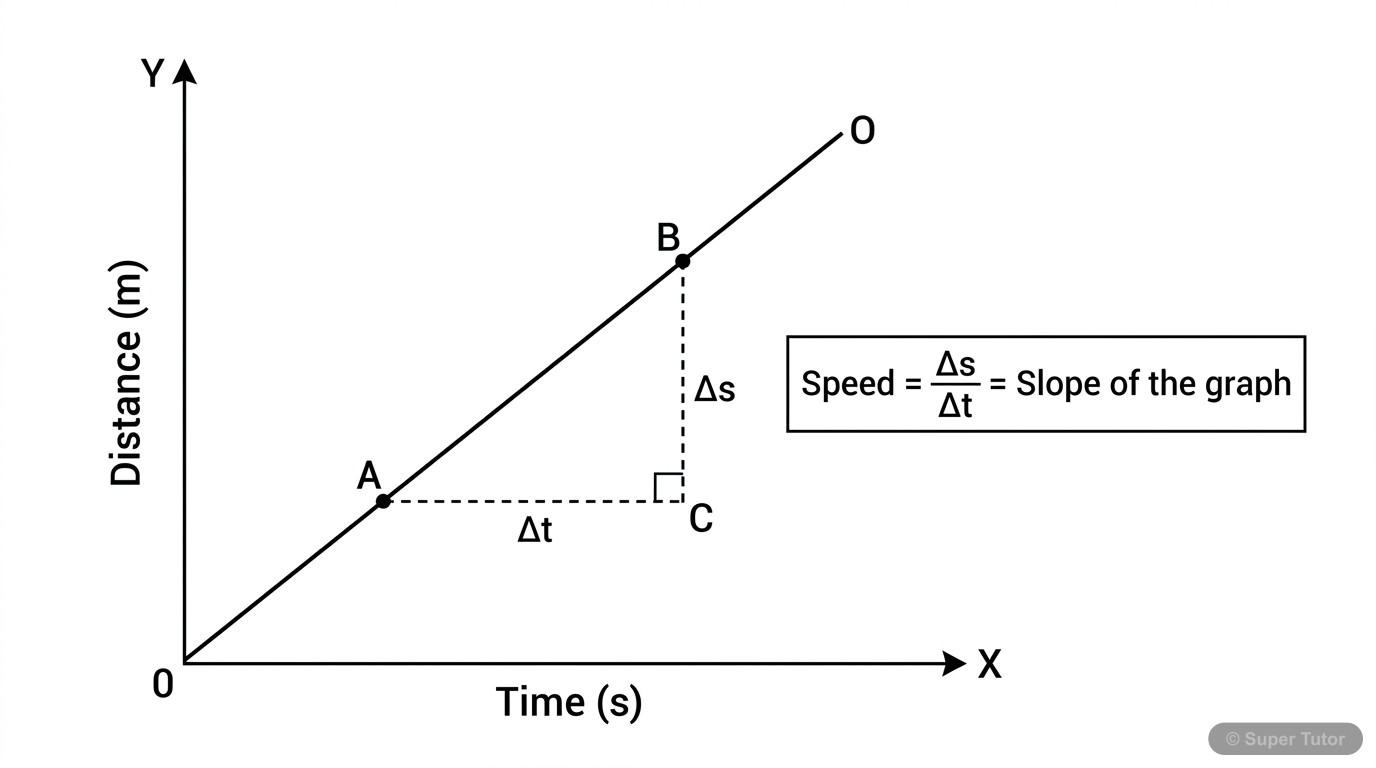
On a distance-time graph, the slope represents speed. The object with the steepest slope is travelling the fastest.

Speed=slope of distance-time graph\text{Speed} = \text{slope of distance-time graph}

From the graph, B has the steepest slope among A, B, and C.

B is travelling the fastest.

(b) Are all three ever at the same point on the road?

All three objects are at the same point on the road only if their distance-time curves intersect at a single common point. From the graph, the three lines do not all meet at one point.

No, all three are never at the same point on the road.

(c) How far has C travelled when B passes A?

From the graph, when B's curve intersects A's curve (i.e., B passes A), reading the position of C on the graph at that same time gives the distance C has travelled.

Based on the standard NCERT graph: C has travelled approximately 8 km when B passes A.

(d) How far has B travelled by the time it passes C?

From the graph, when B's curve intersects C's curve (i.e., B passes C), reading the distance of B at that time:

Based on the standard NCERT graph: B has travelled approximately 4 km by the time it passes C.
7A ball is gently dropped from a height of 20 m. If its velocity increases uniformly at the rate of 10 m s⁻², with what velocity will it strike the ground? After what time will it strike the ground?Show solution
Given:
- Initial velocity, u=0u = 0 (gently dropped)
- Distance (height), s=20s = 20 m
- Acceleration, a=10 m s2a = 10 \text{ m s}^{-2}

Step 1: Find the final velocity using the third equation of motion.
v2=u2+2asv^2 = u^2 + 2as
v2=(0)2+2×10×20v^2 = (0)^2 + 2 \times 10 \times 20
v2=400v^2 = 400
v=20 m s1v = 20 \text{ m s}^{-1}

Step 2: Find the time using the first equation of motion.
v=u+atv = u + at
20=0+10×t20 = 0 + 10 \times t
t=2010=2 st = \frac{20}{10} = 2 \text{ s}

Answer:
- The ball will strike the ground with a velocity of 20 m s⁻¹.
- It will strike the ground after 2 s.
8The speed-time graph for a car is shown in Fig. 7.11. (a) Find how far does the car travel in the first 4 seconds. Shade the area on the graph that represents the distance travelled by the car during the period. (b) Which part of the graph represents uniform motion of the car?Show solution
Note: This question refers to Fig. 7.11 (speed-time graph) which is not fully visible. Based on the standard NCERT graph where the car accelerates from 0 to 6 m s⁻¹ in the first 4 seconds, then moves at uniform speed.

(a) Distance in the first 4 seconds:

The distance is given by the area under the speed-time graph for the first 4 seconds.

From the graph, the car accelerates uniformly from u=0u = 0 to v=6 m s1v = 6 \text{ m s}^{-1} in t=4t = 4 s. This forms a triangle on the graph.

s=Area of triangle=12×base×heights = \text{Area of triangle} = \frac{1}{2} \times \text{base} \times \text{height}
s=12×4×6=12 ms = \frac{1}{2} \times 4 \times 6 = 12 \text{ m}

The triangular area under the graph from t=0t = 0 to t=4t = 4 s should be shaded.

(b) Uniform motion:

The part of the graph that is a horizontal straight line (constant speed) represents uniform motion. From the standard graph, this is the portion after t=4t = 4 s where the speed remains constant at 6 m s⁻¹.

Answer:
- (a) The car travels 12 m in the first 4 seconds.
- (b) The horizontal portion of the graph (after t=4t = 4 s) represents uniform motion.
9State which of the following situations are possible and give an example for each of these: (a) an object with a constant acceleration but with zero velocity (b) an object moving with an acceleration but with uniform speed. (c) an object moving in a certain direction with an acceleration in the perpendicular direction.Show solution
(a) An object with constant acceleration but zero velocity:

Possible.

When an object is thrown vertically upward, at the highest point its velocity becomes zero, but the acceleration due to gravity (g=10 m s2g = 10 \text{ m s}^{-2}) acts continuously downward. Thus, at that instant, velocity = 0 but acceleration = constant (gg).

Example: A ball thrown vertically upward at its highest point.

---

(b) An object moving with acceleration but with uniform speed:

Possible.

Acceleration is a vector quantity — it can change direction without changing magnitude of speed. When an object moves in a circular path at constant speed, its direction changes continuously, so it has acceleration (centripetal acceleration) even though its speed is constant.

Example: A car moving along a circular road at constant speed undergoes uniform circular motion — speed is uniform but acceleration exists due to change in direction.

---

(c) An object moving in a certain direction with acceleration in the perpendicular direction:

Possible.

In uniform circular motion, the velocity of the object is along the tangent to the circle, while the centripetal acceleration is directed towards the centre — which is perpendicular to the velocity (and hence to the direction of motion).

Example: A stone tied to a string and whirled in a horizontal circle — the stone moves tangentially but the centripetal acceleration acts perpendicular (towards the centre).
10An artificial satellite is moving in a circular orbit of radius 42250 km. Calculate its speed if it takes 24 hours to revolve around the earth.Show solution
Given:
- Radius of circular orbit, r=42250 km=42250×1000 m=4.225×10⁷ mr = 42250 \text{ km} = 42250 \times 1000 \text{ m} = 4.225 \times 10^7 \text{ m}
- Time period, T=24 h=24×3600 s=86400 sT = 24 \text{ h} = 24 \times 3600 \text{ s} = 86400 \text{ s}

Formula: Speed in circular motion:
v=CircumferenceTime period=2πrTv = \frac{\text{Circumference}}{\text{Time period}} = \frac{2\pi r}{T}

Calculation:
v=2×3.14×4.225×10786400v = \frac{2 \times 3.14 \times 4.225 \times 10^7}{86400}
v=2×3.14×4225000086400v = \frac{2 \times 3.14 \times 42250000}{86400}
v=26533000086400v = \frac{265330000}{86400}
v3070 m s1v \approx 3070 \text{ m s}^{-1}
v3.07 km s1v \approx 3.07 \text{ km s}^{-1}

Answer: The speed of the artificial satellite is approximately 3.07 km s1\mathbf{3.07 \text{ km s}^{-1}} (or 3070 m s13070 \text{ m s}^{-1}).

Stuck on a step?

Ask Super Tutor AI to explain any solution on this page in a simpler way — free, 24x7.

Ask a Doubt Free

Frequently Asked Questions

What are the important topics in Motion for Rajasthan Board Class 9 Science?
Key topics in Motion include Distance vs Displacement: The Correct Decision Path, Motion - Complete Chapter Concept Overview, Chapter 7 Motion – Complete Concept Map. These are the concepts Rajasthan Board Class 9 examiners draw on most — study them first, then practise related questions.
How to score full marks in Motion — Rajasthan Board Class 9 Science?
Understand the core concepts first, then work through the 31 practice questions available for this chapter. Revise formulas and definitions regularly, and use flashcards for quick recall before the exam.
Where can I get free NCERT Solutions for Motion Class 9 Science?
This page has free step-by-step NCERT Solutions for every exercise question in Motion (Rajasthan Board Class 9 Science) — written the way examiners award marks: given, formula, working, answer.

Sources & Official References

Content is aligned to the official syllabus. Refer to the board website for the latest curriculum.

For serious students

Get the full Motion chapter — for free.

Quizzes, flashcards, AI doubt-solver and a step-by-step study plan for Rajasthan Board Class 9 Science.