Biodiversity and Conservation — NCERT Solutions
Tripura Board · Class 12 · Biology
NCERT Solutions for Biodiversity and Conservation, Tripura Board Class 12 Biology: 10 textbook questions solved step by step.
Interactive on Super Tutor
Studying Biodiversity and Conservation? Get the full interactive chapter.
Quizzes, flashcards, AI doubt-solver and a step-by-step study plan — built for NCERT solutions and more.
Free trial, no card needed.
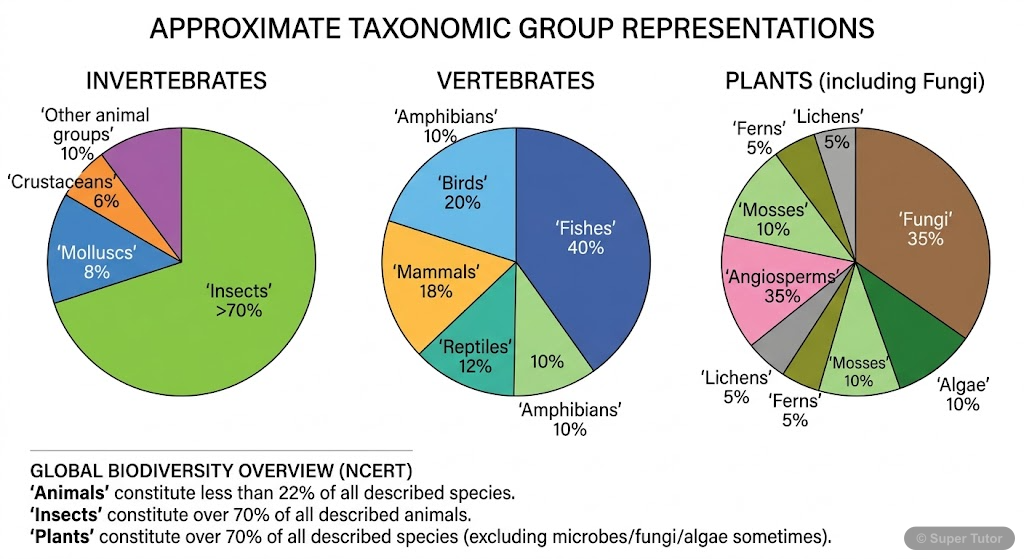
Learn better with visuals Super Tutor pairs illustrations like this with notes and quizzes for Biodiversity and Conservation.
The first 5 solutions are open to read. The other 5 are free with a Super Tutor account.
EXERCISES — Biodiversity and Conservation
1Name the three important components of biodiversity.Show solution
Given/Concept: Biodiversity refers to the variety of life on Earth at all its levels.
Answer:
The three important components of biodiversity are:
- Genetic diversity – Diversity at the genetic level within a species (e.g., different varieties/races of the same species).
- Species diversity – Diversity at the species level, i.e., the variety of species in a given region.
- Ecological (Community/Ecosystem) diversity – Diversity at the ecosystem level, i.e., the variety of habitats, communities and ecological processes in a biosphere.
2How do ecologists estimate the total number of species present in the world?Show solution
Given/Concept: The actual number of species on Earth is not known precisely. Ecologists use statistical comparison methods to estimate the total.
Method used by ecologists:
- Ecologists use the statistical comparison of the species richness of well-studied groups (e.g., plants, mammals, birds) in temperate regions versus tropical regions.
- Since temperate regions are better studied, the ratio of temperate to tropical species for a well-known group is calculated.
- This ratio is then applied to poorly known groups (e.g., insects, fungi, nematodes) to extrapolate the total number of species in the tropics and hence the world.
- For example, if the ratio of temperate to tropical species for a known group is 1:3, the same ratio is applied to estimate the tropical species of a lesser-known group.
Result: Using such extrapolations, the estimated total number of species on Earth ranges from 5 to 50 million, though only about 1.5 million species have been formally described and named so far.
3Give three hypotheses for explaining why tropics show greatest levels of species richness.Show solution
Given/Concept: Tropical regions harbour far greater species diversity than temperate or polar regions. Three major hypotheses explain this:
Hypothesis 1 – Greater Evolutionary Time:
Tropical regions have remained relatively undisturbed for millions of years (unlike temperate regions which were affected by glaciation). This gave species more time to evolve, diversify and adapt, resulting in greater species richness.
Hypothesis 2 – Relatively Constant Environment:
Tropical environments are less seasonal and more constant and predictable compared to temperate environments. This promotes niche specialisation and allows more species to coexist, leading to greater species diversity.
Hypothesis 3 – Greater Solar Energy and Productivity:
Tropics receive more solar energy throughout the year, which leads to higher primary productivity. Greater productivity means more food and resources are available, which can support a larger number of species and more complex food webs.
Conclusion: All three hypotheses together explain why species richness is highest in the tropics and decreases towards the poles.
4What is the significance of the slope of regression in a species-area relationship?Show solution
Given/Concept: The species-area relationship was studied by Alexander von Humboldt. It is expressed as:
where = species richness, = area, = slope of regression (regression coefficient), = y-intercept.
Significance of the slope :
- The slope (regression coefficient) indicates the rate at which species richness increases with increasing area.
- Studies have shown that the value of lies in the range of 0.1 to 0.2 regardless of the taxonomic group or region (for smaller areas within a continent).
- However, when the analysis is done for very large areas (like entire continents), the slope is much steeper, with values ranging from 0.6 to 1.2.
- For example, for frugivorous birds and mammals in tropical forests of different continents, values of 1.15 have been obtained.
Conclusion: The slope tells us how sensitive species richness is to changes in area. A steeper slope means that a greater loss of area will lead to a proportionally greater loss of species — this has important implications for conservation biology (e.g., predicting species loss due to habitat destruction).
5What are the major causes of species losses in a geographical region?Show solution
Given/Concept: The current rate of species extinction is 100–1000 times higher than in pre-human times, largely due to human activities. The major causes are often summarised as the 'Evil Quartet':
- Habitat loss and fragmentation:
- This is the most important cause. Destruction of forests, wetlands, grasslands, etc., for agriculture, urbanisation and development destroys the natural habitat of species.
- Fragmentation of large habitats into small, isolated patches reduces population size and gene flow, increasing extinction risk.
- Over-exploitation:
- Overuse of natural resources by humans (e.g., over-hunting, over-fishing, over-harvesting of plants) leads to population decline and extinction.
- Example: Steller's sea cow, passenger pigeon.
- Alien species invasions:
- Introduction of exotic (non-native) species into a region can outcompete, prey upon or bring diseases to native species, causing their decline or extinction.
- Example: Nile perch introduced in Lake Victoria caused extinction of many native cichlid fish species.
- Co-extinctions:
- When one species becomes extinct, the species that are obligatorily dependent on it (e.g., host-specific parasites, mutualistic partners) also become extinct.
- Example: Extinction of a host plant leads to extinction of its host-specific insect pollinator.
Conclusion: These four causes collectively account for the alarming rate of biodiversity loss observed today.
Free with a Super Tutor account
Free with a Super Tutor account
Free with a Super Tutor account
Free with a Super Tutor account
Free with a Super Tutor account
5 more solved questions in Biodiversity and Conservation
They are free with a Super Tutor account, along with practice quizzes and flashcards for this chapter. Free to start, no card needed.
Frequently Asked Questions
What are the important topics in Biodiversity and Conservation for Tripura Board Class 12 Biology?
Are these NCERT Solutions for Biodiversity and Conservation free?
How should I revise Biodiversity and Conservation for the Tripura Board Class 12 board exam?
Sources & Official References
Content is aligned to the official syllabus. Refer to the board website for the latest curriculum.
More resources for Biodiversity and Conservation
Practice Quiz
Test yourself with a quick quiz
Important Questions
Exam-style questions with answers
Revision Notes
Key points for last-minute revision
Chapter Summary
Understand the chapter at a glance
Concept Maps
See how topics connect
Study Plan
Step-by-step plan for this chapter
Flashcards
Quick-fire cards for active recall
Syllabus
What topics to cover
For serious students
Get the full Biodiversity and Conservation chapter — start free.
Quizzes, flashcards, an AI doubt solver and a study plan for Tripura Board Class 12 Biology. Free to start, no card needed.