Nature and Significance of Management
Tripura Board · Class 12 · Business Studies
NCERT Solutions for Nature and Significance of Management — Tripura Board Class 12 Business Studies.
Interactive on Super Tutor
Studying Nature and Significance of Management? Get the full interactive chapter.
Quizzes, flashcards, AI doubt-solver and a step-by-step study plan — built for ncert solutions and more.
1,000+ Class 12 students started this chapter today

This is just one of 10+ visuals inside Super Tutor's Nature and Significance of Management chapter
Explore the full setVery Short Answer Type
1What is meant by management?Show solution
Answer:
Management is the process of planning, organising, staffing, directing and controlling the resources of an enterprise (human, physical, financial and informational) efficiently and effectively so as to achieve the goals of the organisation.
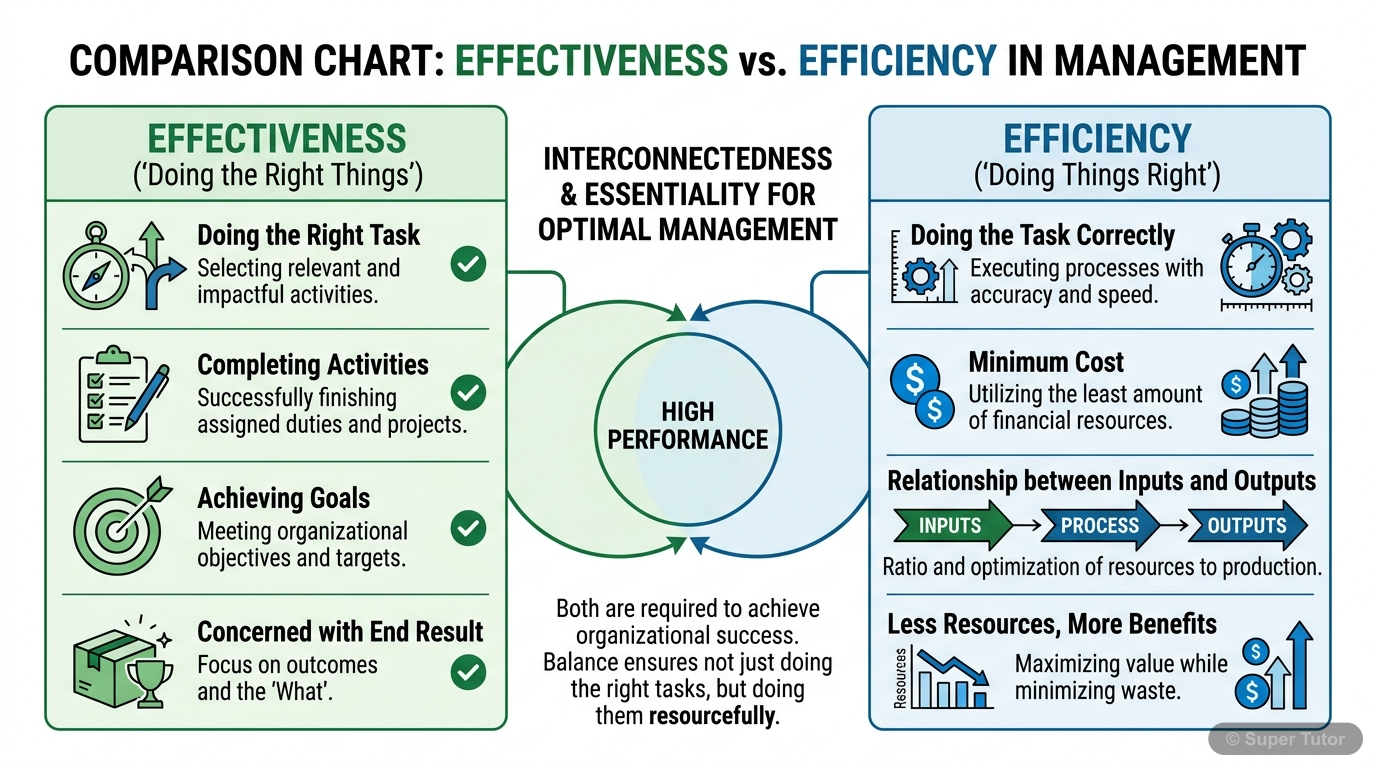
- Effectiveness means doing the right task and achieving goals.
- Efficiency means doing the task correctly with minimum cost and resource wastage.
In short, management is the art of getting things done through and with people in formally organised groups.
2Name any two important characteristics of management.Show solution
Two important characteristics of management are:
1. Goal-Oriented Process: Management is always directed towards achieving organisational, social and personal goals. Every managerial activity is aimed at accomplishing pre-determined objectives.
2. All-Pervasive: Management is required in all types of organisations — business or non-business, large or small — and at all levels (top, middle and lower). It is universal in nature.
3Identify and state the force that binds all the other functions of management.Show solution
Answer:
The force that binds all other functions of management is Coordination.
Coordination is the process of achieving unity of action among interdependent activities and departments of an organisation. It synchronises the efforts of individuals and departments so that all functions — planning, organising, staffing, directing and controlling — work in harmony towards common goals. That is why coordination is called the 'essence of management'.
4List any two indicators of growth of an organisation.Show solution
Two indicators of growth of an organisation are:
1. Increase in the number of employees — As an organisation grows, it needs to hire more people to handle expanded operations.
2. Increase in sales turnover / market share — A growing organisation typically records higher sales revenue and captures a larger share of the market over time.
*(Other valid indicators include increase in product lines, expansion into new markets, increase in profits, etc.)*
5Indian Railways has launched a new broad gauge solar power train which is going to be a path breaking leap towards making trains greener and more environment friendly. The solar power DEMU (Diesel Electric Multiple Unit) has 6 trailer coaches and is expected to save about 21,000 liters of diesel and ensure a cost saving of Rs 12,00,000 per year. Name the objectives of management achieved by Indian Railways in the above case.Show solution
Concept: Management objectives are classified as Organisational, Social and Personal objectives.
Objectives of Management achieved:
1. Organisational Objective — Survival and Growth: By saving Rs 12,00,000 per year through reduced diesel consumption, Indian Railways is reducing costs, which contributes to its financial sustainability and growth.
2. Social Objective — Environmental Responsibility: By launching a greener, solar-powered train, Indian Railways is contributing to environmental protection and reducing carbon footprint, thereby fulfilling its responsibility towards society.
Conclusion: Indian Railways has achieved both organisational objectives (cost saving/efficiency) and social objectives (environment-friendly operations) through this initiative.
Short Answer Type
1Ritu is the manager of the northern division of a large corporate house. At what level does she work in the organisation? What are her basic functions?Show solution
Level of Management:
Ritu works at the Middle Level of Management. Middle-level managers are responsible for a specific division or department and act as a link between top management and lower/supervisory management.
Basic Functions of Ritu (Middle-Level Manager):
1. Interpreting Policies: She interprets and explains the policies framed by top management to lower-level managers.
2. Organising: She organises the activities and resources of her division (northern division) to implement plans.
3. Recruiting and Selecting: She is responsible for recruiting and selecting lower-level managers and other staff for her division.
4. Motivating: She motivates lower-level managers to achieve better performance.
5. Coordinating: She coordinates the activities within her division and with other divisions.
6. Reporting to Top Management: She sends important reports and data about the performance of her division to top management.
7. Achieving Divisional Goals: She ensures that the goals of the northern division are achieved effectively and efficiently.
2State the basic features of management as a profession.Show solution
Basic Features of Management as a Profession:
1. Well-Defined Body of Knowledge: Like other professions, management has a systematic body of knowledge based on principles and theories that can be learnt and taught. Numerous books, journals and courses exist on management.
2. Restricted Entry: Entry into the management profession is increasingly through formal education (MBA, BBA, etc.), though it is not as strictly restricted as medicine or law.
3. Professional Associations: There are professional associations for managers such as the All India Management Association (AIMA) which lays down codes of conduct for members.
4. Ethical Code of Conduct: Management associations prescribe a code of conduct that members are expected to follow, ensuring ethical behaviour.
5. Service Motive: Although managers work for remuneration, professional management also emphasises service to society, employees and other stakeholders.
Note: Management does not fully satisfy all requirements of a profession (e.g., entry is not strictly restricted by a statutory body), but it is largely professional in character and is moving towards becoming a full-fledged profession.
3Why is management considered to be a multi-dimensional concept?Show solution
Management is a Multi-Dimensional Concept because it involves three dimensions:
1. Management of Work:
Every organisation exists to perform some work or task (e.g., a factory produces goods, a hospital provides healthcare). Management translates this work into goals and assigns tasks to achieve them. Thus, management is always about managing some specific work.
2. Management of People:
Organisations are made up of people with different personalities, backgrounds and expectations. Managing people means:
- Getting work done through them, and
- Making their strengths effective and their weaknesses irrelevant.
This is the most challenging dimension of management.
3. Management of Operations:
Every organisation has some basic operation or production process — whether it is manufacturing a product or providing a service. Management of operations deals with the process by which inputs (raw materials, labour) are transformed into outputs (finished goods/services). It links management of work with management of people.
Conclusion: Since management simultaneously deals with work, people and operations, it is rightly called a multi-dimensional concept.
4Company X is facing a lot of problems these days. It manufactures white goods like washing machines, microwave ovens, refrigerators and air conditioners. The company's margins are under pressure and the profits and market share are declining. The production department blames marketing for not meeting sales targets and marketing blames production department for producing goods, which are not of good quality meeting customers' expectations. The finance department blames both production and marketing for declining return on investment and bad marketing. State the quality of management that the company is lacking? What quality of management do you think the company is lacking? Explain briefly. What steps should the company management take to bring the company back on track?Show solution
Quality of Management the Company is Lacking:
The company is lacking Coordination.
Coordination is the process of achieving unity of action among interdependent activities and departments. Here, the three departments — production, marketing and finance — are working at cross purposes instead of in a unified direction.
Explanation:
Coordination is the essence of management. It integrates the efforts of all departments towards common organisational goals. In Company X:
- The production department is not producing goods as per customer expectations.
- The marketing department is not meeting sales targets.
- The finance department is concerned about declining returns.
All three are blaming each other, which indicates a complete lack of coordination, communication and unity of purpose.
Steps the Company Should Take to Come Back on Track:
1. Establish Clear Common Goals: Top management should set unified organisational goals that all departments understand and work towards together.
2. Improve Inter-Departmental Communication: Regular joint meetings between production, marketing and finance departments should be held to share information and resolve conflicts.
3. Appoint a Coordination Committee: A cross-functional team or committee can be formed to coordinate activities across departments.
4. Market Research: The production department should work closely with marketing to understand customer expectations and produce goods accordingly.
5. Performance Review System: A common performance review system should be established so that all departments are evaluated on overall company performance, not just their individual targets.
6. Leadership and Motivation: Top management should provide strong leadership to foster a culture of teamwork and shared responsibility rather than blame.
5Coordination is the essence of management. Do you agree? Give reasons.Show solution
Yes, I agree with this statement. The following reasons justify why coordination is considered the essence of management:
1. Coordination is Implicit in All Functions of Management:
- Planning: Different plans of various departments need to be coordinated to form a unified master plan.
- Organising: Coordination ensures that all jobs and positions are grouped logically and that authority-responsibility relationships are clear.
- Staffing: Coordination ensures the right person is placed at the right job.
- Directing: Coordination ensures that instructions and guidance are consistent across all levels.
- Controlling: Coordination ensures that deviations are corrected in all departments simultaneously.
Thus, coordination runs through all functions like a thread.
2. Coordination Integrates Group Efforts:
Management deals with a group of people working together. Without coordination, individual efforts may pull in different directions. Coordination aligns these efforts towards common goals.
3. Coordination Ensures Unity of Action:
Different departments (production, marketing, finance, HR) have their own goals and methods. Coordination reconciles differences and ensures unity of action.
4. Coordination is a Continuous Process:
Just as management is a continuous process, coordination must be maintained continuously to keep all activities in harmony.
5. Coordination Reconciles Individual and Organisational Goals:
It balances the personal goals of employees with the goals of the organisation, reducing conflict and improving morale.
Conclusion: Since coordination permeates every function and every level of management and is essential for achieving organisational goals, it is rightly called the essence of management.
6Ashita and Lakshita are employees working in Dazzling enterprises dealing in costume jewellery. The firm secured an urgent order for 1,000 bracelets that were to be delivered within 4 days. They were assigned the responsibility of producing 500 bracelets each at a cost of Rs 100 per bracelet. Ashita was able to produce the required number within the stipulated time at the cost of Rs 55,000 whereas, Lakshita was able to produce only 450 units at a cost of Rs 90 per unit. State whether Ashita and Lakshita are efficient and effective. Give reasons to justify your answer.Show solution
- Target: 500 bracelets each, within 4 days, at a cost of Rs 100 per bracelet (i.e., total budgeted cost = 500 × 100 = Rs 50,000 each).
- Ashita: Produced 500 bracelets in 4 days at a total cost of Rs 55,000.
- Lakshita: Produced 450 bracelets in 4 days at a cost of Rs 90 per unit (total cost = 450 × 90 = Rs 40,500).
Concept:
- Effectiveness = Achieving the set goal/target (doing the right thing, completing the task).
- Efficiency = Achieving the goal with minimum cost/resource usage (doing the task correctly).
---
Analysis of Ashita:
| Parameter | Target | Actual | Result |
|---|---|---|---|
| Units produced | 500 | 500 | ✓ Goal achieved |
| Time | 4 days | 4 days | ✓ On time |
| Cost per unit | Rs 100 | Rs 55,000 ÷ 500 = Rs 110 | ✗ Over budget |
- Effectiveness: Ashita is effective because she produced the required 500 bracelets within the stipulated time of 4 days, thereby achieving her goal.
- Efficiency: Ashita is NOT efficient because her actual cost per bracelet is Rs 110, which is higher than the budgeted Rs 100. She used more resources than planned.
---
Analysis of Lakshita:
| Parameter | Target | Actual | Result |
|---|---|---|---|
| Units produced | 500 | 450 | ✗ Goal not achieved |
| Time | 4 days | 4 days | — |
| Cost per unit | Rs 100 | Rs 90 | ✓ Under budget |
- Effectiveness: Lakshita is NOT effective because she could only produce 450 bracelets against the target of 500. She failed to achieve her goal.
- Efficiency: Lakshita is efficient because her cost per bracelet is Rs 90, which is less than the budgeted Rs 100. She used fewer resources per unit.
---
Conclusion:
| Employee | Effective? | Efficient? |
|---|---|---|
| Ashita | Yes | No |
| Lakshita | No | Yes |
Important Note: A good manager must be both effective and efficient. Effectiveness without efficiency leads to wastage of resources, while efficiency without effectiveness means goals are not met. Neither Ashita nor Lakshita is both effective and efficient simultaneously.
Long Answer Type
1Management is considered to be both an art and science. Explain.Show solution
The nature of management has been debated for long. Management is considered to be a combination of science (organised body of knowledge) and art (skillful application of that knowledge). Let us examine both aspects.
---
## Management as a Science
Science is a systematised body of knowledge based on general principles, facts and cause-effect relationships that can be verified. Management qualifies as a science in the following ways:
1. Systematised Body of Knowledge:
Management has a systematic body of knowledge consisting of principles, theories and concepts (e.g., Fayol's 14 Principles of Management, Taylor's Scientific Management). These have been developed through years of observation and research.
2. Principles Based on Experimentation and Observation:
Management principles have been developed through observation of managerial practices and experimental studies. For example, the principle of 'Division of Labour' was derived from observing that specialisation increases productivity.
3. Universal Validity:
Management principles have universal applicability — they can be applied in all types of organisations across different countries and cultures, though they may need to be adapted to specific situations.
However, Management is NOT an Exact Science:
Unlike pure sciences (Physics, Chemistry), management deals with human beings whose behaviour is unpredictable. Management principles are not as exact or universally applicable as laws of natural science. Therefore, management is called a social science or an inexact science.
---
## Management as an Art
Art involves the application of knowledge and skills to achieve desired results. It requires personal skill, creativity and practice. Management qualifies as an art because:
1. Existence of Theoretical Knowledge:
Just as an artist (painter, musician) must study the theory of their art, a manager must study management principles and theories. Management education provides this theoretical base.
2. Personalised Application:
Every manager applies management principles in their own unique way based on their personality, experience and judgment. Two managers may use the same principles but achieve different results — just as two painters using the same colours produce different paintings.
3. Based on Practice and Creativity:
Art improves with practice. Similarly, a manager becomes more effective with experience. Management also requires creativity in solving problems and making decisions.
4. Goal-Oriented:
Both art and management are directed towards achieving specific goals or results.
---
## Relationship Between Science and Art in Management
Science and art are not mutually exclusive in management — they are complementary:
- Science provides the knowledge (the 'what' and 'why').
- Art provides the skill to apply that knowledge (the 'how').
A manager must first learn the principles of management (science) and then apply them skillfully in real situations (art).
Conclusion:
Management is both a science and an art. It is a science because it has a systematised body of knowledge and universal principles. It is an art because it requires the skillful, creative and personalised application of those principles to achieve organisational goals. Hence, management is best described as a 'science as well as an art'.
2Do you think management has the characteristics of a full-fledged profession?Show solution
A profession is an occupation that requires specialised knowledge, formal training, and adherence to an ethical code of conduct. Examples include medicine, law and chartered accountancy. Let us examine whether management satisfies all the criteria of a full-fledged profession.
---
## Criteria of a Profession and Management's Position
1. Well-Defined Body of Knowledge:
- Profession Requirement: Every profession has a systematised body of knowledge that can be learnt and taught.
- Management's Position: ✓ Management has a well-defined body of knowledge consisting of principles, theories and concepts developed by thinkers like Henri Fayol and F.W. Taylor. It is taught in universities and business schools worldwide.
- Conclusion: Management satisfies this criterion.
2. Restricted Entry:
- Profession Requirement: Entry into a profession is restricted. For example, only those who pass the Bar exam can practice law; only MBBS holders can practice medicine.
- Management's Position: ✗ There is no statutory restriction on who can become a manager. Anyone can be appointed as a manager regardless of formal education. Many successful managers do not have formal management degrees.
- Conclusion: Management does NOT fully satisfy this criterion.
3. Presence of Professional Associations:
- Profession Requirement: Professions have regulatory bodies (e.g., Bar Council of India for lawyers, Medical Council of India for doctors).
- Management's Position: ✓ (Partially) There are professional associations like the All India Management Association (AIMA) at the national level and similar bodies internationally. However, membership is not compulsory to practice management.
- Conclusion: Management partially satisfies this criterion.
4. Ethical Code of Conduct:
- Profession Requirement: Professionals must follow a prescribed code of conduct laid down by their professional body.
- Management's Position: ✓ (Partially) AIMA and other bodies have prescribed codes of conduct for managers. However, unlike doctors or lawyers, managers are not legally bound to follow these codes. Violation does not result in loss of licence to practice.
- Conclusion: Management partially satisfies this criterion.
5. Service Motive:
- Profession Requirement: The primary motive of a profession is service to clients/society, not just earning money.
- Management's Position: ✗ (Partially) While managers do serve their organisations and society, the primary motive is often profit maximisation for the owners/shareholders. Service motive is secondary.
- Conclusion: Management partially satisfies this criterion.
---
## Summary Table
| Criterion | Satisfied by Management? |
|---|---|
| Well-defined body of knowledge | Yes |
| Restricted entry | No |
| Professional associations | Partially |
| Ethical code of conduct | Partially |
| Service motive | Partially |
---
## Conclusion
Management does not fully satisfy all the requirements of a full-fledged profession. The most significant gap is the lack of restricted entry — anyone can become a manager without a formal degree or licence. However, management is moving towards professionalisation with the growth of management education, professional associations and ethical standards. Therefore, management is largely professional in character but is not yet a full-fledged profession in the strict sense of the term.
3"A successful enterprise has to achieve its goals effectively and efficiently." Explain.Show solution
The statement highlights that for an enterprise to be truly successful, it must achieve its goals in a manner that is both effective and efficient. These two concepts are the twin pillars of good management.
---
## Meaning of Effectiveness
Effectiveness means doing the right task — completing activities and achieving the set goals. It is concerned with the end result (output).
- An organisation is effective when it accomplishes what it set out to do.
- For example, if a company sets a target of producing 1,000 units in a month and achieves exactly 1,000 units, it is effective.
- Effectiveness focuses on 'what is achieved' — the goal itself.
---
## Meaning of Efficiency
Efficiency means doing the task correctly — achieving goals with minimum cost and resource wastage. It is concerned with the relationship between inputs and outputs.
- An organisation is efficient when it uses the least possible resources (time, money, materials, labour) to achieve its goals.
- For example, if the 1,000 units are produced at a cost lower than the budgeted cost, the organisation is efficient.
- Efficiency focuses on 'how it is achieved' — the process and resource utilisation.
---
## Relationship Between Effectiveness and Efficiency
Both effectiveness and efficiency are necessary for a successful enterprise. Consider the following scenarios:
| Scenario | Effective? | Efficient? | Result |
|---|---|---|---|
| Goals achieved at minimum cost | Yes | Yes | Ideal — Successful Enterprise |
| Goals achieved but at very high cost | Yes | No | Wasteful — not sustainable |
| Low cost but goals not achieved | No | Yes | Purposeless — goals missed |
| Goals not achieved and high cost | No | No | Complete Failure |
Key Insight:
- Effectiveness without efficiency leads to wastage of resources. The organisation achieves its goals but at too high a cost, which is not sustainable in the long run.
- Efficiency without effectiveness means resources are used well but the wrong goals are being pursued. This is equally dangerous.
- A truly successful enterprise must be both effective and efficient simultaneously.
---
## Example
Suppose a company targets producing 500 units at Rs 50 per unit (total budget = Rs 25,000):
- If it produces 500 units at Rs 60 per unit → Effective but NOT Efficient (goal met but over budget).
- If it produces 400 units at Rs 45 per unit → Efficient but NOT Effective (under budget but goal not met).
- If it produces 500 units at Rs 48 per unit → Both Effective AND Efficient (goal met, under budget) — this is the ideal.
---
## Conclusion
A successful enterprise must strike the right balance between effectiveness and efficiency. Management's role is to ensure that organisational goals are achieved (effectiveness) while making optimal use of available resources (efficiency). As Peter Drucker said: "Efficiency is doing things right; effectiveness is doing the right things." A successful enterprise must do both.
4Management is a series of continuous interrelated functions. Comment.Show solution
Management is not a single act but a series of continuous and interrelated functions that managers perform simultaneously and repeatedly. These functions are: Planning, Organising, Staffing, Directing and Controlling. Together, they form the management process.
---
## The Functions of Management
1. Planning:
- Planning is the first and foremost function of management.
- It involves deciding in advance what to do, how to do it, when to do it and who will do it.
- It sets the objectives and determines the course of action to achieve them.
- Planning is a mental exercise that requires foresight, intelligence and sound judgment.
- *Example:* A company plans to increase its market share by 10% in the next year.
2. Organising:
- Once plans are made, organising involves identifying and grouping activities, assigning duties, delegating authority and establishing relationships.
- It creates a structure through which plans can be executed.
- *Example:* The company creates a new marketing team and assigns specific territories to each salesperson.
3. Staffing:
- Staffing involves manning the organisation structure — recruiting, selecting, training, developing, appraising and compensating employees.
- It ensures that the right person is placed at the right job at the right time.
- *Example:* The company recruits experienced sales executives for the new marketing team.
4. Directing:
- Directing involves leading, guiding, motivating and communicating with employees to ensure they work towards organisational goals.
- It includes supervision, leadership, motivation and communication.
- *Example:* The sales manager motivates the team, provides guidance and monitors their daily activities.
5. Controlling:
- Controlling involves measuring actual performance, comparing it with planned performance, identifying deviations and taking corrective action.
- It ensures that activities conform to plans.
- *Example:* The company reviews monthly sales figures and takes corrective steps if targets are not being met.
---
## Why These Functions are Continuous
Management functions are continuous because:
- They are performed repeatedly and on an ongoing basis.
- Planning does not stop once a plan is made — it is revised as circumstances change.
- Similarly, organising, staffing, directing and controlling are performed continuously throughout the life of the organisation.
---
## Why These Functions are Interrelated
Management functions are interrelated because:
- Each function depends on and influences the others.
- Planning sets the goals → Organising creates the structure to achieve them → Staffing fills the structure with people → Directing guides people to work → Controlling checks whether goals are being achieved and feeds back into Planning.
- They cannot be performed in isolation — a change in one function affects all others.
---
## Role of Coordination
All these functions are bound together by Coordination, which is the essence of management. Coordination ensures that all functions work in harmony towards common goals.
---
## Conclusion
Management is indeed a series of continuous and interrelated functions. No function can be performed in isolation, and all functions must be performed continuously and simultaneously. Together, they form a dynamic and ongoing management process that keeps the organisation moving towards its goals.
5A company wants to modify its existing product in the market due to decreasing sales. You can imagine any product about which you are familiar. What decisions/steps should each level of management take to give effect to this decision?Show solution
Assumed Product: A smartphone company (e.g., 'TechX Mobiles') wants to modify its existing budget smartphone model due to declining sales.
Concept: Management has three levels — Top Management, Middle Management and Supervisory/Operational Management. Each level has specific roles and responsibilities.
---
## Steps/Decisions at Each Level of Management
### 1. Top Level Management
*(Board of Directors, CEO, Managing Director)*
Top management is responsible for setting overall objectives and policies.
Decisions/Steps:
- Approve the modification decision: The Board of Directors formally approves the decision to modify the smartphone model.
- Set overall objectives: Define the goal — e.g., increase sales by 20% within 6 months through product modification.
- Allocate budget: Approve the financial resources required for research, redesign, production changes and marketing of the modified product.
- Formulate policy: Decide the broad policy — e.g., the modified phone should target the youth segment with better camera and battery life at the same price point.
- Strategic planning: Decide the timeline for launch of the modified product and the markets to target.
- Coordinate with stakeholders: Communicate the decision to shareholders, investors and major stakeholders.
---
### 2. Middle Level Management
*(Production Manager, Marketing Manager, Finance Manager, R&D Manager)*
Middle management interprets top management's policies and coordinates departmental activities.
Decisions/Steps:
R&D/Production Manager:
- Conduct market research to understand why sales are declining and what modifications customers want.
- Design the modified product — e.g., upgrade camera from 12MP to 48MP, increase battery from 3000mAh to 5000mAh.
- Develop prototypes and test them.
- Plan changes in the production process and procure new components.
Marketing Manager:
- Develop a marketing plan for the modified product.
- Decide on pricing, promotion strategy and distribution channels.
- Plan advertising campaigns targeting the youth segment.
- Coordinate with sales teams to prepare them for the new product launch.
Finance Manager:
- Prepare the budget for modification, production and marketing.
- Ensure funds are available and monitor expenditure.
- Conduct cost-benefit analysis of the modification.
HR Manager:
- Identify training needs for workers who will handle new production processes.
- Recruit additional technical staff if required.
---
### 3. Supervisory/Operational Level Management
*(Supervisors, Foremen, Sales Team Leaders)*
Operational management directly oversees the workforce and ensures day-to-day implementation.
Decisions/Steps:
- Production Supervisors: Oversee the actual modification of the production line, ensure workers follow new processes, maintain quality standards for the modified phone.
- Quality Control Supervisors: Check that the modified phones meet the new specifications and quality standards before dispatch.
- Sales Supervisors: Brief the sales team about the features of the modified product, train them on how to pitch it to customers.
- Training Supervisors: Conduct on-the-job training for workers on new assembly processes.
- Reporting: Report daily/weekly progress to middle management and flag any problems in production or sales.
---
## Summary Table
| Level | Key Decisions/Steps |
|---|---|
| Top Management | Approve decision, set goals, allocate budget, formulate policy |
| Middle Management | Market research, product redesign, marketing plan, budget preparation, training plan |
| Operational Management | Implement production changes, quality control, train workers, sales execution |
---
## Conclusion
The modification of the product requires coordinated effort at all three levels of management. Top management provides direction and resources, middle management plans and coordinates, and operational management executes the plan. The success of the product modification depends on how well all three levels work together in a coordinated manner.
6A firm plans in advance and has a sound organisation structure with efficient supervisory staff and control system but on several occasions it finds that plans are not being adhered to. It leads to confusion and duplication of work. Advise remedy.Show solution
- Sound advance planning
- Good organisation structure
- Efficient supervisory staff
- Effective control system
Problem: Despite all the above, plans are not being adhered to, leading to confusion and duplication of work.
---
## Diagnosis of the Problem
The firm has all the essential elements of management in place — planning, organising, staffing and controlling. Yet plans are not followed and there is confusion and duplication. This clearly indicates that the firm is lacking Coordination.
Coordination is the process of achieving unity of action among interdependent activities and departments. Without coordination, even the best plans, structures and control systems fail because different departments and individuals work in isolation or at cross purposes.
---
## Why Lack of Coordination Causes These Problems
1. Plans not adhered to: When departments do not coordinate, each follows its own interpretation of the plan, leading to deviations.
2. Confusion: Without coordination, employees are unsure of their roles and responsibilities, leading to confusion.
3. Duplication of work: Without coordination, two or more departments may unknowingly perform the same task, wasting resources.
---
## Remedies/Suggestions
1. Establish Clear Communication Channels:
- Set up formal and informal communication channels between all departments.
- Hold regular inter-departmental meetings to share information, progress and problems.
- Use digital tools (ERP systems, project management software) to keep all departments informed in real time.
2. Clearly Define Roles and Responsibilities:
- Prepare detailed job descriptions for every position to eliminate overlap and duplication.
- Use an organisation chart to make authority-responsibility relationships clear to everyone.
3. Form Cross-Functional Teams/Committees:
- Create coordination committees comprising representatives from all departments.
- These committees can resolve conflicts, share information and ensure all departments are aligned with the overall plan.
4. Introduce a Coordination Manager/Liaison Officer:
- Appoint a dedicated coordination officer or use a senior manager to act as a liaison between departments.
- This person ensures that all departments are working in harmony.
5. Strengthen the Directing Function:
- Managers at all levels must provide clear, consistent and unified direction to their teams.
- Leadership should reinforce the importance of following the common plan.
6. Use Management by Objectives (MBO):
- Set common, agreed-upon objectives for all departments so that everyone is working towards the same goals.
- This reduces the chances of departments pursuing conflicting sub-goals.
7. Improve the Control System:
- The existing control system should be enhanced to detect deviations early and trigger coordination meetings when plans are not being followed.
- Feedback from the control system should be shared with all relevant departments simultaneously.
8. Foster a Culture of Teamwork:
- Top management should promote a culture where departments see themselves as parts of one team rather than independent units.
- Reward systems should recognise inter-departmental cooperation.
---
## Conclusion
The root cause of the firm's problems is the absence of effective coordination. The firm must introduce systematic coordination mechanisms — clear communication, defined roles, cross-functional teams and unified objectives — to ensure that all its well-laid plans are actually implemented without confusion or duplication. As coordination is the essence of management, no amount of planning, organising or controlling can succeed without it.
Stuck on a step?
Ask Super Tutor AI to explain any solution on this page in a simpler way — free, 24x7.
Ask a Doubt FreeFrequently Asked Questions
What are the important topics in Nature and Significance of Management for Tripura Board Class 12 Business Studies?
How to score full marks in Nature and Significance of Management — Tripura Board Class 12 Business Studies?
Where can I get free NCERT Solutions for Nature and Significance of Management Class 12 Business Studies?
Sources & Official References
Content is aligned to the official syllabus. Refer to the board website for the latest curriculum.
More resources for Nature and Significance of Management
Important Questions
Practice with board exam-style questions
Syllabus
What topics to cover
Revision Notes
Key points for last-minute revision
Study Plan
Step-by-step plan to ace this chapter
Flashcards
Quick-fire cards for active recall
Formula Sheet
All formulas in one place
Chapter Summary
Understand the chapter at a glance
Practice Quiz
Test yourself with a quick quiz
Concept Maps
See how topics connect visually
For serious students
Get the full Nature and Significance of Management chapter — for free.
Quizzes, flashcards, AI doubt-solver and a step-by-step study plan for Tripura Board Class 12 Business Studies.