The Third Level
Tripura Board · Class 12 · English
NCERT Solutions for The Third Level — Tripura Board Class 12 English.
Interactive on Super Tutor
Studying The Third Level? Get the full interactive chapter.
Quizzes, flashcards, AI doubt-solver and a step-by-step study plan — built for ncert solutions and more.
1,000+ Class 12 students started this chapter today
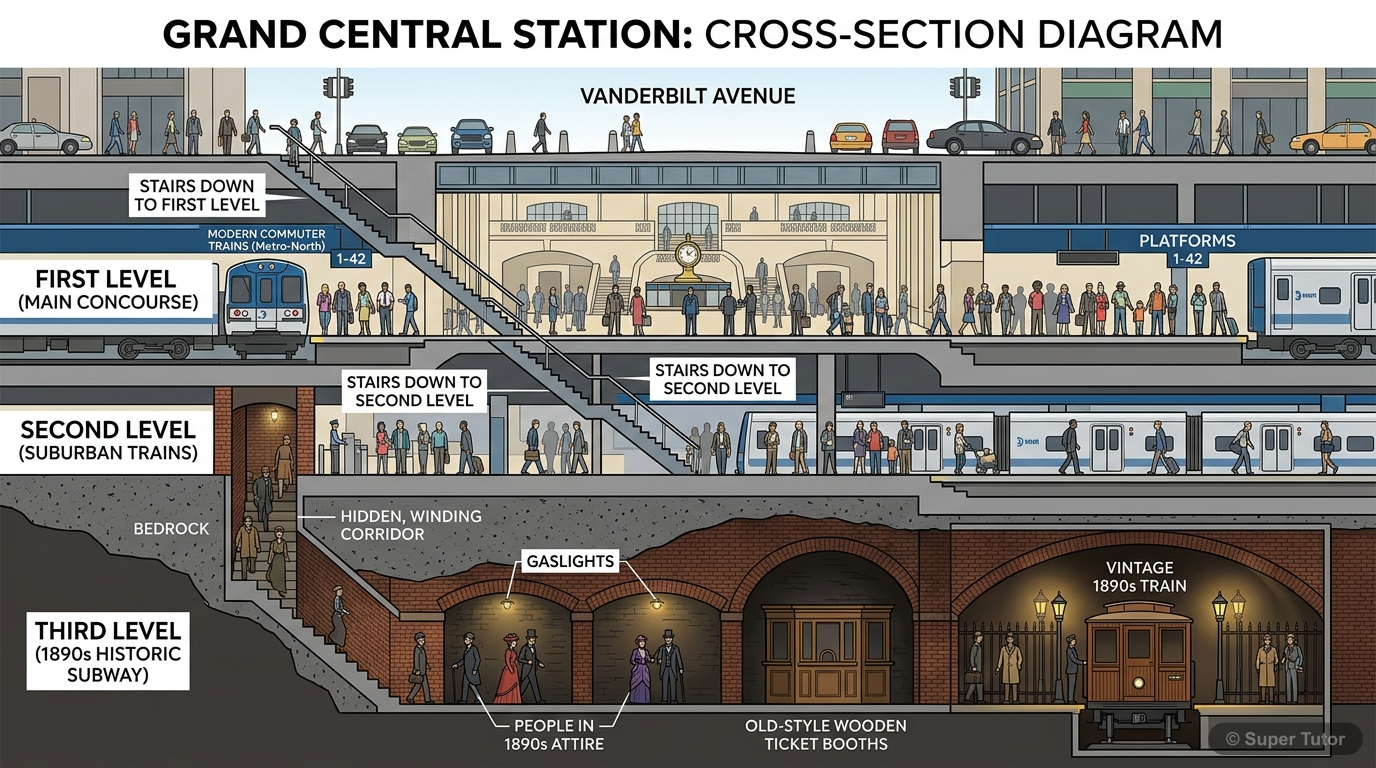
Learn better with visuals Super Tutor has hundreds of illustrations like this across every chapter — all free to try.
Get startedReading with Insight
1Do you think that the third level was a medium of escape for Charley? Why?Show solution
Answer:
Yes, the third level can certainly be seen as a medium of escape for Charley. The following points support this view:
1. Psychological pressure of modern life: Charley himself acknowledges that the modern world is full of "insecurity, fear, war, worry and all the rest of it." The third level represents an escape from these harsh realities into a gentler, more peaceful past.
2. Psychiatrist's diagnosis: Charley's psychiatrist friend calls his experience a "waking-dream wish fulfillment," suggesting that Charley's subconscious mind created the illusion of the third level as a refuge from the anxieties of contemporary life.
3. Stamp collecting as a parallel: Even Charley's hobby of stamp collecting is described as a "temporary refuge from reality," reinforcing the idea that Charley habitually seeks escape from the present.
4. The appeal of 1894: The year 1894 — with its slower pace, cheaper prices (eggs at thirteen cents a dozen), front-porch singing, and small-town warmth — represents everything that the stressful modern world lacks. Charley is drawn to this idyllic image.
5. Persistent search: Despite his wife Louisa's worry and his inability to find the corridor again, Charley keeps searching, showing how desperately he wants to escape.
Thus, whether the third level is real or imagined, it functions as a powerful symbol of escape — a place where Charley (and eventually Sam) can flee the tensions of modern existence and find peace in the past.
2What do you infer from Sam's letter to Charley?Show solution
Inferences from Sam's letter:
1. The third level is real: Sam's letter, postmarked 1894, serves as concrete proof that the third level at Grand Central Station actually exists and is not merely a figment of Charley's imagination. This validates Charley's experience.
2. Sam himself escaped to the past: Sam, who had dismissed Charley's experience as a "waking-dream wish fulfillment," eventually came to believe in the third level and found it himself. This is deeply ironic — the psychiatrist who diagnosed his patient's desire to escape ended up escaping himself.
3. The universal desire to escape: Sam's action confirms that the longing to flee the anxieties of modern life is universal. Even a trained psychiatrist, who understood the psychology of escape, was not immune to it.
4. Sam found fulfilment: The letter is cheerful and warm — Sam describes music, singing, lemonade, and community life. He has found the peaceful, simple existence he always desired (he had wished to run a hay, feed and grain business).
5. An invitation: Sam urges Charley and Louisa to "keep looking" and come back, suggesting that the third level offers genuine happiness and is worth finding.
Conclusion: Sam's letter is both proof of the third level's existence and a testament to the deep human need for peace, simplicity, and escape from the pressures of modern life.
3'The modern world is full of insecurity, fear, war, worry and stress.' What are the ways in which we attempt to overcome them?Show solution
Ways in which we attempt to overcome stress and anxiety:
1. Hobbies and creative pursuits: Like Charley's stamp collecting, hobbies such as painting, gardening, music, reading, or photography provide a "temporary refuge from reality" and help us relax and focus on something positive.
2. Travel and tourism: Visiting new places — or even familiar, peaceful ones — allows people to step away from their daily worries and refresh their minds.
3. Meditation and yoga: These ancient practices help calm the mind, reduce anxiety, and bring a sense of inner peace amidst external chaos.
4. Sports and physical exercise: Physical activity releases endorphins, reduces stress hormones, and improves mental well-being.
5. Social bonding: Spending time with family and friends, sharing meals, conversations, and laughter, provides emotional support and a sense of belonging.
6. Art, literature, and cinema: Engaging with stories, films, and art allows people to temporarily inhabit other worlds and perspectives, providing relief from personal anxieties.
7. Nostalgia and revisiting the past: As seen in the story, people often romanticise simpler times — looking at old photographs, listening to old music, or visiting childhood places — to find comfort.
8. Spirituality and religion: Many people find solace in prayer, religious rituals, and a belief in a higher power.
Conclusion: While none of these methods permanently eliminates the problems of the modern world, they provide necessary relief and help maintain mental and emotional balance. The key is to use these as healthy coping mechanisms rather than permanent escapes from reality.
4Do you see an intersection of time and space in the story?Show solution
Yes, there is a clear and fascinating intersection of time and space in the story:
1. Grand Central Station as the point of intersection: Grand Central Station in New York (a specific space) becomes the portal through which time is crossed. The third level is not just a different floor — it is a different era (1894). Thus, a single physical location connects two different points in time.
2. 1894 Galesburg and present-day New York: The story moves between two distinct spaces — modern New York City and small-town Galesburg, Illinois in 1894 — and two distinct times — the present and the late 19th century. These intersect through the mysterious corridor.
3. Sam's letter: The letter, written in 1894 but found in the present, is the most powerful example of time and space intersecting. A physical object (the letter) travels across time (from 1894 to the present) and space (from Galesburg to New York) to reach Charley.
4. The first-day cover: The stamp collection — objects from the past preserved in the present — also represents this intersection. The past physically exists in the present through these artefacts.
5. Charley's experience on the third level: When Charley steps onto the third level, he is simultaneously in the space of Grand Central Station and in the time of 1894 — a literal intersection of time and space.
Conclusion: The story masterfully uses the concept of time-space intersection to blur the boundaries between past and present, reality and fantasy, suggesting that time and space are not always linear or fixed.
5Apparent illogicality sometimes turns out to be a futuristic projection? Discuss.Show solution
Discussion:
What appears illogical or irrational at first glance often contains within it a deeper truth or a vision that is ahead of its time. This idea is central to the story.
1. Charley's experience dismissed as delusion: When Charley insists there is a third level at Grand Central Station, everyone — his psychiatrist, his friends, even his wife — dismisses it as a "waking-dream wish fulfillment." It seems completely illogical because the railroads officially confirm only two levels.
2. Proven true by Sam's letter: However, Sam's letter from 1894 proves that the third level is real. What was labelled as Charley's psychological disorder turns out to be a genuine discovery — a portal through time.
3. Science fiction as futuristic projection: Many ideas that once seemed illogical — time travel, space exploration, the internet, artificial intelligence — were first imagined in fiction before becoming reality. Jules Verne wrote about submarines and moon travel long before they existed. What seemed like fantasy was actually a projection of future possibilities.
4. The concept of time travel: Modern physics (Einstein's theory of relativity, the concept of wormholes) suggests that time is not strictly linear. What Charley experiences — moving through a corridor into a different time — may not be as illogical as it seems from a purely Newtonian perspective.
5. Psychological insight: Even if we read the story metaphorically, Charley's "illogical" desire to escape to a simpler time reflects a very real and universal human need — one that psychologists and sociologists now widely acknowledge.
Conclusion: The story teaches us that we should not be too quick to dismiss what appears illogical. Many of the greatest discoveries and ideas in human history began as apparent absurdities. Apparent illogicality, viewed with an open mind, can indeed be a futuristic or visionary projection.
6Philately helps keep the past alive. Discuss other ways in which this is done. What do you think of the human tendency to constantly move between the past, the present and the future?Show solution
Other ways in which the past is kept alive:
1. Museums and archives: Museums preserve artefacts, documents, paintings, and objects from history, allowing future generations to connect with the past.
2. Literature and oral tradition: Books, folk tales, myths, legends, and oral histories pass down the experiences, values, and events of past generations.
3. Photography and cinema: Old photographs and films capture moments in time, preserving them for posterity.
4. Historical monuments and heritage sites: Buildings, temples, forts, and UNESCO World Heritage Sites stand as physical reminders of past civilisations and cultures.
5. Music and art: Traditional music, classical art forms, and folk arts carry the cultural memory of communities across generations.
6. Festivals and rituals: Religious and cultural festivals re-enact historical or mythological events, keeping collective memory alive.
7. Genealogy and family histories: Maintaining family trees, diaries, and letters connects individuals to their ancestors.
The human tendency to move between past, present, and future:
This tendency is deeply rooted in human psychology. We look to the past for comfort, identity, and lessons; we live in the present with its joys and anxieties; and we look to the future with hope, ambition, or fear. This movement is what makes us uniquely human — we are the only species capable of reflecting on history and imagining the future.
However, an excessive focus on the past (nostalgia) or the future (anxiety) can prevent us from fully living in the present. The story itself illustrates this: Charley's longing for the peaceful past of 1894 is understandable, but it also reflects an inability to cope with the present.
Conclusion: While it is natural and enriching to honour the past and plan for the future, a healthy balance — being rooted in the present while drawing wisdom from the past and hope from the future — is the ideal approach.
7You have read 'Adventure' by Jayant Narlikar in Hornbill Class XI. Compare the interweaving of fantasy and reality in the two stories.Show solution
Comparison of the interweaving of fantasy and reality:
| Aspect | The Third Level | Adventure |
|---|---|---|
| Central fantasy element | A mysterious third level at Grand Central Station that leads to 1894 | Professor Gaitonde travels to a parallel world where the Marathas won the Battle of Panipat and India was never colonised |
| Grounding in reality | Grand Central Station is a real place; the anxieties of modern life are real | The historical Battle of Panipat is real; the scientific concept of catastrophe theory grounds the fantasy |
| Scientific/logical basis | No explicit scientific explanation; the fantasy is left ambiguous | The story uses the scientific concept of "catastrophe theory" and "many-worlds" interpretation of quantum mechanics to explain the parallel world |
| Purpose of fantasy | Escape from the stress and insecurity of modern life | Exploration of an alternate historical reality; intellectual curiosity |
| Resolution | The fantasy is validated by Sam's letter — reality and fantasy merge | The professor returns to his own world; the two realities remain separate |
| Tone | Wistful, nostalgic, and slightly melancholic | Intellectual, adventurous, and thought-provoking |
| Role of the protagonist | Charley is a passive dreamer who stumbles upon the fantasy | Professor Gaitonde is an active intellectual who analyses and engages with the alternate reality |
Key similarities:
- Both stories blur the line between fantasy and reality so effectively that the reader is left uncertain about what is "real."
- Both use a real, familiar setting (Grand Central Station; historical India) as the launching pad for fantasy.
- Both suggest that reality is not singular or fixed — there may be multiple realities existing simultaneously.
- Both protagonists are changed by their experience of the alternate reality.
Key differences:
- 'The Third Level' is driven by emotion and escapism, while 'Adventure' is driven by intellect and scientific curiosity.
- In 'The Third Level,' the fantasy offers comfort and peace; in 'Adventure,' it offers knowledge and perspective.
Conclusion: Both stories masterfully interweave fantasy and reality, but while Finney uses fantasy as an emotional refuge, Narlikar uses it as an intellectual exercise. Together, they demonstrate the rich possibilities of speculative fiction in exploring the human condition.
Stuck on a step?
Ask Super Tutor AI to explain any solution on this page in a simpler way — free, 24x7.
Ask a Doubt FreeFrequently Asked Questions
What are the important topics in The Third Level for Tripura Board Class 12 English?
How to score full marks in The Third Level — Tripura Board Class 12 English?
Where can I get free NCERT Solutions for The Third Level Class 12 English?
Sources & Official References
Content is aligned to the official syllabus. Refer to the board website for the latest curriculum.
More resources for The Third Level
Important Questions
Practice with board exam-style questions
Syllabus
What topics to cover
Revision Notes
Key points for last-minute revision
Study Plan
Step-by-step plan to ace this chapter
Flashcards
Quick-fire cards for active recall
Formula Sheet
All formulas in one place
Chapter Summary
Understand the chapter at a glance
Practice Quiz
Test yourself with a quick quiz
Concept Maps
See how topics connect visually
For serious students
Get the full The Third Level chapter — for free.
Quizzes, flashcards, AI doubt-solver and a step-by-step study plan for Tripura Board Class 12 English.