Rebels and the Raj: 1857 Revolt and its Representations — Flashcards
Tripura Board · Class 12 · History
76 flashcards for Rebels and the Raj: 1857 Revolt and its Representations (Tripura Board Class 12 History) to test yourself on key terms and facts.
Interactive on Super Tutor
Studying Rebels and the Raj: 1857 Revolt and its Representations? Get the full interactive chapter.
Quizzes, flashcards, AI doubt-solver and a step-by-step study plan — built for flashcards and more.
Free trial, no card needed.
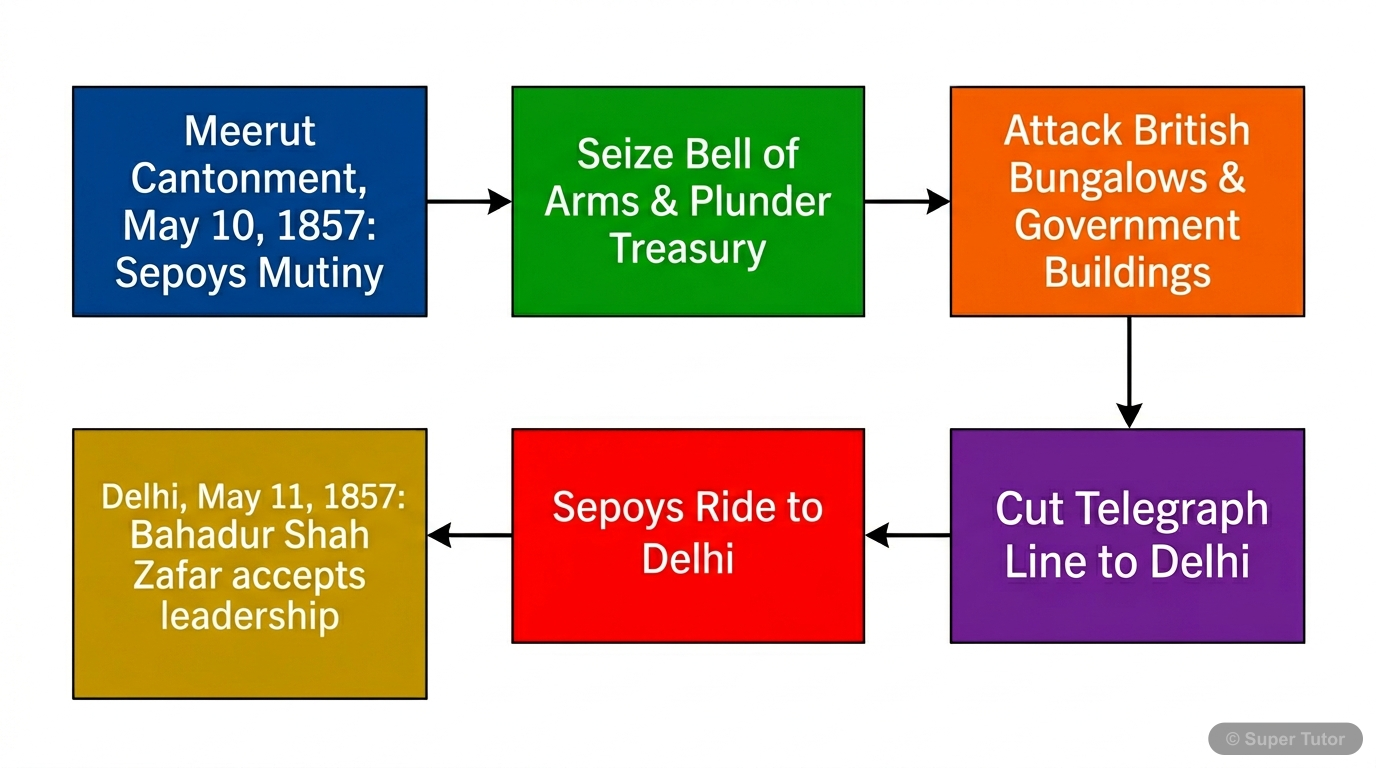
One of 12 illustrations for Rebels and the Raj: 1857 Revolt and its Representations in Super Tutor — alongside flashcards, concept maps and practice questions.
What happened in Meerut on 10 May 1857, and why was it important?
Answer
The Meerut mutiny began late in the afternoon of 10 May 1857. Sepoys broke out in mutiny, seized the bell of arms, attacked government targets, and moved towards Delhi. This marked the start of a wide…
10 मई 1857 को मेरठ में क्या हुआ था और यह क्यों महत्वपूर्ण था?
Answer
मेरठ विद्रोह 10 मई 1857 की दोपहर बाद शुरू हुआ। सिपाहियों ने विद्रोह कर दिया, हथियारों की घंटी जब्त कर ली, सरकारी लक्ष्यों पर हमला किया और दिल्ली की ओर बढ़ गए। यह उत्तर भारत में एक व्यापक विद्रोह की शु…
11 मई 1857 को सिपाही दिल्ली में बहादुर शाह के पास क्यों गए?
Answer
सिपाही 11 मई 1857 की सुबह दिल्ली के लाल किले में पहुँचे और बहादुर शाह से अपने विद्रोह को आशीर्वाद देने के लिए कहा। उन्होंने मेरठ में अंग्रेजों को मार डाला था और दावा किया था कि चिकनाई वाले कारतूसों ने…
Why did the sepoys go to Bahadur Shah in Delhi on 11 May 1857?
Answer
The sepoys reached the Red Fort in Delhi on the morning of 11 May 1857 and asked Bahadur Shah to bless their rebellion. They had killed the Englishmen at Meerut and claimed that the greased cartridges…
What is the difference between mutiny and revolt in the context of 1857?
Answer
Mutiny refers to the uprising of the sepoys in the armed forces. Revolt refers to the uprising of the civilian population such as peasants, zamindars, rajas, and jagirdars. The two are connected, but …
1857 के संदर्भ में विद्रोह और बगावत में क्या अंतर है?
Answer
विद्रोह (Mutiny) से आशय सशस्त्र सेनाओं में सिपाहियों के विद्रोह से है। विद्रोह से आशय नागरिक आबादी जैसे कि किसान, जमींदार, राजा, जागीरदार आदि के विद्रोह से है। दोनों का सम्बन्ध है किन्तु दोनों एक नहीं…
बेल ऑफ आर्म्स क्या है?
Answer
शस्त्र भंडार एक भंडारगृह है जहां हथियार रखे जाते हैं। 1857 के दौरान कई स्थानों पर सिपाहियों ने सबसे पहले शस्त्र भंडार पर कब्जा कर लिया, क्योंकि हथियारों पर नियंत्रण विद्रोह का पहला कदम था।…
What is a bell of arms?
Answer
A bell of arms is a storeroom where weapons are kept. In many places during 1857, sepoys seized the bell of arms first, because control over weapons was the first step in rebellion.
+68 more flashcards
Practise AllFrequently Asked Questions
What are the important topics in Rebels and the Raj: 1857 Revolt and its Representations for Tripura Board Class 12 History?
How many flashcards are available for Rebels and the Raj: 1857 Revolt and its Representations?
How should I revise Rebels and the Raj: 1857 Revolt and its Representations for the Tripura Board Class 12 board exam?
Sources & Official References
Content is aligned to the official syllabus. Refer to the board website for the latest curriculum.
More resources for Rebels and the Raj: 1857 Revolt and its Representations
Practice Quiz
Test yourself with a quick quiz
Important Questions
Exam-style questions with answers
Revision Notes
Key points for last-minute revision
Chapter Summary
Understand the chapter at a glance
Concept Maps
See how topics connect
Study Plan
Step-by-step plan for this chapter
Syllabus
What topics to cover
NCERT Solutions
Every textbook question solved step by step
For serious students
Get the full Rebels and the Raj: 1857 Revolt and its Representations chapter — start free.
Quizzes, flashcards, an AI doubt solver and a study plan for Tripura Board Class 12 History. Free to start, no card needed.