Social Institutions: Continuity and Change — Revision Notes
Tripura Board · Class 12 · Sociology
Social Institutions: Continuity and Change revision notes for Tripura Board Class 12 Sociology: 4 topics in quick points.
Interactive on Super Tutor
Studying Social Institutions: Continuity and Change? Get the full interactive chapter.
Quizzes, flashcards, AI doubt-solver and a step-by-step study plan — built for revision notes and more.
Free trial, no card needed.
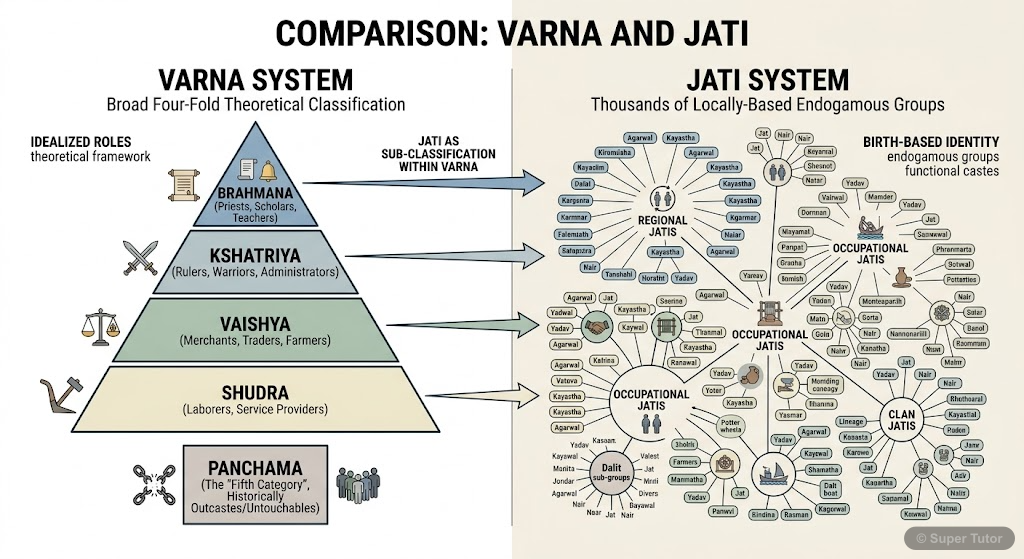
Learn better with visuals Super Tutor pairs illustrations like this with notes and quizzes for Social Institutions: Continuity and Change.
Key Topics to Revise
1. Caste: Meaning, Features, and Historical Change
- Caste is uniquely associated with the Indian sub-continent, though similar social effects exist elsewhere.
- Caste, though characteristic of Hindu society, has spread to Muslims, Christians, and Sikhs.
- The word caste comes from the Portuguese casta, meaning pure breed.
2. Social Reformers and Anti-Caste Movements
- Ayyankali was a leader of the lower castes and Dalits in Kerala; his efforts won Dalits freedom to walk on public roads and allowed Dalit children to join schools.
- Jotirao Govindrao Phule denounced caste injustice and purity and pollution rules.
- Phule founded the Satyashodhak Samaj in 1873 for human rights and social justice for low-caste people.
3. Caste in the Present: Politics, Class, and Social Visibility
- Independent India abolished caste in principle, but the state did not dismantle the economic basis of caste inequality.
- Government jobs were treated in a caste-blind manner, except for reservations for Scheduled Castes and Scheduled Tribes.
- Modern industry and urbanisation created new spaces where old caste rules became weaker.
4. Tribal Communities: Meaning, Classification, and Change
- Tribe is a modern term for very old communities, among the oldest inhabitants of the sub-continent.
- Tribes were defined negatively: they did not practice a religion with a written text, did not have a normal state form, and did not have sharp class divisions.
- By the 1970s, major definitions of tribe were shown to be faulty because size, isolation, religion, and livelihood did not fit all tribes.
Get complete notes with diagrams and examples
Full NotesKey Concepts
Frequently Asked Questions
What are the important topics in Social Institutions: Continuity and Change for Tripura Board Class 12 Sociology?
How should I revise Social Institutions: Continuity and Change for the Tripura Board Class 12 board exam?
Sources & Official References
Content is aligned to the official syllabus. Refer to the board website for the latest curriculum.
More resources for Social Institutions: Continuity and Change
Practice Quiz
Test yourself with a quick quiz
Important Questions
Exam-style questions with answers
Chapter Summary
Understand the chapter at a glance
Concept Maps
See how topics connect
Study Plan
Step-by-step plan for this chapter
Flashcards
Quick-fire cards for active recall
Syllabus
What topics to cover
NCERT Solutions
Every textbook question solved step by step
For serious students
Get the full Social Institutions: Continuity and Change chapter — start free.
Quizzes, flashcards, an AI doubt solver and a study plan for Tripura Board Class 12 Sociology. Free to start, no card needed.