Motion — NCERT Solutions
Tripura Board · Class 9 · Science
NCERT Solutions for Motion, Tripura Board Class 9 Science: 10 textbook questions solved step by step. Covers Exercises.
Interactive on Super Tutor
Studying Motion? Get the full interactive chapter.
Quizzes, flashcards, AI doubt-solver and a step-by-step study plan — built for NCERT solutions and more.
Free trial, no card needed.
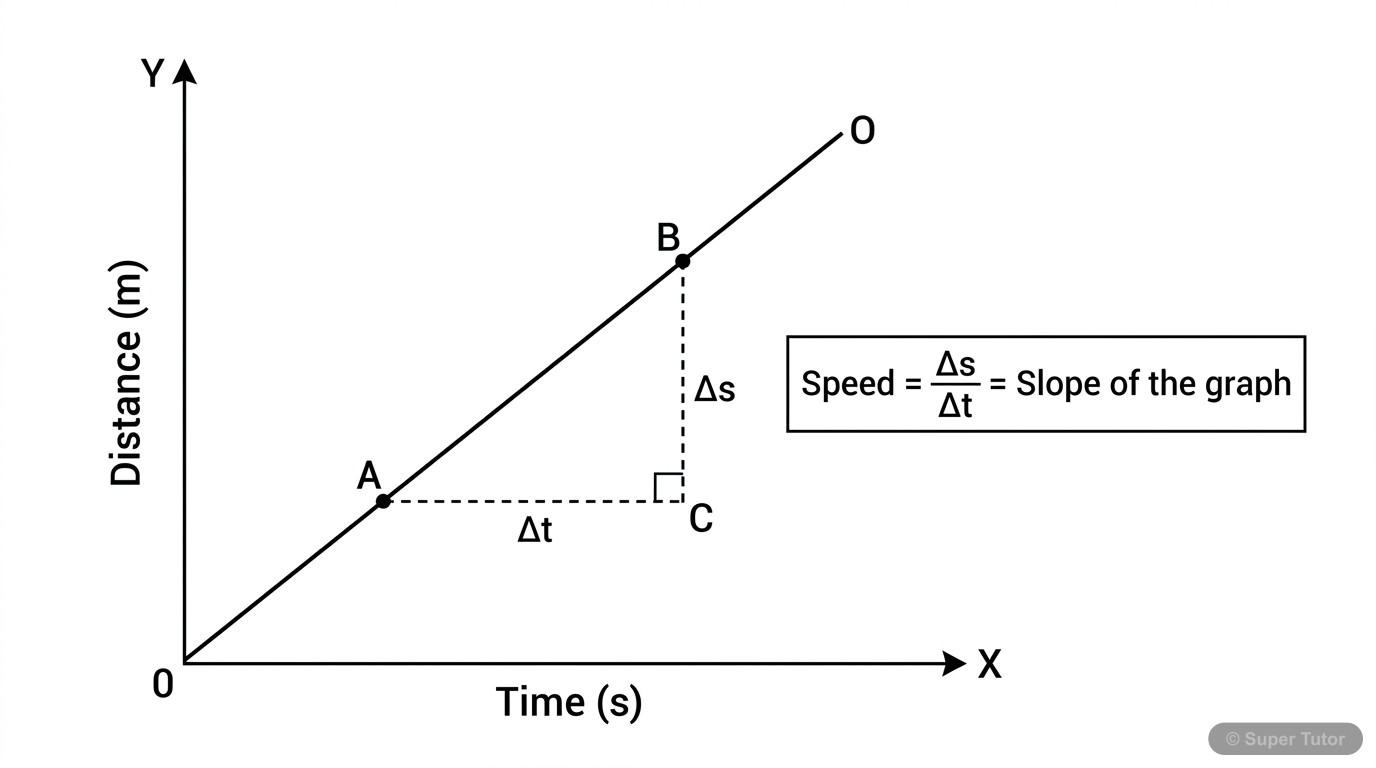
One of 4 illustrations for Motion in Super Tutor — alongside flashcards, concept maps and practice questions.
The first 5 solutions are open to read. The other 5 are free with a Super Tutor account.
Exercises
1An athlete completes one round of a circular track of diameter 200 m in 40 s. What will be the distance covered and the displacement at the end of 2 minutes 20 s?Show solution
Given:
- Diameter of circular track = 200 m, so radius m
- Time for one round = 40 s
- Total time = 2 min 20 s = 140 s
Step 1: Find the number of rounds completed.
Step 2: Find the distance covered.
Circumference of the track (distance per round):
Step 3: Find the displacement.
After 3.5 rounds, the athlete is at the diametrically opposite end of the starting point.
Answer:
- Distance covered = 2200 m
- Displacement = 200 m
2Joseph jogs from one end A to the other end B of a straight 300 m road in 2 minutes 30 seconds and then turns around and jogs 100 m back to point C in another 1 minute. What are Joseph's average speeds and velocities in jogging (a) from A to B and (b) from A to C?Show solution
Given:
- A to B: distance = 300 m, time = 2 min 30 s = 150 s
- B to C: distance = 100 m (back towards A), time = 1 min = 60 s
(a) From A to B:
Displacement from A to B = 300 m (straight road)
(b) From A to C:
Total distance = AB + BC = 300 + 100 = 400 m
Total time = 150 + 60 = 210 s
Displacement from A to C = AB − BC = 300 − 100 = 200 m (from A towards B)
Answer:
- (a) Average speed = ; Average velocity = (A to B direction)
- (b) Average speed ≈ ; Average velocity ≈ (A to B direction)
3Abdul, while driving to school, computes the average speed for his trip to be 20 km h⁻¹. On his return trip along the same route, there is less traffic and the average speed is 30 km h⁻¹. What is the average speed for Abdul's trip?Show solution
Given:
- Speed from home to school,
- Speed from school to home,
- Distance one way = (same route)
Concept: Average speed = Total distance / Total time
Step 1: Find total distance.
Step 2: Find total time.
Step 3: Calculate average speed.
Answer: The average speed for Abdul's entire trip is .
4A motorboat starting from rest on a lake accelerates in a straight line at a constant rate of 3.0 m s⁻² for 8.0 s. How far does the boat travel during this time?Show solution
Given:
- Initial velocity, (starts from rest)
- Acceleration,
- Time,
Formula used (second equation of motion):
Calculation:
Answer: The boat travels 96 m during this time.
5A driver of a car travelling at 52 km h⁻¹ applies the brakes. (a) Shade the area on the graph that represents the distance travelled by the car during the period. (b) Which part of the graph represents uniform motion of the car?Show solution
Note: This question refers to a speed-time graph (Fig. 7.11 in the textbook) that is not fully visible here. The standard answers based on the described graph are given below.
(a) Distance travelled during braking:
The distance travelled by the car after brakes are applied is represented by the area under the speed-time graph between the point where brakes are applied and the point where the car comes to rest. This area is a triangle (since speed decreases uniformly from 52 km h⁻¹ to 0). This triangular area should be shaded.
(b) Uniform motion:
The part of the graph where the speed-time graph is a horizontal straight line (constant speed) represents the uniform motion of the car. This is the portion before the brakes are applied, where speed remains constant at 52 km h⁻¹.
Free with a Super Tutor account
Free with a Super Tutor account
Free with a Super Tutor account
Free with a Super Tutor account
Free with a Super Tutor account
5 more solved questions in Motion
They are free with a Super Tutor account, along with practice quizzes and flashcards for this chapter. Free to start, no card needed.
Frequently Asked Questions
What are the important topics in Motion for Tripura Board Class 9 Science?
Are these NCERT Solutions for Motion free?
How should I revise Motion for Class 9 exams?
Sources & Official References
Content is aligned to the official syllabus. Refer to the board website for the latest curriculum.
More resources for Motion
Practice Quiz
Test yourself with a quick quiz
Important Questions
Exam-style questions with answers
Revision Notes
Key points for last-minute revision
Formula Sheet
The chapter's formulas in one place
Chapter Summary
Understand the chapter at a glance
Concept Maps
See how topics connect
Study Plan
Step-by-step plan for this chapter
Flashcards
Quick-fire cards for active recall
Syllabus
What topics to cover
For serious students
Get the full Motion chapter — start free.
Quizzes, flashcards, an AI doubt solver and a study plan for Tripura Board Class 9 Science. Free to start, no card needed.