Quadratic Equations — NCERT Solutions
Uttarakhand Board · Class 10 · Mathematics
NCERT Solutions for Quadratic Equations, Uttarakhand Board Class 10 Mathematics: 30 textbook questions solved step by step.
Interactive on Super Tutor
Studying Quadratic Equations? Get the full interactive chapter.
Quizzes, flashcards, AI doubt-solver and a step-by-step study plan — built for NCERT solutions and more.
Free trial, no card needed.
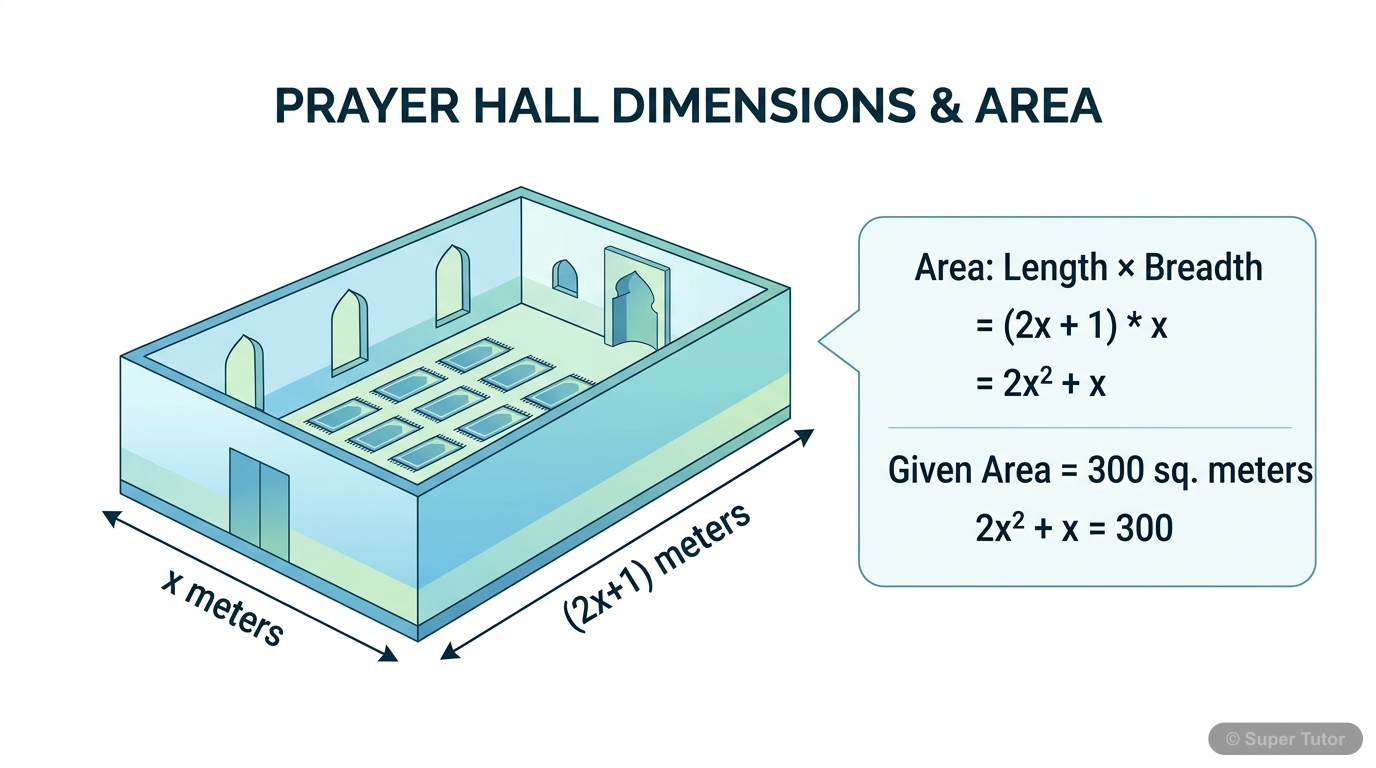
One of 5 illustrations for Quadratic Equations in Super Tutor — alongside flashcards, concept maps and practice questions.
The first 15 solutions are open to read. The other 15 are free with a Super Tutor account.
Exercise 4.1
1(i)Check whether is a quadratic equation.Show solution
Given:
Simplifying LHS and RHS:
This is of the form where and .
Conclusion: The given equation is a quadratic equation.
1(ii)Check whether is a quadratic equation.Show solution
Given:
Simplifying RHS:
This is of the form where and .
Conclusion: The given equation is a quadratic equation.
1(iii)Check whether is a quadratic equation.Show solution
Given:
Expanding LHS:
Expanding RHS:
Setting LHS = RHS:
This is not of the form (the terms cancel, so ).
Conclusion: The given equation is not a quadratic equation.
1(iv)Check whether is a quadratic equation.Show solution
Given:
Expanding LHS:
Expanding RHS:
Setting LHS = RHS:
This is of the form where and .
Conclusion: The given equation is a quadratic equation.
1(v)Check whether is a quadratic equation.Show solution
Given:
Expanding LHS:
Expanding RHS:
Setting LHS = RHS:
This is of the form where and .
Conclusion: The given equation is a quadratic equation.
1(vi)Check whether is a quadratic equation.Show solution
Given:
Expanding RHS:
Setting LHS = RHS:
This is not of the form (the terms cancel).
Conclusion: The given equation is not a quadratic equation.
1(vii)Check whether is a quadratic equation.Show solution
Given:
Expanding LHS:
Expanding RHS:
Setting LHS = RHS:
This is a polynomial of degree 3 (cubic equation), not of the form .
Conclusion: The given equation is not a quadratic equation.
1(viii)Check whether is a quadratic equation.Show solution
Given:
Expanding RHS:
Setting LHS = RHS:
This is of the form where and .
Conclusion: The given equation is a quadratic equation.
2(i)The area of a rectangular plot is . The length of the plot (in metres) is one more than twice its breadth. Represent this situation as a quadratic equation.Show solution
Let the breadth of the plot metres.
Then the length of the plot metres.
Given: Area
This is the required quadratic equation, where represents the breadth of the plot.
2(ii)The product of two consecutive positive integers is 306. Represent this situation as a quadratic equation.Show solution
Let the two consecutive positive integers be and .
Given: Their product
This is the required quadratic equation, where is the smaller of the two consecutive integers.
2(iii)Rohan's mother is 26 years older than him. The product of their ages 3 years from now will be 360. Represent this situation as a quadratic equation to find Rohan's present age.Show solution
Let Rohan's present age years.
Then his mother's present age years.
3 years from now:
- Rohan's age years
- Mother's age years
Given: Product of their ages 3 years from now
This is the required quadratic equation, where is Rohan's present age.
2(iv)A train travels a distance of at a uniform speed. If the speed had been less, it would have taken 3 hours more to cover the same distance. Represent this situation as a quadratic equation to find the speed of the train.Show solution
Let the speed of the train .
Time taken at speed :
Time taken at speed :
Given:
This is the required quadratic equation, where is the speed of the train in km/h.
Exercise 4.2
1(i)Find the roots of the quadratic equation by factorisation.Show solution
Given:
Splitting the middle term: We need two numbers whose product is and sum is . These are and .
Setting each factor to zero:
The roots of the equation are and .
1(ii)Find the roots of the quadratic equation by factorisation.Show solution
Given:
Splitting the middle term: We need two numbers whose product is and sum is . These are and .
Setting each factor to zero:
The roots of the equation are and .
1(iii)Find the roots of the quadratic equation by factorisation.Show solution
Given:
Splitting the middle term: We need two numbers whose product is and sum is . These are and .
Setting each factor to zero:
The roots of the equation are and .
Free with a Super Tutor account
Free with a Super Tutor account
Free with a Super Tutor account
Free with a Super Tutor account
Free with a Super Tutor account
Free with a Super Tutor account
Free with a Super Tutor account
Exercise 4.3
Free with a Super Tutor account
Free with a Super Tutor account
Free with a Super Tutor account
Free with a Super Tutor account
Free with a Super Tutor account
Free with a Super Tutor account
Free with a Super Tutor account
Free with a Super Tutor account
15 more solved questions in Quadratic Equations
They are free with a Super Tutor account, along with practice quizzes and flashcards for this chapter. Free to start, no card needed.
Frequently Asked Questions
What are the important topics in Quadratic Equations for Uttarakhand Board Class 10 Mathematics?
Are these NCERT Solutions for Quadratic Equations free?
How should I revise Quadratic Equations for the Uttarakhand Board Class 10 board exam?
Sources & Official References
Content is aligned to the official syllabus. Refer to the board website for the latest curriculum.
More resources for Quadratic Equations
Practice Quiz
Test yourself with a quick quiz
Important Questions
Exam-style questions with answers
Revision Notes
Key points for last-minute revision
Formula Sheet
The chapter's formulas in one place
Chapter Summary
Understand the chapter at a glance
Concept Maps
See how topics connect
Study Plan
Step-by-step plan for this chapter
Flashcards
Quick-fire cards for active recall
Syllabus
What topics to cover
For serious students
Get the full Quadratic Equations chapter — start free.
Quizzes, flashcards, an AI doubt solver and a study plan for Uttarakhand Board Class 10 Mathematics. Free to start, no card needed.