Chapter 5 of 13
NCERT Solutions

Life Processes

Uttarakhand Board · Class 10 · Science

NCERT Solutions for Life Processes — Uttarakhand Board Class 10 Science.

63 questions20 flashcards5 concepts

Interactive on Super Tutor

Studying Life Processes? Get the full interactive chapter.

Quizzes, flashcards, AI doubt-solver and a step-by-step study plan — built for ncert solutions and more.

1,000+ Class 10 students started this chapter today

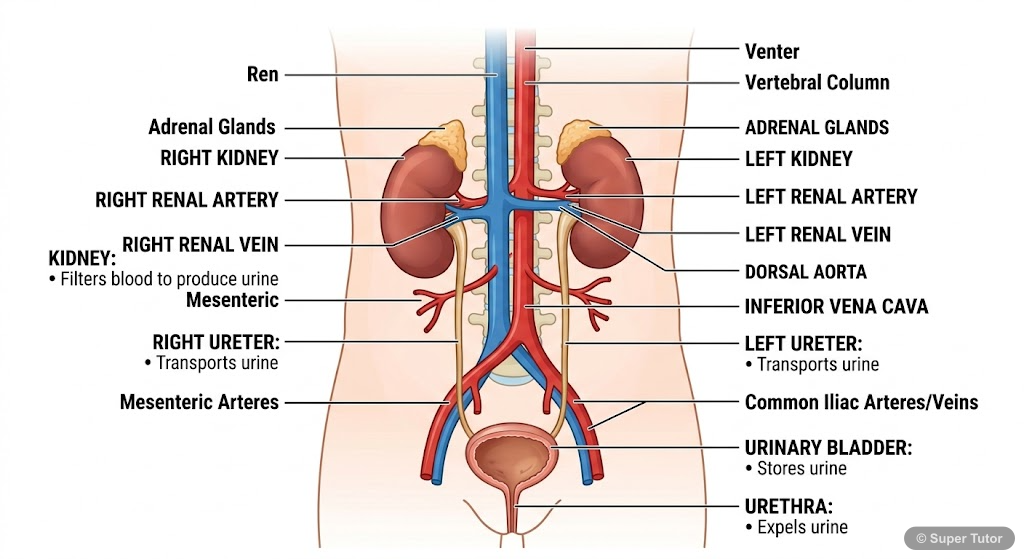
A labeled diagram of the human excretory system, showing the kidneys, ureters, urinary bladder, and urethra, along with major associated blood vessels (aorta, vena cava).
Super Tutor

Learn better with visuals Super Tutor has hundreds of illustrations like this across every chapter — all free to try.

Get started
16 Questions Solved · 2 Sections

QUESTIONS (Intext – Section 5.5.2)

1Describe the structure and functioning of nephrons.Show solution
Given / Context: Nephrons are the structural and functional units of the kidney.

Structure of a Nephron:

Each nephron consists of the following parts:

1. Bowman's Capsule: A cup-shaped, double-walled structure at the beginning of the nephron. It encloses a network of capillaries called the glomerulus.
2. Glomerulus: A tuft of capillaries formed by the afferent arteriole (bringing blood in) and drained by the efferent arteriole (taking blood out). Together, the glomerulus and Bowman's capsule form the Malpighian corpuscle.
3. Proximal Convoluted Tubule (PCT): The first coiled portion of the renal tubule, located in the cortex.
4. Loop of Henle: A U-shaped loop that dips into the medulla. It has a descending limb and an ascending limb.
5. Distal Convoluted Tubule (DCT): The second coiled portion, located in the cortex.
6. Collecting Duct: Several nephrons join into a collecting duct, which carries urine to the renal pelvis.

Functioning of a Nephron:

The nephron performs urine formation in three steps:

Step 1 – Ultrafiltration (Glomerular Filtration):
Blood enters the glomerulus under high pressure through the afferent arteriole. Due to this pressure, water, glucose, amino acids, urea, uric acid, salts, and other small molecules are filtered out of the blood into the Bowman's capsule. This filtrate is called glomerular filtrate. Large molecules like proteins and blood cells are NOT filtered.

Step 2 – Selective Reabsorption:
As the filtrate passes through the PCT, Loop of Henle, and DCT, useful substances such as glucose, amino acids, salts, and a large amount of water are reabsorbed back into the surrounding capillaries. This ensures that useful materials are not lost.

Step 3 – Tubular Secretion:
Certain waste substances like excess salts, hydrogen ions, and some drugs are actively secreted from the blood into the tubular filtrate.

The remaining concentrated liquid — urine — passes into the collecting duct, then to the renal pelvis, ureter, urinary bladder, and is finally expelled through the urethra.

Composition of urine: Water (~95%), urea, uric acid, creatinine, and salts.
2What are the methods used by plants to get rid of excretory products?Show solution
Given / Context: Plants have different strategies for excretion compared to animals.

Plants use the following methods to get rid of excretory products:

1. Gaseous exchange through stomata and lenticels:
- Oxygen (produced during photosynthesis) and Carbon dioxide (produced during respiration) are released through stomata in leaves and lenticels in stems.

2. Transpiration:
- Excess water is removed in the form of water vapour through the process of transpiration via stomata.

3. Storage in vacuoles:
- Many waste products are stored in cellular vacuoles of plant cells where they do not interfere with cell metabolism.

4. Storage in leaves:
- Waste products are stored in leaves, which eventually fall off (leaf fall / abscission), thereby removing the wastes from the plant body.

5. Storage as resins and gums:
- Some waste products are stored as resins and gums, especially in the cells of old xylem (heartwood).

6. Excretion into the soil:
- Plants also excrete some waste substances into the surrounding soil through their roots.

Conclusion: Unlike animals, plants do not have a specialised excretory system; instead, they use a combination of the above strategies.
3How is the amount of urine produced regulated?Show solution
Given / Context: The kidneys produce urine, but the amount produced must be regulated according to the body's needs.

Regulation of urine production:

The amount of urine produced is regulated primarily by the amount of water reabsorbed in the tubules of the nephron, which is controlled by hormonal feedback mechanisms.

Key mechanism:

1. When the water level in the blood is low (e.g., on a hot day or after less water intake), the pituitary gland releases ADH (Anti-Diuretic Hormone).
- ADH increases the permeability of the collecting duct and DCT, causing more water to be reabsorbed back into the blood.
- As a result, less urine is produced, and it is more concentrated.

2. When the water level in the blood is high (e.g., after drinking a lot of water), less ADH is released.
- Less water is reabsorbed from the tubules.
- As a result, more urine is produced, and it is more dilute.

3. The amount of dissolved wastes (like urea) also affects urine volume — more waste requires more water to dissolve and excrete it.

4. The glomerular filtration rate also influences the volume of filtrate and hence urine.

Conclusion: The amount of urine is regulated mainly by ADH, which controls water reabsorption in the nephron tubules, ensuring the body maintains water and salt balance (osmoregulation).

EXERCISES

1The kidneys in human beings are a part of the system for
(a) nutrition.
(b) respiration.
(c) excretion.
(d) transportation.
Show solution
Correct Option: (c) excretion.

Justification: The kidneys filter waste products (mainly urea, uric acid, and excess salts) from the blood and excrete them in the form of urine. Therefore, kidneys are the primary organs of the excretory system in human beings.
2The xylem in plants are responsible for
(a) transport of water.
(b) transport of food.
(c) transport of amino acids.
(d) transport of oxygen.
Show solution
Correct Option: (a) transport of water.

Justification: Xylem is a vascular tissue in plants responsible for the unidirectional transport of water and dissolved mineral salts from the roots to the aerial parts (stems and leaves). Transport of food (sugars and amino acids) is carried out by phloem.
3The autotrophic mode of nutrition requires
(a) carbon dioxide and water.
(b) chlorophyll.
(c) sunlight.
(d) all of the above.
Show solution
Correct Option: (d) all of the above.

Justification: Autotrophic nutrition (photosynthesis) requires carbon dioxide and water as raw materials, chlorophyll as the photosynthetic pigment to absorb light energy, and sunlight as the energy source. The overall equation is:
6CO2+6H2Osunlight, chlorophyllC6H12O6+6O26CO_2 + 6H_2O \xrightarrow{\text{sunlight, chlorophyll}} C_6H_{12}O_6 + 6O_2
All three conditions are essential, so the answer is all of the above.
4The breakdown of pyruvate to give carbon dioxide, water and energy takes place in
(a) cytoplasm.
(b) mitochondria.
(c) chloroplast.
(d) nucleus.
Show solution
Correct Option: (b) mitochondria.

Justification: Pyruvate (3-carbon compound) formed in the cytoplasm during glycolysis is transported into the mitochondria. Inside the mitochondria, it is completely oxidised (aerobic respiration) to give CO2CO_2, H2OH_2O, and a large amount of energy in the form of ATP. This is why mitochondria are called the powerhouse of the cell.
5How are fats digested in our bodies? Where does this process take place?Show solution
Given: Fats are complex biomolecules (lipids) that need to be broken down before absorption.

Location: Fat digestion takes place mainly in the small intestine (specifically the duodenum and jejunum).

Process of Fat Digestion:

Step 1 – Emulsification (Physical breakdown):
- Fats enter the small intestine as large fat globules.
- Bile juice (secreted by the liver and stored in the gall bladder) is released into the duodenum.
- Bile salts break large fat globules into smaller droplets — this process is called emulsification of fats.
- Emulsification increases the surface area of fat for enzyme action.

Step 2 – Chemical Digestion (Enzymatic breakdown):
- The pancreas secretes pancreatic lipase into the small intestine.
- Pancreatic lipase acts on the emulsified fat droplets and breaks them down into fatty acids and glycerol.

FatslipaseFatty acids+Glycerol\text{Fats} \xrightarrow{\text{lipase}} \text{Fatty acids} + \text{Glycerol}

Step 3 – Absorption:
- The fatty acids and glycerol are absorbed by the villi of the small intestine.
- They are reassembled into fats inside the intestinal cells and transported via the lymphatic system (lacteals) before entering the bloodstream.

Conclusion: Fat digestion occurs in the small intestine through emulsification by bile and enzymatic hydrolysis by lipase.
6What is the role of saliva in the digestion of food?Show solution
Given: Saliva is secreted by the salivary glands in the mouth.

Role of Saliva in Digestion:

1. Contains Salivary Amylase (Ptyalin):
- Saliva contains the enzyme salivary amylase which acts on starch (a complex carbohydrate) and breaks it down into maltose (a simpler sugar).
Starchsalivary amylaseMaltose\text{Starch} \xrightarrow{\text{salivary amylase}} \text{Maltose}
- This is the first step of chemical digestion and it begins in the mouth itself.

2. Moistens and Lubricates Food:
- Saliva moistens the food, making it easier to chew and swallow.
- It helps in forming a soft, slippery mass called a bolus that can be easily swallowed.

3. Maintains pH:
- Saliva keeps the mouth slightly alkaline (pH ~7), which is the optimum pH for salivary amylase to function.

4. Dissolves Food Substances:
- Saliva dissolves soluble components of food, allowing us to taste them (taste buds detect dissolved substances).

5. Cleanses the Mouth:
- Saliva helps clean the mouth and teeth, preventing bacterial growth.

Conclusion: The primary digestive role of saliva is to begin the digestion of carbohydrates (starch) through the enzyme salivary amylase, while also lubricating food for easy swallowing.
7What are the necessary conditions for autotrophic nutrition and what are its by-products?Show solution
Given: Autotrophic nutrition is the mode of nutrition in which organisms prepare their own food from inorganic substances using an external energy source.

Necessary Conditions for Autotrophic Nutrition (Photosynthesis):

| Condition | Role |
|---|---|
| Carbon dioxide (CO2CO_2) | Raw material; source of carbon for making glucose |
| Water (H2OH_2O) | Raw material; source of hydrogen; also provides electrons |
| Sunlight (Solar energy) | Energy source to drive the photosynthesis reaction |
| Chlorophyll | Green pigment that absorbs light energy and converts it to chemical energy |

All four conditions must be present simultaneously for photosynthesis to occur.

Overall Equation:
6CO2+6H2Osunlight + chlorophyllC6H12O6+6O26CO_2 + 6H_2O \xrightarrow{\text{sunlight + chlorophyll}} C_6H_{12}O_6 + 6O_2

By-products of Autotrophic Nutrition:

1. Oxygen (O2O_2): Released as a by-product during the splitting of water molecules (photolysis of water) in the light reaction. This oxygen is released into the atmosphere through stomata.

2. Water (H2OH_2O): A small amount of water is also produced as a by-product.

Conclusion: The necessary conditions are CO2CO_2, water, sunlight, and chlorophyll. The main by-product is oxygen, which is vital for all aerobic life on Earth.
8What are the differences between aerobic and anaerobic respiration? Name some organisms that use the anaerobic mode of respiration.Show solution
Given: Respiration is the process of breaking down food to release energy. It can be aerobic or anaerobic.

Differences between Aerobic and Anaerobic Respiration:

| Feature | Aerobic Respiration | Anaerobic Respiration |
|---|---|---|
| Oxygen requirement | Requires oxygen | Does not require oxygen |
| Site | Cytoplasm + Mitochondria | Cytoplasm only |
| Substrates broken down | Glucose completely oxidised | Glucose partially broken down |
| End products | CO2CO_2 + H2OH_2O + Energy | Ethanol + CO2CO_2 + Energy (in yeast); Lactic acid + Energy (in muscle cells) |
| Energy released | Large amount — 38 ATP molecules per glucose | Small amount — 2 ATP molecules per glucose |
| Efficiency | More efficient | Less efficient |
| Occurrence | Most plants, animals, and many microorganisms | Yeast, some bacteria, muscle cells during vigorous exercise |

Chemical Equations:

Aerobic:
C6H12O6+6O26CO2+6H2O+Energy (38 ATP)C_6H_{12}O_6 + 6O_2 \rightarrow 6CO_2 + 6H_2O + \text{Energy (38 ATP)}

Anaerobic (in yeast):
C6H12O62C2H5OH+2CO2+Energy (2 ATP)C_6H_{12}O_6 \rightarrow 2C_2H_5OH + 2CO_2 + \text{Energy (2 ATP)}

Anaerobic (in muscle cells):
C6H12O62C3H6O3 (lactic acid)+Energy (2 ATP)C_6H_{12}O_6 \rightarrow 2C_3H_6O_3 \text{ (lactic acid)} + \text{Energy (2 ATP)}

Organisms using Anaerobic Respiration:
- Yeast (*Saccharomyces cerevisiae*) — produces ethanol and CO2CO_2
- Some bacteria — e.g., *Lactobacillus* (produces lactic acid)
- Parasitic worms — e.g., tapeworm (*Taenia*)
- Human muscle cells — during intense/vigorous exercise when oxygen supply is insufficient (produces lactic acid, causing muscle cramps)
9How are the alveoli designed to maximise the exchange of gases?Show solution
Given: Alveoli are tiny air sacs in the lungs where gaseous exchange (between air and blood) takes place.

Design features of alveoli that maximise gas exchange:

1. Extremely large number:
- Each lung contains approximately 300–400 million alveoli, providing an enormous surface area of about 80 square metres — roughly the size of a tennis court.
- This large surface area allows rapid and efficient diffusion of gases.

2. Very thin walls (one cell thick):
- The walls of alveoli are made of a single layer of squamous epithelial cells, making them extremely thin.
- This reduces the distance over which diffusion must occur, speeding up gas exchange.

3. Rich blood supply (dense capillary network):
- Each alveolus is surrounded by a dense network of blood capillaries.
- This ensures a continuous supply of deoxygenated blood and rapid removal of oxygenated blood, maintaining the concentration gradient for diffusion.

4. Moist surface:
- The inner surface of alveoli is moist, which allows gases (O2O_2 and CO2CO_2) to dissolve and diffuse easily across the membrane.

5. Balloon-like (spherical) shape:
- The spherical shape maximises the surface area to volume ratio, allowing more gas exchange per unit volume.

Mechanism:
- O2O_2 diffuses from alveolar air (high concentration) → into blood capillaries (low concentration).
- CO2CO_2 diffuses from blood capillaries (high concentration) → into alveolar air (low concentration).

Conclusion: The large number, thin walls, moist surface, and rich capillary network of alveoli collectively maximise the efficiency of gaseous exchange.
10What would be the consequences of a deficiency of haemoglobin in our bodies?Show solution
Given: Haemoglobin (Hb) is the iron-containing red pigment present in red blood cells (RBCs) that transports oxygen.

Role of Haemoglobin:
- Haemoglobin binds with oxygen in the lungs to form oxyhaemoglobin and releases it to body tissues.
- It also carries a small amount of CO2CO_2 from tissues back to the lungs.

Consequences of Haemoglobin Deficiency:

1. Reduced oxygen supply to cells:
- Less haemoglobin means less oxygen is transported to body cells and tissues.
- Cells receive insufficient oxygen for aerobic respiration, leading to reduced energy (ATP) production.

2. Anaemia:
- Deficiency of haemoglobin leads to a condition called anaemia, characterised by fatigue, weakness, and pale skin.

3. Breathlessness and fatigue:
- The body tries to compensate by increasing the breathing rate and heart rate, causing a person to feel breathless even during mild activity.

4. Reduced cellular respiration:
- Cells may be forced to switch to anaerobic respiration, producing lactic acid and causing muscle cramps.

5. Impaired organ function:
- Vital organs like the brain, heart, and muscles receive less oxygen, impairing their function. This can lead to dizziness, headaches, and poor concentration.

6. Reduced CO2CO_2 transport:
- Removal of CO2CO_2 from tissues becomes less efficient, leading to a build-up of waste gases.

Conclusion: A deficiency of haemoglobin severely impairs oxygen transport, leading to anaemia, fatigue, breathlessness, and reduced efficiency of all body functions.
11Describe double circulation of blood in human beings. Why is it necessary?Show solution
Given: In human beings, the heart is a four-chambered organ that pumps blood through two separate circuits.

Double Circulation:

Double circulation means that blood passes through the heart twice in one complete circuit of the body. It consists of two circuits:

1. Pulmonary Circulation (Heart → Lungs → Heart):
- Deoxygenated blood from the body collects in the right atrium.
- It passes to the right ventricle, which pumps it to the lungs via the pulmonary artery.
- In the lungs, blood releases CO2CO_2 and picks up O2O_2 (becomes oxygenated).
- Oxygenated blood returns to the left atrium via the pulmonary veins.

2. Systemic Circulation (Heart → Body → Heart):
- Oxygenated blood from the left atrium passes to the left ventricle.
- The left ventricle pumps it to the entire body (all organs and tissues) via the aorta.
- Oxygen and nutrients are delivered to body cells; CO2CO_2 and wastes are collected.
- Deoxygenated blood returns to the right atrium via the vena cava.

Diagram summary:
BodyRight AtriumRight VentricleLungsLeft AtriumLeft VentricleBody\text{Body} \rightarrow \text{Right Atrium} \rightarrow \text{Right Ventricle} \rightarrow \text{Lungs} \rightarrow \text{Left Atrium} \rightarrow \text{Left Ventricle} \rightarrow \text{Body}

Why is Double Circulation Necessary?

1. Separation of oxygenated and deoxygenated blood:
- The four-chambered heart ensures that oxygenated and deoxygenated blood never mix, so tissues always receive pure, oxygen-rich blood.

2. Efficient oxygen supply:
- Blood is re-pressurised by the left ventricle after returning from the lungs, ensuring it reaches all parts of the body with sufficient pressure.

3. Supports high metabolic rate:
- Warm-blooded animals (like humans) have a high metabolic rate and need a constant, efficient supply of oxygen — double circulation fulfils this need.

Conclusion: Double circulation ensures complete separation of oxygenated and deoxygenated blood, providing efficient oxygen delivery to all body tissues.
12What are the differences between the transport of materials in xylem and phloem?Show solution
Given: Xylem and phloem are the two types of vascular tissue in plants responsible for transport.

Differences between Transport in Xylem and Phloem:

| Feature | Xylem | Phloem |
|---|---|---|
| Materials transported | Water and dissolved mineral salts | Food (mainly sucrose and amino acids) |
| Direction of transport | Unidirectional — only upward (roots → stem → leaves) | Bidirectional — upward and downward (from leaves to all parts) |
| Driving force | Transpiration pull (suction force created by evaporation of water from leaves); root pressure | Active transport (requires energy/ATP) to load food into phloem |
| Energy requirement | Does not require metabolic energy (passive process) | Requires metabolic energy (active process) |
| Cells involved | Tracheids and vessel elements (dead cells with no cell contents) | Sieve tube cells and companion cells (living cells) |
| Nature of cells | Dead cells | Living cells |
| Mechanism | Cohesion-tension mechanism; capillary action; root pressure | Pressure flow (mass flow) hypothesis |

Additional points:
- In xylem, water moves due to the transpiration pull created when water evaporates from leaves, pulling water up from the roots.
- In phloem, food prepared in leaves (source) is transported to storage organs, roots, and growing parts (sink) using energy.

Conclusion: Xylem transports water and minerals upward passively, while phloem transports food in both directions using metabolic energy.
13Compare the functioning of alveoli in the lungs and nephrons in the kidneys with respect to their structure and functioning.Show solution
Given: Alveoli are the functional units of the lungs; nephrons are the functional units of the kidneys. Both are highly specialised structures for exchange/filtration.

Comparison of Alveoli and Nephrons:

| Feature | Alveoli (in Lungs) | Nephrons (in Kidneys) |
|---|---|---|
| Location | Lungs | Kidneys |
| Function | Exchange of gases (O2O_2 and CO2CO_2) between air and blood | Filtration of blood; formation and excretion of urine |
| Structure | Tiny balloon-like sacs; thin single-layered walls; surrounded by capillaries | Cup-shaped Bowman's capsule enclosing glomerulus; long tubule (PCT, Loop of Henle, DCT); surrounded by capillaries |
| Wall thickness | Extremely thin (one cell thick — squamous epithelium) | Thin walls in Bowman's capsule and tubules (one cell thick) |
| Blood supply | Dense network of capillaries surrounding each alveolus | Glomerular capillaries (for filtration) + peritubular capillaries (for reabsorption) |
| Surface area | Very large (~80 m²) due to large number (~300–400 million) | Large due to long, coiled tubules and large number (~1 million per kidney) |
| Process | DiffusionO2O_2 moves from alveoli to blood; CO2CO_2 moves from blood to alveoli | UltrafiltrationSelective reabsorptionTubular secretion |
| What is removed from blood | CO2CO_2 (waste gas) | Urea, uric acid, excess salts, excess water (waste products) |
| What is added to blood | O2O_2 (useful gas) | Useful substances (glucose, amino acids, water) are reabsorbed back |
| Energy requirement | Passive (diffusion — no energy needed) | Partly passive (filtration) and partly active (reabsorption requires energy) |

Similarities:
1. Both alveoli and nephrons have thin walls to facilitate easy exchange/filtration.
2. Both are surrounded by a rich network of blood capillaries.
3. Both have a large surface area to maximise efficiency.
4. Both help in removing waste from the body (alveoli remove CO2CO_2; nephrons remove urea and other wastes).
5. Both are present in very large numbers to increase efficiency.

Conclusion: Both alveoli and nephrons are structurally adapted (thin walls, large surface area, rich blood supply) to perform their respective functions of gas exchange and blood filtration efficiently. While alveoli work by simple diffusion, nephrons use a more complex process of filtration, reabsorption, and secretion.

Stuck on a step?

Ask Super Tutor AI to explain any solution on this page in a simpler way — free, 24x7.

Ask a Doubt Free

Frequently Asked Questions

What are the important topics in Life Processes for Uttarakhand Board Class 10 Science?
Key topics in Life Processes include Life Processes Overview, Life Processes Overview, Life Processes Overview. These are the concepts Uttarakhand Board Class 10 examiners draw on most — study them first, then practise related questions.
How to score full marks in Life Processes — Uttarakhand Board Class 10 Science?
Understand the core concepts first, then work through the 63 practice questions available for this chapter. Revise formulas and definitions regularly, and use flashcards for quick recall before the exam.
Where can I get free NCERT Solutions for Life Processes Class 10 Science?
This page has free step-by-step NCERT Solutions for every exercise question in Life Processes (Uttarakhand Board Class 10 Science) — written the way examiners award marks: given, formula, working, answer.

Sources & Official References

Content is aligned to the official syllabus. Refer to the board website for the latest curriculum.

For serious students

Get the full Life Processes chapter — for free.

Quizzes, flashcards, AI doubt-solver and a step-by-step study plan for Uttarakhand Board Class 10 Science.