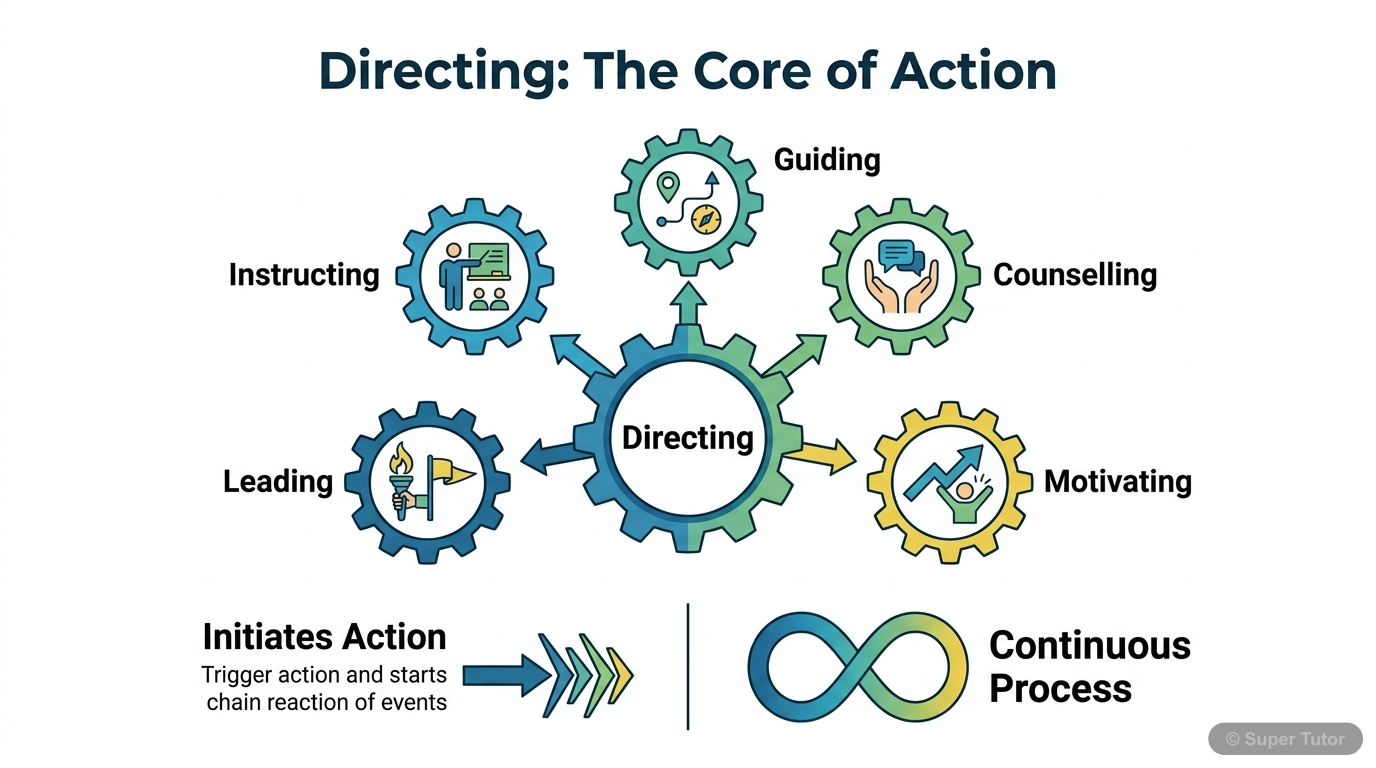
Directing
Uttarakhand Board · Class 12 · Business Studies
NCERT Solutions for Directing — Uttarakhand Board Class 12 Business Studies.
Interactive on Super Tutor
Studying Directing? Get the full interactive chapter.
Quizzes, flashcards, AI doubt-solver and a step-by-step study plan — built for ncert solutions and more.
1,000+ Class 12 students started this chapter today

Super Tutor has 18+ illustrations like this for Directing alone — flashcards, concept maps, and step-by-step visuals.
See them allVery Short Answer Type
1What is informal communication?Show solution
Informal communication refers to the communication that takes place outside the official or formal channels of an organisation. It is not prescribed by the organisation and arises out of social interactions among employees.
Key features:
- It is unofficial, spontaneous, and unrecorded.
- It spreads very fast and is usually in the form of rumours, whispers, or gossip.
- It does not follow any fixed path or hierarchy.
- It is also known as grapevine communication.
Example: Two employees discussing a management decision informally in the cafeteria.
2Which style of leadership does not believe in use of power unless it is absolutely essential?Show solution
Explanation: In the laissez-faire style, the leader gives complete freedom to subordinates to make decisions. The leader avoids using authority or power and interferes only when it is absolutely necessary. Subordinates are trusted to manage their own work with minimal supervision.
3Which element in the communication process involves converting the message into words, symbols, gestures etc.?Show solution
Explanation: Encoding is the element of the communication process in which the sender converts the idea or message into words, symbols, gestures, pictures, or any other form that can be transmitted to the receiver. It is the process of putting thoughts into a communicable format.
Example: A manager writing a memo or using sign language to convey a message is performing the act of encoding.
4The workers always try to show their inability when any new work is given to them. They are always unwilling to take up any kind of work. Due to sudden rise in demand a firm wants to meet excess orders. The supervisor is finding it difficult to cope up with the situation. State the element of directing that can help the supervisor in handling the problem.Show solution
Explanation:
- Given: Workers are unwilling to work, show inability when given new tasks, and the supervisor is struggling to meet excess orders due to sudden rise in demand.
- Element of Directing: Motivation is the element that can help the supervisor handle this problem.
Reason: Motivation is the process of stimulating people to action to accomplish desired goals. Since the workers are unwilling and show inability, the supervisor needs to motivate them by offering appropriate financial incentives (such as bonus, overtime pay) or non-financial incentives (such as recognition, praise, job enrichment) to encourage them to work harder and meet the excess orders.
Motivation will stimulate the internal drive of workers, change their attitude from unwillingness to willingness, and help the organisation meet its targets.
Short Answer Type
1What are semantic barriers of communication?Show solution
Semantic barriers arise from the use of language and relate to the meaning of words, symbols, and gestures used in communication. These barriers occur when the sender and receiver interpret the same message differently.
Main types of Semantic Barriers:
1. Badly expressed message: When the message is poorly worded, uses jargon, or is ambiguous, it leads to misunderstanding. For example, using technical terms that the receiver does not understand.
2. Symbols with different meanings: A single word may have multiple meanings. For example, the word 'value' can mean price, importance, or moral principles. If the sender and receiver interpret it differently, communication fails.
3. Faulty translation: When a message is translated from one language to another, the original meaning may be lost or distorted.
4. Unclarified assumptions: Sometimes the sender assumes that the receiver understands certain background information, which may not be the case, leading to confusion.
5. Technical jargon: Use of highly technical or specialised language that the receiver is not familiar with creates a barrier.
Conclusion: Semantic barriers can be overcome by using simple, clear, and precise language and by ensuring that the message is understood in the intended sense.
2Explain the process of motivation with the help of a diagram.Show solution
Motivation is the process of stimulating people to action to accomplish desired goals. It is based on the needs of individuals.
Steps in the Process of Motivation:
Step 1 – Unsatisfied Need: Every individual has certain needs that are unsatisfied. These unsatisfied needs create a state of tension or discomfort in the individual.
Step 2 – Tension: The unsatisfied need creates internal tension (physical or psychological) in the individual.
Step 3 – Drive: The tension leads to a drive or urge within the individual to take some action to satisfy the need.
Step 4 – Search Behaviour: The individual searches for ways and means to satisfy the need and reduce the tension.
Step 5 – Satisfied Need: The individual takes action and the need gets satisfied.
Step 6 – Reduction of Tension: Once the need is satisfied, the tension is reduced and the individual returns to a state of equilibrium.
Diagram:
This cycle repeats as new needs arise, making motivation a continuous and dynamic process.
Conclusion: The process of motivation is cyclical in nature. As one need is satisfied, another need emerges, and the process begins again.
3State the different networks of grapevine communications.Show solution
Grapevine (informal) communication does not follow a fixed path. It spreads through various networks. The main networks are:
1. Single Strand Network: In this network, each person communicates with the next person in a sequence, i.e., A tells B, B tells C, C tells D, and so on. The information passes through a chain of individuals one by one.
2. Gossip Network: In this network, one person communicates with all others directly. A single individual acts as the central source and spreads the information to everyone else. It is like a wheel with one person at the hub.
3. Probability Network: In this network, the individual communicates randomly with other individuals. The sender passes the message to anyone they meet by chance, and those people further pass it randomly.
4. Cluster Network: In this network, one person tells a selected group of people (a cluster), and then some members of that group tell another selected group, and so on. This is the most common form of grapevine communication.
Conclusion: Among all the networks, the Cluster Network is the most popular and widely observed in organisations.
4Explain any three principles of Directing.Show solution
1. Principle of Maximum Individual Contribution:
Directing techniques should help every individual in the organisation to contribute to their maximum potential towards the achievement of organisational goals. The manager should motivate and guide employees in a way that brings out the best in them. For example, assigning tasks that match the skills and interests of employees.
2. Principle of Harmony of Objectives:
There should be harmony between organisational goals and individual goals. Directing should be done in such a way that employees feel that achieving organisational objectives also helps them achieve their personal goals. When both sets of goals are aligned, employees work with greater commitment and enthusiasm.
3. Principle of Unity of Command:
Each subordinate should receive instructions from only one superior at a time. If an employee receives orders from multiple superiors, it creates confusion, conflict, and a lack of accountability. Following this principle ensures clarity of authority and responsibility, and helps in maintaining discipline.
Conclusion: These principles guide managers in directing their subordinates effectively, ensuring both organisational efficiency and employee satisfaction.
5In an organisation, one of the departmental manager is inflexible and once he takes a decision, he does not like to be contradicted. As a result, employees always feel they are under stress and they take least initiative and fear to express their opinions and problems before the manager. What is the problem in the way authority is being used by the manager?Show solution
Given: The manager is inflexible, does not like to be contradicted, employees are under stress, take least initiative, and fear to express opinions.
Identification: The manager is following an Autocratic (Authoritarian) Leadership Style.
Problem: The problem is that the manager is using authority in an autocratic and rigid manner. He centralises all decision-making power in himself and does not allow subordinates to participate in decisions or express their views. This creates the following issues:
1. Lack of Initiative: Employees do not take initiative because they fear being overruled or criticised.
2. Stress and Fear: The work environment becomes stressful, reducing employee morale and job satisfaction.
3. Poor Communication: Employees hesitate to communicate their problems and opinions upward, leading to a communication gap.
4. Reduced Creativity: Since employees cannot contribute ideas, the organisation loses out on creative solutions.
5. Dependence on Manager: All decisions depend on one person, which can slow down operations.
Suggestion: The manager should adopt a Democratic (Participative) Leadership Style where employees are encouraged to participate in decision-making, express their views freely, and take initiative. This will reduce stress, improve morale, and increase productivity.
6A reputed hostel, GyanPradan provides medical aid and free education to children of its employees. Which incentive is being highlighted here? State its category and name any two more incentives of the same category.Show solution
Incentive Highlighted: Providing medical aid and free education to children of employees.
Name of Incentive: This is an example of Employee Welfare / Perquisites (also called fringe benefits).
Category: This incentive belongs to the category of Non-Financial Incentives (also referred to as non-monetary incentives).
Reason: Non-financial incentives are those that do not involve direct monetary payment but provide social, psychological, or welfare satisfaction to employees. Medical aid and free education for children fulfil the social and security needs of employees without being a direct cash payment.
Two More Non-Financial Incentives of the Same Category:
1. Job Security: Providing employees with the assurance of continued employment, which reduces anxiety and increases loyalty towards the organisation.
2. Employee Recognition: Acknowledging and appreciating the efforts and achievements of employees through awards, certificates, or public praise, which satisfies their esteem needs.
Conclusion: Non-financial incentives play a crucial role in motivating employees by satisfying their higher-level needs such as social, esteem, and self-actualisation needs.
Long Answer Type
1Discuss Maslow's Need Hierarchy theory of motivation.Show solution
Introduction:
Abraham Maslow, an American psychologist, proposed the Need Hierarchy Theory of Motivation in 1943. According to this theory, human beings are motivated by a hierarchy of needs, and they seek to satisfy these needs in a specific order — from the most basic to the most complex.
Assumptions of the Theory:
1. People's behaviour is based on their needs.
2. People always want more, and what they want depends on what they already have.
3. Needs are arranged in a hierarchy — lower-level needs must be satisfied before higher-level needs become motivators.
The Five Levels of Needs (Hierarchy):
1. Physiological Needs (Basic/Survival Needs):
- These are the most fundamental needs required for human survival.
- They include food, water, shelter, clothing, sleep, and air.
- In an organisational context, these are satisfied through salary, wages, and basic working conditions.
- Until these needs are satisfied, a person cannot be motivated by higher-level needs.
2. Safety and Security Needs:
- Once physiological needs are met, individuals seek safety and security.
- These include physical safety (protection from accidents), job security, financial security, and protection from threats.
- In organisations, these are satisfied through job security, provident fund, pension, safe working conditions, and insurance.
3. Social/Affiliation/Belonging Needs:
- After safety needs are satisfied, individuals desire love, affection, friendship, and a sense of belonging.
- These include the need to be accepted by peers, to belong to a group, and to have social relationships.
- In organisations, these are satisfied through teamwork, group activities, social events, and a friendly work environment.
4. Esteem/Ego Needs:
- These include the need for self-respect, recognition, status, prestige, and achievement.
- They are of two types: (a) Self-esteem — confidence, independence, achievement; (b) Esteem from others — recognition, reputation, status.
- In organisations, these are satisfied through promotions, titles, awards, praise, and public recognition.
5. Self-Actualisation Needs:
- This is the highest level of need in the hierarchy.
- It refers to the desire to realise one's full potential, to grow, and to achieve the best one is capable of.
- These needs are never fully satisfied — as one goal is achieved, a new one emerges.
- In organisations, these are satisfied through challenging assignments, creative work, opportunities for growth, and autonomy.
Implications for Managers:
- Managers must identify the level of need at which each employee is operating.
- They should offer appropriate incentives to satisfy those needs.
- As lower-level needs are satisfied, managers should focus on higher-level needs to keep employees motivated.
Criticism of the Theory:
1. The strict hierarchy may not apply to all individuals — some people may prioritise esteem over social needs.
2. It is difficult to measure the level of need satisfaction.
3. The theory does not account for cultural differences.
Conclusion:
Despite its limitations, Maslow's Need Hierarchy Theory is one of the most widely accepted theories of motivation. It provides managers with a useful framework for understanding employee needs and designing appropriate motivational strategies.
2What are the common barriers to effective communication? Suggest measures to overcome them.Show solution
Introduction:
Communication is the process of exchange of ideas between persons to create understanding. However, various barriers can distort or block the communication process, making it ineffective.
---
A. Common Barriers to Effective Communication:
1. Semantic Barriers:
These arise from the use of language and relate to the meaning of words and symbols.
- Badly expressed messages with vague or ambiguous words.
- Use of technical jargon not understood by the receiver.
- Words with multiple meanings being interpreted differently.
- Faulty translation from one language to another.
2. Psychological/Emotional Barriers:
These arise from the mental state of the sender or receiver.
- Premature evaluation: Judging the message before it is fully received.
- Lack of attention: Inattentiveness or distraction of the receiver.
- Loss by transmission: Information gets distorted as it passes through multiple levels.
- Distrust: Lack of trust between sender and receiver leads to misinterpretation.
3. Organisational Barriers:
These arise from the structure and policies of the organisation.
- Organisational policy: If the policy does not support free flow of information, communication is restricted.
- Rules and regulations: Rigid rules about the form and channel of communication can hinder free flow.
- Status differences: Employees may hesitate to communicate freely with superiors due to hierarchical differences.
- Complexity of organisational structure: Too many levels in the hierarchy can distort messages.
4. Personal Barriers:
These arise from personal attitudes and values of individuals.
- Fear of challenge to authority: Superiors may withhold information fearing that subordinates may challenge their decisions.
- Lack of confidence in subordinates: Superiors may not consult subordinates, assuming they lack knowledge.
- Unwillingness to communicate: Subordinates may be unwilling to communicate upward due to fear of criticism.
- Lack of proper incentive: If there is no reward for communicating, employees may not bother.
---
B. Measures to Overcome Communication Barriers:
1. Clarify ideas before communication: The sender should think clearly and organise the message before transmitting it to avoid ambiguity.
2. Communicate according to the receiver's level: The language, tone, and content of the message should be adapted to the understanding level of the receiver.
3. Consult others before communicating: Involving others in planning the communication helps in gaining their support and improves the quality of the message.
4. Be aware of language, tone, and content: The sender should use simple, clear, and precise language. The tone should be polite and respectful.
5. Convey things of help to the listener: The message should focus on the needs and interests of the receiver to gain their attention.
6. Ensure proper feedback: The sender should seek feedback to confirm that the message has been understood correctly. Two-way communication should be encouraged.
7. Communicate for the present and future: Important communications should be followed up in writing to ensure they are not forgotten.
8. Follow up communication: The sender should follow up to check whether the message has been acted upon and whether any clarification is needed.
9. Be a good listener: Managers should listen patiently and attentively to subordinates. Active listening reduces misunderstandings.
10. Reduce organisational barriers: The organisation should create an open and supportive communication climate, reduce unnecessary hierarchical levels, and encourage upward communication.
Conclusion:
Effective communication is essential for the smooth functioning of an organisation. By identifying and addressing these barriers, managers can ensure that information flows freely and accurately, leading to better coordination and higher productivity.
3Explain different financial and non-financial incentives used to motivate employees of a company?Show solution
Introduction:
Incentives are the rewards or benefits offered to employees to motivate them to work harder and achieve organisational goals. They are broadly classified into two categories: Financial Incentives and Non-Financial Incentives.
---
A. Financial Incentives:
Financial incentives are monetary rewards that directly satisfy the economic needs of employees. They are tangible and measurable.
1. Pay and Allowances:
Salary, wages, dearness allowance, house rent allowance, and other monetary benefits form the basic financial incentive. Regular increments and revisions in pay motivate employees to perform better.
2. Productivity Linked Wage Incentives:
These are incentives linked directly to the output or productivity of the employee. Employees who produce more earn more. For example, piece-rate wages.
3. Bonus:
Bonus is an additional payment made to employees over and above their regular salary, usually at the end of the year or on special occasions. It rewards good performance and encourages employees to work harder.
4. Profit Sharing:
Under this scheme, employees are given a share in the profits of the organisation. This creates a sense of ownership and motivates employees to work towards increasing profits.
5. Co-partnership/Stock Options (ESOPs):
Employees are given the option to purchase shares of the company at a price lower than the market price. This makes them part-owners of the company and aligns their interests with organisational success.
6. Retirement Benefits:
Benefits such as provident fund, pension, gratuity, and medical benefits after retirement provide financial security to employees and motivate them to remain loyal to the organisation.
7. Perquisites (Fringe Benefits):
These include company car, housing, medical facilities, children's education allowance, and other benefits provided in addition to salary. They improve the standard of living of employees.
---
B. Non-Financial Incentives:
Non-financial incentives are non-monetary rewards that satisfy the social, psychological, and esteem needs of employees. They do not involve direct cash payment.
1. Status:
Providing a higher status, title, or designation to an employee satisfies their esteem needs and motivates them to perform better. For example, promoting an employee to a senior position.
2. Organisational Climate:
A positive, open, and supportive work environment motivates employees. When employees feel valued and respected, they are more committed and productive.
3. Career Advancement Opportunity:
Opportunities for growth, promotion, and career development motivate employees to improve their skills and performance. Employees work harder when they see a clear career path.
4. Job Enrichment:
Making the job more interesting, challenging, and meaningful by adding more responsibilities, variety, and autonomy motivates employees intrinsically. It satisfies higher-level needs.
5. Employee Recognition Programmes:
Acknowledging and appreciating the efforts and achievements of employees through awards, certificates, public praise, or 'Employee of the Month' programmes satisfies their esteem needs.
6. Job Security:
Assurance of continued employment reduces anxiety and insecurity among employees. When employees feel secure in their jobs, they are more loyal and motivated.
7. Employee Participation:
Involving employees in decision-making processes makes them feel important and valued. It increases their commitment to the decisions made and motivates them to implement them effectively.
8. Autonomy/Empowerment:
Giving employees the freedom to make decisions related to their work and empowering them with authority satisfies their self-esteem and self-actualisation needs.
9. Quality Circles:
Groups of employees who voluntarily meet to discuss and solve work-related problems. Participation in quality circles gives employees a sense of involvement and recognition.
Conclusion:
Both financial and non-financial incentives are important for motivating employees. While financial incentives satisfy lower-level (physiological and safety) needs, non-financial incentives satisfy higher-level (social, esteem, and self-actualisation) needs. An effective motivational strategy should combine both types of incentives based on the needs of employees.
4In an organisation all the employees take things easy and are free to approach anyone for minor queries and problems. This has resulted in everyone taking to each other and thus resulting in inefficiency in the office. It has also resulted in loss of secrecy and confidential information being leaked out. What system do you think the manager should adopt to improve communication?Show solution
Given Situation:
- Employees are free to approach anyone for queries — indicating an informal communication system is being followed.
- This has led to: (a) inefficiency in the office, (b) loss of secrecy, and (c) leakage of confidential information.
Problem Identified:
The organisation is relying excessively on informal (grapevine) communication, which, while useful for building relationships, has serious drawbacks when it becomes the primary mode of communication.
Recommended System: Formal Communication
The manager should adopt a Formal Communication System to address the problems. Here is a detailed explanation:
What is Formal Communication?
Formal communication refers to the official communication that flows through the formally established channels of the organisation. It follows the chain of command and is recorded and documented.
Types of Formal Communication:
1. Vertical Communication: Flows upward (from subordinates to superiors) or downward (from superiors to subordinates) through the hierarchy.
2. Horizontal Communication: Flows between employees at the same level in the organisation.
3. Diagonal Communication: Flows between employees at different levels and different departments.
How Formal Communication Will Help:
1. Reduces Inefficiency: When communication follows a defined path and hierarchy, employees know whom to approach for what. This saves time and reduces confusion, thereby improving efficiency.
2. Maintains Secrecy: Formal communication is restricted to authorised personnel. Confidential information is shared only with those who need to know, preventing leakage.
3. Accountability: Since formal communication is documented (in the form of memos, circulars, official emails, minutes of meetings), there is a clear record of who communicated what, ensuring accountability.
4. Clarity and Precision: Formal communication is carefully worded and structured, reducing the chances of misunderstanding or distortion.
5. Discipline: It establishes a sense of discipline and order in the organisation, as employees follow the prescribed channels.
Additional Suggestion:
While adopting formal communication, the manager should not completely eliminate informal communication, as it helps in building relationships and improving morale. However, it should be managed and controlled so that it does not interfere with official work or lead to the spread of rumours.
Conclusion:
The manager should implement a well-structured formal communication system with clearly defined channels, documented procedures, and restricted access to confidential information. This will improve efficiency, maintain secrecy, and bring discipline to the organisation.
Stuck on a step?
Ask Super Tutor AI to explain any solution on this page in a simpler way — free, 24x7.
Ask a Doubt FreeFrequently Asked Questions
What are the important topics in Directing for Uttarakhand Board Class 12 Business Studies?
How to score full marks in Directing — Uttarakhand Board Class 12 Business Studies?
Where can I get free NCERT Solutions for Directing Class 12 Business Studies?
Sources & Official References
Content is aligned to the official syllabus. Refer to the board website for the latest curriculum.
More resources for Directing
Important Questions
Practice with board exam-style questions
Syllabus
What topics to cover
Revision Notes
Key points for last-minute revision
Study Plan
Step-by-step plan to ace this chapter
Flashcards
Quick-fire cards for active recall
Formula Sheet
All formulas in one place
Chapter Summary
Understand the chapter at a glance
Practice Quiz
Test yourself with a quick quiz
Concept Maps
See how topics connect visually
For serious students
Get the full Directing chapter — for free.
Quizzes, flashcards, AI doubt-solver and a step-by-step study plan for Uttarakhand Board Class 12 Business Studies.