Chapter 9 of 12
NCERT Solutions

Market Equilibrium

Uttarakhand Board · Class 12 · Economics

NCERT Solutions for Market Equilibrium — Uttarakhand Board Class 12 Economics.

30 questions22 flashcards5 concepts

Interactive on Super Tutor

Studying Market Equilibrium? Get the full interactive chapter.

Quizzes, flashcards, AI doubt-solver and a step-by-step study plan — built for ncert solutions and more.

1,000+ Class 12 students started this chapter today

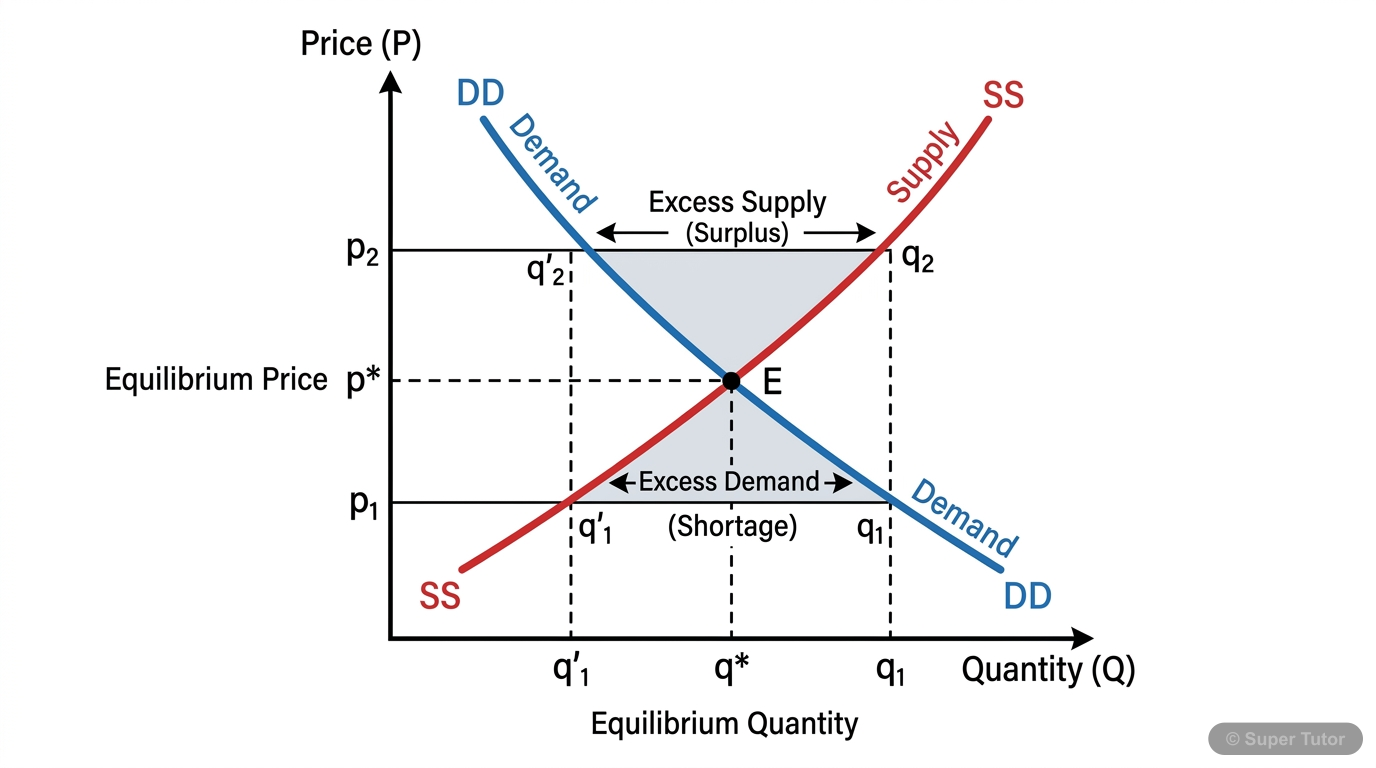
A graph showing the intersection of market demand and supply curves, illustrating the equilibrium price and quantity, and areas of excess demand and excess supply.
Super Tutor

Super Tutor has 11+ illustrations like this for Market Equilibrium alone — flashcards, concept maps, and step-by-step visuals.

See them all
25 Questions Solved · 1 Section

Exercises — Chapter 5: Market Equilibrium

1Explain market equilibrium.Show solution
Market Equilibrium is a situation in a market where the quantity demanded by buyers exactly equals the quantity supplied by sellers at a particular price. This price is called the equilibrium price (pp^*) and the corresponding quantity is called the equilibrium quantity (qq^*).

Concept: At equilibrium, there is no tendency for price to change because the market clears — there is neither excess demand nor excess supply.

Determination:
The equilibrium is determined at the intersection of the market demand curve and the market supply curve.

QD(p)=QS(p)Q_D(p^*) = Q_S(p^*)

- If the prevailing market price p > p^*: quantity supplied exceeds quantity demanded → excess supply → price falls back to pp^*.
- If the prevailing market price p < p^*: quantity demanded exceeds quantity supplied → excess demand → price rises back to pp^*.

Thus, the market has a self-correcting mechanism that always pushes price toward equilibrium.
2When do we say there is excess demand for a commodity in the market?Show solution
Excess Demand occurs when, at the prevailing market price, the quantity demanded by buyers is greater than the quantity supplied by sellers.

Q_D(p) > Q_S(p)

This situation arises when the prevailing price is below the equilibrium price (p < p^*).

Consequence: Since buyers want more than what is available, they compete with each other and are willing to pay a higher price. This competition among buyers pushes the price upward until it reaches the equilibrium price pp^*, where excess demand is eliminated.

Example: If equilibrium price is ₹10 but the market price is ₹7, buyers demand more units than sellers are willing to supply at ₹7, creating excess demand.
3When do we say there is excess supply for a commodity in the market?Show solution
Excess Supply occurs when, at the prevailing market price, the quantity supplied by sellers is greater than the quantity demanded by buyers.

Q_S(p) > Q_D(p)

This situation arises when the prevailing price is above the equilibrium price (p > p^*).

Consequence: Since sellers are unable to sell all they wish to supply, they compete with each other and are willing to accept a lower price. This competition among sellers pushes the price downward until it reaches the equilibrium price pp^*, where excess supply is eliminated.

Example: If equilibrium price is ₹10 but the market price is ₹13, sellers supply more units than buyers are willing to purchase at ₹13, creating excess supply.
4What will happen if the price prevailing in the market is (i) above the equilibrium price? (ii) below the equilibrium price?Show solution
**(i) Price above equilibrium price (p > p^*):

Given:** Prevailing price p > p^* (equilibrium price).

Effect: At this higher price, quantity supplied > quantity demanded, leading to excess supply (unsold stocks accumulate with sellers).

Adjustment: Sellers, unable to sell their entire stock, will lower their prices to attract buyers. This process continues until the price falls back to pp^*, where QD=QSQ_D = Q_S and the market clears.

**(ii) Price below equilibrium price (p < p^*):

Given:** Prevailing price p < p^* (equilibrium price).

Effect: At this lower price, quantity demanded > quantity supplied, leading to excess demand (shortage in the market).

Adjustment: Buyers, unable to obtain the desired quantity, will bid up the price. Sellers, seeing strong demand, will also raise prices. This process continues until the price rises back to pp^*, where QD=QSQ_D = Q_S and the market clears.

Conclusion: In both cases, market forces automatically restore equilibrium at pp^*.
5Explain how price is determined in a perfectly competitive market with fixed number of firms.Show solution
Given: A perfectly competitive market with a fixed number of firms.

Step 1 — Market Demand Curve:
The market demand curve is downward sloping, showing that as price falls, quantity demanded increases.

Step 2 — Market Supply Curve:
With a fixed number of firms, the market supply curve is obtained by the horizontal summation of individual firms' supply curves. It is upward sloping — as price rises, each firm supplies more.

Step 3 — Equilibrium Determination:
Equilibrium is determined at the point where:
QD(p)=QS(p)Q_D(p^*) = Q_S(p^*)
This is the intersection of the market demand curve and the market supply curve.

- The price at this intersection is the equilibrium price pp^*.
- The quantity at this intersection is the equilibrium quantity qq^*.

Step 4 — Stability:
- If p > p^*: excess supply → price falls toward pp^*.
- If p < p^*: excess demand → price rises toward pp^*.

Thus, with a fixed number of firms, the equilibrium price and quantity are uniquely determined by the intersection of market demand and market supply curves.
6Suppose the price at which equilibrium is attained in exercise 5 is above the minimum average cost of the firms constituting the market. Now if we allow for free entry and exit of firms, how will the market price adjust to it?Show solution
Given: Equilibrium price p^* > minimum average cost (min AC) of firms; free entry and exit is now allowed.

Step 1 — Existence of Supernormal Profits:
Since p^* > min AC, firms in the market are earning supernormal (positive economic) profits.

Step 2 — Entry of New Firms:
Attracted by these supernormal profits, new firms will enter the market.

Step 3 — Shift in Supply Curve:
As new firms enter, the market supply curve shifts rightward (supply increases).

Step 4 — Fall in Price:
With demand unchanged, the rightward shift in supply causes the equilibrium price to fall.

Step 5 — Long-Run Equilibrium:
This process of entry continues until the price falls to the minimum average cost of the firms, i.e., p=p = min AC.

At this point, firms earn only normal profits (zero economic profit), so there is no further incentive for new firms to enter.

Conclusion: With free entry and exit, the market price adjusts downward from pp^* to the minimum average cost of the firms, which becomes the new long-run equilibrium price.
7At what level of price do the firms in a perfectly competitive market supply when free entry and exit is allowed in the market? How is equilibrium quantity determined in such a market?Show solution
Price Level with Free Entry and Exit:

With free entry and exit in a perfectly competitive market with identical firms, the equilibrium price is always equal to the minimum average cost (min AC) of the firms.

Reason:
- If p > min AC → supernormal profits → new firms enter → supply increases → price falls to min AC.
- If p < min AC → losses → firms exit → supply decreases → price rises to min AC.

Thus: p=min ACp^* = \text{min AC}

Determination of Equilibrium Quantity:

Once the equilibrium price is fixed at min AC, the equilibrium quantity is determined by the market demand curve.

q=QD(p=min AC)q^* = Q_D(p^* = \text{min AC})

In other words, at the price equal to minimum average cost, we read off the quantity demanded from the market demand curve — that quantity is the equilibrium quantity supplied in the market.

Summary:
- Equilibrium price = min AC (supply side determines price).
- Equilibrium quantity = quantity demanded at that price (demand side determines quantity).
8How is the equilibrium number of firms determined in a market where entry and exit is permitted?Show solution
Given: Free entry and exit; identical firms; equilibrium price = min AC.

Step 1: With free entry and exit, the equilibrium price is fixed at p=p^* = min AC.

Step 2: At this price, the equilibrium quantity is determined by the market demand curve:
q=QD(p)q^* = Q_D(p^*)

Step 3: Each individual firm produces at the output level corresponding to its minimum average cost. Let this output per firm be qfq_f^* (the output at which AC is minimised).

Step 4: The equilibrium number of firms (nn^*) is determined by dividing the total equilibrium quantity by the output per firm:

n=qqf=QD(p)qfn^* = \frac{q^*}{q_f^*} = \frac{Q_D(p^*)}{q_f^*}

Conclusion: The equilibrium number of firms equals the total market equilibrium quantity divided by the output produced by each individual firm at minimum average cost. If demand increases, qq^* rises and more firms enter; if demand decreases, qq^* falls and some firms exit.
9How are equilibrium price and quantity affected when income of the consumers (a) increase? (b) decrease?Show solution
(a) When income of consumers increases:

Assumption: The good is a normal good (most goods fall in this category).

Effect on Demand: As income rises, consumers demand more of the good at every price → demand curve shifts rightward.

Effect on Equilibrium (supply unchanged):
- Equilibrium price increases (rises from p1p_1^* to p2p_2^*).
- Equilibrium quantity increases (rises from q1q_1^* to q2q_2^*).

p_2^* > p_1^* \quad \text{and} \quad q_2^* > q_1^*

(b) When income of consumers decreases:

Effect on Demand: As income falls, consumers demand less of the good at every price → demand curve shifts leftward.

Effect on Equilibrium (supply unchanged):
- Equilibrium price decreases (falls from p1p_1^* to p2p_2^*).
- Equilibrium quantity decreases (falls from q1q_1^* to q2q_2^*).

p_2^* < p_1^* \quad \text{and} \quad q_2^* < q_1^*

Note: For an inferior good, the effects would be reversed — higher income reduces demand, shifting the demand curve leftward.
10Using supply and demand curves, show how an increase in the price of shoes affects the price of a pair of socks and the number of pairs of socks bought and sold.Show solution
Concept: Shoes and socks are complementary goods — they are consumed together.

Step 1 — Effect of rise in price of shoes:
When the price of shoes increases, the demand for shoes falls (law of demand).

Step 2 — Effect on demand for socks:
Since shoes and socks are complements, a fall in demand for shoes leads to a fall in demand for socks as well. The demand curve for socks shifts leftward (from D1D_1 to D2D_2).

Step 3 — Effect on equilibrium in socks market:
With the supply curve of socks unchanged:
- The demand curve shifts left.
- New equilibrium is at a lower price and lower quantity.

Diagram Description:
- Draw the socks market with original demand D1D_1 and supply SS, intersecting at (p1,q1)(p_1^*, q_1^*).
- Shift demand leftward to D2D_2.
- New equilibrium at (p2,q2)(p_2^*, q_2^*) where p_2^* < p_1^* and q_2^* < q_1^*.

Conclusion:
- Equilibrium price of socks falls.
- Equilibrium quantity (number of pairs) of socks bought and sold falls.

psocksandqsocksp_{\text{socks}}^* \downarrow \quad \text{and} \quad q_{\text{socks}}^* \downarrow
11How will a change in price of coffee affect the equilibrium price of tea? Explain the effect on equilibrium quantity also through a diagram.Show solution
Concept: Tea and coffee are substitute goods — if the price of one rises, consumers switch to the other.

Case: Price of coffee increases

Step 1: When the price of coffee rises, coffee becomes relatively more expensive.

Step 2: Consumers substitute tea for coffee → demand for tea increases → demand curve for tea shifts rightward (from D1D_1 to D2D_2).

Step 3 — Effect on equilibrium in tea market (supply unchanged):

Diagram:
- X-axis: Quantity of tea; Y-axis: Price of tea.
- Original equilibrium at intersection of D1D_1 and SS at (q1,p1)(q_1^*, p_1^*).
- Demand shifts right to D2D_2.
- New equilibrium at intersection of D2D_2 and SS at (q2,p2)(q_2^*, p_2^*).
- p_2^* > p_1^* and q_2^* > q_1^*.

Conclusion:
- Equilibrium price of tea increases (from p1p_1^* to p2p_2^*).
- Equilibrium quantity of tea increases (from q1q_1^* to q2q_2^*).

Case: Price of coffee decreases — Demand for tea shifts leftward → equilibrium price and quantity of tea both decrease.

Price of coffeeptea,  qtea\text{Price of coffee} \uparrow \Rightarrow p_{\text{tea}}^* \uparrow, \; q_{\text{tea}}^* \uparrow
12How do the equilibrium price and quantity of a commodity change when price of input used in its production changes?Show solution
Concept: The price of inputs (raw materials, labour, etc.) affects the cost of production, which in turn affects the supply of the commodity.

Case 1: Price of input increases

- Cost of production rises → firms are willing to supply less at every price → supply curve shifts leftward (from S1S_1 to S2S_2).
- With demand unchanged, leftward shift in supply causes:
- Equilibrium price increases (from p1p_1^* to p2p_2^*).
- Equilibrium quantity decreases (from q1q_1^* to q2q_2^*).

p_2^* > p_1^* \quad \text{and} \quad q_2^* < q_1^*

Case 2: Price of input decreases

- Cost of production falls → firms are willing to supply more at every price → supply curve shifts rightward (from S1S_1 to S2S_2).
- With demand unchanged, rightward shift in supply causes:
- Equilibrium price decreases (from p1p_1^* to p2p_2^*).
- Equilibrium quantity increases (from q1q_1^* to q2q_2^*).

p_2^* < p_1^* \quad \text{and} \quad q_2^* > q_1^*

Conclusion: A rise in input price raises equilibrium price and reduces equilibrium quantity; a fall in input price reduces equilibrium price and raises equilibrium quantity.
13If the price of a substitute (Y) of good X increases, what impact does it have on the equilibrium price and quantity of good X?Show solution
Given: Good Y is a substitute for good X. Price of Y increases.

Step 1 — Effect on demand for X:
When the price of substitute Y rises, good X becomes relatively cheaper. Consumers shift their demand from Y to X → demand for X increases → demand curve of X shifts rightward (from D1D_1 to D2D_2).

Step 2 — Effect on equilibrium of X (supply of X unchanged):

With the supply curve of X unchanged:
- The rightward shift in demand leads to a new equilibrium at a higher price and higher quantity.

Step 3 — Results:

pX(equilibrium price of X increases)p_X^* \uparrow \quad \text{(equilibrium price of X increases)}
qX(equilibrium quantity of X increases)q_X^* \uparrow \quad \text{(equilibrium quantity of X increases)}

Conclusion: An increase in the price of substitute good Y causes both the equilibrium price and equilibrium quantity of good X to increase.
14Compare the effect of shift in demand curve on the equilibrium when the number of firms in the market is fixed with the situation when entry-exit is permitted.Show solution
Case 1: Fixed number of firms

- The market supply curve is upward sloping (fixed number of firms, each supplying more at higher prices).
- When demand shifts rightward:
- Equilibrium price increases.
- Equilibrium quantity increases.
- The increase in quantity is limited because existing firms can only expand output along their upward-sloping supply curves.
- The increase in price is significant.

Case 2: Free entry and exit

- The long-run market supply curve is perfectly elastic (horizontal) at p=p = min AC.
- When demand shifts rightward:
- Equilibrium price remains unchanged (stays at min AC).
- Equilibrium quantity increases by a larger amount (new firms enter to meet the increased demand).
- Number of firms increases.

Comparison Table:

| Aspect | Fixed Firms | Free Entry/Exit |
|---|---|---|
| Effect on Price | Increases | No change |
| Effect on Quantity | Increases (smaller) | Increases (larger) |
| Effect on No. of Firms | No change | Increases |

Conclusion: A rightward shift in demand has a larger effect on price and smaller effect on quantity when firms are fixed, compared to free entry/exit where the effect on price is zero but effect on quantity is larger.
15Explain through a diagram the effect of a rightward shift of both the demand and supply curves on equilibrium price and quantity.Show solution
Given: Both demand and supply curves shift rightward simultaneously.

Effect on Equilibrium Quantity:
A rightward shift in demand increases quantity; a rightward shift in supply also increases quantity. Both shifts work in the same direction, so equilibrium quantity unambiguously increases.

q (certain)q^* \uparrow \text{ (certain)}

Effect on Equilibrium Price:
A rightward shift in demand tends to increase price; a rightward shift in supply tends to decrease price. These two effects work in opposite directions, so the net effect on price is ambiguous and depends on the relative magnitudes of the two shifts.

Three possible outcomes:

1. Demand shift > Supply shift: Price increases.
2. Demand shift < Supply shift: Price decreases.
3. Demand shift = Supply shift: Price remains unchanged.

Diagram Description:
- Draw original demand D1D_1 and supply S1S_1 intersecting at (p1,q1)(p_1^*, q_1^*).
- Shift both rightward to D2D_2 and S2S_2.
- New equilibrium at (p2,q2)(p_2^*, q_2^*) where q_2^* &gt; q_1^*.
- Show three cases for price: p_2^* &gt; p_1^*, p2=p1p_2^* = p_1^*, or p_2^* &lt; p_1^* depending on relative shifts.

Conclusion: Rightward shift of both curves → equilibrium quantity definitely increases; equilibrium price change is indeterminate.
16How are the equilibrium price and quantity affected when (a) both demand and supply curves shift in the same direction? (b) demand and supply curves shift in opposite directions?Show solution
(a) Both curves shift in the same direction:

Sub-case (i): Both shift rightward (increase)
- Demand ↑ → price tends to rise, quantity tends to rise.
- Supply ↑ → price tends to fall, quantity tends to rise.
- Equilibrium quantity: Both effects increase quantity → quantity unambiguously increases.
- Equilibrium price: Effects on price are opposite → price change is ambiguous (depends on magnitude of shifts).

Sub-case (ii): Both shift leftward (decrease)
- Equilibrium quantity: Both effects decrease quantity → quantity unambiguously decreases.
- Equilibrium price: Effects on price are opposite → price change is ambiguous.

q changes unambiguously; p is indeterminateq^* \text{ changes unambiguously; } p^* \text{ is indeterminate}

(b) Demand and supply curves shift in opposite directions:

Sub-case (i): Demand increases (rightward), Supply decreases (leftward)
- Both effects tend to increase price → price unambiguously increases.
- Demand ↑ increases quantity; Supply ↓ decreases quantity → quantity change is ambiguous.

Sub-case (ii): Demand decreases (leftward), Supply increases (rightward)
- Both effects tend to decrease price → price unambiguously decreases.
- Quantity change is ambiguous.

p changes unambiguously; q is indeterminatep^* \text{ changes unambiguously; } q^* \text{ is indeterminate}

Summary:
- Same direction shifts → quantity change certain, price change uncertain.
- Opposite direction shifts → price change certain, quantity change uncertain.
17In what respect do the supply and demand curves in the labour market differ from those in the goods market?Show solution
Differences between Labour Market and Goods Market curves:

1. Demand Curve:

| Goods Market | Labour Market |
|---|---|
| Demand curve is the market demand curve derived from consumers' utility maximisation. | Demand curve for labour is derived from firms' profit maximisation — it is a derived demand. |
| Downward sloping due to law of demand. | Downward sloping because as wage rises, the marginal revenue product of labour (MRPL_L) equals wage at a lower level of employment. |
| Horizontal axis: quantity of goods. | Horizontal axis: number of workers (labour units). |
| Vertical axis: price of goods. | Vertical axis: wage rate. |

2. Supply Curve:

| Goods Market | Labour Market |
|---|---|
| Supply curve comes from firms — upward sloping as higher price incentivises more production. | Supply curve of labour comes from households/workers — they supply more labour at higher wage rates. |
| Upward sloping due to profit motive of firms. | Generally upward sloping (though may bend backward at very high wages due to income effect). |

3. Key Concept:
- In the goods market, the firm is the supplier and the consumer is the demander.
- In the labour market, the firm is the demander and the household/worker is the supplier.
- The demand for labour is determined by the Value of Marginal Product of Labour (VMPL_L) = p×MPLp \times MP_L, where pp is the price of the good produced.
18How is the optimal amount of labour determined in a perfectly competitive market?Show solution
Given: A perfectly competitive market where firms are price-takers in both the goods market and the labour market.

Concept: A profit-maximising firm will hire labour up to the point where the additional revenue generated by employing one more unit of labour equals the additional cost of hiring that unit.

Step 1 — Marginal Revenue Product of Labour (MRPL_L):
In a perfectly competitive market, the price of the good (pp) is constant. The additional revenue from hiring one more unit of labour is:
MRPL=p×MPLMRP_L = p \times MP_L
where MPLMP_L is the marginal product of labour. This is also called the Value of Marginal Product of Labour (VMPL_L).

Step 2 — Marginal Cost of Labour:
In a competitive labour market, the wage rate (ww) is given (constant). The marginal cost of hiring one more unit of labour = ww.

Step 3 — Optimality Condition:
The firm maximises profit by hiring labour up to the point where:
MRPL=wMRP_L = w
p×MPL=wp \times MP_L = w

- If MRP_L &gt; w: hiring more labour adds more to revenue than cost → hire more.
- If MRP_L &lt; w: hiring more labour adds more to cost than revenue → hire less.
- If MRPL=wMRP_L = w: optimal level of employment.

Conclusion: The optimal amount of labour is determined where p×MPL=wp \times MP_L = w, i.e., where the value of marginal product of labour equals the wage rate.
19How is the wage rate determined in a perfectly competitive labour market?Show solution
Given: A perfectly competitive labour market.

Step 1 — Labour Demand Curve:
The market demand for labour is derived from firms' profit maximisation. Each firm demands labour up to the point where VMPL=wVMP_L = w. Since VMPL=p×MPLVMP_L = p \times MP_L and MPLMP_L diminishes as more labour is hired, the labour demand curve is downward sloping — firms demand more labour at lower wage rates.

The market demand for labour is the horizontal summation of all individual firms' labour demand curves.

Step 2 — Labour Supply Curve:
The market supply of labour comes from households. Workers supply more labour at higher wage rates (generally). The labour supply curve is upward sloping.

Step 3 — Equilibrium Wage Determination:
The equilibrium wage rate (ww^*) is determined at the intersection of the market labour demand curve and the market labour supply curve:

LD(w)=LS(w)L_D(w^*) = L_S(w^*)

At this wage rate, the number of workers firms want to hire exactly equals the number of workers willing to work.

Step 4 — Stability:
- If w &gt; w^*: excess supply of labour → wage falls to ww^*.
- If w &lt; w^*: excess demand for labour → wage rises to ww^*.

Conclusion: In a perfectly competitive labour market, the wage rate is determined by the intersection of market demand for labour and market supply of labour.
20Can you think of any commodity on which price ceiling is imposed in India? What may be the consequence of price-ceiling?Show solution
Examples of Price Ceiling in India:
- Essential food items such as wheat, rice, sugar, and kerosene distributed through the Public Distribution System (PDS/ration shops) at prices below market rates.
- Drugs and medicines — the government fixes maximum retail prices (MRP) for essential medicines under the Drug Price Control Order (DPCO).
- Rent control in some cities.

Consequences of Price Ceiling:

A price ceiling is set below the equilibrium price (p_c &lt; p^*), which leads to:

1. Excess Demand:
Q_D(p_c) &gt; Q_S(p_c)
At the lower controlled price, consumers demand more but producers supply less, creating a shortage.

2. Long Queues:
Since the good is available at a lower price but in limited quantity, consumers have to stand in long queues at ration shops to obtain the good.

3. Black Market:
Since not all consumers can obtain the good at the controlled price, some are willing to pay higher prices. This creates a black market where the good is sold illegally at prices above the ceiling.

4. Reduced Quality:
Producers, receiving a lower price, may reduce the quality of the good to cut costs.

5. Under-supply:
Lower prices reduce the incentive for producers to supply the good, worsening the shortage over time.

Conclusion: While price ceilings aim to make goods affordable, they often lead to shortages, black markets, and rationing.
21A shift in demand curve has a larger effect on price and smaller effect on quantity when the number of firms is fixed compared to the situation when free entry and exit is permitted. Explain.Show solution
Case 1: Fixed Number of Firms

- The market supply curve is upward sloping (positively sloped).
- When demand shifts rightward (increases), the new equilibrium is at the intersection of the new demand curve and the upward-sloping supply curve.
- Result: Both price and quantity increase, but the price increase is significant because the supply curve is not flat — to induce existing firms to produce more, price must rise.
- The quantity increase is limited because existing firms face rising marginal costs and can only expand output to a limited extent.

Case 2: Free Entry and Exit

- The long-run market supply curve is perfectly elastic (horizontal) at p=p = min AC.
- When demand shifts rightward, the new equilibrium is at the same price (min AC) but higher quantity.
- Result: Price does not change at all (the horizontal supply curve means any increase in demand is met by new firms entering at the same price).
- The quantity increase is larger because new firms enter the market, adding to total supply without raising price.

Comparison:

| | Fixed Firms | Free Entry/Exit |
|---|---|---|
| Effect on Price | Large increase | No change |
| Effect on Quantity | Small increase | Large increase |

Conclusion: With fixed firms, the upward-sloping supply curve means a demand increase raises price substantially but quantity only moderately. With free entry/exit, the perfectly elastic supply curve means price is unchanged but quantity rises by the full extent of the demand increase. Hence, the effect on price is larger and on quantity is smaller with fixed firms compared to free entry/exit.
22Suppose the demand and supply curve of commodity X in a perfectly competitive market are given by: qD=700pq^D = 700 - p; qS=500+3pq^S = 500 + 3p for p15p \geq 15; =0= 0 for 0 \leq p &lt; 15. Assume that the market consists of identical firms. Identify the reason behind the market supply of commodity X being zero at any price less than Rs 15. What will be the equilibrium price for this commodity? At equilibrium, what quantity of X will be produced?Show solution
Part 1: Why is market supply zero for p &lt; 15?

The supply is zero for p &lt; 15 because Rs 15 is the minimum average variable cost (or minimum average cost / shut-down price) of the firms. In a perfectly competitive market, a firm will not supply any output if the price is below its minimum average variable cost, since it cannot even cover its variable costs. Therefore, at any price below Rs 15, no firm finds it profitable to produce, and hence market supply is zero.

Part 2: Equilibrium Price

At equilibrium: QD=QSQ_D = Q_S

700p=500+3p700 - p = 500 + 3p

700500=3p+p700 - 500 = 3p + p

200=4p200 = 4p

p=2004=50p^* = \frac{200}{4} = 50

Since p=5015p^* = 50 \geq 15, the supply function qS=500+3pq^S = 500 + 3p is applicable. ✓

Equilibrium price = Rs 50

Part 3: Equilibrium Quantity

Substituting p=50p^* = 50 in the demand equation:
q=70050=650q^* = 700 - 50 = 650

Verification using supply: qS=500+3(50)=500+150=650q^S = 500 + 3(50) = 500 + 150 = 650

Equilibrium quantity = 650 units
23Considering the same demand curve as in exercise 22, now let us allow for free entry and exit of the firms producing commodity X. Also assume the market consists of identical firms producing commodity X. Let the supply curve of a single firm be: qfS=8+3pq^S_f = 8 + 3p for p20p \geq 20; =0= 0 for 0 \leq p &lt; 20. (a) What is the significance of p=20p = 20? (b) At what price will the market for X be in equilibrium? State the reason for your answer. (c) Calculate the equilibrium quantity and number of firms.Show solution
(a) Significance of p=20p = 20:

p=20p = 20 is the minimum average cost (min AC) of each individual firm. It is the price below which no firm will supply any output (shut-down point). At p=20p = 20, firms earn only normal profits (zero economic profit). This is the price at which firms are just willing to operate in the long run.

With free entry and exit, p=20p = 20 is the long-run equilibrium price because:
- If p &gt; 20: firms earn supernormal profits → new firms enter → price falls to 20.
- If p &lt; 20: firms incur losses → firms exit → price rises to 20.

(b) Equilibrium Price:

With free entry and exit, the equilibrium price equals the minimum average cost of the firms:

p=Rs  20\boxed{p^* = Rs\; 20}

Reason: At p=20p = 20, firms earn zero economic (normal) profit. There is no incentive for new firms to enter or existing firms to exit. The market is in long-run equilibrium.

(c) Equilibrium Quantity and Number of Firms:

Equilibrium Quantity:
Using the demand curve qD=700pq^D = 700 - p at p=20p^* = 20:
q=70020=680 unitsq^* = 700 - 20 = 680 \text{ units}

Output per firm at p=20p = 20:
qf=8+3(20)=8+60=68 units per firmq_f^* = 8 + 3(20) = 8 + 60 = 68 \text{ units per firm}

Number of firms:
n=qqf=68068=10 firmsn^* = \frac{q^*}{q_f^*} = \frac{680}{68} = 10 \text{ firms}

Conclusion:
- Equilibrium price = Rs 20
- Equilibrium quantity = 680 units
- Number of firms = 10 firms
24Suppose the demand and supply curves of salt are given by: qD=1000pq^D = 1000 - p; qS=700+2pq^S = 700 + 2p. (a) Find the equilibrium price and quantity. (b) Now suppose that the price of an input used to produce salt has increased so that the new supply curve is qS=400+2pq^S = 400 + 2p. How does the equilibrium price and quantity change? Does the change conform to your expectation? (c) Suppose the government has imposed a tax of Rs 3 per unit of sale of salt. How does it affect the equilibrium price and quantity?Show solution
(a) Original Equilibrium:

At equilibrium: QD=QSQ_D = Q_S

1000p=700+2p1000 - p = 700 + 2p

1000700=2p+p1000 - 700 = 2p + p

300=3p300 = 3p

p1=100p_1^* = 100

q1=1000100=900 unitsq_1^* = 1000 - 100 = 900 \text{ units}

Equilibrium price = Rs 100; Equilibrium quantity = 900 units

(b) New supply curve after input price rise: qS=400+2pq^S = 400 + 2p

At new equilibrium: QD=QSQ_D = Q_S

1000p=400+2p1000 - p = 400 + 2p

1000400=2p+p1000 - 400 = 2p + p

600=3p600 = 3p

p2=200p_2^* = 200

q2=1000200=800 unitsq_2^* = 1000 - 200 = 800 \text{ units}

New equilibrium price = Rs 200; New equilibrium quantity = 800 units

Change: Price increased from Rs 100 to Rs 200 (↑); Quantity decreased from 900 to 800 units (↓).

Does it conform to expectation? YES. A rise in input price increases production cost → supply curve shifts leftward (from 700+2p700 + 2p to 400+2p400 + 2p, the intercept decreased by 300, indicating leftward shift) → equilibrium price rises and equilibrium quantity falls. This is exactly what we expect.

(c) Effect of a tax of Rs 3 per unit:

A tax of Rs 3 per unit on sellers increases their cost of production by Rs 3 per unit. This shifts the supply curve leftward. The new supply curve is obtained by replacing pp with (p3)(p - 3) in the original supply function (sellers receive p3p - 3 after paying tax):

qnewS=700+2(p3)=700+2p6=694+2pq^S_{\text{new}} = 700 + 2(p - 3) = 700 + 2p - 6 = 694 + 2p

At new equilibrium: QD=QSQ_D = Q_S

1000p=694+2p1000 - p = 694 + 2p

1000694=3p1000 - 694 = 3p

306=3p306 = 3p

p3=102p_3^* = 102

q3=1000102=898 unitsq_3^* = 1000 - 102 = 898 \text{ units}

Effect of tax:
- Equilibrium price increases from Rs 100 to Rs 102 (rises by Rs 2, not the full Rs 3 — the burden is shared between buyers and sellers).
- Equilibrium quantity decreases from 900 to 898 units.

Note: The price rises by Rs 2 (buyers bear Rs 2 of the tax) and sellers bear Rs 1 of the tax (they receive Rs 102 − Rs 3 = Rs 99, compared to Rs 100 earlier).
25Suppose the market determined rent for apartments is too high for common people to afford. If the government comes forward to help those seeking apartments on rent by imposing control on rent, what impact will it have on the market for apartments?Show solution
Given: Market equilibrium rent rr^* is too high; government imposes a rent ceiling r_c &lt; r^* (price ceiling on rent).

Impact of Rent Control (Price Ceiling) on the Apartment Market:

Step 1 — Excess Demand:
At the controlled rent rcr_c (which is below equilibrium rent rr^*):
- Quantity demanded of apartments increases (more people want to rent at lower rent).
- Quantity supplied of apartments decreases (landlords are less willing to rent out at lower rent).
- This creates excess demand (shortage of apartments):
Q_D(r_c) &gt; Q_S(r_c)

Step 2 — Consequences:

1. Shortage of apartments: The number of people seeking apartments exceeds the number of apartments available for rent.

2. Long queues/waiting lists: People seeking apartments have to wait for long periods to get one.

3. Black market: Since many people cannot get apartments at the controlled rent, some may be willing to pay more than rcr_c. This may lead to illegal subletting or under-the-table payments above the controlled rent.

4. Deterioration in quality: Landlords, receiving lower rent, have less incentive to maintain or improve the quality of apartments.

5. Reduced supply in the long run: New construction of rental apartments may slow down as it becomes less profitable, worsening the shortage over time.

Conclusion: While rent control aims to make housing affordable for common people, it leads to a shortage of apartments, long waiting lists, possible black markets, and deterioration in housing quality. The policy helps existing tenants who get apartments at lower rent but harms those who cannot find apartments at all.

Stuck on a step?

Ask Super Tutor AI to explain any solution on this page in a simpler way — free, 24x7.

Ask a Doubt Free

Frequently Asked Questions

What are the important topics in Market Equilibrium for Uttarakhand Board Class 12 Economics?
Market Equilibrium covers several key topics that are frequently asked in Uttarakhand Board Class 12 board exams. Focus on the core concepts listed on this page and practise related questions to build confidence.
How to score full marks in Market Equilibrium — Uttarakhand Board Class 12 Economics?
Understand the core concepts first, then work through the 30 practice questions available for this chapter. Revise formulas and definitions regularly, and use flashcards for quick recall before the exam.
Where can I get free NCERT Solutions for Market Equilibrium Class 12 Economics?
This page has free step-by-step NCERT Solutions for every exercise question in Market Equilibrium (Uttarakhand Board Class 12 Economics) — written the way examiners award marks: given, formula, working, answer.

Sources & Official References

Content is aligned to the official syllabus. Refer to the board website for the latest curriculum.

For serious students

Get the full Market Equilibrium chapter — for free.

Quizzes, flashcards, AI doubt-solver and a step-by-step study plan for Uttarakhand Board Class 12 Economics.