Chapter 8 of 17
NCERT Solutions

Primary Activities

Uttarakhand Board · Class 12 · Geography

NCERT Solutions for Primary Activities — Uttarakhand Board Class 12 Geography.

44 questions24 flashcards5 concepts

Interactive on Super Tutor

Studying Primary Activities? Get the full interactive chapter.

Quizzes, flashcards, AI doubt-solver and a step-by-step study plan — built for ncert solutions and more.

1,000+ Class 12 students started this chapter today

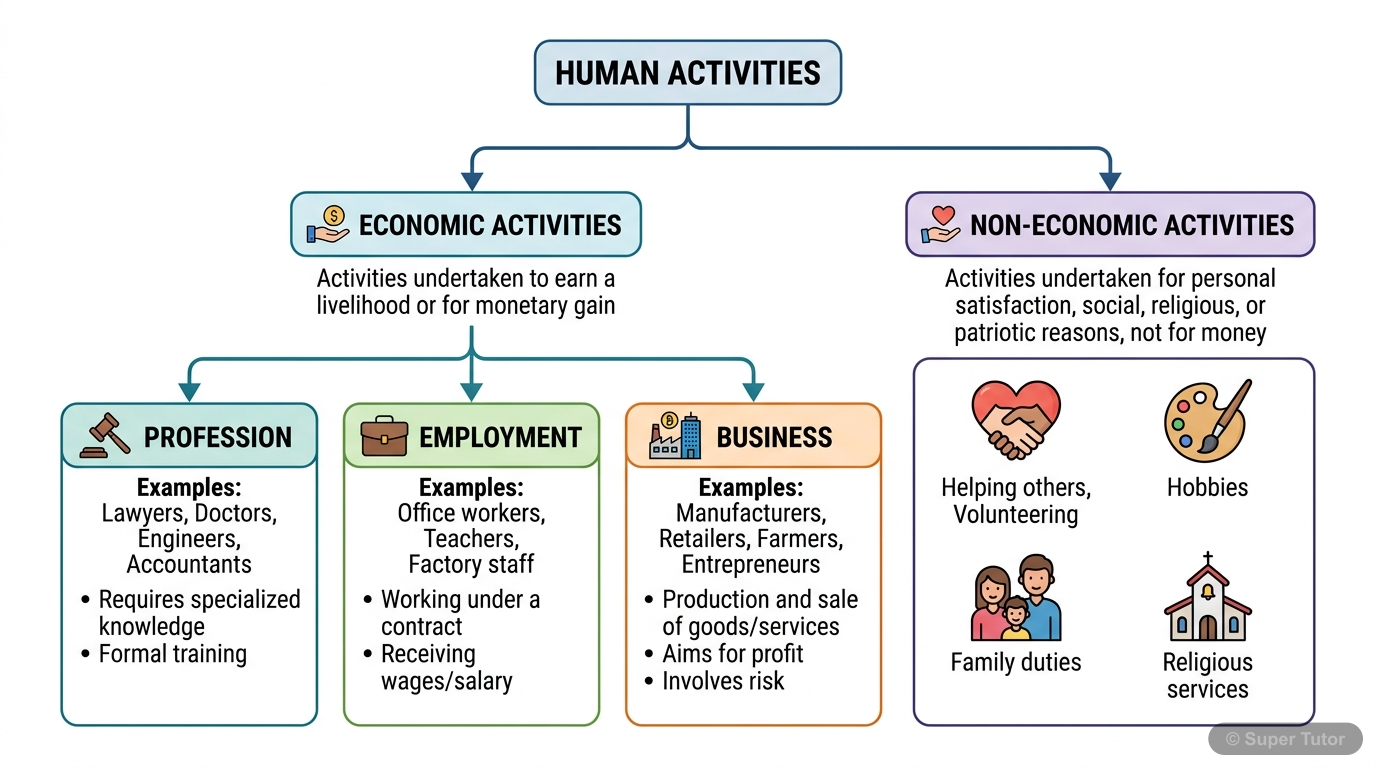
A flowchart illustrating the broad categories of economic activities: Economic and Non-Economic, and further classifying Economic activities into Profession, Employment, and Business.
Super Tutor

This is just one of 30+ visuals inside Super Tutor's Primary Activities chapter

Explore the full set
14 Questions Solved · 1 Section

EXERCISES

1(i)Which one of the following is not a plantation crop?
(a) Coffee
(b) Sugarcane
(c) Wheat
(d) Rubber
Show solution
Correct Answer: (c) Wheat

Justification: Coffee, sugarcane, and rubber are all plantation crops grown on large estates, typically in tropical regions. Wheat is a food grain crop grown through extensive or intensive grain cultivation, not as a plantation crop.
1(ii)In which one of the following countries co-operative farming was the most successful experiment?
(a) Russia
(b) Denmark
(c) India
(d) The Netherlands
Show solution
Correct Answer: (b) Denmark

Justification: Co-operative farming has been most successful in Denmark, where farmers pool their resources, share machinery, and collectively market their produce. Denmark is regarded as the model country for co-operative farming in the world.
1(iii)Growing of flowers is called:
(a) Truck farming
(b) Factory farming
(c) Mixed farming
(d) Floriculture
Show solution
Correct Answer: (d) Floriculture

Justification: Floriculture refers specifically to the cultivation of flowers and ornamental plants. It is a specialised branch of horticulture practised near urban and peri-urban areas where demand for flowers is high.
1(iv)Which one of the following types of cultivation was developed by European colonists?
(a) Kolkoz
(b) Viticulture
(c) Mixed farming
(d) Plantation
Show solution
Correct Answer: (d) Plantation

Justification: Plantation agriculture was introduced and developed by European colonists in tropical and sub-tropical regions of Asia, Africa, and Latin America to grow commercial crops like tea, coffee, rubber, and sugarcane for export to European markets.
1(v)In which one of the following regions is extensive commercial grain cultivation not practised?
(a) American Canadian prairies
(b) European Steppes
(c) Pampas of Argentina
(d) Amazon Basin
Show solution
Correct Answer: (d) Amazon Basin

Justification: Extensive commercial grain cultivation requires large, flat, fertile land with a suitable climate. The Amazon Basin is covered by dense tropical rainforest with high rainfall and humidity, making it unsuitable for extensive commercial grain cultivation.
1(vi)In which of the following types of agriculture is the farming of citrus fruit very important?
(a) Market gardening
(b) Plantation agriculture
(c) Mediterranean agriculture
(d) Co-operative farming
Show solution
Correct Answer: (c) Mediterranean agriculture

Justification: Mediterranean agriculture is practised in regions around the Mediterranean Sea and similar climatic zones. The warm, dry summers and mild, wet winters are ideal for growing citrus fruits (oranges, lemons, grapes), olives, and figs, making citrus cultivation a hallmark of this type of agriculture.
1(vii)Which one type of agriculture amongst the following is also called 'slash and burn agriculture'?
(a) Extensive subsistence agriculture
(b) Primitive subsistence agriculture
(c) Extensive commercial grain cultivation
(d) Mixed farming
Show solution
Correct Answer: (b) Primitive subsistence agriculture

Justification: Primitive subsistence agriculture, also known as shifting cultivation or 'slash and burn' agriculture, involves clearing a patch of forest by cutting and burning vegetation, cultivating it for a few years, and then moving on to a new patch when soil fertility declines. It is known by different names in different regions — Jhumming (India), Milpa (Central America), Ladang (Malaysia), etc.
1(viii)Which one of the following does not follow monoculture?
(a) Dairy farming
(b) Mixed farming
(c) Plantation agriculture
(d) Commercial grain farming
Show solution
Correct Answer: (b) Mixed farming

Justification: Mixed farming involves the cultivation of multiple crops along with the rearing of animals simultaneously on the same farm. It is therefore the opposite of monoculture. Plantation agriculture, commercial grain farming, and dairy farming each focus on a single product or crop (monoculture).
2(i)Future of shifting cultivation is bleak. Discuss.Show solution
Given: The question asks us to discuss why the future of shifting cultivation is bleak.

Answer:
Shifting cultivation (slash and burn agriculture) is a primitive form of subsistence farming. Its future is bleak due to the following reasons:

1. Decreasing forest area: Rapid deforestation and population pressure have reduced the availability of forest land for clearing and rotation.
2. Environmental degradation: Burning of forests leads to soil erosion, loss of biodiversity, and contributes to climate change.
3. Government restrictions: Many governments have banned or restricted shifting cultivation to protect forests.
4. Low productivity: It supports only small populations and cannot meet the food demands of a growing population.
5. Alternative options: Farmers are being encouraged to adopt settled farming with better techniques and inputs.

Thus, shifting cultivation is gradually being replaced by more sustainable and productive agricultural practices.
2(ii)Market gardening is practised near urban areas. Why?Show solution
Given: The question asks why market gardening is practised near urban areas.

Answer:
Market gardening is practised near urban areas because of the following reasons:

1. Proximity to market: Urban areas provide a large and ready market for perishable products like vegetables, fruits, and flowers.
2. Perishability of produce: Since the crops grown (vegetables, fruits, flowers) are highly perishable, they must reach consumers quickly. Proximity to cities reduces transportation time and cost.
3. High demand: The dense urban population creates a continuous and high demand for fresh produce.
4. Better prices: Farmers get better prices by selling directly to urban consumers or local markets.

Thus, the need for quick supply of fresh, perishable produce to a large consumer base makes urban proximity essential for market gardening.
2(iii)Large scale dairy farming is the result of the development of transportation and refrigeration.Show solution
Given: The statement asks us to explain how transportation and refrigeration have enabled large-scale dairy farming.

Answer:
Dairy products such as milk, butter, cheese, and cream are highly perishable and cannot be stored or transported over long distances without spoiling. The development of:

1. Refrigeration technology: Allows milk and dairy products to be stored at low temperatures, preventing spoilage and extending shelf life. This enables dairy farms to supply products to distant markets.
2. Improved transportation (refrigerated trucks, rail, ships): Enables the quick and safe movement of perishable dairy products from farms to urban markets, processing plants, and even export destinations.

Together, these developments have freed dairy farming from the constraint of being located only near consumption centres, allowing large-scale, commercially oriented dairy farms to operate efficiently and supply regional and global markets. Countries like Denmark, New Zealand, and the Netherlands have developed large-scale dairy industries as a result.
3(i)Differentiate between Nomadic Herding and Commercial Livestock Rearing.Show solution
Given: The question asks for a differentiation between Nomadic Herding and Commercial Livestock Rearing.

Nomadic Herding vs. Commercial Livestock Rearing:

| Basis | Nomadic Herding | Commercial Livestock Rearing |
|---|---|---|
| Nature | Subsistence activity; herders move with their animals | Commercial activity; animals are reared on permanent ranches/farms |
| Purpose | To meet the basic needs of the herder's family (food, clothing, shelter) | To earn profit by selling meat, wool, hides, and dairy products in the market |
| Location | Practised in arid and semi-arid regions of Africa, Asia (Sahara, Central Asia, tundra) | Practised in temperate grasslands — Pampas (Argentina), Prairies (USA/Canada), Downs (Australia) |
| Movement | Herders migrate seasonally in search of pasture and water | Animals are reared on fixed, large ranches; no migration |
| Scale | Small-scale, traditional | Large-scale, organised, and scientific |
| Technology | Traditional, no modern inputs | Modern techniques, veterinary care, selective breeding used |
| Animals | Cattle, sheep, goats, camels, reindeer (depending on region) | Mainly cattle and sheep for beef, wool, and mutton |
| Market orientation | Non-commercial; self-sufficient | Highly commercial; products exported globally |

Conclusion: Nomadic herding is a traditional, subsistence-based activity dependent on natural pastures, while commercial livestock rearing is a scientifically managed, market-oriented enterprise aimed at profit maximisation.
3(ii)Discuss the important characteristic features of plantation agriculture. Name a few important plantation crops from different countries.Show solution
Given: The question asks for characteristic features of plantation agriculture and examples of plantation crops from different countries.

Characteristic Features of Plantation Agriculture:

1. Large estates/farms: Plantation agriculture is carried out on large tracts of land, often covering hundreds of hectares.
2. Single crop specialisation (Monoculture): Only one crop is cultivated on the entire estate at a time.
3. Large capital investment: Huge amounts of capital are required for land preparation, machinery, processing plants, and labour.
4. Scientific methods: Modern and scientific techniques of cultivation, pest control, and soil management are used.
5. Cheap labour: A large supply of cheap labour is required for planting, weeding, and harvesting. Historically, slave or indentured labour was used.
6. Processing on the estate: The harvested crop is processed on the plantation itself before being exported, e.g., tea leaves are dried and processed on the tea estate.
7. Export-oriented: Plantation crops are primarily grown for export to foreign markets, not for local consumption.
8. Colonial origin: This type of agriculture was introduced by European colonists in tropical and sub-tropical regions of Asia, Africa, and Latin America.
9. Transport network: Well-developed road and rail networks connect the plantation to ports for export.
10. Management by MNCs: Many plantations are owned and managed by multinational corporations.

Important Plantation Crops from Different Countries:

| Crop | Country/Region |
|---|---|
| Tea | India (Assam, Darjeeling), Sri Lanka |
| Coffee | Brazil, Colombia, Côte d'Ivoire |
| Rubber | Malaysia, Indonesia, Thailand |
| Sugarcane | Cuba, Brazil, India |
| Cotton | USA, Egypt |
| Cocoa | Ghana, Nigeria, Côte d'Ivoire |
| Banana | Central American countries (Honduras, Costa Rica) |
| Palm oil | Malaysia, Indonesia |

Conclusion: Plantation agriculture is a highly organised, capital-intensive, and export-oriented form of agriculture that transformed the economies of many tropical countries during the colonial era and continues to be economically significant today.
Project/ActivityVisit a nearby village and observe the cultivation of some crops. Ask the farmers and list the various operations.Show solution
Note: This is a field-based activity. Students are expected to visit a nearby village and interact with farmers. A sample framework for the activity is provided below.

Objective: To observe crop cultivation and understand the various agricultural operations involved.

Sample Observations (for a crop like Wheat or Rice):

Crop observed: Wheat

Various Agricultural Operations listed after interacting with farmers:

1. Land preparation: Ploughing, levelling, and tilling the field using tractors or bullocks.
2. Selection of seeds: Choosing high-yielding variety (HYV) seeds.
3. Sowing: Broadcasting seeds or using a seed drill.
4. Irrigation: Watering the field at regular intervals using canals, tube wells, or drip irrigation.
5. Manuring and fertilisation: Application of organic manure (compost, FYM) and chemical fertilisers (urea, DAP).
6. Weeding: Removal of unwanted plants manually or using herbicides.
7. Pest and disease control: Spraying pesticides and fungicides.
8. Harvesting: Cutting the mature crop using sickles or combine harvesters.
9. Threshing: Separating grain from the stalk using threshers.
10. Winnowing: Separating grain from chaff using wind or machines.
11. Storage: Storing the grain in godowns, silos, or at home.
12. Marketing: Selling the produce at the local mandi (market) or to government procurement centres.

Conclusion: Students should write their own observations based on the actual visit, noting the crop type, season, tools used, and challenges faced by farmers.

Stuck on a step?

Ask Super Tutor AI to explain any solution on this page in a simpler way — free, 24x7.

Ask a Doubt Free

Frequently Asked Questions

What are the important topics in Primary Activities for Uttarakhand Board Class 12 Geography?
Primary Activities covers several key topics that are frequently asked in Uttarakhand Board Class 12 board exams. Focus on the core concepts listed on this page and practise related questions to build confidence.
How to score full marks in Primary Activities — Uttarakhand Board Class 12 Geography?
Understand the core concepts first, then work through the 44 practice questions available for this chapter. Revise formulas and definitions regularly, and use flashcards for quick recall before the exam.
Where can I get free NCERT Solutions for Primary Activities Class 12 Geography?
This page has free step-by-step NCERT Solutions for every exercise question in Primary Activities (Uttarakhand Board Class 12 Geography) — written the way examiners award marks: given, formula, working, answer.

Sources & Official References

Content is aligned to the official syllabus. Refer to the board website for the latest curriculum.

For serious students

Get the full Primary Activities chapter — for free.

Quizzes, flashcards, AI doubt-solver and a step-by-step study plan for Uttarakhand Board Class 12 Geography.