Matrices — NCERT Solutions
Uttarakhand Board · Class 12 · Mathematics
NCERT Solutions for Matrices, Uttarakhand Board Class 12 Mathematics: 56 textbook questions solved step by step.
Interactive on Super Tutor
Studying Matrices? Get the full interactive chapter.
Quizzes, flashcards, AI doubt-solver and a step-by-step study plan — built for NCERT solutions and more.
Free trial, no card needed.
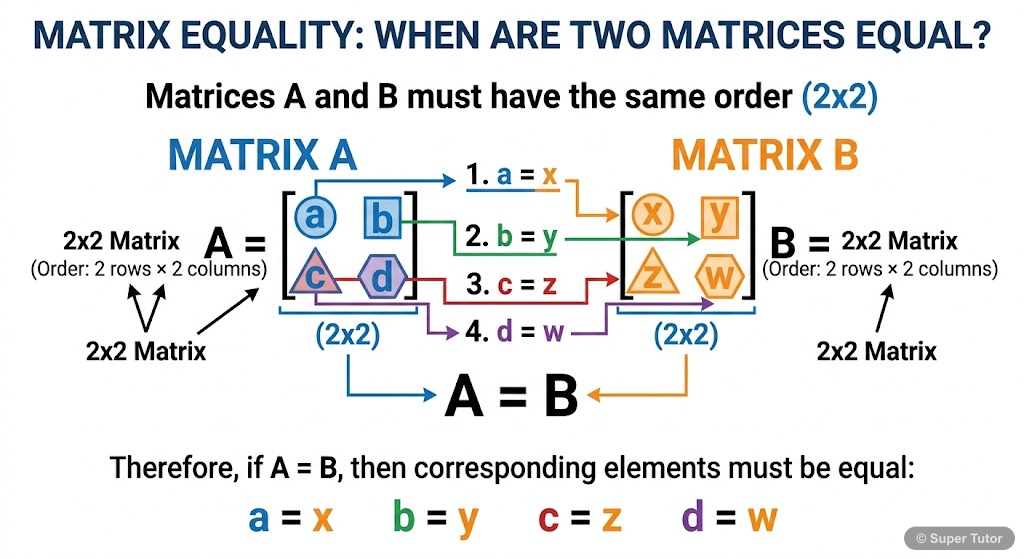
One of 5 illustrations for Matrices in Super Tutor — alongside flashcards, concept maps and practice questions.
The first 28 solutions are open to read. The other 28 are free with a Super Tutor account.
Exercise 3.1
1In the matrix , write: (i) The order of the matrix, (ii) The number of elements, (iii) Write the elements .Show solution
Given: Matrix
(i) Order of the matrix:
The matrix has 3 rows and 4 columns.
(ii) Number of elements:
Number of elements
(iii) Elements:
- = element in row 1, column 3
- = element in row 2, column 1
- = element in row 3, column 3
- = element in row 2, column 4
- = element in row 2, column 3
2If a matrix has 24 elements, what are the possible orders it can have? What, if it has 13 elements?Show solution
Concept: For a matrix of order , the number of elements .
For 24 elements: We need all pairs such that .
The possible orders are:
For 13 elements: We need . Since 13 is prime, the only factor pairs are and .
The possible orders are:
3If a matrix has 18 elements, what are the possible orders it can have? What, if it has 5 elements?Show solution
Concept: For a matrix of order , the number of elements .
For 18 elements: We need all pairs such that .
The possible orders are:
For 5 elements: Since 5 is prime, gives only:
4Construct a matrix, , whose elements are given by: (i) , (ii) , (iii) Show solution
A matrix has elements where .
(i)
(ii)
(iii)
5Construct a matrix, whose elements are given by: (i) , (ii) Show solution
A matrix has and .
(i)
Computing each element:
(ii)
6Find the values of and from the following equations: (i) , (ii) , (iii) Show solution
Concept: Two matrices are equal if and only if their corresponding elements are equal.
(i) Equating corresponding elements:
(ii) Equating corresponding elements:
From (1): . Substituting in (3):
If , then . If , then .
(iii) Equating corresponding elements:
From (1) and (2):
From (3):
From (2):
7Find the value of and from the equation: Show solution
Given:
Equating corresponding elements:
Subtracting (1) from (3):
From (1):
From (2):
From (4):
8 is a square matrix, if (A) (B) (C) (D) None of theseShow solution
Correct Answer: (C)
A matrix is called a square matrix when the number of rows equals the number of columns, i.e., .
9Which of the given values of and make the following pair of matrices equal: , ? (A) (B) Not possible to find (C) (D) Show solution
Correct Answer: (B) Not possible to find
Equating corresponding elements:
From (1) and (2), we get two different values of , which is a contradiction. Hence it is not possible to find values of and that satisfy all conditions simultaneously.
10The number of all possible matrices of order with each entry 0 or 1 is: (A) 27 (B) 18 (C) 81 (D) 512Show solution
Correct Answer: (D) 512
A matrix has entries. Each entry can be filled in 2 ways (either 0 or 1).
Exercise 3.2
1Let , , . Find each of the following: (i) A+B, (ii) A-B, (iii) 3A-C, (iv) AB, (v) BAShow solution
Given: , ,
(i) :
(ii) :
(iii) :
(iv) :
(v) :
2Compute the following: (i) , (ii) , (iii) , (iv) Show solution
(i)
(ii)
(iii)
(iv)
(Using )
3Compute the indicated products: (i) , (ii) , (iii) , (iv) , (v) , (vi) Show solution
(i)
(ii)
(iii)
(iv)
Row 1:
Row 2:
Row 3:
(v)
Row 1:
Row 2:
Row 3:
(vi)
Row 1:
Row 2:
4If , and , then compute and . Also, verify that .Show solution
Computing :
Computing :
LHS: :
RHS: :
Since LHS = RHS, is verified.
5If and , then compute .Show solution
Computing :
Computing :
Therefore:
6Simplify Show solution
7Find X and Y, if (i) and , (ii) and Show solution
(i) Adding the two equations:
Subtracting:
(ii) Let and .
Multiply first equation by 2 and second by 3:
Subtracting:
Multiply first equation by 3 and second by 2:
Subtracting:
8Find X, if and Show solution
Given:
9Find and , if Show solution
Equating corresponding elements:
10Solve the equation for and , if Show solution
Equating corresponding elements:
11If , find the values of and .Show solution
Equating corresponding elements:
Adding (1) and (2):
From (1):
12Given , find the values of and .Show solution
Equating corresponding elements:
From (1):
13If , show that .Show solution
Given:
Computing :
Element :
Element :
Element :
Element :
Element :
Element :
Element : , Element : , Element :
Hence proved.
14Show that (i) , (ii) Show solution
(i) Computing LHS:
Computing RHS:
Since , the result is proved.
(ii) Let and
Computing PQ:
Row 1:
Row 2:
Row 3:
Computing QP:
Row 1:
Row 2: — let me recalculate:
Row 1:
Row 2:
Row 3:
Since , the result is proved.
15Find , if Show solution
Step 1: Compute
Row 1:
Row 2:
Row 3:
Step 2: Compute
Step 3: Compute
Step 4:
16If , prove that .Show solution
Step 1: Compute
Row 1:
Row 2:
Row 3:
Step 2: Compute
Row 1:
Row 2:
Row 3:
Step 3: Compute
Hence proved.
17If and , find so that .Show solution
Step 1: Compute
Step 2: Compute
Step 3: Equate
From element :
Verification: ✓, ✓, ✓
18If and is the identity matrix of order 2, show that .Show solution
Let . Then:
Using the identities:
Computing RHS = :
Element :
Element :
Element :
Element :
Hence proved.
Free with a Super Tutor account
Free with a Super Tutor account
Free with a Super Tutor account
Free with a Super Tutor account
Exercise 3.3
Free with a Super Tutor account
Free with a Super Tutor account
Free with a Super Tutor account
Free with a Super Tutor account
Free with a Super Tutor account
Free with a Super Tutor account
Free with a Super Tutor account
Free with a Super Tutor account
Free with a Super Tutor account
Free with a Super Tutor account
Free with a Super Tutor account
Free with a Super Tutor account
Exercise 3.4
Free with a Super Tutor account
Miscellaneous Exercise on Chapter 3
Free with a Super Tutor account
Free with a Super Tutor account
Free with a Super Tutor account
Free with a Super Tutor account
Free with a Super Tutor account
Free with a Super Tutor account
Free with a Super Tutor account
Free with a Super Tutor account
Free with a Super Tutor account
Free with a Super Tutor account
Free with a Super Tutor account
28 more solved questions in Matrices
They are free with a Super Tutor account, along with practice quizzes and flashcards for this chapter. Free to start, no card needed.
Frequently Asked Questions
What are the important topics in Matrices for Uttarakhand Board Class 12 Mathematics?
Are these NCERT Solutions for Matrices free?
How should I revise Matrices for the Uttarakhand Board Class 12 board exam?
Sources & Official References
Content is aligned to the official syllabus. Refer to the board website for the latest curriculum.
More resources for Matrices
Practice Quiz
Test yourself with a quick quiz
Important Questions
Exam-style questions with answers
Revision Notes
Key points for last-minute revision
Formula Sheet
The chapter's formulas in one place
Chapter Summary
Understand the chapter at a glance
Concept Maps
See how topics connect
Study Plan
Step-by-step plan for this chapter
Flashcards
Quick-fire cards for active recall
Syllabus
What topics to cover
For serious students
Get the full Matrices chapter — start free.
Quizzes, flashcards, an AI doubt solver and a study plan for Uttarakhand Board Class 12 Mathematics. Free to start, no card needed.