Is Matter around us Pure? — NCERT Solutions
Uttarakhand Board · Class 9 · Science
NCERT Solutions for Is Matter around us Pure?, Uttarakhand Board Class 9 Science: 11 textbook questions solved step by step.
Interactive on Super Tutor
Studying Is Matter around us Pure?? Get the full interactive chapter.
Quizzes, flashcards, AI doubt-solver and a step-by-step study plan — built for NCERT solutions and more.
Free trial, no card needed.
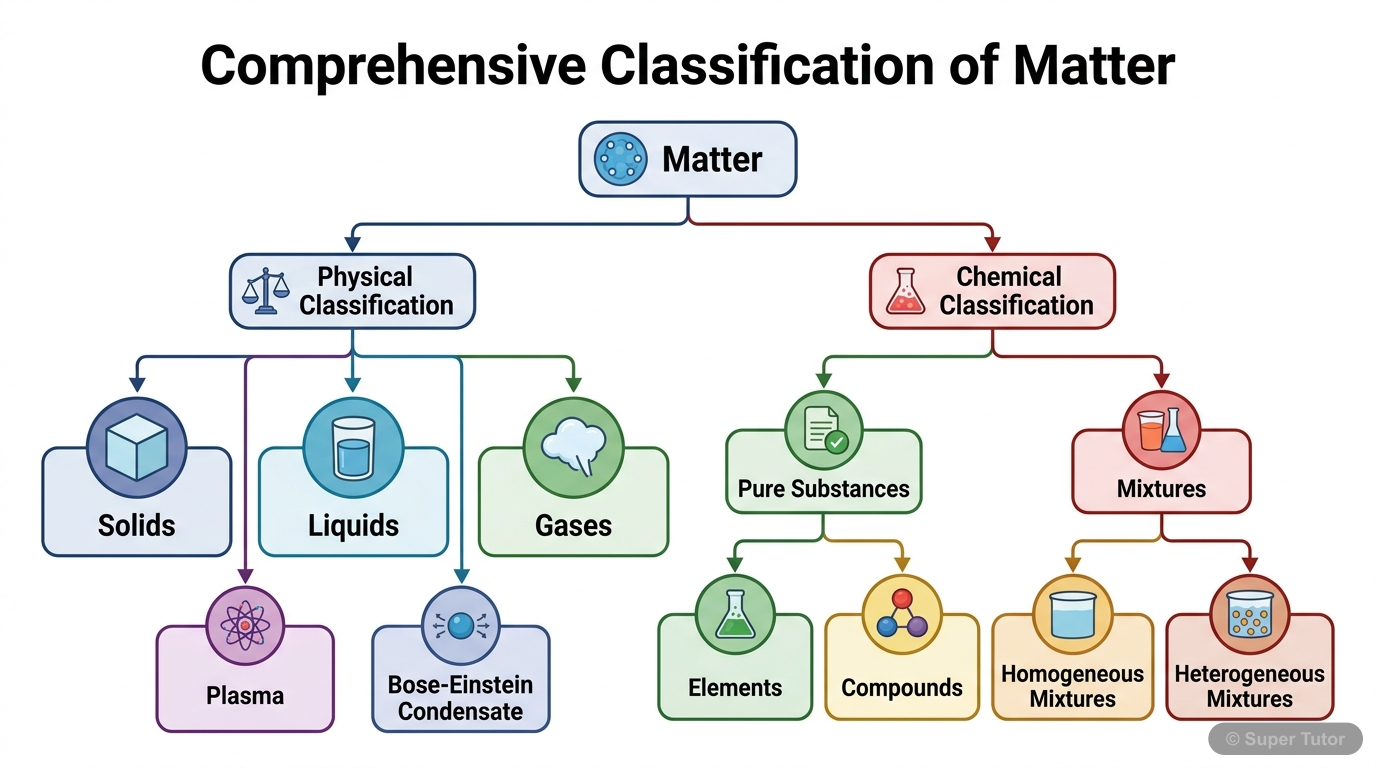
Learn better with visuals Super Tutor pairs illustrations like this with notes and quizzes for Is Matter around us Pure?.
The first 6 solutions are open to read. The other 5 are free with a Super Tutor account.
Exercises — Is Matter Around Us Pure? (Class 9 Science)
1Which separation techniques will you apply for the separation of the following?
(a) Sodium chloride from its solution in water
(b) Ammonium chloride from a mixture containing sodium chloride and ammonium chloride
(c) Small pieces of metal in the engine oil of a car
(d) Different pigments from an extract of flower petals
(e) Butter from curd
(f) Oil from water
(g) Tea leaves from tea
(h) Iron pins from sand
(i) Wheat grains from husk
(j) Fine mud particles suspended in waterShow solution
(a) Sodium chloride from its solution in water:
Technique — Evaporation (or Crystallisation).
Water (solvent) evaporates on heating, leaving behind solid sodium chloride.
(b) Ammonium chloride from a mixture of sodium chloride and ammonium chloride:
Technique — Sublimation.
Ammonium chloride sublimes (converts directly from solid to vapour) on heating, while sodium chloride does not. The vapours are collected and condensed to get pure ammonium chloride.
(c) Small pieces of metal from engine oil:
Technique — Filtration (using a fine mesh/filter) or using a magnet if the metal is magnetic (e.g., iron).
The metal pieces are insoluble in oil and can be filtered out.
(d) Different pigments from an extract of flower petals:
Technique — Chromatography.
Different pigments travel at different speeds on the chromatography paper due to their different solubilities, separating them into distinct bands.
(e) Butter from curd:
Technique — Centrifugation.
Curd is churned at high speed; the denser butter separates out due to centrifugal force.
(f) Oil from water:
Technique — Separating funnel (Separatory funnel).
Oil and water are immiscible liquids with different densities. They form two distinct layers in the separating funnel; the lower layer (water) is drained out first, then oil is collected.
(g) Tea leaves from tea:
Technique — Filtration.
Tea is poured through a strainer/filter; tea leaves (residue) are retained and the liquid tea (filtrate) passes through.
(h) Iron pins from sand:
Technique — Magnetic separation.
A magnet is moved over the mixture; iron pins (being magnetic) are attracted to the magnet and separated from sand.
(i) Wheat grains from husk:
Technique — Winnowing.
The mixture is allowed to fall from a height in a gentle breeze; the lighter husk is blown away while the heavier wheat grains fall straight down.
(j) Fine mud particles suspended in water:
Technique — Centrifugation or Sedimentation followed by Decantation.
On centrifugation (or on allowing to stand), the heavier mud particles settle at the bottom; the clear water is then carefully poured off (decanted).
2Write the steps you would use for making tea. Use the words solution, solvent, solute, dissolve, soluble, insoluble, filtrate and residue.Show solution
Steps for Making Tea:
Step 1: Take water in a pan and heat it. Water acts as the solvent.
Step 2: Add tea leaves to the boiling water. Tea leaves are partially soluble in hot water — the colour and flavour compounds dissolve in water, while the leaf material itself is insoluble.
Step 3: Add sugar (a solute) to the mixture. Sugar readily dissolves in hot water to form a solution.
Step 4: Add milk (another solute/component) and allow the mixture to boil for a short time, forming a uniform solution of tea.
Step 5: Pour the tea through a strainer (filtration). The liquid tea that passes through is the filtrate — this is our tea. The undissolved tea leaves left behind on the strainer are the residue.
Result: The final tea is a solution in which water is the solvent and the dissolved substances (sugar, colour, flavour compounds from tea leaves) are the solutes.
3Pragya tested the solubility of three different substances at different temperatures. The data is given in the table (grams of substance dissolved in 100 g of water to form a saturated solution).
| Substance | 283 K | 293 K | 313 K | 333 K | 353 K |
|---|---|---|---|---|---|
| Potassium nitrate | 21 | 32 | 62 | 106 | 167 |
| Sodium chloride | 36 | 36 | 36 | 37 | 37 |
| Potassium chloride | 35 | 35 | 40 | 46 | 54 |
| Ammonium chloride | 24 | 37 | 41 | 55 | 66 |
(a) What mass of potassium nitrate would be needed to produce a saturated solution of potassium nitrate in 50 grams of water at 313 K?
(b) Pragya makes a saturated solution of potassium chloride in water at 353 K and leaves the solution to cool at room temperature. What would she observe as the solution cools? Explain.
(c) Find the solubility of each salt at 293 K. Which salt has the highest solubility at this temperature?
(d) What is the effect of change of temperature on the solubility of a salt?Show solution
(a) Mass of potassium nitrate for saturated solution in 50 g water at 313 K:
Given: At 313 K, solubility of potassium nitrate = 62 g per 100 g of water.
This means: 100 g water dissolves 62 g of potassium nitrate.
For 50 g of water:
Answer: 31 g of potassium nitrate is needed to make a saturated solution in 50 g of water at 313 K.
(b) Observation when saturated KCl solution at 353 K cools to room temperature (~293 K):
At 353 K, solubility of KCl = 54 g per 100 g water.
At 293 K (room temperature), solubility of KCl = 35 g per 100 g water.
When the solution cools, the solubility decreases from 54 g to 35 g per 100 g water. The excess dissolved KCl (54 − 35 = 19 g per 100 g water) can no longer remain dissolved.
Observation: Crystals of potassium chloride will start to appear (crystallise out) as the solution cools. This process is called crystallisation.
(c) Solubility of each salt at 293 K (from the table):
| Salt | Solubility at 293 K (g/100 g water) |
|---|---|
| Potassium nitrate | 32 |
| Sodium chloride | 36 |
| Potassium chloride | 35 |
| Ammonium chloride | 37 |
Salt with highest solubility at 293 K = Ammonium chloride (37 g per 100 g water).
(d) Effect of change of temperature on solubility:
From the table, we observe:
- For potassium nitrate, potassium chloride, and ammonium chloride: solubility increases significantly with increase in temperature.
- For sodium chloride: solubility remains almost unchanged (very slight increase) with increase in temperature.
Conclusion: In general, the solubility of a solid solute in water increases with increase in temperature. However, the extent of increase varies from substance to substance.
4Explain the following giving examples.
(a) Saturated solution
(b) Pure substance
(c) Colloid
(d) SuspensionShow solution
(a) Saturated Solution:
A solution in which no more solute can be dissolved at a given temperature is called a saturated solution.
At a particular temperature, when the maximum amount of solute has dissolved in the solvent, the solution is said to be saturated. Any additional solute added will remain undissolved.
Example: At 293 K, a solution containing 36 g of sodium chloride dissolved in 100 g of water is a saturated solution. Adding more NaCl will not dissolve; it will settle at the bottom.
(b) Pure Substance:
A pure substance is one that consists of a single type of particles (atoms or molecules) and has a definite, fixed composition throughout. It cannot be separated into other substances by physical methods.
Pure substances have fixed melting points, boiling points, and other characteristic properties.
Examples:
- Elements: Gold (Au), Iron (Fe), Oxygen ()
- Compounds: Water (), Common salt (NaCl), Sugar ()
(c) Colloid:
A colloid is a heterogeneous mixture in which the particle size of the dispersed substance is intermediate — too small to be seen with the naked eye (between and ) but large enough to scatter a beam of light (Tyndall effect).
The particles dispersed are called the dispersed phase and the medium in which they are dispersed is called the dispersion medium.
Colloids appear homogeneous to the naked eye but are actually heterogeneous.
Examples: Milk (fat dispersed in water), Fog (water droplets in air), Smoke (carbon particles in air), Starch solution.
(d) Suspension:
A suspension is a heterogeneous mixture in which the solute particles do not dissolve but remain suspended throughout the bulk of the medium. The particles are large enough to be seen with the naked eye (particle size greater than ) and will eventually settle down under gravity.
A suspension is unstable — the particles settle on standing and can be separated by filtration.
Examples: Chalk powder in water, Muddy water, Flour mixed in water, Sand in water.
5Classify each of the following as a homogeneous or heterogeneous mixture: soda water, wood, air, soil, vinegar, filtered tea.Show solution
Concept: A homogeneous mixture has a uniform composition throughout, while a heterogeneous mixture has a non-uniform composition.
| Mixture | Classification | Reason |
|---|---|---|
| Soda water | Homogeneous | gas is uniformly dissolved in water; uniform composition throughout. |
| Wood | Heterogeneous | Wood contains cellulose fibres, lignin, water, etc., which are not uniformly distributed. |
| Air | Homogeneous | Air is a uniform mixture of gases (, , , etc.) with the same composition throughout. |
| Soil | Heterogeneous | Soil contains sand, clay, organic matter, minerals, etc., which are not uniformly mixed. |
| Vinegar | Homogeneous | Vinegar is a uniform solution of acetic acid in water. |
| Filtered tea | Homogeneous | Filtered tea is a uniform solution of tea compounds and sugar in water (no visible particles). |
6How would you confirm that a colourless liquid given to you is pure water?Show solution
To confirm that a colourless liquid is pure water, the following tests can be performed:
Test 1 — Boiling Point:
Pure water boils at exactly (373 K) at 1 atmospheric pressure. Heat the liquid and note the temperature at which it boils. If it boils at exactly and the temperature remains constant throughout boiling, it indicates pure water. Any dissolved impurity would raise the boiling point.
Test 2 — Freezing/Melting Point:
Pure water freezes at exactly (273 K). Cool the liquid and note the temperature at which it freezes. Pure water will freeze at .
Test 3 — Density:
The density of pure water at is exactly . Measure the density of the liquid.
Test 4 — Anhydrous Copper Sulphate (Chemical Test):
Add a few drops of the liquid to white anhydrous copper sulphate powder. If it turns blue, the liquid contains water. (This confirms the presence of water but not purity alone.)
Conclusion: If the liquid boils at exactly , freezes at exactly , and has a density of , it can be confirmed to be pure water.
(a) Ice (b) Milk (c) Iron (d) Hydrochloric acid (e) Calcium oxide (f) Mercury (g) Brick (h) Wood (i) Air
Free with a Super Tutor account
(a) Soil (b) Sea water (c) Air (d) Coal (e) Soda water
Free with a Super Tutor account
(a) Salt solution (b) Milk (c) Copper sulphate solution (d) Starch solution
Free with a Super Tutor account
(a) Sodium (b) Soil (c) Sugar solution (d) Silver (e) Calcium carbonate (f) Tin (g) Silicon (h) Coal (i) Air (j) Soap (k) Methane (l) Carbon dioxide (m) Blood
Free with a Super Tutor account
(a) Growth of a plant
(b) Rusting of iron
(c) Mixing of iron filings and sand
(d) Cooking of food
(e) Digestion of food
(f) Freezing of water
(g) Burning of a candle
Free with a Super Tutor account
5 more solved questions in Is Matter around us Pure?
They are free with a Super Tutor account, along with practice quizzes and flashcards for this chapter. Free to start, no card needed.
Frequently Asked Questions
What are the important topics in Is Matter around us Pure? for Uttarakhand Board Class 9 Science?
Are these NCERT Solutions for Is Matter around us Pure? free?
How should I revise Is Matter around us Pure? for Class 9 exams?
Sources & Official References
Content is aligned to the official syllabus. Refer to the board website for the latest curriculum.
More resources for Is Matter around us Pure?
For serious students
Get the full Is Matter around us Pure? chapter — start free.
Quizzes, flashcards, an AI doubt solver and a study plan for Uttarakhand Board Class 9 Science. Free to start, no card needed.