Two Stories about Flying — NCERT Solutions
Uttar Pradesh Board · Class 10 · English
NCERT Solutions for Two Stories about Flying, Uttar Pradesh Board Class 10 English: 32 textbook questions solved step by step.
Interactive on Super Tutor
Studying Two Stories about Flying? Get the full interactive chapter.
Quizzes, flashcards, AI doubt-solver and a step-by-step study plan — built for NCERT solutions and more.
Free trial, no card needed.
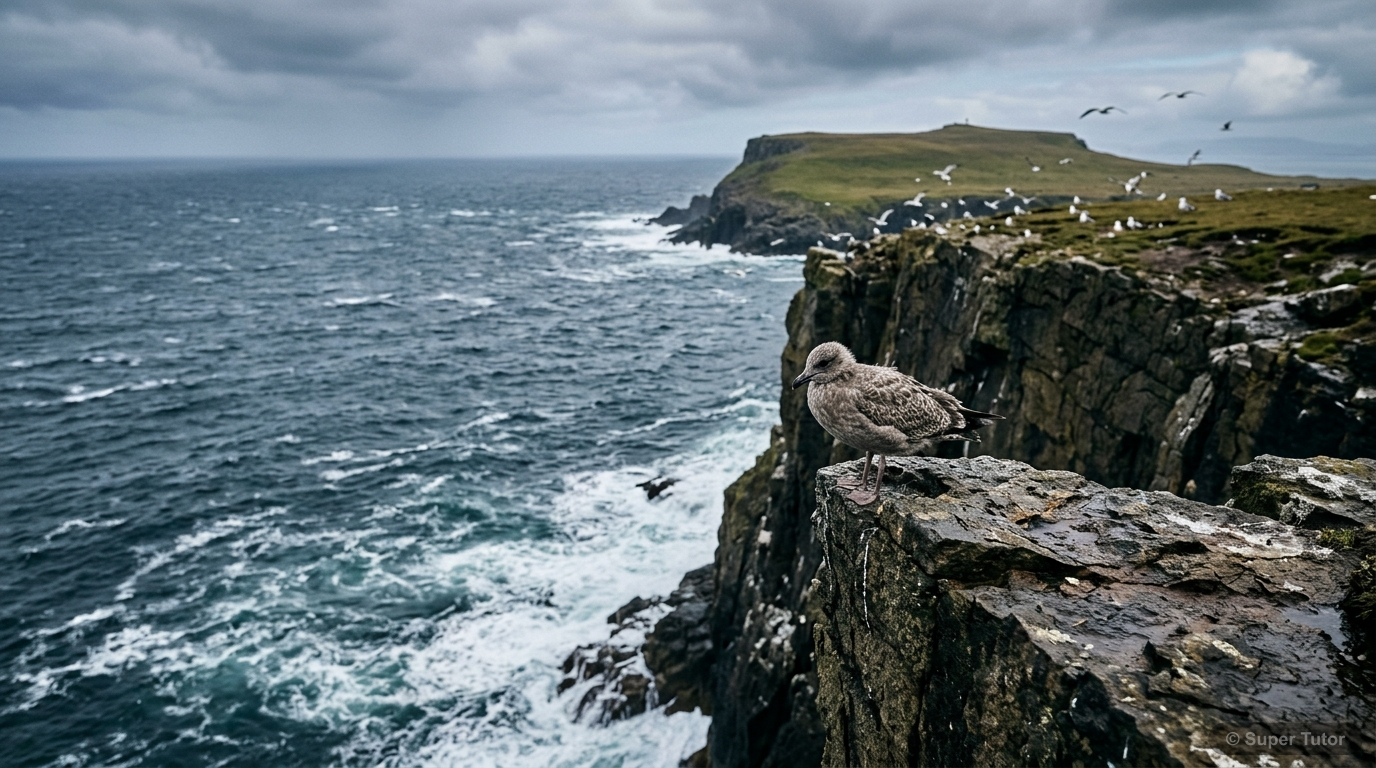
One of 8 illustrations for Two Stories about Flying in Super Tutor — alongside flashcards, concept maps and practice questions.
The first 16 solutions are open to read. The other 16 are free with a Super Tutor account.
His First Flight — Thinking about the Text
1Why was the young seagull afraid to fly? Do you think all young birds are afraid to make their first flight, or are some birds more timid than others? Do you think a human baby also finds it a challenge to take its first steps?Show solution
Given: The story describes a young seagull who is unable to make his first flight despite his family having already flown.
Answer:
The young seagull was afraid to fly because he felt that his wings would never support him in the air. Whenever he ran towards the edge of the ledge and looked down at the vast, deep sea far below, he became terrified. The great expanse of the ocean and the fear of falling made him retreat in fear.
It is quite natural for young birds to be afraid of their first flight, as it is an entirely new experience. However, some birds may be bolder by nature while others are more timid — just as individual personalities differ among humans.
Similarly, a human baby does find it a challenge to take its first steps. The baby has to overcome the fear of falling, balance its body, and coordinate its limbs — all for the very first time. In both cases, the first attempt requires courage and the overcoming of an instinctive fear.
2"The sight of the food maddened him." What does this suggest? What compelled the young seagull to finally fly?Show solution
Given: The young seagull had been starving for twenty-four hours. His mother held a piece of fish in her beak and flew close to him but did not give it to him.
Answer:
The phrase "the sight of the food maddened him" suggests that the young seagull was so desperately hungry that the sight of food drove him beyond the limits of his self-control. His hunger overpowered his fear.
What ultimately compelled him to fly was his extreme hunger combined with his mother's deliberate act of temptation. When his mother flew close to him with a piece of fish but did not give it to him, the seagull could no longer resist. He dived at the fish with a loud scream, and in doing so, he fell off the ledge. As he fell downward, his wings spread out automatically, and he found himself flying. Thus, hunger and the lure of food conquered his fear and compelled him to make his first flight.
3"They were beckoning to him, calling shrilly." Why did the seagull's father and mother threaten him and cajole him to fly?Show solution
Given: The young seagull's parents, brothers, and sister had all flown away, leaving him alone on the ledge. They called to him from the plateau below.
Answer:
The seagull's father and mother threatened and cajoled him to fly because they knew that flying was an essential life skill — without it, the young seagull could not survive. He could not hunt for food, escape predators, or live the life of a seagull if he remained on the ledge forever.
They were acting out of parental concern and love. By threatening him (even pretending to leave him to starve) and by calling out to him encouragingly, they were trying to push him out of his comfort zone so that he would discover his own ability. They understood that the only way he would overcome his fear was by actually attempting to fly. Their actions were a form of tough love meant to ensure his survival and independence.
4Have you ever had a similar experience, where your parents encouraged you to do something that you were too scared to try? Discuss this in pairs or groups.Show solution
Note: This is a personal/discussion-based question. A model answer is provided below.
Sample Answer:
Yes, I had a similar experience when I was learning to ride a bicycle. I was very scared of falling and kept refusing to try without the support of training wheels. My father, however, encouraged me patiently. He held the bicycle from behind and ran alongside me, assuring me that he would not let go. Gradually, he loosened his grip, and before I realised it, I was riding on my own. When I looked back and saw him standing far behind, I was both thrilled and proud. His encouragement helped me overcome my fear and discover a skill I still enjoy today.
(Students should share their own personal experiences in pairs or groups.)
5In the case of a bird flying, it seems a natural act, and a foregone conclusion that it should succeed. In the examples you have given in answer to the previous question, was your success guaranteed, or was it important for you to try, regardless of a possibility of failure?Show solution
Note: This is a reflective/discussion-based question linked to Question 4. A model answer is provided.
Sample Answer:
In the case of a bird, flying is indeed a natural, instinctive act, and it is almost certain that the bird will succeed once it attempts it. However, in human endeavours such as learning to ride a bicycle or swim, success is not guaranteed. One may fall, get hurt, or fail multiple times before succeeding.
Yet, it is extremely important to try, regardless of the possibility of failure. The attempt itself builds confidence, teaches us to handle setbacks, and develops perseverance. Even if we do not succeed immediately, the effort is never wasted — we learn from each failure. As the seagull's story shows, the willingness to take the leap is the first and most important step toward success.
Writing
1Write a short composition on your initial attempts at learning a skill. You could describe the challenges of learning to ride a bicycle or learning to swim. Make it as humorous as possible.Show solution
When I first tried to learn cycling, I thought the bicycle was my enemy. It kept wobbling like a nervous goat, and I sat on it as if I were balancing a basket of eggs. My father ran behind me shouting, “Don’t fear, just pedal!” which was easier said than done, because my feet seemed to have forgotten their job.
At first I managed only a few shaky metres before the bicycle decided to perform a dramatic fall. I fell, the bicycle fell, and my dignity fell the farthest. My little brother, who had never ridden anything except a toy car, laughed so hard that he nearly rolled into the drain.
After several more attempts, bruises, and one near-collision with a flowerpot, I finally rode without support. That tiny victory felt grand. I learned that skill comes not from magic but from patience, practice, and repeated falling—preferably in front of fewer spectators.
Black Aeroplane — Thinking about the Text
1"I'll take the risk." What is the risk? Why does the narrator take it?Show solution
Given: The narrator is flying his old Dakota aeroplane from France to England. He sees a huge storm cloud ahead.
The Risk:
The risk is that of flying straight into the massive, dark storm clouds instead of turning back to Paris. Flying into such clouds in an old Dakota aeroplane — without proper visibility, with instruments that could fail, and with the danger of losing control — was extremely dangerous and could have been fatal.
Why he takes it:
The narrator takes the risk because he is eager to reach England. He is thinking of his family — his children, a warm bed, and a good English breakfast. He is so close to home that he does not want to turn back. His longing to be home overrides his caution, and so he decides to fly through the storm despite the danger.
2Describe the narrator's experience as he flew the aeroplane into the storm.Show solution
Given: The narrator flew his Dakota aeroplane into a large storm cloud over France while heading to England.
Description of the experience:
As soon as the narrator entered the storm clouds, everything turned suddenly and completely black. He could see nothing outside the aeroplane. The old Dakota began to be tossed about violently — it jumped and twisted in the storm. The compass and other instruments stopped working, so he had no idea which direction he was flying in. He was lost inside the clouds with no radio contact and no navigational aids.
Just when he was in complete despair, he saw the lights of another aeroplane inside the clouds. The pilot of that mysterious black aeroplane signalled him to follow. The narrator followed the strange pilot through the dark clouds for about half an hour. Finally, the black aeroplane led him out of the storm, and he found himself flying over a runway where he landed safely.
The experience was terrifying, disorienting, and miraculous all at once.
3Why does the narrator say, "I landed and was not sorry to walk away from the old Dakota..."?Show solution
Given: After being guided safely through the storm by the mysterious black aeroplane, the narrator lands on a runway.
Answer:
The narrator says this because the flight had been an extremely frightening and harrowing experience. Flying through the violent storm in the old Dakota — with no working instruments, no visibility, no radio contact, and no sense of direction — had been terrifying. He had nearly lost his life.
He was greatly relieved to be safely on the ground. The old Dakota, though it had carried him through, was associated with the fear and danger of that night. He was simply glad to be alive and on solid ground, and felt no attachment to the aeroplane that had put him through such an ordeal. The statement reflects his immense relief at having survived.
4What made the woman in the control centre look at the narrator strangely?Show solution
Given: After landing safely, the narrator goes to the control centre and asks about the other aeroplane that had guided him.
Answer:
The woman in the control centre looked at the narrator strangely because he asked her about the other aeroplane — the black aeroplane that had guided him through the storm. However, according to the radar and all records at the control centre, there had been no other aeroplane in the sky that night. Only the narrator's Dakota had been flying in that area during the storm.
The woman was puzzled and surprised because the narrator was insisting on the existence of an aeroplane that, as far as all official records were concerned, simply did not exist. This made her look at him in a strange, bewildered manner.
5Who do you think helped the narrator to reach safely? Discuss this among yourselves and give reasons for your answer.Show solution
Note: This is an open-ended, interpretive question. Multiple valid answers are possible.
Answer:
This question has no single definitive answer, and different readers may interpret it differently:
- Supernatural/Spiritual explanation: Many readers believe that the mysterious pilot was a guardian angel or a supernatural force that appeared to save the narrator's life. The fact that the black aeroplane vanished without a trace and left no record on radar supports this view.
- Psychological explanation: Some readers suggest that the narrator, in a state of extreme stress and fear, may have hallucinated the other aeroplane. His mind, desperate for help, may have created the illusion of a guide.
- Unexplained mystery: The story deliberately leaves the question unanswered to create a sense of mystery and wonder.
My view: The most likely intended interpretation is that a mysterious, perhaps supernatural, force helped the narrator. The story is titled 'The Black Aeroplane' and the pilot is never identified, suggesting the author wants us to believe in the miraculous nature of the rescue. The narrator himself wonders, "Who was the pilot?" — leaving us with the same unanswered question.
Writing
1Have you ever been alone or away from home during a thunderstorm? Narrate your experience in a paragraph.Show solution
Once, I was away from home when a thunderstorm began suddenly in the evening. The sky turned dark, the wind howled, and the rain came down in sheets. I sat near a window and watched the trees bend violently as lightning flashed across the sky. For a few minutes I felt nervous, because the thunder sounded very loud and the power went off. I kept close to my family and listened to the rain pounding on the roof. After some time, the storm passed, and the air became fresh and cool. I felt safe and relieved, and I still remember how powerful nature seemed that night.
Thinking about the Poem
1Does 'dyin' really rhyme with 'lion'? Can you say it in such a way that it does?Show solution
Yes, “dyin’” can rhyme with “lion” if it is read in a stretched, poetic way, almost like “dye-in”. The poet uses this pronunciation to make the rhyme work and to create a playful rhythm.
2How does the poet suggest that you identify the lion and the tiger? When can you do so, according to him?Show solution
The poet suggests identifying the lion by its roar and the tiger by its black stripes on a yellow ground. According to him, you can do this when the animal is close enough to attack you—that is, when it roars at you or when it starts to eat you.
3Do you think the words 'lept' and 'lep' in the third stanza are spelt correctly? Why does the poet spell them like this?Show solution
No, “lept” and “lep” are not standard spellings. The poet spells them like this to match the humorous sound of the poem and to make the words fit the playful rhythm and rhyme.
4Do you know what a 'bearhug' is? It's a friendly and strong hug — such as bears are thought to give, as they attack you! Again, hyenas are thought to laugh, and crocodiles to weep ('crocodile tears') as they swallow their victims. Are there similar expressions and popular ideas about wild animals in your own language(s)?Show solution
Yes, many languages have similar expressions and popular ideas about wild animals, such as saying a bear gives a bearhug, or that crocodiles cry false tears. These expressions are based on common beliefs about animal behavior and are often used humorously.
Free with a Super Tutor account
Free with a Super Tutor account
Free with a Super Tutor account
Thinking about the Poem
Free with a Super Tutor account
Free with a Super Tutor account
Free with a Super Tutor account
Free with a Super Tutor account
Free with a Super Tutor account
I (Meanings of 'Black')
Free with a Super Tutor account
Free with a Super Tutor account
Free with a Super Tutor account
Free with a Super Tutor account
Free with a Super Tutor account
Free with a Super Tutor account
II (Phrases with 'Fly')
1. Fly a flag
2. Fly into rage
3. Fly along
4. Fly high
5. Fly the coop
Free with a Super Tutor account
III (Words meaning 'to fly')
Free with a Super Tutor account
16 more solved questions in Two Stories about Flying
They are free with a Super Tutor account, along with practice quizzes and flashcards for this chapter. Free to start, no card needed.
Frequently Asked Questions
What are the important topics in Two Stories about Flying for Uttar Pradesh Board Class 10 English?
Are these NCERT Solutions for Two Stories about Flying free?
How should I revise Two Stories about Flying for the Uttar Pradesh Board Class 10 board exam?
Sources & Official References
Content is aligned to the official syllabus. Refer to the board website for the latest curriculum.
More resources for Two Stories about Flying
Practice Quiz
Test yourself with a quick quiz
Important Questions
Exam-style questions with answers
Revision Notes
Key points for last-minute revision
Chapter Summary
Understand the chapter at a glance
Concept Maps
See how topics connect
Study Plan
Step-by-step plan for this chapter
Flashcards
Quick-fire cards for active recall
Syllabus
What topics to cover
For serious students
Get the full Two Stories about Flying chapter — start free.
Quizzes, flashcards, an AI doubt solver and a study plan for Uttar Pradesh Board Class 10 English. Free to start, no card needed.