Chapter 1 of 14
NCERT Solutions

Real Numbers

Uttar Pradesh Board · Class 10 · Mathematics

NCERT Solutions for Real Numbers — Uttar Pradesh Board Class 10 Mathematics.

61 questions22 flashcards4 concepts

Interactive on Super Tutor

Studying Real Numbers? Get the full interactive chapter.

Quizzes, flashcards, AI doubt-solver and a step-by-step study plan — built for ncert solutions and more.

1,000+ Class 10 students started this chapter today

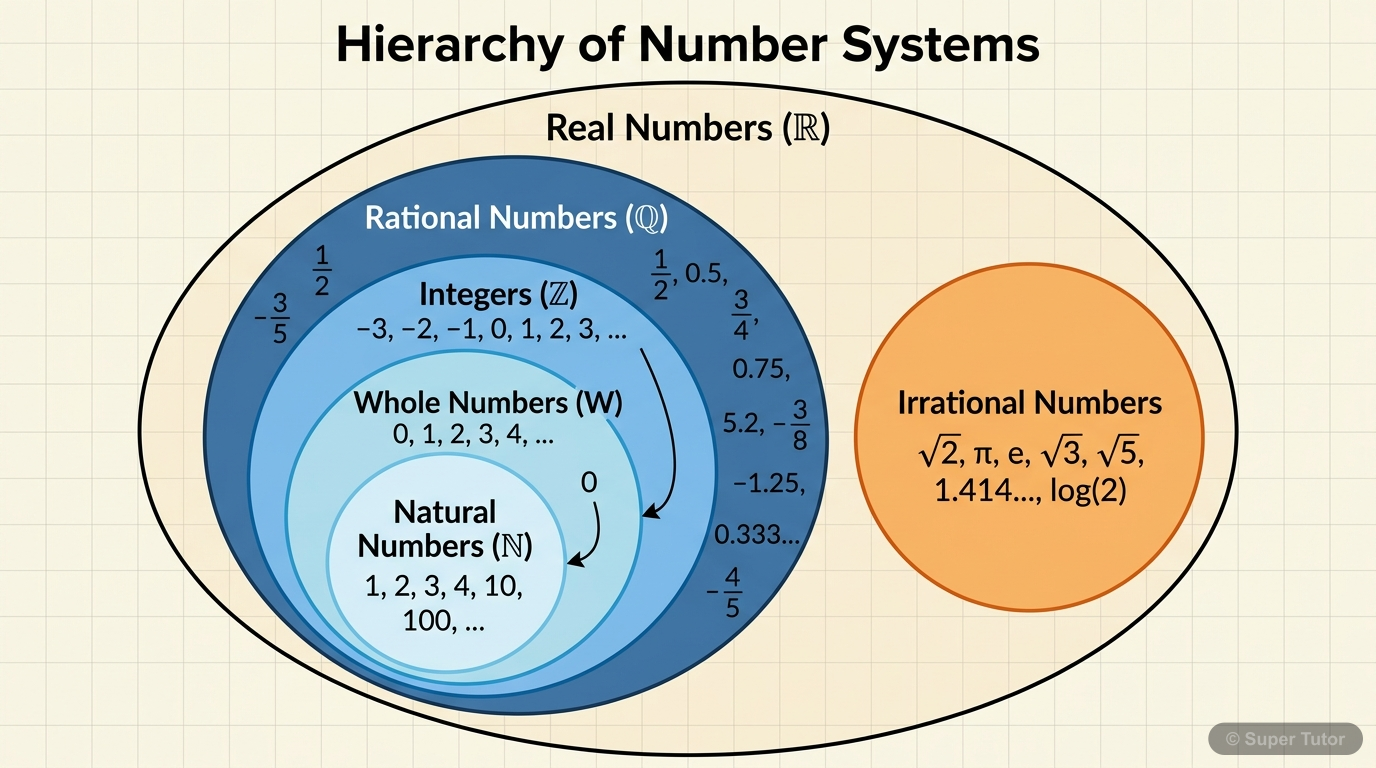
A Venn diagram illustrating the classification of real numbers into rational and irrational numbers, with further subdivisions for rational numbers (integers, whole numbers, natural numbers).
Super Tutor

This is just one of 6+ visuals inside Super Tutor's Real Numbers chapter

Explore the full set
10 Questions Solved · 2 Sections

Exercise 1.1

1Express each number as a product of its prime factors:
(i) 140
(ii) 156
(iii) 3825
(iv) 5005
(v) 7429
Show solution
Concept: Prime factorisation — divide the number successively by the smallest prime factor until the quotient is 1.

(i) 140
140=2×70=2×2×35=2×2×5×7140 = 2 \times 70 = 2 \times 2 \times 35 = 2 \times 2 \times 5 \times 7
140=22×5×7\boxed{140 = 2^2 \times 5 \times 7}

(ii) 156
156=2×78=2×2×39=2×2×3×13156 = 2 \times 78 = 2 \times 2 \times 39 = 2 \times 2 \times 3 \times 13
156=22×3×13\boxed{156 = 2^2 \times 3 \times 13}

(iii) 3825
3825=3×1275=3×3×425=3×3×5×85=3×3×5×5×173825 = 3 \times 1275 = 3 \times 3 \times 425 = 3 \times 3 \times 5 \times 85 = 3 \times 3 \times 5 \times 5 \times 17
3825=32×52×17\boxed{3825 = 3^2 \times 5^2 \times 17}

(iv) 5005
5005=5×1001=5×7×143=5×7×11×135005 = 5 \times 1001 = 5 \times 7 \times 143 = 5 \times 7 \times 11 \times 13
5005=5×7×11×13\boxed{5005 = 5 \times 7 \times 11 \times 13}

(v) 7429
7429=17×437=17×19×237429 = 17 \times 437 = 17 \times 19 \times 23
7429=17×19×23\boxed{7429 = 17 \times 19 \times 23}
2Find the LCM and HCF of the following pairs of integers and verify that LCM × HCF = product of the two numbers.
(i) 26 and 91
(ii) 510 and 92
(iii) 336 and 54
Show solution
Concept: Express each number as a product of prime factors. HCF = product of the smallest powers of common prime factors. LCM = product of the greatest powers of all prime factors. Verification: LCM × HCF = product of the two numbers.

---
(i) 26 and 91

Prime factorisations:
26=2×13,91=7×1326 = 2 \times 13, \quad 91 = 7 \times 13

Common prime factor: 1313
HCF(26,91)=13\text{HCF}(26, 91) = 13
LCM(26,91)=2×7×13=182\text{LCM}(26, 91) = 2 \times 7 \times 13 = 182

Verification:
LCM×HCF=182×13=2366\text{LCM} \times \text{HCF} = 182 \times 13 = 2366
26×91=236626 \times 91 = 2366 \quad \checkmark

---
(ii) 510 and 92

Prime factorisations:
510=2×255=2×3×85=2×3×5×17510 = 2 \times 255 = 2 \times 3 \times 85 = 2 \times 3 \times 5 \times 17
92=2×46=2×2×23=22×2392 = 2 \times 46 = 2 \times 2 \times 23 = 2^2 \times 23

Common prime factor: 22 (smallest power =21= 2^1)
HCF(510,92)=2\text{HCF}(510, 92) = 2
LCM(510,92)=22×3×5×17×23=23460\text{LCM}(510, 92) = 2^2 \times 3 \times 5 \times 17 \times 23 = 23460

Verification:
LCM×HCF=23460×2=46920\text{LCM} \times \text{HCF} = 23460 \times 2 = 46920
510×92=46920510 \times 92 = 46920 \quad \checkmark

---
(iii) 336 and 54

Prime factorisations:
336=2×168=24×3×7336 = 2 \times 168 = 2^4 \times 3 \times 7
54=2×27=2×3354 = 2 \times 27 = 2 \times 3^3

Common prime factors: 22 and 33 (smallest powers 212^1 and 313^1)
HCF(336,54)=21×31=6\text{HCF}(336, 54) = 2^1 \times 3^1 = 6
LCM(336,54)=24×33×7=16×27×7=3024\text{LCM}(336, 54) = 2^4 \times 3^3 \times 7 = 16 \times 27 \times 7 = 3024

Verification:
LCM×HCF=3024×6=18144\text{LCM} \times \text{HCF} = 3024 \times 6 = 18144
336×54=18144336 \times 54 = 18144 \quad \checkmark
3Find the LCM and HCF of the following integers by applying the prime factorisation method.
(i) 12, 15 and 21
(ii) 17, 23 and 29
(iii) 8, 9 and 25
Show solution
Concept: HCF = product of smallest powers of common prime factors; LCM = product of greatest powers of all prime factors present.

---
(i) 12, 15 and 21

Prime factorisations:
12=22×3,15=3×5,21=3×712 = 2^2 \times 3, \quad 15 = 3 \times 5, \quad 21 = 3 \times 7

Common prime factor to all three: 33 (smallest power =31= 3^1)
HCF(12,15,21)=3\text{HCF}(12, 15, 21) = 3

Greatest powers of all prime factors: 22, 31, 51, 712^2,\ 3^1,\ 5^1,\ 7^1
LCM(12,15,21)=22×3×5×7=420\text{LCM}(12, 15, 21) = 2^2 \times 3 \times 5 \times 7 = 420

---
(ii) 17, 23 and 29

All three numbers are prime, so they have no common factor other than 1.
17=17,23=23,29=2917 = 17, \quad 23 = 23, \quad 29 = 29
HCF(17,23,29)=1\text{HCF}(17, 23, 29) = 1
LCM(17,23,29)=17×23×29=11339\text{LCM}(17, 23, 29) = 17 \times 23 \times 29 = 11339

---
(iii) 8, 9 and 25

Prime factorisations:
8=23,9=32,25=528 = 2^3, \quad 9 = 3^2, \quad 25 = 5^2

There is no prime factor common to all three numbers.
HCF(8,9,25)=1\text{HCF}(8, 9, 25) = 1

Greatest powers of all prime factors: 23, 32, 522^3,\ 3^2,\ 5^2
LCM(8,9,25)=23×32×52=8×9×25=1800\text{LCM}(8, 9, 25) = 2^3 \times 3^2 \times 5^2 = 8 \times 9 \times 25 = 1800
4Given that HCF(306, 657) = 9, find LCM(306, 657).Show solution
Given: HCF(306,657)=9\text{HCF}(306, 657) = 9

Formula used:
LCM(a,b)=a×bHCF(a,b)\text{LCM}(a, b) = \frac{a \times b}{\text{HCF}(a, b)}

Calculation:
LCM(306,657)=306×6579\text{LCM}(306, 657) = \frac{306 \times 657}{9}
=2010429=22338= \frac{201042}{9} = 22338

LCM(306,657)=22338\boxed{\text{LCM}(306, 657) = 22338}
5Check whether 6n6^n can end with the digit 0 for any natural number nn.Show solution
Concept: A number ends with the digit 0 if and only if it has both 2 and 5 as prime factors (i.e., 10 is a factor of the number).

Prime factorisation of 6n6^n:
6n=(2×3)n=2n×3n6^n = (2 \times 3)^n = 2^n \times 3^n

The only prime factors of 6n6^n are 2 and 3.

For 6n6^n to end in 0, it must be divisible by 10, which requires 5 as a prime factor. But 5 does not appear in the prime factorisation of 6n6^n for any natural number nn.

By the Fundamental Theorem of Arithmetic, the prime factorisation of a number is unique. Since 5 is never a factor of 6n6^n, it can never be divisible by 10.

Conclusion: 6n6^n cannot end with the digit 0 for any natural number nn.
6Explain why 7×11×13+137 \times 11 \times 13 + 13 and 7×6×5×4×3×2×1+57 \times 6 \times 5 \times 4 \times 3 \times 2 \times 1 + 5 are composite numbers.Show solution
Concept: A composite number has at least one factor other than 1 and itself.

---
Expression 1: 7×11×13+137 \times 11 \times 13 + 13

Take 13 as a common factor:
7×11×13+13=13×(7×11+1)=13×(77+1)=13×787 \times 11 \times 13 + 13 = 13 \times (7 \times 11 + 1) = 13 \times (77 + 1) = 13 \times 78

Further: 78=2×3×1378 = 2 \times 3 \times 13, so
13×78=13×2×3×13=2×3×13213 \times 78 = 13 \times 2 \times 3 \times 13 = 2 \times 3 \times 13^2

Since the number has factors other than 1 and itself (e.g., 13 and 78), it is a composite number.

---
Expression 2: 7×6×5×4×3×2×1+57 \times 6 \times 5 \times 4 \times 3 \times 2 \times 1 + 5

Take 5 as a common factor:
7×6×5×4×3×2×1+5=5×(7×6×4×3×2×1+1)7 \times 6 \times 5 \times 4 \times 3 \times 2 \times 1 + 5 = 5 \times (7 \times 6 \times 4 \times 3 \times 2 \times 1 + 1)
=5×(1008+1)=5×1009= 5 \times (1008 + 1) = 5 \times 1009

Since 1009 is a prime number, 5×10095 \times 1009 has factors 1, 5, 1009, and 5045. It has factors other than 1 and itself, so it is a composite number.

Conclusion: Both expressions are composite numbers because each can be expressed as a product of two integers both greater than 1.
7There is a circular path around a sports field. Sonia takes 18 minutes to drive one round of the field, while Ravi takes 12 minutes for the same. Suppose they both start at the same point and at the same time, and go in the same direction. After how many minutes will they meet again at the starting point?Show solution
Given: Sonia takes 18 minutes per round; Ravi takes 12 minutes per round. They start together from the same point.

Concept: They will meet again at the starting point after a time that is the LCM of their individual times (the smallest time at which both complete a whole number of rounds).

Prime factorisations:
18=2×32,12=22×318 = 2 \times 3^2, \quad 12 = 2^2 \times 3

LCM:
LCM(18,12)=22×32=4×9=36\text{LCM}(18, 12) = 2^2 \times 3^2 = 4 \times 9 = 36

Conclusion: Sonia and Ravi will meet again at the starting point after 36 minutes.

*(In 36 minutes, Sonia completes 36÷18=236 \div 18 = 2 rounds and Ravi completes 36÷12=336 \div 12 = 3 rounds.)*

Exercise 1.2

1Prove that 5\sqrt{5} is irrational.Show solution
Proof (by contradiction):

Assume that 5\sqrt{5} is rational.

Then there exist integers aa and bb (with b0b \neq 0) such that
5=ab\sqrt{5} = \frac{a}{b}
where aa and bb are coprime (i.e., HCF(a,b)=1\text{HCF}(a, b) = 1).

Squaring both sides:
5=a2b2    a2=5b2(1)5 = \frac{a^2}{b^2} \implies a^2 = 5b^2 \quad \cdots (1)

This means 55 divides a2a^2. Since 5 is prime, by the theorem *"if a prime pp divides a2a^2, then pp divides aa"*, we get:
5 divides a5 \text{ divides } a

So we can write a=5ca = 5c for some integer cc.

Substituting in (1):
(5c)2=5b2    25c2=5b2    b2=5c2(5c)^2 = 5b^2 \implies 25c^2 = 5b^2 \implies b^2 = 5c^2

This means 55 divides b2b^2, and therefore 55 divides bb.

But now 5 divides both aa and bb, which contradicts our assumption that HCF(a,b)=1\text{HCF}(a, b) = 1.

Conclusion: Our assumption was wrong. Therefore, 5\sqrt{5} is irrational. \blacksquare
2Prove that 3+253 + 2\sqrt{5} is irrational.Show solution
Proof (by contradiction):

We first note that 5\sqrt{5} is irrational (proved in Q.1).

Assume that 3+253 + 2\sqrt{5} is rational.

Then there exist integers aa and bb (b0b \neq 0) such that:
3+25=ab3 + 2\sqrt{5} = \frac{a}{b}

Rearranging:
25=ab3=a3bb2\sqrt{5} = \frac{a}{b} - 3 = \frac{a - 3b}{b}
5=a3b2b\sqrt{5} = \frac{a - 3b}{2b}

Since aa, bb are integers and b0b \neq 0, the right-hand side a3b2b\dfrac{a-3b}{2b} is a rational number.

This means 5\sqrt{5} is rational — but this contradicts the fact that 5\sqrt{5} is irrational.

Conclusion: Our assumption was wrong. Therefore, 3+253 + 2\sqrt{5} is irrational. \blacksquare
3Prove that the following are irrationals:
(i) 12\dfrac{1}{\sqrt{2}}
(ii) 757\sqrt{5}
(iii) 6+26 + \sqrt{2}
Show solution
Preliminary fact: 2\sqrt{2} and 5\sqrt{5} are irrational (standard results).

---
(i) 12\dfrac{1}{\sqrt{2}}

Assume 12\dfrac{1}{\sqrt{2}} is rational. Then there exist integers aa, bb (b0b \neq 0, HCF(a,b)=1\text{HCF}(a,b)=1) such that:
12=ab\frac{1}{\sqrt{2}} = \frac{a}{b}
2=ba\sqrt{2} = \frac{b}{a}

Since aa and bb are integers (a0a \neq 0), ba\dfrac{b}{a} is rational, which means 2\sqrt{2} is rational. This contradicts the known fact that 2\sqrt{2} is irrational.

Conclusion: 12\dfrac{1}{\sqrt{2}} is irrational. \blacksquare

---
(ii) 757\sqrt{5}

Assume 757\sqrt{5} is rational. Then there exist integers aa, bb (b0b \neq 0) such that:
75=ab7\sqrt{5} = \frac{a}{b}
5=a7b\sqrt{5} = \frac{a}{7b}

Since aa and 7b7b are integers (7b07b \neq 0), a7b\dfrac{a}{7b} is rational, which means 5\sqrt{5} is rational. This contradicts the known fact that 5\sqrt{5} is irrational.

Conclusion: 757\sqrt{5} is irrational. \blacksquare

---
(iii) 6+26 + \sqrt{2}

Assume 6+26 + \sqrt{2} is rational. Then there exist integers aa, bb (b0b \neq 0) such that:
6+2=ab6 + \sqrt{2} = \frac{a}{b}
2=ab6=a6bb\sqrt{2} = \frac{a}{b} - 6 = \frac{a - 6b}{b}

Since aa and bb are integers (b0b \neq 0), a6bb\dfrac{a-6b}{b} is rational, which means 2\sqrt{2} is rational. This contradicts the known fact that 2\sqrt{2} is irrational.

Conclusion: 6+26 + \sqrt{2} is irrational. \blacksquare

Stuck on a step?

Ask Super Tutor AI to explain any solution on this page in a simpler way — free, 24x7.

Ask a Doubt Free

Frequently Asked Questions

What are the important topics in Real Numbers for Uttar Pradesh Board Class 10 Mathematics?
Key topics in Real Numbers include How to Correctly Identify Rational vs Irrational Numbers, Real Numbers Chapter — Complete Concept Map, Real Numbers — Complete Chapter Overview. These are the concepts Uttar Pradesh Board Class 10 examiners draw on most — study them first, then practise related questions.
How to score full marks in Real Numbers — Uttar Pradesh Board Class 10 Mathematics?
Understand the core concepts first, then work through the 61 practice questions available for this chapter. Revise formulas and definitions regularly, and use flashcards for quick recall before the exam.
Where can I get free NCERT Solutions for Real Numbers Class 10 Mathematics?
This page has free step-by-step NCERT Solutions for every exercise question in Real Numbers (Uttar Pradesh Board Class 10 Mathematics) — written the way examiners award marks: given, formula, working, answer.

Sources & Official References

Content is aligned to the official syllabus. Refer to the board website for the latest curriculum.

For serious students

Get the full Real Numbers chapter — for free.

Quizzes, flashcards, AI doubt-solver and a step-by-step study plan for Uttar Pradesh Board Class 10 Mathematics.