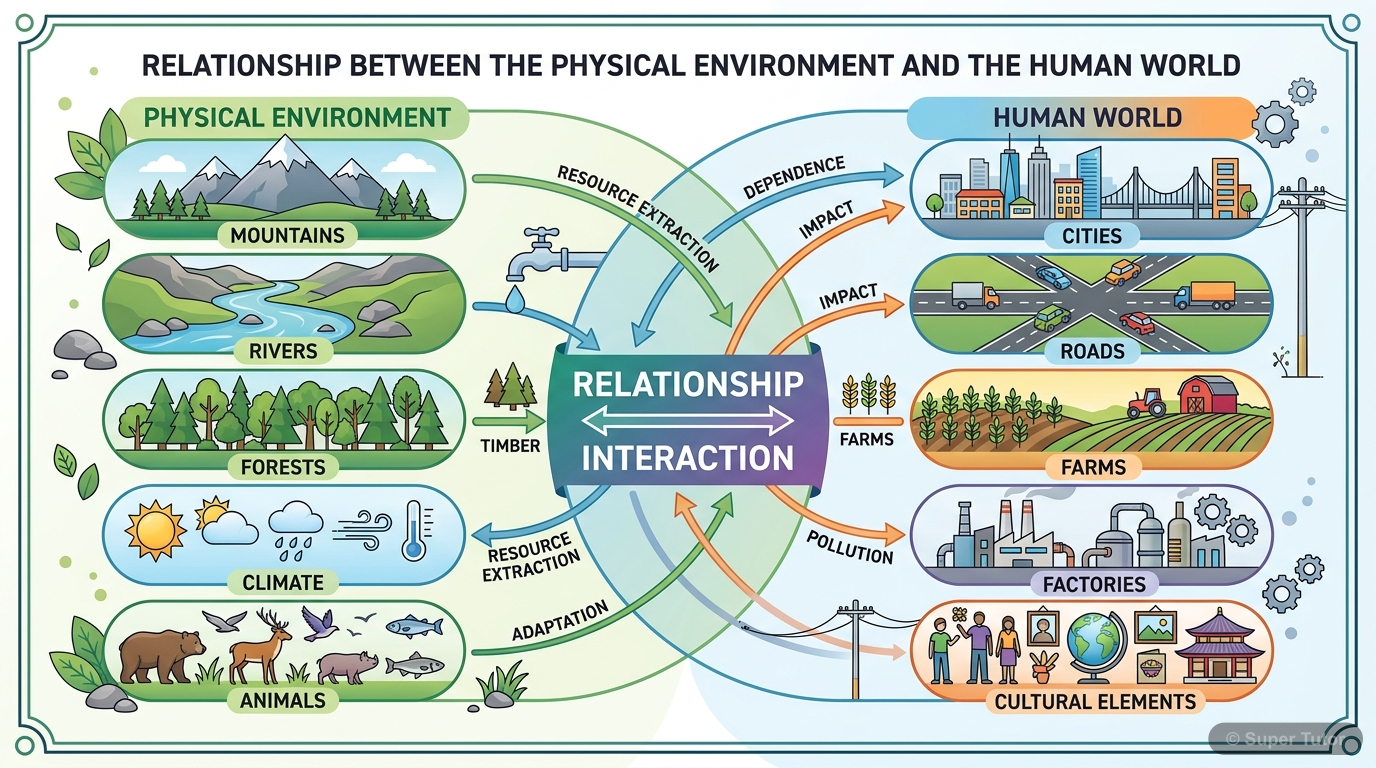
Human Geography Nature and Scope
Uttar Pradesh Board · Class 12 · Geography
NCERT Solutions for Human Geography Nature and Scope — Uttar Pradesh Board Class 12 Geography.
Interactive on Super Tutor
Studying Human Geography Nature and Scope? Get the full interactive chapter.
Quizzes, flashcards, AI doubt-solver and a step-by-step study plan — built for ncert solutions and more.
1,000+ Class 12 students started this chapter today

Learn better with visuals Super Tutor has hundreds of illustrations like this across every chapter — all free to try.
Get startedEXERCISES
1(i)Which one of the following statements does not describe geography?
(a) an integrative discipline
(b) study of the inter-relationship between humans and environment
(c) subjected to dualism
(d) not relevant in the present time due to the development of technology.Show solution
Justification: Geography is very much relevant in the present time. It is an integrative discipline that studies the inter-relationship between humans and their environment and has been subjected to dualism (physical vs. human geography). Technology has only enhanced geographical inquiry rather than making it irrelevant.
1(ii)Which one of the following is not a source of geographical information?
(a) traveller's accounts
(b) old maps
(c) samples of rock materials from the moon
(d) ancient epicsShow solution
Justification: Traveller's accounts, old maps, and ancient epics all provide information about the Earth's surface, human settlements, trade routes, and environments — these are valid sources of geographical information. Rock samples from the moon relate to planetary geology/astronomy and are not a source of geographical (Earth-related human-environment) information.
1(iii)Which one of the following is the most important factor in the interaction between people and environment?
(a) human intelligence
(b) people's perception
(c) technology
(d) human brotherhoodShow solution
Justification: Technology is the most important factor mediating the interaction between people and environment. The level of technology available to a society determines how much it can modify, use, or adapt to its natural environment. Higher technology enables greater human control over nature, as seen in the shift from environmental determinism to possibilism and the neo-determinism concept.
1(iv)Which one of the following is not an approach in human geography?
(a) Areal differentiation
(b) Spatial organisation
(c) Quantitative revolution
(d) Exploration and descriptionShow solution
Justification: Areal differentiation, spatial organisation, and exploration and description are all recognised approaches within human geography. The Quantitative Revolution is an approach associated with systematic/scientific geography as a whole (particularly with the use of statistical and mathematical methods), but it is not listed as a distinct approach specifically within human geography in the NCERT framework for this chapter.
2(i)Define human geography.Show solution
Definition: Human geography studies the inter-relationship between the physical/natural environment and the socio-cultural environment created by human beings. It analyses how humans interact with, adapt to, and modify their environment.
As defined by Ratzel: "Human geography is the synthetic study of the relationship between human societies and the Earth's surface."
In essence, human geography examines the spatial patterns of human activities and their relationship with the natural environment across the globe.
2(ii)Name some sub-fields of human geography.Show solution
Human geography has the following major sub-fields:
1. Social/Cultural Geography
2. Population and Settlement Geography
3. Economic Geography
4. Historical Geography
5. Political Geography
6. Electoral Geography
7. Military Geography
Each sub-field focuses on a specific aspect of human activity and its spatial distribution on the Earth's surface.
2(iii)How is human geography related to other social sciences?Show solution
Human geography is closely related to other social sciences because it borrows concepts and methods from them and also contributes to them:
- It is related to Sociology through Social Geography (study of social groups and spatial patterns).
- It is related to Economics through Economic Geography and Geography of Resources.
- It is related to History through Historical Geography.
- It is related to Political Science through Political and Electoral Geography.
- It is related to Anthropology through Cultural Geography.
Thus, human geography acts as an integrative discipline that forms an interface with various social sciences.
3(i)Explain naturalisation of humans.Show solution
Concept: Naturalisation of humans refers to the process by which human beings adapt themselves to the natural environment. In this process, nature dominates and humans submit to its dictates.
Explanation:
In the early stages of human civilisation, people had limited technology and knowledge. They were largely controlled by the forces of nature — climate, terrain, rivers, and vegetation determined where and how people lived. This is the stage of environmental determinism, where nature was all-powerful.
- Early humans lived in forests, caves, and river valleys and depended entirely on nature for food, shelter, and clothing.
- They followed natural rhythms — seasons, floods, and droughts dictated their activities.
- Human societies were shaped by their physical surroundings; for example, people in cold regions developed specific clothing, housing, and food habits suited to their environment.
This close dependence on nature and adaptation to natural conditions is called the naturalisation of humans. It represents the early phase of human–environment interaction where nature was the dominant force and humans were passive recipients of natural gifts.
Conclusion: Naturalisation of humans thus signifies a stage where humans lived in harmony with nature, making minimal modifications to the environment and adjusting their lives according to natural conditions.
3(ii)Write a note on the scope of human geography.Show solution
Scope of Human Geography:
Human geography has a very wide scope as it studies the inter-relationship between humans and their physical environment across space and time.
1. Thematic Areas: Human geography covers a broad range of themes:
- Population Geography — distribution, density, growth, and migration of population.
- Settlement Geography — rural and urban settlements, their patterns and functions.
- Economic Geography — agriculture, industries, trade, tourism, and resources.
- Cultural/Social Geography — languages, religions, social groups, and their spatial patterns.
- Political Geography — states, boundaries, electoral patterns, and geopolitics.
- Historical Geography — evolution of geographical patterns over time.
2. Interface with Other Disciplines: Human geography forms an interface with sociology, economics, political science, history, and anthropology, making it an integrative discipline.
3. Relevance: Human geography is highly relevant today as it helps in understanding issues like population growth, resource depletion, urbanisation, migration, and globalisation.
Conclusion: The scope of human geography is vast and dynamic, encompassing all aspects of human life and their spatial expression on the Earth's surface.
Stuck on a step?
Ask Super Tutor AI to explain any solution on this page in a simpler way — free, 24x7.
Ask a Doubt FreeFrequently Asked Questions
What are the important topics in Human Geography Nature and Scope for Uttar Pradesh Board Class 12 Geography?
How to score full marks in Human Geography Nature and Scope — Uttar Pradesh Board Class 12 Geography?
Where can I get free NCERT Solutions for Human Geography Nature and Scope Class 12 Geography?
Sources & Official References
Content is aligned to the official syllabus. Refer to the board website for the latest curriculum.
More resources for Human Geography Nature and Scope
Important Questions
Practice with board exam-style questions
Syllabus
What topics to cover
Revision Notes
Key points for last-minute revision
Study Plan
Step-by-step plan to ace this chapter
Flashcards
Quick-fire cards for active recall
Formula Sheet
All formulas in one place
Chapter Summary
Understand the chapter at a glance
Practice Quiz
Test yourself with a quick quiz
Concept Maps
See how topics connect visually
For serious students
Get the full Human Geography Nature and Scope chapter — for free.
Quizzes, flashcards, AI doubt-solver and a step-by-step study plan for Uttar Pradesh Board Class 12 Geography.