Rebels and the Raj: 1857 Revolt and its Representations
Uttar Pradesh Board · Class 12 · History
NCERT Solutions for Rebels and the Raj: 1857 Revolt and its Representations — Uttar Pradesh Board Class 12 History.
Interactive on Super Tutor
Studying Rebels and the Raj: 1857 Revolt and its Representations? Get the full interactive chapter.
Quizzes, flashcards, AI doubt-solver and a step-by-step study plan — built for ncert solutions and more.
1,000+ Class 12 students started this chapter today

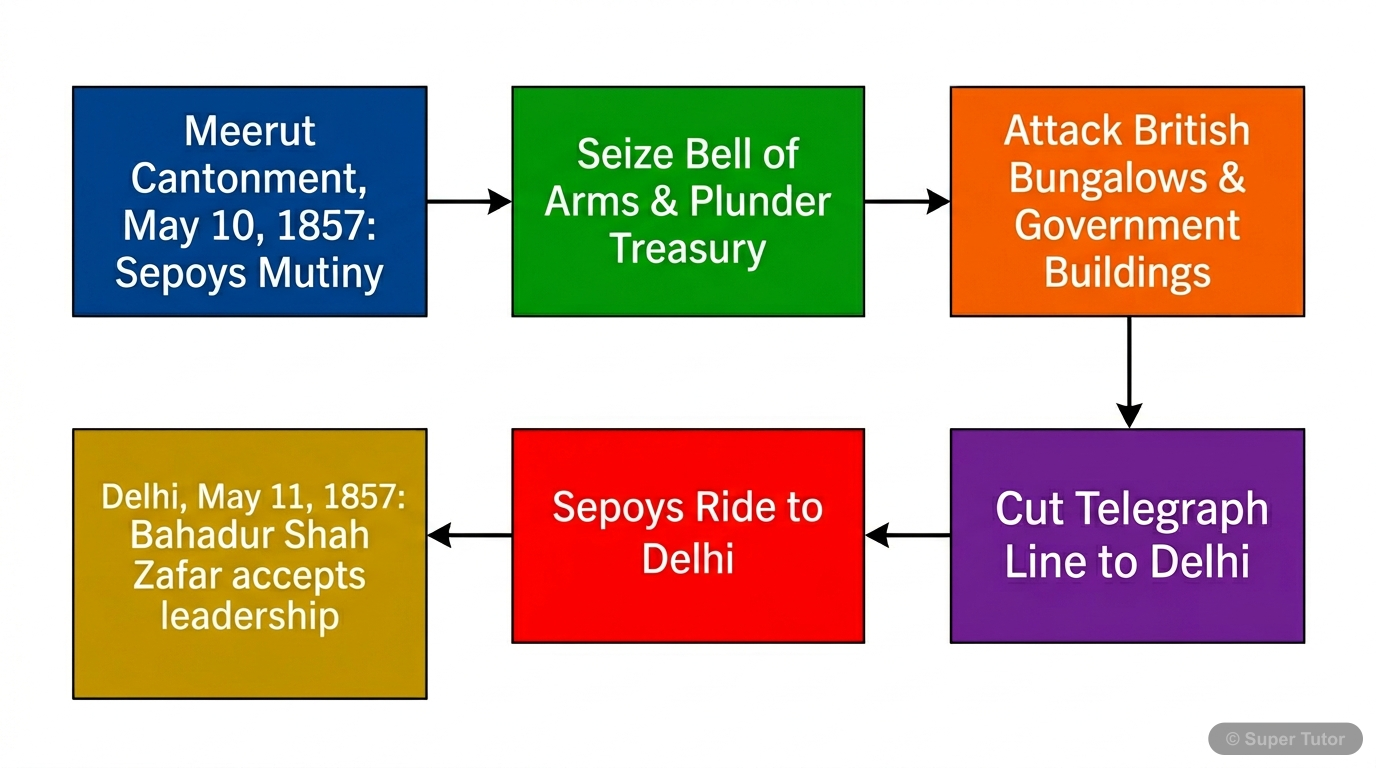
Super Tutor has 12+ illustrations like this for Rebels and the Raj: 1857 Revolt and its Representations alone — flashcards, concept maps, and step-by-step visuals.
See them allAnswer in 100-150 Words
1Why did the mutinous sepoys in many places turn to erstwhile rulers to provide leadership to the revolt?Show solution
Answer:
The mutinous sepoys turned to erstwhile rulers for several important reasons:
1. Legitimacy and Symbol of Authority: The sepoys needed a recognised figurehead who could give their rebellion political legitimacy. Former rulers like Bahadur Shah Zafar, Begum Hazrat Mahal, and Nana Sahib represented the pre-British order and were respected by the people.
2. Lack of Political Vision: The sepoys were skilled fighters but lacked political experience and administrative ability. The erstwhile rulers could provide the organisational framework and political direction the revolt needed.
3. Emotional and Cultural Connect: The deposed rulers symbolised everything the rebels were fighting to restore — the Mughal world, regional kingdoms, and the culture of the courts. Bahadur Shah Zafar, for instance, was a unifying symbol for both Hindus and Muslims.
4. Shared Grievances: The rulers had their own grievances against the British — annexation of territories, loss of pensions, and disrespect. This made them natural allies.
Thus, the sepoys saw the erstwhile rulers as the most appropriate leaders to restore the pre-British world they cherished.
2Discuss the evidence that indicates planning and coordination on the part of the rebels.Show solution
Answer:
Several pieces of evidence point to planning and coordination among the rebels:
1. Communication between Sepoy Lines: After the 7th Awadh Irregular Cavalry refused the new cartridges, they wrote to the 48th Native Infantry stating they had 'acted for the faith and awaited the 48th's orders.' This shows deliberate communication between cantonments.
2. Movement of Emissaries: Sepoys or their emissaries moved from one station to another, spreading the message of revolt and coordinating action.
3. The Panchayat System: Charles Ball noted that panchayats were a nightly occurrence in the Kanpur sepoy lines. These collective gatherings of native officers from different regiments were used to take decisions collectively about the course of the rebellion.
4. The Sisten–Tahsildar Conversation (Source 2): A Muslim tahsildar from Bijnor, upon meeting someone he believed to be a rebel, spoke confidently about the progress of the revolt, saying 'the direction of the business is in able hands.' This suggests a wider network of communication among rebel sympathisers.
5. Chapatti Movement: The mysterious circulation of chapattis from village to village was read by people as an omen of an upheaval, suggesting some form of coded communication.
Thus, the similarity in the pattern of the revolt across different places was not accidental but the result of deliberate planning and coordination.
3Discuss the extent to which religious beliefs shaped the events of 1857.Show solution
Answer:
Religious beliefs shaped the events of 1857 in several important ways:
Role of Religion as a Trigger:
- The immediate cause of the sepoy mutiny was the introduction of the Enfield rifle cartridges, which were rumoured to be greased with the fat of cows and pigs. This was seen as a deliberate attempt to defile the religion of both Hindus and Muslims.
- The rebel arzi (petition) clearly states: 'we have fought for two years in order that our faith and religion may not be polluted.'
Rumours and Religious Fear:
- Rumours spread that the British were mixing bone powder in flour (atta) and distributing it to destroy caste distinctions.
- People feared that the British were bent on converting Indians to Christianity through their educational and social reform policies (abolition of sati, widow remarriage, etc.).
Religion as a Unifying Force:
- The rebel proclamations called upon Hindus and Muslims to unite against the 'infidel' British who were enemies of both religions.
- Pundits and fakirs were specifically urged to join the 'holy war.'
Limitations:
- However, religion alone does not explain the revolt. Economic grievances — dispossession of taluqdars, exploitation of peasants, ruin of artisans — were equally important.
- The revolt was also driven by political factors such as the annexation of Awadh and the doctrine of lapse.
Conclusion: Religion was a powerful mobilising force that gave the revolt an emotional and moral dimension, but it worked alongside economic and political grievances.
4What were the measures taken to ensure unity among the rebels?Show solution
Answer:
Several measures were taken to ensure unity among the rebels:
1. Proclamations Addressing All Social Groups: The rebel proclamations (like the one issued in the name of Bahadur Shah Zafar) specifically addressed zamindars, merchants, public servants, artisans, and religious leaders (pundits and fakirs), listing the grievances of each group and urging them to join the fight against British rule.
2. Appeal to Common Religion: Both Hindus and Muslims were urged to unite against the British, who were portrayed as enemies of both religions. The fear of religious conversion was used as a common rallying point.
3. Panchayat System: Collective decision-making through panchayats composed of native officers from different regiments helped build consensus and shared ownership of the rebellion.
4. Symbolic Leadership: Erstwhile rulers like Bahadur Shah Zafar and Begum Hazrat Mahal were placed at the head of the revolt to provide a unifying symbol that transcended caste and community differences.
5. Common Enemy: The proclamations consistently identified the British (firangi raj) as the common enemy responsible for the misery of all sections of society, thus creating a shared sense of purpose.
6. Administrative Structures: In places like Delhi, Lucknow, and Kanpur, the rebels set up administrative structures, made appointments, and issued orders — creating a sense of an alternative government that could unite different groups.
Thus, unity was maintained through a combination of political, religious, and administrative measures.
5What steps did the British take to quell the uprising?Show solution
Answer:
The British took the following steps to quell the uprising:
Legal Measures:
- In May and June 1857, the British passed a series of Acts putting the whole of North India under martial law.
- Military officers and even ordinary Britons were given the power to try and punish Indians suspected of rebellion.
- The ordinary processes of law and trial were suspended; rebellion was made punishable by death.
Military Measures:
- Reinforcements were brought in from Britain.
- A two-pronged military attack was launched: one force moved from Calcutta into North India, and another moved from the Punjab (which was largely peaceful) to reconquer Delhi.
- Delhi, recognised as the symbolic centre of the revolt, was specifically targeted and recaptured.
Psychological Measures (Terror):
- Rebels were executed in brutal and public ways — blown from guns or hanged from gallows.
- Images of these executions were widely circulated through popular journals to terrorise the population into submission.
- The British used collective punishment, burning villages and executing large numbers of people suspected of rebellion.
Strategic Use of Loyal Areas:
- The Punjab, Bombay, and Madras presidencies remained largely loyal, providing the British with troops and resources to fight the rebels in North India.
Through these measures, the British gradually suppressed the revolt by the end of 1858.
Write a Short Essay (250-300 Words)
6Why was the revolt particularly widespread in Awadh? What prompted the peasants, taluqdars and zamindars to join the revolt?Show solution
Awadh was one of the most intense and long-lasting centres of the revolt of 1857. The widespread nature of the rebellion there was the result of a chain of grievances that linked princes, taluqdars, peasants, and sepoys.
Annexation of Awadh:
In 1856, the British deposed Nawab Wajid Ali Shah and annexed Awadh on the plea of misgovernance. This was deeply resented by the people. The Nawab was a popular ruler, and his removal was mourned widely. Folk songs lamented: 'The honourable English came and took the country.' The dissolution of the court led to the loss of livelihood for musicians, dancers, poets, artisans, cooks, and administrative officials.
Grievances of Taluqdars:
The British introduced summary revenue settlements in Awadh that dispossessed many taluqdars of their estates. The attitude of the taluqdars was best expressed by Hanwant Singh of Kalakankar, who told a British officer: 'At one blow you took from me lands which from time immemorial had been in my family.' The dispossession of taluqdars meant the breakdown of an entire social order — the ties of loyalty and patronage that had bound peasants to taluqdars were disrupted.
Grievances of Peasants:
Under British rule, peasants were directly exposed to overassessment of revenue and inflexible methods of collection. There was no guarantee of relief in times of hardship or crop failure. The taluqdars, despite being oppressive, had earlier provided loans and support during festivals and famines. The British system was impersonal and alien.
Role of Sepoys:
A vast majority of the Bengal Army sepoys were recruited from the villages of Awadh. The grievances of their families were transmitted to the sepoy lines, and in turn, the fears of the sepoys were communicated back to the villages. When the sepoys mutinied, peasants poured into towns and joined the rebellion.
Conclusion:
In Awadh, the revolt was not merely a sepoy mutiny but a genuine popular uprising. The combination of political dispossession, economic exploitation, and cultural humiliation made Awadh the heartland of the revolt of 1857.
7What did the rebels want? To what extent did the vision of different social groups differ?Show solution
The rebels of 1857 came from diverse social backgrounds — sepoys, peasants, taluqdars, artisans, merchants, and religious leaders. While they shared a common opposition to British rule, their specific grievances and visions differed.
What the Rebels Wanted — Common Goals:
The rebel proclamations completely rejected firangi raj. They condemned British annexations, broken treaties, and the destruction of a familiar way of life. The rebels wanted to restore the pre-British world — the Mughal order, regional kingdoms, and the culture of the courts. In places like Delhi, Lucknow, and Kanpur, the rebels set up administrative structures, made appointments, and tried to establish an alternative government.
Differences in Vision:
- Sepoys were primarily motivated by religious fears — the greased cartridges, the mixing of bone powder in flour — and by professional grievances such as low pay, racial abuse by white officers, and restrictions on leave. Their arzi states: 'we have fought for two years in order that our faith and religion may not be polluted.'
- Taluqdars and Zamindars wanted the restoration of their estates and the feudal social order. Hanwant Singh of Kalakankar expressed this clearly — he resented the loss of ancestral lands and the humiliation of being subjected to British courts.
- Peasants wanted relief from oppressive revenue demands and the restoration of the protective relationship with taluqdars.
- Artisans and Weavers wanted protection from British manufactured goods that had destroyed their livelihoods.
- Merchants wanted freedom from British monopolies and excessive taxation.
- Religious Leaders (Pundits and Fakirs) wanted to protect their religions from what they saw as a British assault on Hindu and Muslim faith.
An Alternative Vision:
In the villages, rebels burnt account books and ransacked moneylenders' houses, suggesting a desire to overturn traditional hierarchies and create a more egalitarian society. However, this vision was not articulated in the official proclamations, which focused on uniting all groups against the British.
Conclusion:
While all rebels shared the goal of ending British rule, their visions of the future differed. The leadership sought to restore the eighteenth-century Mughal world, while ordinary people harboured hopes of a more just social order. These differences ultimately limited the cohesion of the revolt.
8What do visual representations tell us about the revolt of 1857? How do historians analyse these representations?Show solution
Visual representations — paintings, cartoons, prints, and photographs — are important historical sources for understanding the revolt of 1857. They tell us not only about the events themselves but also about the perspectives, emotions, and ideologies of those who produced and consumed them.
British Visual Representations:
British visual representations of the revolt were shaped by the trauma of the uprising and the desire to justify repression. For example:
- The Punch cartoon 'The British Lion's Vengeance on the Bengal Tiger' (1857) depicted the British as a noble lion avenging the killing of British women and children by a ferocious tiger. The images of a woman and child symbolised British innocence and vulnerability, justifying brutal retaliation.
- Images of executions — rebels being blown from guns or hanged — were widely circulated in journals like the Illustrated London News. These were not merely records of events but performances of power, designed to terrorise the Indian population and reassure the British public that order had been restored.
- These images fed public opinion in Britain, leading people to sanction the most brutal forms of repression.
Indian Nationalist Visual Representations:
The national movement in the twentieth century produced its own visual imagery of 1857:
- Rani Lakshmi Bai was portrayed in battle armour, sword in hand, riding a horse — a symbol of resistance against injustice and alien rule.
- Films and popular prints celebrated the leaders of the revolt as heroic figures fighting for freedom.
- Subhadra Kumari Chauhan's poem 'Khoob lari mardani woh to Jhansi wali rani thi' captured this nationalist imagination.
- These images helped shape the nationalist movement by inspiring people with the memory of 1857 as the 'First War of Independence.'
How Historians Analyse Visual Representations:
Historians analyse visual representations by asking:
1. Who produced the image? — The perspective of the artist (British or Indian, colonial or nationalist) shapes what is depicted and how.
2. What is the intended audience? — British cartoons were meant for a British audience; nationalist prints were meant to inspire Indians.
3. What emotions does the image seek to evoke? — Fear, pride, anger, sympathy?
4. What is included and what is left out? — Silences in visual sources are as important as what is shown.
5. How does the image relate to the text sources of the period?
Conclusion:
Visual representations are not neutral records of history. They reflect the fears, values, and ideologies of their creators. By critically analysing them, historians can understand both the events of 1857 and the ways in which those events have been remembered and interpreted across time.
9Examine any two sources presented in the chapter, choosing one visual and one text, and discuss how these represent the point of view of the victor and the vanquished.Show solution
The revolt of 1857 was recorded primarily by the victors — the British. However, a few sources give us a glimpse of the perspective of the vanquished — the rebels. By examining one visual source and one text source, we can understand how the same events were perceived very differently by the two sides.
Visual Source: The Punch Cartoon — 'The British Lion's Vengeance on the Bengal Tiger' (1857)
This cartoon represents the point of view of the victor — the British.
- The British are depicted as a powerful, noble lion, symbolising justice, strength, and civilisation.
- The Indian rebels are depicted as a ferocious, savage tiger — a symbol of barbarism and treachery.
- The figures of a woman and child in the image represent British innocence and vulnerability, suggesting that the British were victims of unprovoked Indian savagery.
- The cartoon completely ignores the legitimate grievances of the rebels — the annexation of Awadh, the greased cartridges, the dispossession of taluqdars — and portrays British repression as righteous vengeance.
- It was designed to justify brutal repression and build public support in Britain for the suppression of the revolt.
Text Source: The Arzi (Petition) of the Rebel Sepoys (Source 6)
This arzi represents the point of view of the vanquished — the rebel sepoys.
- The sepoys present themselves not as traitors but as loyal soldiers who had served the British faithfully for generations: 'Our forefathers have always served them, and we also entered their service.'
- They describe in detail the injustice of the greased cartridges and the brutal punishment of the 84 troopers who refused to bite them.
- They frame their rebellion as a defensive act forced upon them: 'we have been compelled to make war for two years' to protect their faith and religion.
- The arzi reveals the deep sense of betrayal felt by the sepoys — they had served loyally but were humiliated and their religion threatened.
- It presents the revolt not as a mutiny but as a righteous struggle for the preservation of faith.
Comparison:
- The British cartoon dehumanises the rebels and portrays British violence as justified; the arzi humanises the rebels and portrays British actions as unjust provocation.
- The cartoon speaks the language of imperial power; the arzi speaks the language of wounded dignity and religious honour.
- Together, these two sources illustrate how history is always told from a particular perspective, and how the same events can be interpreted in radically different ways depending on who is telling the story.
Conclusion:
By examining both visual and text sources critically, historians can attempt to reconstruct a more complete and balanced picture of the revolt of 1857 — one that goes beyond the victor's narrative to include the voices of those who were defeated.
Map Work
10On an outline map of India, mark Calcutta (Kolkata), Bombay (Mumbai) and Madras (Chennai), three major centres of British power in 1857. Refer to Maps 1 and 2 and plot the areas where the revolt was most widespread. How close or far were these areas from the colonial cities?Show solution
Step 1 — Mark the three major centres of British power:
- Calcutta (Kolkata) — in the east, in present-day West Bengal (headquarters of the British administration)
- Bombay (Mumbai) — on the west coast, in present-day Maharashtra
- Madras (Chennai) — on the southeast coast, in present-day Tamil Nadu
Step 2 — Plot the areas where the revolt was most widespread (referring to Maps 1 and 2 in the chapter):
The revolt was most intense in the following regions:
- Delhi and surrounding areas (present-day Delhi/Haryana/western UP)
- Meerut, Aligarh, Etawah, Mainpuri, Etah (western Uttar Pradesh)
- Awadh (Lucknow, Rae Bareli, Sitapur) (central Uttar Pradesh)
- Kanpur (Cawnpore) (central Uttar Pradesh)
- Jhansi and Bundelkhand (present-day UP/MP border)
- Bihar (Arrah, Jagdishpur — associated with Kunwar Singh)
- Rohilkhand (Bareilly, Bijnor)
Step 3 — Analyse the distance from colonial cities:
The areas of most intense revolt were concentrated in North India — particularly in the Gangetic plain of present-day Uttar Pradesh, Bihar, and Delhi. These areas were:
- Far from Bombay and Madras, which were on the coasts and remained largely peaceful. The Bombay and Madras armies did not mutiny on a significant scale.
- Relatively far from Calcutta, though Calcutta was the administrative capital. The revolt did not reach Calcutta itself.
- The Punjab (northwest) also remained largely peaceful and was used by the British as a base to reconquer Delhi.
Conclusion:
The revolt was most widespread in the heartland of North India — far from the three major colonial cities of Calcutta, Bombay, and Madras. This geographical distance from the centres of British power partly explains why the revolt could sustain itself for as long as it did, and also why the three presidencies (Bengal, Bombay, Madras) remained under British control throughout the uprising.
Projects
11Read a biography of any one of the leaders of the revolt of 1857. Check the sources used by the biographer. Do these include government reports, newspaper accounts, stories in regional languages, visual material, anything else? Do all the sources say the same thing, or are there differences? Prepare a report on your findings.Show solution
---
Project Report: Rani Lakshmi Bai of Jhansi
Introduction:
Rani Lakshmi Bai (1828–1858) was one of the most celebrated leaders of the revolt of 1857. She became the ruler of Jhansi after the death of her husband, Maharaja Gangadhar Rao, but the British refused to recognise her adopted son as heir and annexed Jhansi under the Doctrine of Lapse. She led the defence of Jhansi against the British and died in battle in June 1858.
Sources Used by Biographers (e.g., Tapti Roy's 'Raj of the Rani'):
1. Government Reports: British military and administrative reports describe the siege of Jhansi, the Rani's military tactics, and her death. These are written from the perspective of the victors and tend to portray her as a formidable but ultimately defeated enemy.
2. Newspaper Accounts: British newspapers like the Times of London and the Illustrated London News reported on the revolt. They often portrayed the Rani in contradictory ways — sometimes as a brave warrior, sometimes as a treacherous rebel.
3. Letters: Letters written by the Rani herself (available at www.copsey-family.org) reveal her perspective — her sense of injustice at the annexation of Jhansi and her determination to fight for her kingdom.
4. Regional Language Sources: Hindi and Marathi oral traditions and folk songs celebrated the Rani as a heroic figure. Subhadra Kumari Chauhan's famous poem 'Khoob lari mardani' is the most well-known example.
5. Visual Material: Popular prints and later film posters depict the Rani in battle armour on horseback — a nationalist icon of resistance.
Do All Sources Say the Same Thing?
No. There are significant differences:
- British government reports focus on military operations and portray the Rani as a rebel who had to be defeated.
- The Rani's own letters present her as a legitimate ruler defending her rights.
- Nationalist literature and visual art transform her into a symbol of the freedom struggle.
- Regional oral traditions emphasise her personal courage and sacrifice.
Conclusion:
The biography of Rani Lakshmi Bai illustrates how historical figures are constructed differently depending on the sources used and the perspective of the writer. A critical reading of multiple sources — government records, personal letters, regional literature, and visual material — gives us a more complete and nuanced picture of her life and legacy.
12See a film made on the revolt of 1857 and write about the way it represents the revolt. How does it depict the British, the rebels, and those who remained loyal to the British? What does it say about peasants, city dwellers, tribals, zamindars and taluqdars? What kind of a response does the film seek to evoke?Show solution
---
Film Review and Analysis: Mangal Pandey: The Rising (2005)
Introduction:
The film is based on the life of Mangal Pandey, a sepoy of the 34th Bengal Native Infantry, who is credited with firing one of the first shots of the revolt of 1857. The film was released in 2005 to mark the 150th anniversary of the revolt.
Depiction of the British:
The British are depicted in a complex manner. While some British officers (like Captain William Gordon) are shown as sympathetic individuals who develop genuine friendships with Indian sepoys, the British colonial system as a whole is portrayed as exploitative, racist, and unjust. The introduction of greased cartridges is shown as a deliberate act of cultural aggression.
Depiction of the Rebels:
Mangal Pandey is portrayed as a heroic, passionate, and principled figure who fights for the honour of his religion and his country. He is shown as a man of the people — connected to ordinary soldiers, peasants, and women. His rebellion is presented as righteous and inevitable.
Those Loyal to the British:
Indians who cooperate with the British are shown as compromised figures who have sacrificed their dignity for personal gain.
Depiction of Social Groups:
- Peasants and ordinary people are shown as victims of British exploitation — their lands taken, their livelihoods destroyed.
- Women (particularly a courtesan named Heera) are given significant roles, representing the suffering of ordinary people under colonial rule.
- Zamindars and taluqdars are not given much prominence in this particular film.
Response the Film Seeks to Evoke:
The film seeks to evoke nationalist pride and anger at colonial injustice. It presents 1857 as the 'First War of Independence' and Mangal Pandey as a proto-nationalist hero. The audience is invited to identify with the rebels and feel outrage at British oppression.
Critical Evaluation:
While the film is visually powerful and emotionally engaging, it simplifies the complex causes of the revolt and focuses on individual heroism rather than the collective nature of the uprising. It does not adequately represent the role of taluqdars, zamindars, or the diversity of rebel motivations discussed in the NCERT chapter.
Conclusion:
Films about 1857 are not neutral historical records — they are interpretations shaped by the political and cultural context of their making. By critically analysing such films alongside textual and visual sources, we can better understand both the revolt itself and how it has been remembered and represented in Indian popular culture.
Stuck on a step?
Ask Super Tutor AI to explain any solution on this page in a simpler way — free, 24x7.
Ask a Doubt FreeFrequently Asked Questions
What are the important topics in Rebels and the Raj: 1857 Revolt and its Representations for Uttar Pradesh Board Class 12 History?
How to score full marks in Rebels and the Raj: 1857 Revolt and its Representations — Uttar Pradesh Board Class 12 History?
Where can I get free NCERT Solutions for Rebels and the Raj: 1857 Revolt and its Representations Class 12 History?
Sources & Official References
Content is aligned to the official syllabus. Refer to the board website for the latest curriculum.
More resources for Rebels and the Raj: 1857 Revolt and its Representations
Important Questions
Practice with board exam-style questions
Syllabus
What topics to cover
Revision Notes
Key points for last-minute revision
Study Plan
Step-by-step plan to ace this chapter
Flashcards
Quick-fire cards for active recall
Formula Sheet
All formulas in one place
Chapter Summary
Understand the chapter at a glance
Practice Quiz
Test yourself with a quick quiz
Concept Maps
See how topics connect visually
For serious students
Get the full Rebels and the Raj: 1857 Revolt and its Representations chapter — for free.
Quizzes, flashcards, AI doubt-solver and a step-by-step study plan for Uttar Pradesh Board Class 12 History.