Chapter 8 of 14
NCERT Solutions

Atoms

Uttar Pradesh Board · Class 12 · Physics

NCERT Solutions for Atoms — Uttar Pradesh Board Class 12 Physics.

32 questions20 flashcards5 concepts

Interactive on Super Tutor

Studying Atoms? Get the full interactive chapter.

Quizzes, flashcards, AI doubt-solver and a step-by-step study plan — built for ncert solutions and more.

1,000+ Class 12 students started this chapter today

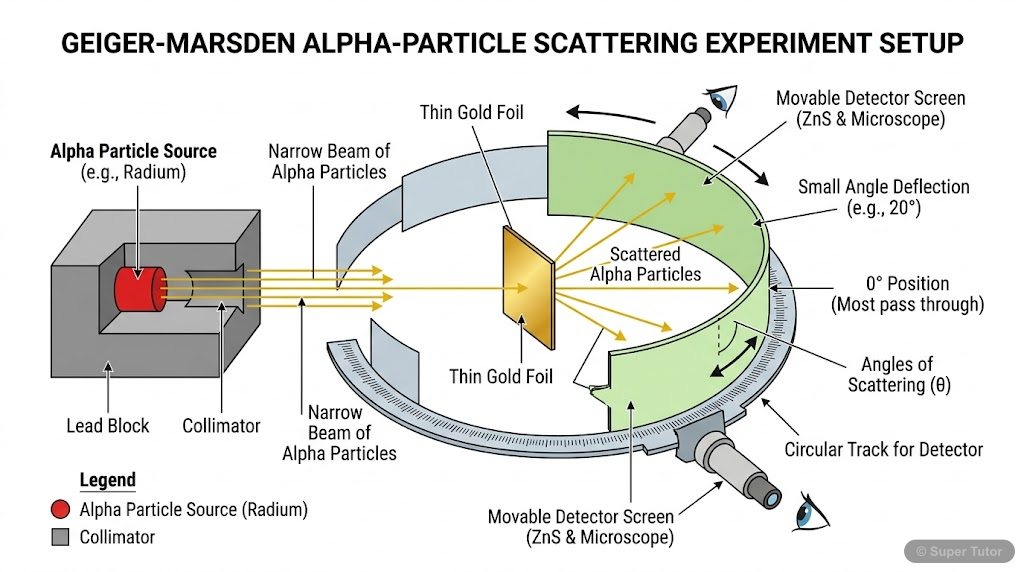
A labeled diagram showing the experimental setup for the Geiger-Marsden alpha-particle scattering experiment, including the alpha source, lead bricks, gold foil, and a movable detector screen.
Super Tutor

Learn better with visuals Super Tutor has hundreds of illustrations like this across every chapter — all free to try.

Get started
9 Questions Solved · 1 Section

EXERCISES

12.1Choose the correct alternative from the clues given at the end of the each statement:
(a) The size of the atom in Thomson's model is ... the atomic size in Rutherford's model.
(b) In the ground state of ... electrons are in stable equilibrium, while in ... electrons always experience a net force.
(c) A classical atom based on ... is doomed to collapse.
(d) An atom has a nearly continuous mass distribution in a ... but has a highly non-uniform mass distribution in ...
(e) The positively charged part of the atom possesses most of the mass in ...
Show solution
(a) No different from.

In both Thomson's model and Rutherford's model, the overall size of the atom is of the same order (~101010^{-10} m). The difference lies in the internal structure, not the overall atomic size.

(b) Thomson's model / Rutherford's model.

In Thomson's model, electrons are embedded in a uniform positive charge distribution. At the equilibrium positions the net electrostatic force on each electron is zero, so they are in stable equilibrium. In Rutherford's model, the electrons revolve around the nucleus and are always under the influence of the Coulomb attractive force (centripetal force), so they always experience a net force.

(c) Rutherford's model.

In Rutherford's model, electrons revolve in circular orbits and undergo centripetal acceleration. An accelerating charge radiates energy (according to classical electrodynamics), so the electron would continuously lose energy and spiral into the nucleus — the atom would collapse.

(d) Thomson's model / Rutherford's model.

In Thomson's model, the positive charge is spread uniformly throughout the atom, giving a nearly continuous (uniform) mass distribution. In Rutherford's model, almost all the mass is concentrated in the tiny nucleus, giving a highly non-uniform mass distribution.

(e) Both the models.

In Thomson's model the positive charge (and hence most of the mass) is distributed throughout the sphere. In Rutherford's model the positive charge and most of the mass are concentrated in the nucleus. In both models, the positively charged part possesses most of the mass (since electron mass is negligible compared to nuclear/atomic mass).
12.2Suppose you are given a chance to repeat the alpha-particle scattering experiment using a thin sheet of solid hydrogen in place of the gold foil. (Hydrogen is a solid at temperatures below 14 K.) What results do you expect?Show solution
Given: Alpha-particle scattering experiment is repeated with a thin sheet of solid hydrogen instead of gold foil.

Key facts:
- Mass of alpha particle (mαm_\alpha) =4= 4 u
- Mass of hydrogen nucleus (proton, mpm_p) =1= 1 u
- Since m_\alpha > m_p, the alpha particle is heavier than the target nucleus.

Analysis:

In the original Rutherford experiment with gold (A=197A = 197 u), the gold nucleus is much heavier than the alpha particle, so the gold nucleus remains essentially stationary and the alpha particle can be scattered back.

When an alpha particle (mass 44 u) collides with a hydrogen nucleus (proton, mass 11 u), by the laws of elastic collision, the lighter target (proton) will be knocked forward with a speed up to twice the alpha particle's speed, while the alpha particle itself will continue forward with reduced speed.

Using conservation of momentum and energy for a head-on elastic collision:
vα=mαmpmα+mpv0=414+1v0=35v0v'_\alpha = \frac{m_\alpha - m_p}{m_\alpha + m_p}\,v_0 = \frac{4-1}{4+1}\,v_0 = \frac{3}{5}\,v_0

The alpha particle cannot be scattered backward (large-angle scattering) because it is heavier than the proton. The maximum scattering angle for the alpha particle is less than 90°90°.

Expected Result: No large-angle (backward) scattering of alpha particles will be observed. The alpha particles will mostly pass through with small deflections, and the protons (hydrogen nuclei) will be knocked forward. This experiment would not reveal the nuclear structure in the way Rutherford's gold-foil experiment did.
12.3A difference of 2.3 eV separates two energy levels in an atom. What is the frequency of radiation emitted when the atom makes a transition from the upper level to the lower level?Show solution
Given:
ΔE=EiEf=2.3 eV=2.3×1.6×1019 J=3.68×10¹⁹ J\Delta E = E_i - E_f = 2.3 \text{ eV} = 2.3 \times 1.6 \times 10^{-19} \text{ J} = 3.68 \times 10^{-19} \text{ J}

Formula used (Bohr's frequency condition):
hν=ΔEh\nu = \Delta E
ν=ΔEh\nu = \frac{\Delta E}{h}

Calculation:
ν=3.68×10196.626×1034\nu = \frac{3.68 \times 10^{-19}}{6.626 \times 10^{-34}}
ν5.55×10¹⁴ Hz\boxed{\nu \approx 5.55 \times 10^{14} \text{ Hz}}

This frequency lies in the visible region of the electromagnetic spectrum.
12.4The ground state energy of hydrogen atom is -13.6 eV. What are the kinetic and potential energies of the electron in this state?Show solution
Given: Total energy in ground state, E1=13.6E_1 = -13.6 eV

Concept: For an electron in a circular orbit, the electrostatic force provides the centripetal force:
e24πε0r2=mv2r\frac{e^2}{4\pi\varepsilon_0 r^2} = \frac{mv^2}{r}

This gives:
12mv2=e28πε0rK=12U\frac{1}{2}mv^2 = \frac{e^2}{8\pi\varepsilon_0 r} \quad \Rightarrow \quad K = -\frac{1}{2}\,U

where U=e24πε0rU = -\dfrac{e^2}{4\pi\varepsilon_0 r} is the potential energy.

Also, total energy:
E=K+U=e28πε0r=U2=KE = K + U = -\frac{e^2}{8\pi\varepsilon_0 r} = \frac{U}{2} = -K

Therefore:
K=E1=(13.6)=+13.6 eVK = -E_1 = -(-13.6) = +13.6 \text{ eV}
U=2E1=2×(13.6)=27.2 eVU = 2E_1 = 2 \times (-13.6) = -27.2 \text{ eV}

Results:
- Kinetic energy =+13.6= +13.6 eV
- Potential energy =27.2= -27.2 eV

*Verification:* E=K+U=13.6+(27.2)=13.6E = K + U = 13.6 + (-27.2) = -13.6 eV ✓
12.5A hydrogen atom initially in the ground level absorbs a photon, which excites it to the n=4n = 4 level. Determine the wavelength and frequency of photon.Show solution
Given:
- Initial state: ni=1n_i = 1 (ground level), E1=13.6E_1 = -13.6 eV
- Final state: nf=4n_f = 4

Energy of the n=4n = 4 level:
E4=13.642=13.616=0.85 eVE_4 = \frac{-13.6}{4^2} = \frac{-13.6}{16} = -0.85 \text{ eV}

Energy of the absorbed photon:
ΔE=E4E1=0.85(13.6)=12.75 eV\Delta E = E_4 - E_1 = -0.85 - (-13.6) = 12.75 \text{ eV}
ΔE=12.75×1.6×1019=2.04×10¹⁸ J\Delta E = 12.75 \times 1.6 \times 10^{-19} = 2.04 \times 10^{-18} \text{ J}

Frequency of the photon:
ν=ΔEh=2.04×10186.626×1034\nu = \frac{\Delta E}{h} = \frac{2.04 \times 10^{-18}}{6.626 \times 10^{-34}}
ν3.08×10¹⁵ Hz\boxed{\nu \approx 3.08 \times 10^{15} \text{ Hz}}

Wavelength of the photon:
λ=cν=3×1083.08×1015\lambda = \frac{c}{\nu} = \frac{3 \times 10^8}{3.08 \times 10^{15}}
λ9.74×10⁸ m=97.4 nm\boxed{\lambda \approx 9.74 \times 10^{-8} \text{ m} = 97.4 \text{ nm}}

This wavelength lies in the ultraviolet region (Lyman series).
12.6(a) Using the Bohr's model calculate the speed of the electron in a hydrogen atom in the n=1,2,n = 1, 2, and 3 levels. (b) Calculate the orbital period in each of these levels.Show solution
Formula for speed in Bohr's model:
vn=e24πε01n=v1nv_n = \frac{e^2}{4\pi\varepsilon_0}\cdot\frac{1}{n\hbar} = \frac{v_1}{n}

where v1=e24πε02.18×10⁶v_1 = \dfrac{e^2}{4\pi\varepsilon_0 \hbar} \approx 2.18 \times 10^6 m/s

(a) Speeds:

v1=2.18×1061=2.18×10⁶ m/sv_1 = \frac{2.18 \times 10^6}{1} = 2.18 \times 10^6 \text{ m/s}

v2=2.18×1062=1.09×10⁶ m/sv_2 = \frac{2.18 \times 10^6}{2} = 1.09 \times 10^6 \text{ m/s}

v3=2.18×1063=7.27×10⁵ m/sv_3 = \frac{2.18 \times 10^6}{3} = 7.27 \times 10^5 \text{ m/s}

(b) Orbital period:

The radius of the nn-th orbit: rn=n2a0r_n = n^2 a_0, where a0=5.3×10¹¹a_0 = 5.3 \times 10^{-11} m

Orbital period:
Tn=2πrnvn=2πn2a0v1/n=2πn3a0v1T_n = \frac{2\pi r_n}{v_n} = \frac{2\pi n^2 a_0}{v_1/n} = \frac{2\pi n^3 a_0}{v_1}

T1=2π×(5.3×1011)2.18×106=3.33×10102.18×1061.527×1016 sT_1 = \frac{2\pi \times (5.3 \times 10^{-11})}{2.18 \times 10^6} = \frac{3.33 \times 10^{-10}}{2.18 \times 10^6} \approx 1.527 \times 10^{-16} \text{ s}

T11.53×1016 s\boxed{T_1 \approx 1.53 \times 10^{-16} \text{ s}}

T2=T1×23=1.53×1016×81.22×1015 sT_2 = T_1 \times 2^3 = 1.53 \times 10^{-16} \times 8 \approx 1.22 \times 10^{-15} \text{ s}

T21.22×1015 s\boxed{T_2 \approx 1.22 \times 10^{-15} \text{ s}}

T3=T1×33=1.53×1016×274.13×1015 sT_3 = T_1 \times 3^3 = 1.53 \times 10^{-16} \times 27 \approx 4.13 \times 10^{-15} \text{ s}

T34.13×1015 s\boxed{T_3 \approx 4.13 \times 10^{-15} \text{ s}}
12.7The radius of the innermost electron orbit of a hydrogen atom is 5.3×10115.3 \times 10^{-11} m. What are the radii of the n=2n = 2 and n=3n = 3 orbits?Show solution
Given: r1=a0=5.3×10¹¹r_1 = a_0 = 5.3 \times 10^{-11} m

Formula (Bohr's model):
rn=n2a0r_n = n^2 a_0

For n=2n = 2:
r2=(2)2×5.3×1011=4×5.3×1011r_2 = (2)^2 \times 5.3 \times 10^{-11} = 4 \times 5.3 \times 10^{-11}
r2=2.12×10¹⁰ m\boxed{r_2 = 2.12 \times 10^{-10} \text{ m}}

For n=3n = 3:
r3=(3)2×5.3×1011=9×5.3×1011r_3 = (3)^2 \times 5.3 \times 10^{-11} = 9 \times 5.3 \times 10^{-11}
r3=4.77×10¹⁰ m\boxed{r_3 = 4.77 \times 10^{-10} \text{ m}}
12.8A 12.5 eV electron beam is used to bombard gaseous hydrogen at room temperature. What series of wavelengths will be emitted?Show solution
Given: Energy of electron beam = 12.5 eV; hydrogen is at room temperature (ground state, n=1n = 1, E1=13.6E_1 = -13.6 eV).

Finding the highest excited level reached:

Energy of level nn: En=13.6/n2E_n = -13.6/n^2 eV

The electron can excite hydrogen from ground state (n=1n=1) to level nn if:
EnE112.5 eVE_n - E_1 \leq 12.5 \text{ eV}
13.6n2(13.6)12.5-\frac{13.6}{n^2} - (-13.6) \leq 12.5
13.6(11n2)12.513.6\left(1 - \frac{1}{n^2}\right) \leq 12.5
11n20.9191 - \frac{1}{n^2} \leq 0.919
1n20.081n212.3n3.5\frac{1}{n^2} \geq 0.081 \Rightarrow n^2 \leq 12.3 \Rightarrow n \leq 3.5

So the maximum level reached is n=3n = 3.

Check: E3E1=13.6/9(13.6)=13.6(11/9)=13.6×8/9=12.09E_3 - E_1 = -13.6/9 - (-13.6) = 13.6(1 - 1/9) = 13.6 \times 8/9 = 12.09 eV < 12.5 eV ✓

Check n=4n=4: E4E1=13.6(11/16)=12.75E_4 - E_1 = 13.6(1-1/16) = 12.75 eV > 12.5 eV ✗

Possible transitions from n=3n = 3:

The electrons can be in n=1,2,3n = 1, 2, 3. The possible downward transitions are:

1. n=3n=1n = 3 \to n = 1: ΔE=12.09\Delta E = 12.09 eV → Lyman series (UV)
2. n=3n=2n = 3 \to n = 2: ΔE=1.51(3.4)=1.89\Delta E = -1.51 - (-3.4) = 1.89 eV → Balmer series (visible)
3. n=2n=1n = 2 \to n = 1: ΔE=3.4(13.6)=10.2\Delta E = -3.4 - (-13.6) = 10.2 eV → Lyman series (UV)

Wavelengths emitted:

Using λ=hc/ΔE\lambda = hc/\Delta E:

- n=3n=1n=3\to n=1: λ=124012.09102.6\lambda = \dfrac{1240}{12.09} \approx 102.6 nm (Lyman series)
- n=2n=1n=2\to n=1: λ=124010.2121.6\lambda = \dfrac{1240}{10.2} \approx 121.6 nm (Lyman series)
- n=3n=2n=3\to n=2: λ=12401.89656.6\lambda = \dfrac{1240}{1.89} \approx 656.6 nm (Balmer series)

Conclusion: The emitted spectrum will contain wavelengths belonging to the Lyman series (ultraviolet) and the Balmer series (visible). Specifically, three spectral lines at approximately 102.6 nm, 121.6 nm (Lyman), and 656.6 nm (Balmer) will be emitted.
12.9In accordance with the Bohr's model, find the quantum number that characterises the earth's revolution around the sun in an orbit of radius 1.5×10111.5 \times 10^{11} m with orbital speed 3×1043 \times 10^4 m/s. (Mass of earth =6.0×1024= 6.0 \times 10^{24} kg.)Show solution
Given:
- Orbital radius: r=1.5×10¹¹r = 1.5 \times 10^{11} m
- Orbital speed: v=3×10⁴v = 3 \times 10^4 m/s
- Mass of earth: m=6.0×1024m = 6.0 \times 10^{24} kg
- h=6.626×1034h = 6.626 \times 10^{-34} J·s

Bohr's quantisation condition:
L=mvr=nh2πL = mvr = \frac{nh}{2\pi}

Solving for nn:
n=mvr2πh=2πmvrhn = \frac{mvr \cdot 2\pi}{h} = \frac{2\pi m v r}{h}

Substituting values:
n=2π×6.0×1024×3×104×1.5×10116.626×1034n = \frac{2\pi \times 6.0 \times 10^{24} \times 3 \times 10^4 \times 1.5 \times 10^{11}}{6.626 \times 10^{-34}}

Numerator:
2π×6.0×1024×3×104×1.5×10112\pi \times 6.0 \times 10^{24} \times 3 \times 10^4 \times 1.5 \times 10^{11}
=2π×2.7×1040= 2\pi \times 2.7 \times 10^{40}
=6.2832×2.7×1040= 6.2832 \times 2.7 \times 10^{40}
=1.6965×1041= 1.6965 \times 10^{41}

n=1.6965×10416.626×1034n = \frac{1.6965 \times 10^{41}}{6.626 \times 10^{-34}}

n2.56×1074\boxed{n \approx 2.56 \times 10^{74}}

Conclusion: The quantum number n2.56×1074n \approx 2.56 \times 10^{74}, which is an enormously large number. This is consistent with the correspondence principle — at very large quantum numbers, quantum mechanics merges with classical mechanics, and the quantisation is imperceptible at macroscopic scales.

Stuck on a step?

Ask Super Tutor AI to explain any solution on this page in a simpler way — free, 24x7.

Ask a Doubt Free

Frequently Asked Questions

What are the important topics in Atoms for Uttar Pradesh Board Class 12 Physics?
Atoms covers several key topics that are frequently asked in Uttar Pradesh Board Class 12 board exams. Focus on the core concepts listed on this page and practise related questions to build confidence.
How to score full marks in Atoms — Uttar Pradesh Board Class 12 Physics?
Understand the core concepts first, then work through the 32 practice questions available for this chapter. Revise formulas and definitions regularly, and use flashcards for quick recall before the exam.
Where can I get free NCERT Solutions for Atoms Class 12 Physics?
This page has free step-by-step NCERT Solutions for every exercise question in Atoms (Uttar Pradesh Board Class 12 Physics) — written the way examiners award marks: given, formula, working, answer.

Sources & Official References

Content is aligned to the official syllabus. Refer to the board website for the latest curriculum.

For serious students

Get the full Atoms chapter — for free.

Quizzes, flashcards, AI doubt-solver and a step-by-step study plan for Uttar Pradesh Board Class 12 Physics.