Chapter 10 of 12
NCERT Solutions

Surface Areas and Volumes

Uttar Pradesh Board · Class 9 · Mathematics

NCERT Solutions for Surface Areas and Volumes — Uttar Pradesh Board Class 9 Mathematics.

30 questions20 flashcards5 concepts

Interactive on Super Tutor

Studying Surface Areas and Volumes? Get the full interactive chapter.

Quizzes, flashcards, AI doubt-solver and a step-by-step study plan — built for ncert solutions and more.

1,000+ Class 9 students started this chapter today

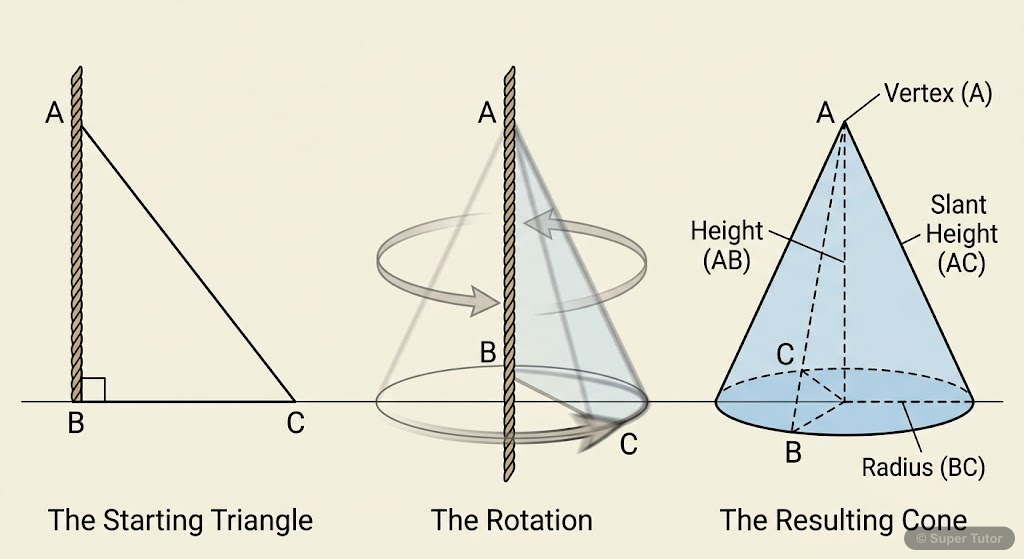
Illustrates how a right-angled triangle, when rotated about one of its perpendicular sides, forms a right circular cone. Shows the progression from a flat triangle to a 3D cone.
Super Tutor

Super Tutor has 10+ illustrations like this for Surface Areas and Volumes alone — flashcards, concept maps, and step-by-step visuals.

See them all
36 Questions Solved · 4 Sections

Exercise 11.1

1Diameter of the base of a cone is 10.5 cm and its slant height is 10 cm. Find its curved surface area.Show solution
Given: Diameter = 10.5 cm, so radius r=10.52=5.25r = \dfrac{10.5}{2} = 5.25 cm; slant height l=10l = 10 cm.

Formula: Curved Surface Area of cone =πrl= \pi r l

Calculation:
CSA=227×5.25×10\text{CSA} = \frac{22}{7} \times 5.25 \times 10
=227×52.5= \frac{22}{7} \times 52.5
=22×7.5= 22 \times 7.5
=165 cm2= 165 \text{ cm}^2

Answer: The curved surface area of the cone is 165 cm2\mathbf{165 \text{ cm}^2}.
2Find the total surface area of a cone, if its slant height is 21 m and diameter of its base is 24 m.Show solution
Given: Slant height l=21l = 21 m; diameter = 24 m, so radius r=12r = 12 m.

Formula: Total Surface Area =πrl+πr2=πr(l+r)= \pi r l + \pi r^2 = \pi r(l + r)

Calculation:
TSA=227×12×(21+12)\text{TSA} = \frac{22}{7} \times 12 \times (21 + 12)
=227×12×33= \frac{22}{7} \times 12 \times 33
=22×3967= \frac{22 \times 396}{7}
=87127= \frac{8712}{7}
=1244.57 m2 (approx.)= 1244.57 \text{ m}^2 \text{ (approx.)}

Answer: The total surface area of the cone is approximately 1244.57 m2\mathbf{1244.57 \text{ m}^2}.
3Curved surface area of a cone is 308 cm² and its slant height is 14 cm. Find (i) radius of the base and (ii) total surface area of the cone.Show solution
Given: Curved Surface Area =308= 308 cm²; slant height l=14l = 14 cm.

(i) Finding the radius:

πrl=308\pi r l = 308
227×r×14=308\frac{22}{7} \times r \times 14 = 308
44r=30844r = 308
r=30844=7 cmr = \frac{308}{44} = 7 \text{ cm}

Radius of the base = 7 cm.

(ii) Total Surface Area:

TSA=πrl+πr2=πr(l+r)\text{TSA} = \pi r l + \pi r^2 = \pi r(l + r)
=227×7×(14+7)= \frac{22}{7} \times 7 \times (14 + 7)
=22×21= 22 \times 21
=462 cm2= 462 \text{ cm}^2

Answer: (i) Radius =7= 7 cm; (ii) Total surface area =462 cm2= \mathbf{462 \text{ cm}^2}.
4A conical tent is 10 m high and the radius of its base is 24 m. Find (i) slant height of the tent. (ii) cost of the canvas required to make the tent, if the cost of 1 m² canvas is ₹ 70.Show solution
Given: Height h=10h = 10 m; radius r=24r = 24 m; cost per m² =70= ₹70.

(i) Slant height:
l=r2+h2=242+102=576+100=676=26 ml = \sqrt{r^2 + h^2} = \sqrt{24^2 + 10^2} = \sqrt{576 + 100} = \sqrt{676} = 26 \text{ m}

Slant height =26= 26 m.

(ii) Cost of canvas:

Canvas required = Curved Surface Area of the cone
CSA=πrl=227×24×26=22×6247=137287=1961.14 m2 (approx.)\text{CSA} = \pi r l = \frac{22}{7} \times 24 \times 26 = \frac{22 \times 624}{7} = \frac{13728}{7} = 1961.14 \text{ m}^2 \text{ (approx.)}

Cost=1961.14×70=137279.80137280\text{Cost} = 1961.14 \times 70 = ₹\,137279.80 \approx ₹\,137280

Answer: (i) Slant height =26= 26 m; (ii) Cost of canvas 1,37,280\approx ₹\,1,37,280.
5What length of tarpaulin 3 m wide will be required to make conical tent of height 8 m and base radius 6 m? Assume that the extra length of material that will be required for stitching margins and wastage in cutting is approximately 20 cm (Use π = 3.14).Show solution
Given: Height h=8h = 8 m; radius r=6r = 6 m; width of tarpaulin =3= 3 m; extra length =20= 20 cm =0.20= 0.20 m; π=3.14\pi = 3.14.

Step 1: Find slant height.
l=r2+h2=62+82=36+64=100=10 ml = \sqrt{r^2 + h^2} = \sqrt{6^2 + 8^2} = \sqrt{36 + 64} = \sqrt{100} = 10 \text{ m}

Step 2: Find curved surface area of the cone.
CSA=πrl=3.14×6×10=188.4 m2\text{CSA} = \pi r l = 3.14 \times 6 \times 10 = 188.4 \text{ m}^2

Step 3: Find length of tarpaulin.
Area of tarpaulin=length×width\text{Area of tarpaulin} = \text{length} \times \text{width}
Length=CSAwidth=188.43=62.8 m\text{Length} = \frac{\text{CSA}}{\text{width}} = \frac{188.4}{3} = 62.8 \text{ m}

Step 4: Add extra length for wastage.
Total length=62.8+0.20=63 m\text{Total length} = 62.8 + 0.20 = 63 \text{ m}

Answer: The required length of tarpaulin is 63 m\mathbf{63 \text{ m}}.
6The slant height and base diameter of a conical tomb are 25 m and 14 m respectively. Find the cost of white-washing its curved surface at the rate of ₹ 210 per 100 m².Show solution
Given: Slant height l=25l = 25 m; diameter =14= 14 m, so radius r=7r = 7 m; rate =210= ₹210 per 100100 m².

Step 1: Curved Surface Area.
CSA=πrl=227×7×25=22×25=550 m2\text{CSA} = \pi r l = \frac{22}{7} \times 7 \times 25 = 22 \times 25 = 550 \text{ m}^2

Step 2: Cost of white-washing.
Cost=550100×210=5.5×210=1155\text{Cost} = \frac{550}{100} \times 210 = 5.5 \times 210 = ₹\,1155

Answer: The cost of white-washing the curved surface of the conical tomb is 1155\mathbf{₹\,1155}.
7A joker's cap is in the form of a right circular cone of base radius 7 cm and height 24 cm. Find the area of the sheet required to make 10 such caps.Show solution
Given: Radius r=7r = 7 cm; height h=24h = 24 cm; number of caps =10= 10.

Step 1: Find slant height.
l=r2+h2=72+242=49+576=625=25 cml = \sqrt{r^2 + h^2} = \sqrt{7^2 + 24^2} = \sqrt{49 + 576} = \sqrt{625} = 25 \text{ cm}

Step 2: Curved surface area of one cap.
CSA=πrl=227×7×25=22×25=550 cm2\text{CSA} = \pi r l = \frac{22}{7} \times 7 \times 25 = 22 \times 25 = 550 \text{ cm}^2

Step 3: Area for 10 caps.
Total area=10×550=5500 cm2\text{Total area} = 10 \times 550 = 5500 \text{ cm}^2

Answer: The area of the sheet required to make 10 caps is 5500 cm2\mathbf{5500 \text{ cm}^2}.
8A bus stop is barricaded from the remaining part of the road, by using 50 hollow cones made of recycled cardboard. Each cone has a base diameter of 40 cm and height 1 m. If the outer side of each of the cones is to be painted and the cost of painting is ₹ 12 per m², what will be the cost of painting all these cones? (Use π = 3.14 and take √1.04 = 1.02)Show solution
Given: Base diameter =40= 40 cm =0.40= 0.40 m, so radius r=0.20r = 0.20 m; height h=1h = 1 m; number of cones =50= 50; cost =12= ₹12 per m²; π=3.14\pi = 3.14; 1.04=1.02\sqrt{1.04} = 1.02.

Step 1: Find slant height.
l=r2+h2=(0.20)2+12=0.04+1=1.04=1.02 ml = \sqrt{r^2 + h^2} = \sqrt{(0.20)^2 + 1^2} = \sqrt{0.04 + 1} = \sqrt{1.04} = 1.02 \text{ m}

Step 2: Curved surface area of one cone.
CSA=πrl=3.14×0.20×1.02=3.14×0.204=0.64056 m2\text{CSA} = \pi r l = 3.14 \times 0.20 \times 1.02 = 3.14 \times 0.204 = 0.64056 \text{ m}^2

Step 3: Total curved surface area of 50 cones.
Total CSA=50×0.64056=32.028 m2\text{Total CSA} = 50 \times 0.64056 = 32.028 \text{ m}^2

Step 4: Cost of painting.
Cost=32.028×12=384.336384.34\text{Cost} = 32.028 \times 12 = ₹\,384.336 \approx ₹\,384.34

Answer: The cost of painting all 50 cones is approximately 384.34\mathbf{₹\,384.34}.

Exercise 11.2

1Find the surface area of a sphere of radius: (i) 10.5 cm (ii) 5.6 cm (iii) 14 cmShow solution
Formula: Surface area of a sphere =4πr2= 4\pi r^2

(i) r=10.5r = 10.5 cm:
=4×227×10.5×10.5=4×227×110.25=4×22×110.257=97027=1386 cm2= 4 \times \frac{22}{7} \times 10.5 \times 10.5 = 4 \times \frac{22}{7} \times 110.25 = \frac{4 \times 22 \times 110.25}{7} = \frac{9702}{7} = 1386 \text{ cm}^2

(ii) r=5.6r = 5.6 cm:
=4×227×5.6×5.6=4×227×31.36=4×22×31.367=2759.687=394.24 cm2= 4 \times \frac{22}{7} \times 5.6 \times 5.6 = 4 \times \frac{22}{7} \times 31.36 = \frac{4 \times 22 \times 31.36}{7} = \frac{2759.68}{7} = 394.24 \text{ cm}^2

(iii) r=14r = 14 cm:
=4×227×14×14=4×22×2×14=4×22×28=2464 cm2= 4 \times \frac{22}{7} \times 14 \times 14 = 4 \times 22 \times 2 \times 14 = 4 \times 22 \times 28 = 2464 \text{ cm}^2

Answers: (i) 1386 cm21386 \text{ cm}^2, (ii) 394.24 cm2394.24 \text{ cm}^2, (iii) 2464 cm22464 \text{ cm}^2.
2Find the surface area of a sphere of diameter: (i) 14 cm (ii) 21 cm (iii) 3.5 mShow solution
Formula: Surface area =4πr2= 4\pi r^2, where r=d2r = \dfrac{d}{2}.

(i) Diameter =14= 14 cm, r=7r = 7 cm:
=4×227×7×7=4×22×7=616 cm2= 4 \times \frac{22}{7} \times 7 \times 7 = 4 \times 22 \times 7 = 616 \text{ cm}^2

(ii) Diameter =21= 21 cm, r=10.5r = 10.5 cm:
=4×227×10.5×10.5=4×22×110.257=97027=1386 cm2= 4 \times \frac{22}{7} \times 10.5 \times 10.5 = \frac{4 \times 22 \times 110.25}{7} = \frac{9702}{7} = 1386 \text{ cm}^2

(iii) Diameter =3.5= 3.5 m, r=1.75r = 1.75 m:
=4×227×1.75×1.75=4×22×3.06257=269.57=38.5 m2= 4 \times \frac{22}{7} \times 1.75 \times 1.75 = \frac{4 \times 22 \times 3.0625}{7} = \frac{269.5}{7} = 38.5 \text{ m}^2

Answers: (i) 616 cm2616 \text{ cm}^2, (ii) 1386 cm21386 \text{ cm}^2, (iii) 38.5 m238.5 \text{ m}^2.
3Find the total surface area of a hemisphere of radius 10 cm. (Use π = 3.14)Show solution
Given: Radius r=10r = 10 cm; π=3.14\pi = 3.14.

Formula: Total surface area of hemisphere =3πr2= 3\pi r^2

=3×3.14×10×10= 3 \times 3.14 \times 10 \times 10
=3×314= 3 \times 314
=942 cm2= 942 \text{ cm}^2

Answer: Total surface area of the hemisphere =942 cm2= \mathbf{942 \text{ cm}^2}.
4The radius of a spherical balloon increases from 7 cm to 14 cm as air is being pumped into it. Find the ratio of surface areas of the balloon in the two cases.Show solution
Given: Initial radius r1=7r_1 = 7 cm; final radius r2=14r_2 = 14 cm.

Formula: Surface area of sphere =4πr2= 4\pi r^2

Surface area1Surface area2=4πr124πr22=r12r22=72142=49196=14\frac{\text{Surface area}_1}{\text{Surface area}_2} = \frac{4\pi r_1^2}{4\pi r_2^2} = \frac{r_1^2}{r_2^2} = \frac{7^2}{14^2} = \frac{49}{196} = \frac{1}{4}

Answer: The ratio of surface areas of the balloon in the two cases is 1:4\mathbf{1 : 4}.
5A hemispherical bowl made of brass has inner diameter 10.5 cm. Find the cost of tin-plating it on the inside at the rate of ₹ 16 per 100 cm².Show solution
Given: Inner diameter =10.5= 10.5 cm, so inner radius r=5.25r = 5.25 cm; rate =16= ₹16 per 100100 cm².

Step 1: Curved surface area of hemisphere (inner side).
CSA=2πr2=2×227×5.25×5.25\text{CSA} = 2\pi r^2 = 2 \times \frac{22}{7} \times 5.25 \times 5.25
=2×227×27.5625= 2 \times \frac{22}{7} \times 27.5625
=2×22×27.56257= \frac{2 \times 22 \times 27.5625}{7}
=1212.757=173.25 cm2= \frac{1212.75}{7} = 173.25 \text{ cm}^2

Step 2: Cost of tin-plating.
Cost=173.25100×16=1.7325×16=27.72\text{Cost} = \frac{173.25}{100} \times 16 = 1.7325 \times 16 = ₹\,27.72

Answer: The cost of tin-plating the bowl on the inside is 27.72\mathbf{₹\,27.72}.
6Find the radius of a sphere whose surface area is 154 cm².Show solution
Given: Surface area =154= 154 cm².

Formula: 4πr2=1544\pi r^2 = 154

r2=1544π=1544×227=154×74×22=107888=494r^2 = \frac{154}{4\pi} = \frac{154}{4 \times \frac{22}{7}} = \frac{154 \times 7}{4 \times 22} = \frac{1078}{88} = \frac{49}{4}

r=72=3.5 cmr = \frac{7}{2} = 3.5 \text{ cm}

Answer: The radius of the sphere is 3.5 cm\mathbf{3.5 \text{ cm}}.
7The diameter of the moon is approximately one fourth of the diameter of the earth. Find the ratio of their surface areas.Show solution
Given: Let diameter of earth =d= d, then diameter of moon =d4= \dfrac{d}{4}.

So radius of earth =d2= \dfrac{d}{2} and radius of moon =d8= \dfrac{d}{8}.

Formula: Surface area =4πr2= 4\pi r^2

Surface area of moonSurface area of earth=4π(d8)24π(d2)2=d264d24=d264×4d2=464=116\frac{\text{Surface area of moon}}{\text{Surface area of earth}} = \frac{4\pi \left(\frac{d}{8}\right)^2}{4\pi \left(\frac{d}{2}\right)^2} = \frac{\frac{d^2}{64}}{\frac{d^2}{4}} = \frac{d^2}{64} \times \frac{4}{d^2} = \frac{4}{64} = \frac{1}{16}

Answer: The ratio of the surface area of the moon to that of the earth is 1:16\mathbf{1 : 16}.
8A hemispherical bowl is made of steel, 0.25 cm thick. The inner radius of the bowl is 5 cm. Find the outer curved surface area of the bowl.Show solution
Given: Inner radius =5= 5 cm; thickness =0.25= 0.25 cm.

Outer radius r=5+0.25=5.25r = 5 + 0.25 = 5.25 cm.

Outer curved surface area:
=2πr2=2×227×5.25×5.25= 2\pi r^2 = 2 \times \frac{22}{7} \times 5.25 \times 5.25
=2×227×27.5625= 2 \times \frac{22}{7} \times 27.5625
=1212.757= \frac{1212.75}{7}
=173.25 cm2= 173.25 \text{ cm}^2

Answer: The outer curved surface area of the bowl is 173.25 cm2\mathbf{173.25 \text{ cm}^2}.
9A right circular cylinder just encloses a sphere of radius r (see Fig. 11.10). Find (i) surface area of the sphere, (ii) curved surface area of the cylinder, (iii) ratio of the areas obtained in (i) and (ii).Show solution
Given: A right circular cylinder just encloses a sphere of radius rr.

Since the cylinder just encloses the sphere:
- Radius of cylinder =r= r
- Height of cylinder =2r= 2r (diameter of sphere)

(i) Surface area of the sphere:
=4πr2= 4\pi r^2

(ii) Curved surface area of the cylinder:
=2πrh=2πr×2r=4πr2= 2\pi r h = 2\pi r \times 2r = 4\pi r^2

(iii) Ratio of surface area of sphere to curved surface area of cylinder:
=4πr24πr2=11= \frac{4\pi r^2}{4\pi r^2} = \frac{1}{1}

Answer: (i) 4πr24\pi r^2; (ii) 4πr24\pi r^2; (iii) The ratio is 1:1\mathbf{1 : 1}.

Exercise 11.3

1Find the volume of the right circular cone with (i) radius 6 cm, height 7 cm (ii) radius 3.5 cm, height 12 cmShow solution
Formula: Volume of cone =13πr2h= \dfrac{1}{3}\pi r^2 h

(i) r=6r = 6 cm, h=7h = 7 cm:
V=13×227×6×6×7V = \frac{1}{3} \times \frac{22}{7} \times 6 \times 6 \times 7
=13×22×36= \frac{1}{3} \times 22 \times 36
=7923=264 cm3= \frac{792}{3} = 264 \text{ cm}^3

(ii) r=3.5r = 3.5 cm, h=12h = 12 cm:
V=13×227×3.5×3.5×12V = \frac{1}{3} \times \frac{22}{7} \times 3.5 \times 3.5 \times 12
=13×227×12.25×12= \frac{1}{3} \times \frac{22}{7} \times 12.25 \times 12
=13×22×1477= \frac{1}{3} \times \frac{22 \times 147}{7}
=13×22×21= \frac{1}{3} \times 22 \times 21
=4623=154 cm3= \frac{462}{3} = 154 \text{ cm}^3

Answers: (i) 264 cm3264 \text{ cm}^3, (ii) 154 cm3154 \text{ cm}^3.
2Find the capacity in litres of a conical vessel with (i) radius 7 cm, slant height 25 cm (ii) height 12 cm, slant height 13 cmShow solution
Formula: Volume of cone =13πr2h= \dfrac{1}{3}\pi r^2 h; 1000 cm3=11000 \text{ cm}^3 = 1 litre.

(i) r=7r = 7 cm, l=25l = 25 cm:

First find height: h=l2r2=62549=576=24h = \sqrt{l^2 - r^2} = \sqrt{625 - 49} = \sqrt{576} = 24 cm.

V=13×227×7×7×24=13×22×7×24=36963=1232 cm3V = \frac{1}{3} \times \frac{22}{7} \times 7 \times 7 \times 24 = \frac{1}{3} \times 22 \times 7 \times 24 = \frac{3696}{3} = 1232 \text{ cm}^3

=12321000=1.232 litres= \frac{1232}{1000} = 1.232 \text{ litres}

(ii) h=12h = 12 cm, l=13l = 13 cm:

First find radius: r=l2h2=169144=25=5r = \sqrt{l^2 - h^2} = \sqrt{169 - 144} = \sqrt{25} = 5 cm.

V=13×227×5×5×12=13×22×3007=660021=22007314.28 cm3V = \frac{1}{3} \times \frac{22}{7} \times 5 \times 5 \times 12 = \frac{1}{3} \times \frac{22 \times 300}{7} = \frac{6600}{21} = \frac{2200}{7} \approx 314.28 \text{ cm}^3

=22007000=11350.314 litres= \frac{2200}{7000} = \frac{11}{35} \approx 0.314 \text{ litres}

Answers: (i) 1.2321.232 litres, (ii) 1135\dfrac{11}{35} litres 0.314\approx 0.314 litres.
3The height of a cone is 15 cm. If its volume is 1570 cm³, find the radius of the base. (Use π = 3.14)Show solution
Given: Height h=15h = 15 cm; Volume =1570= 1570 cm³; π=3.14\pi = 3.14.

Formula: V=13πr2hV = \dfrac{1}{3}\pi r^2 h

1570=13×3.14×r2×151570 = \frac{1}{3} \times 3.14 \times r^2 \times 15
1570=3.14×5×r21570 = 3.14 \times 5 \times r^2
1570=15.7×r21570 = 15.7 \times r^2
r2=157015.7=100r^2 = \frac{1570}{15.7} = 100
r=10 cmr = 10 \text{ cm}

Answer: The radius of the base of the cone is 10 cm\mathbf{10 \text{ cm}}.
4If the volume of a right circular cone of height 9 cm is 48π cm³, find the diameter of its base.Show solution
Given: Height h=9h = 9 cm; Volume =48π= 48\pi cm³.

Formula: V=13πr2hV = \dfrac{1}{3}\pi r^2 h

48π=13×π×r2×948\pi = \frac{1}{3} \times \pi \times r^2 \times 9
48π=3πr248\pi = 3\pi r^2
r2=483=16r^2 = \frac{48}{3} = 16
r=4 cmr = 4 \text{ cm}

Diameter=2r=8 cm\text{Diameter} = 2r = 8 \text{ cm}

Answer: The diameter of the base is 8 cm\mathbf{8 \text{ cm}}.
5A conical pit of top diameter 3.5 m is 12 m deep. What is its capacity in kilolitres?Show solution
Given: Top diameter =3.5= 3.5 m, so radius r=1.75r = 1.75 m; depth (height) h=12h = 12 m.

Formula: Volume of cone =13πr2h= \dfrac{1}{3}\pi r^2 h

V=13×227×1.75×1.75×12V = \frac{1}{3} \times \frac{22}{7} \times 1.75 \times 1.75 \times 12
=13×227×3.0625×12= \frac{1}{3} \times \frac{22}{7} \times 3.0625 \times 12
=13×22×36.757= \frac{1}{3} \times \frac{22 \times 36.75}{7}
=13×808.57= \frac{1}{3} \times \frac{808.5}{7}
=808.521=38.5 m3= \frac{808.5}{21} = 38.5 \text{ m}^3

Since 1 m3=11 \text{ m}^3 = 1 kilolitre:
Capacity=38.5 kilolitres\text{Capacity} = 38.5 \text{ kilolitres}

Answer: The capacity of the conical pit is 38.5 kilolitres\mathbf{38.5 \text{ kilolitres}}.
6The volume of a right circular cone is 9856 cm³. If the diameter of the base is 28 cm, find (i) height of the cone (ii) slant height of the cone (iii) curved surface area of the coneShow solution
Given: Volume =9856= 9856 cm³; diameter =28= 28 cm, so radius r=14r = 14 cm.

(i) Height of the cone:
V=13πr2hV = \frac{1}{3}\pi r^2 h
9856=13×227×14×14×h9856 = \frac{1}{3} \times \frac{22}{7} \times 14 \times 14 \times h
9856=13×22×1967×h9856 = \frac{1}{3} \times \frac{22 \times 196}{7} \times h
9856=13×616×h9856 = \frac{1}{3} \times 616 \times h
9856=616h39856 = \frac{616h}{3}
h=9856×3616=29568616=48 cmh = \frac{9856 \times 3}{616} = \frac{29568}{616} = 48 \text{ cm}

(ii) Slant height:
l=r2+h2=142+482=196+2304=2500=50 cml = \sqrt{r^2 + h^2} = \sqrt{14^2 + 48^2} = \sqrt{196 + 2304} = \sqrt{2500} = 50 \text{ cm}

(iii) Curved surface area:
CSA=πrl=227×14×50=22×2×50=2200 cm2\text{CSA} = \pi r l = \frac{22}{7} \times 14 \times 50 = 22 \times 2 \times 50 = 2200 \text{ cm}^2

Answers: (i) Height =48= 48 cm; (ii) Slant height =50= 50 cm; (iii) CSA =2200 cm2= 2200 \text{ cm}^2.
7A right triangle ABC with sides 5 cm, 12 cm and 13 cm is revolved about the side 12 cm. Find the volume of the solid so obtained.Show solution
Given: Right triangle with sides 5 cm, 12 cm, 13 cm (hypotenuse). Revolved about the side of 12 cm.

When revolved about the side 12 cm, the triangle generates a cone where:
- Height h=12h = 12 cm (axis of revolution)
- Radius r=5r = 5 cm (the other leg)
- Slant height l=13l = 13 cm (hypotenuse)

Volume of cone:
V=13πr2h=13×227×5×5×12V = \frac{1}{3}\pi r^2 h = \frac{1}{3} \times \frac{22}{7} \times 5 \times 5 \times 12
=13×227×300= \frac{1}{3} \times \frac{22}{7} \times 300
=660021=22007314.28 cm3= \frac{6600}{21} = \frac{2200}{7} \approx 314.28 \text{ cm}^3

Answer: The volume of the solid obtained is 22007314.28 cm3\dfrac{2200}{7} \approx \mathbf{314.28 \text{ cm}^3}.
8If the triangle ABC in the Question 7 above is revolved about the side 5 cm, then find the volume of the solid so obtained. Find also the ratio of the volumes of the two solids obtained in Questions 7 and 8.Show solution
Given: Same right triangle revolved about the side 5 cm.

When revolved about the side 5 cm:
- Height h=5h = 5 cm
- Radius r=12r = 12 cm

Volume of cone:
V=13πr2h=13×227×12×12×5V = \frac{1}{3}\pi r^2 h = \frac{1}{3} \times \frac{22}{7} \times 12 \times 12 \times 5
=13×227×720= \frac{1}{3} \times \frac{22}{7} \times 720
=1584021=52807754.28 cm3= \frac{15840}{21} = \frac{5280}{7} \approx 754.28 \text{ cm}^3

Ratio of volumes (Q7 : Q8):
=2200752807=22005280=512= \frac{\frac{2200}{7}}{\frac{5280}{7}} = \frac{2200}{5280} = \frac{5}{12}

Answer: Volume =52807754.28 cm3= \dfrac{5280}{7} \approx 754.28 \text{ cm}^3; Ratio of volumes (Q7 to Q8) =5:12= \mathbf{5 : 12}.
9A heap of wheat is in the form of a cone whose diameter is 10.5 m and height is 3 m. Find its volume. The heap is to be covered by canvas to protect it from rain. Find the area of the canvas required.Show solution
Given: Diameter =10.5= 10.5 m, so radius r=5.25r = 5.25 m; height h=3h = 3 m.

Step 1: Volume of the heap.
V=13πr2h=13×227×5.25×5.25×3V = \frac{1}{3}\pi r^2 h = \frac{1}{3} \times \frac{22}{7} \times 5.25 \times 5.25 \times 3
=227×5.25×5.25= \frac{22}{7} \times 5.25 \times 5.25
=227×27.5625= \frac{22}{7} \times 27.5625
=606.3757=86.625 m3= \frac{606.375}{7} = 86.625 \text{ m}^3

Step 2: Slant height for canvas area.
l=r2+h2=(5.25)2+32=27.5625+9=36.5625=6.046 m (approx.)l = \sqrt{r^2 + h^2} = \sqrt{(5.25)^2 + 3^2} = \sqrt{27.5625 + 9} = \sqrt{36.5625} = 6.046 \text{ m (approx.)}

Step 3: Curved surface area (canvas required).
CSA=πrl=227×5.25×6.046\text{CSA} = \pi r l = \frac{22}{7} \times 5.25 \times 6.046
=22×5.25×6.0467= \frac{22 \times 5.25 \times 6.046}{7}
=22×31.74157= \frac{22 \times 31.7415}{7}
=698.313799.76 m2= \frac{698.313}{7} \approx 99.76 \text{ m}^2

Answer: Volume of the heap 86.625 m3\approx 86.625 \text{ m}^3; Area of canvas required 99.76 m2\approx \mathbf{99.76 \text{ m}^2}.

Exercise 11.4

1Find the volume of a sphere whose radius is (i) 7 cm (ii) 0.63 mShow solution
Formula: Volume of sphere =43πr3= \dfrac{4}{3}\pi r^3

(i) r=7r = 7 cm:
V=43×227×7×7×7V = \frac{4}{3} \times \frac{22}{7} \times 7 \times 7 \times 7
=43×22×49= \frac{4}{3} \times 22 \times 49
=43123=143713 cm3= \frac{4312}{3} = 1437\frac{1}{3} \text{ cm}^3

(ii) r=0.63r = 0.63 m:
V=43×227×0.63×0.63×0.63V = \frac{4}{3} \times \frac{22}{7} \times 0.63 \times 0.63 \times 0.63
=43×227×0.250047= \frac{4}{3} \times \frac{22}{7} \times 0.250047
=4×22×0.25004721= \frac{4 \times 22 \times 0.250047}{21}
=22.00414211.0478 m3= \frac{22.00414}{21} \approx 1.0478 \text{ m}^3

More precisely: 43×227×(0.63)3=4×22×0.250047210.9477 m3\dfrac{4}{3} \times \dfrac{22}{7} \times (0.63)^3 = \dfrac{4 \times 22 \times 0.250047}{21} \approx 0.9477 \text{ m}^3

Let us recalculate: (0.63)3=0.250047(0.63)^3 = 0.250047
V=43×227×0.250047=8821×0.250047=4.19×0.2500471.0478V = \frac{4}{3} \times \frac{22}{7} \times 0.250047 = \frac{88}{21} \times 0.250047 = 4.19 \times 0.250047 \approx 1.0478

Using exact fractions: r=63100r = \dfrac{63}{100} m
V=43×227×(63100)3=43×227×2500471000000V = \frac{4}{3} \times \frac{22}{7} \times \left(\frac{63}{100}\right)^3 = \frac{4}{3} \times \frac{22}{7} \times \frac{250047}{1000000}
=8821×2500471000000=22004136210000001.0478 m3= \frac{88}{21} \times \frac{250047}{1000000} = \frac{22004136}{21000000} \approx 1.0478 \text{ m}^3

Note: Standard answer is 1.05 m3\approx 1.05 \text{ m}^3.

Answers: (i) 431231437.33 cm3\dfrac{4312}{3} \approx 1437.33 \text{ cm}^3; (ii) 1.05 m3\approx 1.05 \text{ m}^3.
2Find the amount of water displaced by a solid spherical ball of diameter (i) 28 cm (ii) 0.21 mShow solution
Formula: Volume of sphere =43πr3= \dfrac{4}{3}\pi r^3 (water displaced = volume of sphere)

(i) Diameter =28= 28 cm, r=14r = 14 cm:
V=43×227×14×14×14V = \frac{4}{3} \times \frac{22}{7} \times 14 \times 14 \times 14
=43×227×2744= \frac{4}{3} \times \frac{22}{7} \times 2744
=4×22×274421= \frac{4 \times 22 \times 2744}{21}
=24147221=34496311498.67 cm3= \frac{241472}{21} = \frac{34496}{3} \approx 11498.67 \text{ cm}^3

(ii) Diameter =0.21= 0.21 m, r=0.105r = 0.105 m:
V=43×227×0.105×0.105×0.105V = \frac{4}{3} \times \frac{22}{7} \times 0.105 \times 0.105 \times 0.105
=43×227×0.001157625= \frac{4}{3} \times \frac{22}{7} \times 0.001157625
=8821×0.001157625= \frac{88}{21} \times 0.001157625
0.004851 m3\approx 0.004851 \text{ m}^3

Answers: (i) 11498.67 cm3\approx 11498.67 \text{ cm}^3; (ii) 0.004851 m3\approx 0.004851 \text{ m}^3.
3The diameter of a metallic ball is 4.2 cm. What is the mass of the ball, if the density of the metal is 8.9 g per cm³?Show solution
Given: Diameter =4.2= 4.2 cm, so radius r=2.1r = 2.1 cm; density =8.9= 8.9 g/cm³.

Step 1: Volume of the ball.
V=43πr3=43×227×2.1×2.1×2.1V = \frac{4}{3}\pi r^3 = \frac{4}{3} \times \frac{22}{7} \times 2.1 \times 2.1 \times 2.1
=43×227×9.261= \frac{4}{3} \times \frac{22}{7} \times 9.261
=4×22×9.26121= \frac{4 \times 22 \times 9.261}{21}
=814.96821=38.808 cm3= \frac{814.968}{21} = 38.808 \text{ cm}^3

Step 2: Mass of the ball.
Mass=Volume×Density=38.808×8.9=345.39 g (approx.)\text{Mass} = \text{Volume} \times \text{Density} = 38.808 \times 8.9 = 345.39 \text{ g (approx.)}

Answer: The mass of the metallic ball is approximately 345.39 g\mathbf{345.39 \text{ g}}.
4The diameter of the moon is approximately one-fourth of the diameter of the earth. What fraction of the volume of the earth is the volume of the moon?Show solution
Given: Diameter of moon =14×= \dfrac{1}{4} \times diameter of earth.

Let radius of earth =R= R, then radius of moon =R4= \dfrac{R}{4}.

Formula: Volume of sphere =43πr3= \dfrac{4}{3}\pi r^3

Volume of moonVolume of earth=43π(R4)343πR3=R364R3=164\frac{\text{Volume of moon}}{\text{Volume of earth}} = \frac{\frac{4}{3}\pi \left(\frac{R}{4}\right)^3}{\frac{4}{3}\pi R^3} = \frac{\frac{R^3}{64}}{R^3} = \frac{1}{64}

Answer: The volume of the moon is 164\dfrac{1}{64} of the volume of the earth.
5How many litres of milk can a hemispherical bowl of diameter 10.5 cm hold?Show solution
Given: Diameter =10.5= 10.5 cm, so radius r=5.25r = 5.25 cm.

Formula: Volume of hemisphere =23πr3= \dfrac{2}{3}\pi r^3

V=23×227×5.25×5.25×5.25V = \frac{2}{3} \times \frac{22}{7} \times 5.25 \times 5.25 \times 5.25
=23×227×144.703125= \frac{2}{3} \times \frac{22}{7} \times 144.703125
=2×22×144.70312521= \frac{2 \times 22 \times 144.703125}{21}
=6366.937521=303.1875 cm3= \frac{6366.9375}{21} = 303.1875 \text{ cm}^3

Converting to litres (1000 cm3=11000 \text{ cm}^3 = 1 litre):
=303.187510000.303 litres= \frac{303.1875}{1000} \approx 0.303 \text{ litres}

Answer: The hemispherical bowl can hold approximately 0.303\mathbf{0.303} litres of milk.
6A hemispherical tank is made up of an iron sheet 1 cm thick. If the inner radius is 1 m, then find the volume of the iron used to make the tank.Show solution
Given: Inner radius r=1r = 1 m; thickness =1= 1 cm =0.01= 0.01 m.

Outer radius R=1+0.01=1.01R = 1 + 0.01 = 1.01 m.

Volume of iron used = Volume of outer hemisphere - Volume of inner hemisphere:
V=23πR323πr3=23π(R3r3)V = \frac{2}{3}\pi R^3 - \frac{2}{3}\pi r^3 = \frac{2}{3}\pi(R^3 - r^3)
=23×227×[(1.01)3(1)3]= \frac{2}{3} \times \frac{22}{7} \times \left[(1.01)^3 - (1)^3\right]
=23×227×[1.0303011]= \frac{2}{3} \times \frac{22}{7} \times [1.030301 - 1]
=23×227×0.030301= \frac{2}{3} \times \frac{22}{7} \times 0.030301
=4421×0.030301= \frac{44}{21} \times 0.030301
=1.333244210.06348 m3= \frac{1.333244}{21} \approx 0.06348 \text{ m}^3

Answer: The volume of iron used to make the tank is approximately 0.06348 m3\mathbf{0.06348 \text{ m}^3}.
7Find the volume of a sphere whose surface area is 154 cm².Show solution
Given: Surface area =154= 154 cm².

Step 1: Find radius.
4πr2=1544\pi r^2 = 154
r2=1544×227=154×788=107888=494r^2 = \frac{154}{4 \times \frac{22}{7}} = \frac{154 \times 7}{88} = \frac{1078}{88} = \frac{49}{4}
r=72=3.5 cmr = \frac{7}{2} = 3.5 \text{ cm}

Step 2: Find volume.
V=43πr3=43×227×3.5×3.5×3.5V = \frac{4}{3}\pi r^3 = \frac{4}{3} \times \frac{22}{7} \times 3.5 \times 3.5 \times 3.5
=43×227×42.875= \frac{4}{3} \times \frac{22}{7} \times 42.875
=4×22×42.87521= \frac{4 \times 22 \times 42.875}{21}
=377321=5393=17923 cm3= \frac{3773}{21} = \frac{539}{3} = 179\frac{2}{3} \text{ cm}^3

Answer: The volume of the sphere is 17923 cm3\mathbf{179\dfrac{2}{3} \text{ cm}^3}.
8A dome of a building is in the form of a hemisphere. From inside, it was white-washed at the cost of ₹ 4989.60. If the cost of white-washing is ₹ 20 per square metre, find the (i) inside surface area of the dome, (ii) volume of the air inside the dome.Show solution
Given: Total cost =4989.60= ₹4989.60; rate =20= ₹20 per m².

(i) Inside surface area:
Surface area=Total costRate=4989.6020=249.48 m2\text{Surface area} = \frac{\text{Total cost}}{\text{Rate}} = \frac{4989.60}{20} = 249.48 \text{ m}^2

(ii) Volume of air inside the dome:

Curved surface area of hemisphere =2πr2=249.48= 2\pi r^2 = 249.48
r2=249.482×227=249.48×744=1746.3644=39.69r^2 = \frac{249.48}{2 \times \frac{22}{7}} = \frac{249.48 \times 7}{44} = \frac{1746.36}{44} = 39.69
r=39.69=6.3 mr = \sqrt{39.69} = 6.3 \text{ m}

V=23πr3=23×227×6.3×6.3×6.3V = \frac{2}{3}\pi r^3 = \frac{2}{3} \times \frac{22}{7} \times 6.3 \times 6.3 \times 6.3
=23×227×250.047= \frac{2}{3} \times \frac{22}{7} \times 250.047
=2×22×250.04721= \frac{2 \times 22 \times 250.047}{21}
=11002.06821=523.908 m3523.9 m3= \frac{11002.068}{21} = 523.908 \text{ m}^3 \approx 523.9 \text{ m}^3

Answers: (i) Inside surface area =249.48 m2= 249.48 \text{ m}^2; (ii) Volume of air 523.9 m3\approx \mathbf{523.9 \text{ m}^3}.
9Twenty seven solid iron spheres, each of radius r and surface area S are melted to form a sphere with surface area S'. Find the (i) radius r' of the new sphere, (ii) ratio of S and S'.Show solution
Given: 27 spheres each of radius rr and surface area SS are melted to form a new sphere of radius rr' and surface area SS'.

(i) Radius rr' of the new sphere:

Volume of 27 small spheres = Volume of new sphere
27×43πr3=43πr327 \times \frac{4}{3}\pi r^3 = \frac{4}{3}\pi r'^3
27r3=r327r^3 = r'^3
r=27r33=3rr' = \sqrt[3]{27r^3} = 3r

Radius of new sphere r=3rr' = 3r.

(ii) Ratio of SS and SS':
S=4πr2S = 4\pi r^2
S=4πr2=4π(3r)2=4π×9r2=36πr2S' = 4\pi r'^2 = 4\pi (3r)^2 = 4\pi \times 9r^2 = 36\pi r^2

SS=4πr236πr2=19\frac{S}{S'} = \frac{4\pi r^2}{36\pi r^2} = \frac{1}{9}

Answer: (i) r=3rr' = 3r; (ii) S:S=1:9S : S' = \mathbf{1 : 9}.
10A capsule of medicine is in the shape of a sphere of diameter 3.5 mm. How much medicine (in mm³) is needed to fill this capsule?Show solution
Given: Diameter =3.5= 3.5 mm, so radius r=1.75r = 1.75 mm.

Formula: Volume of sphere =43πr3= \dfrac{4}{3}\pi r^3

V=43×227×1.75×1.75×1.75V = \frac{4}{3} \times \frac{22}{7} \times 1.75 \times 1.75 \times 1.75
=43×227×5.359375= \frac{4}{3} \times \frac{22}{7} \times 5.359375
=4×22×5.35937521= \frac{4 \times 22 \times 5.359375}{21}
=471.62521= \frac{471.625}{21}
=22.458 mm322.46 mm3= 22.458 \text{ mm}^3 \approx 22.46 \text{ mm}^3

Answer: The amount of medicine needed to fill the capsule is approximately 22.46 mm3\mathbf{22.46 \text{ mm}^3}.

Stuck on a step?

Ask Super Tutor AI to explain any solution on this page in a simpler way — free, 24x7.

Ask a Doubt Free

Frequently Asked Questions

What are the important topics in Surface Areas and Volumes for Uttar Pradesh Board Class 9 Mathematics?
Surface Areas and Volumes covers several key topics that are frequently asked in Uttar Pradesh Board Class 9 board exams. Focus on the core concepts listed on this page and practise related questions to build confidence.
How to score full marks in Surface Areas and Volumes — Uttar Pradesh Board Class 9 Mathematics?
Understand the core concepts first, then work through the 30 practice questions available for this chapter. Revise formulas and definitions regularly, and use flashcards for quick recall before the exam.
Where can I get free NCERT Solutions for Surface Areas and Volumes Class 9 Mathematics?
This page has free step-by-step NCERT Solutions for every exercise question in Surface Areas and Volumes (Uttar Pradesh Board Class 9 Mathematics) — written the way examiners award marks: given, formula, working, answer.

Sources & Official References

Content is aligned to the official syllabus. Refer to the board website for the latest curriculum.

For serious students

Get the full Surface Areas and Volumes chapter — for free.

Quizzes, flashcards, AI doubt-solver and a step-by-step study plan for Uttar Pradesh Board Class 9 Mathematics.