Chapter 1 of 12
NCERT Solutions

Matter in Our Surroundings

Uttar Pradesh Board · Class 9 · Science

NCERT Solutions for Matter in Our Surroundings — Uttar Pradesh Board Class 9 Science.

27 questions25 flashcards5 concepts

Interactive on Super Tutor

Studying Matter in Our Surroundings? Get the full interactive chapter.

Quizzes, flashcards, AI doubt-solver and a step-by-step study plan — built for ncert solutions and more.

1,000+ Class 9 students started this chapter today

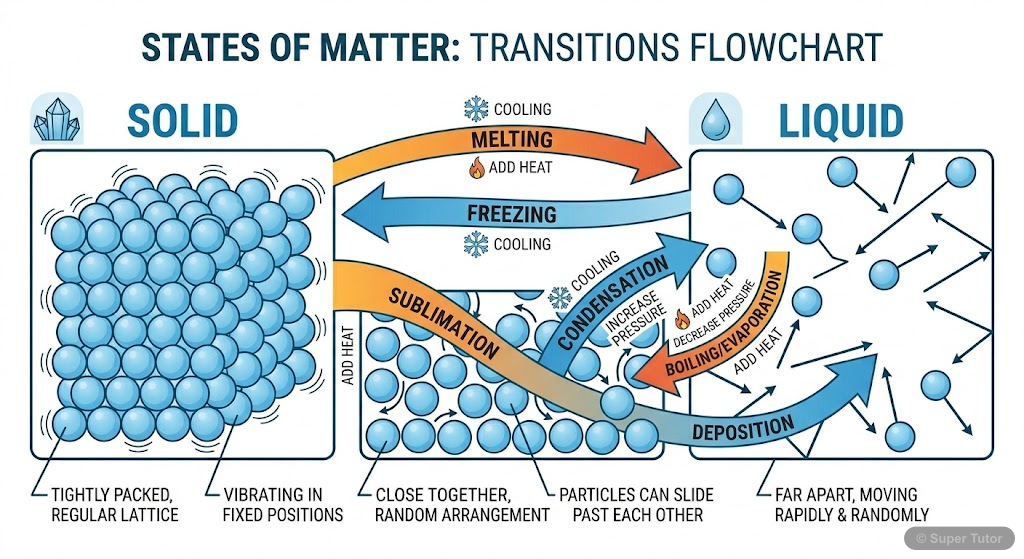
A flowchart illustrating the processes by which matter changes from one state to another (solid, liquid, gas) and the conditions (temperature, pressure) that facilitate these changes.
Super Tutor

This is just one of 16+ visuals inside Super Tutor's Matter in Our Surroundings chapter

Explore the full set
9 Questions Solved · 1 Section

Exercises — Matter in Our Surroundings

1Convert the following temperatures to the celsius scale.
(a) 293 K
(b) 470 K
Show solution
Formula used: T(°C)=T(K)273T(°C) = T(K) - 273

(a) 293 K to Celsius:
T(°C)=293273=20°CT(°C) = 293 - 273 = 20°C

(b) 470 K to Celsius:
T(°C)=470273=197°CT(°C) = 470 - 273 = 197°C
2Convert the following temperatures to the kelvin scale.
(a) 25°C
(b) 373°C
Show solution
Formula used: T(K)=T(°C)+273T(K) = T(°C) + 273

(a) 25°C to Kelvin:
T(K)=25+273=298 KT(K) = 25 + 273 = 298 \text{ K}

(b) 373°C to Kelvin:
T(K)=373+273=646 KT(K) = 373 + 273 = 646 \text{ K}
3Give reason for the following observations.
(a) Naphthalene balls disappear with time without leaving any solid.
(b) We can get the smell of perfume sitting several metres away.
Show solution
(a) Naphthalene balls disappear with time without leaving any solid:

Naphthalene undergoes sublimation — it directly converts from the solid state to the gaseous (vapour) state without passing through the liquid state. The naphthalene vapours mix with the surrounding air and disperse, which is why no solid residue is left behind.

(b) We can get the smell of perfume sitting several metres away:

Perfume contains volatile liquid substances. These substances evaporate and their particles (molecules) mix with air. Due to the property of diffusion, the particles of perfume spread and intermix with the particles of air and reach our nostrils even from several metres away. Gases diffuse very rapidly because their particles have high kinetic energy and large intermolecular spaces.
4Arrange the following substances in increasing order of forces of attraction between the particles — water, sugar, oxygen.Show solution
Concept: Forces of attraction between particles are weakest in gases, intermediate in liquids, and strongest in solids.

- Oxygen is a gas → weakest intermolecular forces.
- Water is a liquid → intermediate intermolecular forces.
- Sugar is a solid → strongest intermolecular forces.

Increasing order of forces of attraction:
\text{Oxygen} < \text{Water} < \text{Sugar}
5What is the physical state of water at—
(a) 25°C
(b) 0°C
(c) 100°C?
Show solution
Known facts: Water melts at 0°C0°C (273 K) and boils at 100°C100°C (373 K) at standard atmospheric pressure.

(a) At 25°C: 25°C is between 0°C and 100°C, so water exists as a liquid.

(b) At 0°C: This is the melting/freezing point of water. At this temperature, water can exist in both solid (ice) and liquid states simultaneously (it is a transition point). Generally, it is considered to be in the solid state (ice) or at the boundary of solid and liquid.

(c) At 100°C: This is the boiling point of water. At this temperature, water can exist in both liquid and gaseous (steam) states simultaneously. It is at the boundary of liquid and gas, generally considered as liquid converting to gas (steam).
6Give two reasons to justify—
(a) water at room temperature is a liquid.
(b) an iron almirah is a solid at room temperature.
Show solution
(a) Water at room temperature is a liquid — Two reasons:

1. Definite volume but no definite shape: Water occupies a definite volume but takes the shape of the container it is kept in, which is a characteristic property of liquids.
2. Fluidity: Water can flow freely from one place to another. The intermolecular forces in water are intermediate — strong enough to keep the molecules together (giving definite volume) but not strong enough to keep them in fixed positions (hence no definite shape). This confirms it is a liquid at room temperature.

(b) An iron almirah is a solid at room temperature — Two reasons:

1. Definite shape and definite volume: An iron almirah has a fixed shape and a fixed volume that does not change on its own, which is a characteristic of solids.
2. Rigidity and incompressibility: Iron is rigid (it cannot be compressed easily) and its particles are held together by very strong intermolecular forces of attraction, keeping them in fixed positions. This confirms it is a solid at room temperature.
7Why is ice at 273 K more effective in cooling than water at the same temperature?Show solution
Given: Ice at 273 K (0°C) and water at 273 K (0°C).

Concept: Latent heat of fusion.

When ice at 273 K is used for cooling, it first absorbs the latent heat of fusion (334 J/g334 \text{ J/g} approximately) from the surroundings to melt and convert into water at 273 K. This extra heat absorption (latent heat) makes ice more effective in cooling.

Water at 273 K, on the other hand, does not need to absorb this extra latent heat — it only absorbs heat to raise its own temperature.

Conclusion: Since ice at 273 K absorbs additional latent heat of fusion from the surroundings (in addition to the heat it absorbs to raise its temperature), it produces a greater cooling effect than water at the same temperature (273 K).
8What produces more severe burns, boiling water or steam?Show solution
Answer: Steam at 100°C produces more severe burns than boiling water at 100°C.

Reason:

Steam at 100°C contains more heat energy than boiling water at 100°C. When steam condenses on the skin, it first releases its latent heat of vaporisation (approximately 2260 J/g2260 \text{ J/g}) in addition to the heat it gives off while cooling. Boiling water at 100°C only releases heat as it cools down, without releasing any latent heat.

Therefore, steam causes more severe burns because it transfers a much larger amount of heat energy to the skin compared to boiling water at the same temperature.
9Name A, B, C, D, E and F in the following diagram showing change in its state. (Refer to diagram in the textbook showing interconversion of states of matter.)Show solution
Note: The diagram shows interconversion of the three states of matter — Solid, Liquid, and Gas — with arrows labelled A, B, C, D, E, and F.

Based on the standard NCERT diagram (Fig. 1.10 type) for Class 9, the labels are as follows:

| Label | Process | Change of State |
|-------|---------|----------------|
| A | Melting (Fusion) | Solid → Liquid |
| B | Evaporation / Vaporisation | Liquid → Gas |
| C | Condensation | Gas → Liquid |
| D | Freezing / Solidification | Liquid → Solid |
| E | Sublimation | Solid → Gas |
| F | Deposition (Reverse Sublimation) | Gas → Solid |

Summary:
- AA = Melting (Solid \rightarrow Liquid)
- BB = Evaporation/Vaporisation (Liquid \rightarrow Gas)
- CC = Condensation (Gas \rightarrow Liquid)
- DD = Freezing (Liquid \rightarrow Solid)
- EE = Sublimation (Solid \rightarrow Gas)
- FF = Deposition/Reverse Sublimation (Gas \rightarrow Solid)

Stuck on a step?

Ask Super Tutor AI to explain any solution on this page in a simpler way — free, 24x7.

Ask a Doubt Free

Frequently Asked Questions

What are the important topics in Matter in Our Surroundings for Uttar Pradesh Board Class 9 Science?
Matter in Our Surroundings covers several key topics that are frequently asked in Uttar Pradesh Board Class 9 board exams. Focus on the core concepts listed on this page and practise related questions to build confidence.
How to score full marks in Matter in Our Surroundings — Uttar Pradesh Board Class 9 Science?
Understand the core concepts first, then work through the 27 practice questions available for this chapter. Revise formulas and definitions regularly, and use flashcards for quick recall before the exam.
Where can I get free NCERT Solutions for Matter in Our Surroundings Class 9 Science?
This page has free step-by-step NCERT Solutions for every exercise question in Matter in Our Surroundings (Uttar Pradesh Board Class 9 Science) — written the way examiners award marks: given, formula, working, answer.

Sources & Official References

Content is aligned to the official syllabus. Refer to the board website for the latest curriculum.

For serious students

Get the full Matter in Our Surroundings chapter — for free.

Quizzes, flashcards, AI doubt-solver and a step-by-step study plan for Uttar Pradesh Board Class 9 Science.