Security in the Contemporary World — Practice Quiz
Assam Board · Class 12 · Political Science
Try a 4-question quiz on Security in the Contemporary World for Assam Board Class 12 Political Science: tap an answer to check it and see why.
Interactive on Super Tutor
Studying Security in the Contemporary World? Get the full interactive chapter.
Quizzes, flashcards, AI doubt-solver and a step-by-step study plan — built for practice quiz and more.
Free trial, no card needed.
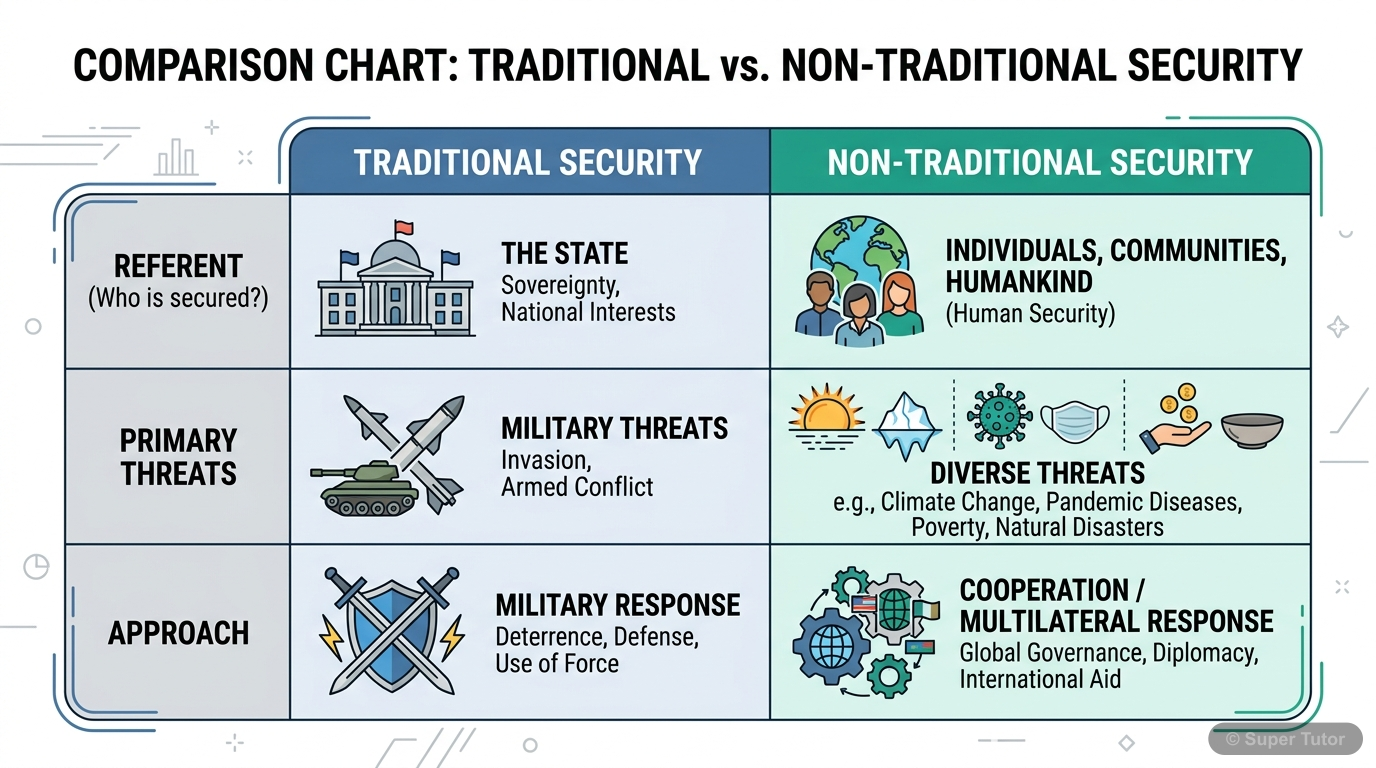
One of 7 illustrations for Security in the Contemporary World in Super Tutor — alongside flashcards, concept maps and practice questions.
Quick Quiz: Security in the Contemporary World
0/4Tap an answer to check it instantly. No sign-up needed for these 4.
What does security fundamentally mean at its most basic level?
In traditional security conception, what is considered the greatest danger to a country?
What is deterrence in the context of security policy?
What is an alliance in international security?
Sample Questions
Which of the following are components of traditional security policy? (Select all correct answers)
Show answer
Deterrence, Defence, Balance of power, Alliance building
Traditional security policy has four main components: deterrence (preventing war), defence (limiting or ending war), balance of power (maintaining favorable power relations), and alliance building (forming coalitions for security). Human rights protection is part of non-traditional security.
In non-traditional security concepts, who is the primary referent of security?
Show answer
Individuals and communities
Non-traditional security concepts expand the referent beyond just the state to include individuals, communities, and all of humankind. This is called 'human security' or 'global security' and focuses on protecting people, not just states.
Which of the following are examples of non-traditional security threats? (Select all correct answers)
Show answer
Terrorism, Global poverty, Health epidemics, Human rights violations
Non-traditional security threats include terrorism, global poverty, health epidemics, and human rights violations. Military invasion is a traditional security threat. Non-traditional threats go beyond military concerns to include threats to human existence and dignity.
What is terrorism according to the chapter?
Show answer
Political violence that targets civilians deliberately and indiscriminately
Terrorism is defined as political violence that targets civilians deliberately and indiscriminately. Terrorist groups seek to change political conditions through force, often targeting civilians to terrorize the public and pressure governments.
+43 more questions on Security in the Contemporary World (Assam Board Class 12 Political Science)
Practise AllFrequently Asked Questions
What are the important topics in Security in the Contemporary World for Assam Board Class 12 Political Science?
How many practice questions are there for Security in the Contemporary World?
Sources & Official References
Content is aligned to the official syllabus. Refer to the board website for the latest curriculum.
More resources for Security in the Contemporary World
Important Questions
Exam-style questions with answers
Revision Notes
Key points for last-minute revision
Chapter Summary
Understand the chapter at a glance
Concept Maps
See how topics connect
Study Plan
Step-by-step plan for this chapter
Flashcards
Quick-fire cards for active recall
Syllabus
What topics to cover
NCERT Solutions
Every textbook question solved step by step
For serious students
Get the full Security in the Contemporary World chapter — start free.
Quizzes, flashcards, an AI doubt solver and a study plan for Assam Board Class 12 Political Science. Free to start, no card needed.