Consumer Rights
Bihar Board · Class 10 · Social Science
NCERT Solutions for Consumer Rights — Bihar Board Class 10 Social Science.
Interactive on Super Tutor
Studying Consumer Rights? Get the full interactive chapter.
Quizzes, flashcards, AI doubt-solver and a step-by-step study plan — built for ncert solutions and more.
1,000+ Class 10 students started this chapter today

Super Tutor has 8+ illustrations like this for Consumer Rights alone — flashcards, concept maps, and step-by-step visuals.
See them allEXERCISES
1Why are rules and regulations required in the marketplace? Illustrate with a few examples.Show solution
Answer:
Rules and regulations are required in the marketplace to protect consumers from exploitation and to ensure fair trade practices. The following reasons and examples illustrate this:
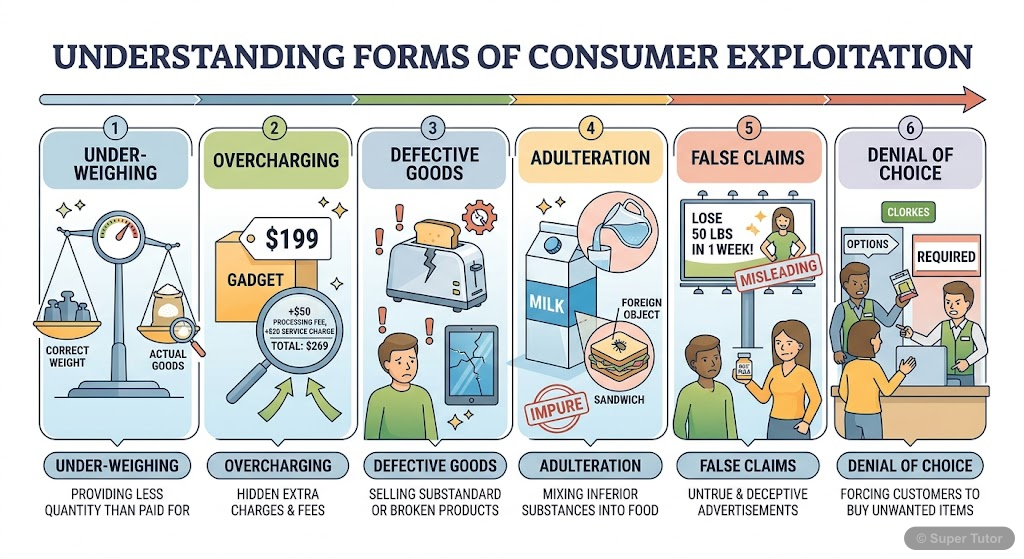
1. Prevention of adulteration: Without regulations, sellers may mix inferior substances in food items. For example, milk may be diluted with water or chalk powder may be mixed in flour. The Food Safety and Standards Act prevents such adulteration.
2. Accurate weights and measures: Sellers may use faulty weights to cheat consumers. Regulations under the Weights and Measures Act ensure that correct weights are used. For example, a vegetable vendor must use standard weights.
3. Misleading advertisements: Companies may make false claims about their products. Regulations prevent misleading advertisements. For example, a medicine cannot claim to cure a disease it cannot cure.
4. Hoarding and black marketing: Traders may hoard essential commodities to create artificial scarcity and raise prices. The Essential Commodities Act prevents such practices.
5. Safety standards: Without regulations, manufacturers may produce unsafe goods. For example, electrical appliances without proper insulation can cause accidents. The Bureau of Indian Standards (BIS) sets safety standards.
Conclusion: Rules and regulations create a level playing field, protect consumers' interests, and ensure that markets function in a fair and transparent manner.
2What factors gave birth to the consumer movement in India? Trace its evolution.Show solution
Factors that gave birth to the Consumer Movement:
1. Widespread adulteration of food: Sellers mixed harmful substances in food items, endangering consumers' health.
2. Faulty weights and measures: Traders used incorrect weights to cheat consumers.
3. Hoarding and black marketing: Essential goods were hoarded during scarcity (especially during World War II and the 1960s food shortages), leading to high prices.
4. Misleading advertisements: False claims were made about products and services.
5. Unsafe products: Goods were sold without proper safety standards.
6. Lack of consumer awareness: Consumers were largely unaware of their rights and had no platform to voice grievances.
Evolution of the Consumer Movement in India:
- Before 1970s: Consumer movement was limited to writing articles and holding exhibitions. Consumer organisations were few and focused mainly on food shortages and hoarding.
- 1970s onwards: Consumer groups became more active. They started filing cases against unfair trade practices and demanded accountability from businesses.
- 1986 – Major Milestone: The Government of India enacted the Consumer Protection Act (COPRA), 1986 — a landmark legislation that gave consumers legal rights and established a three-tier quasi-judicial machinery (District, State, and National Consumer Commissions) for redressal of grievances.
- Post-1986: Consumer awareness spread further. India became a member of Consumers International, a global body of consumer organisations.
- 2019 Amendment: COPRA was amended to include online purchases, make manufacturers/service providers liable, and introduce mediation as an alternative dispute resolution mechanism.
Conclusion: The consumer movement evolved from informal awareness campaigns to a strong legal framework protecting consumer rights in India.
3Explain the need for consumer consciousness by giving two examples.Show solution
Need for Consumer Consciousness:
Consumers need to be conscious because sellers and manufacturers often try to maximise profits at the expense of consumers. An aware consumer can protect himself/herself from being cheated.
Example 1 – Checking for ISI/Agmark/Hallmark:
When buying electrical goods, a consumer should look for the ISI mark (Bureau of Indian Standards certification). An unconscious consumer may buy a substandard electrical appliance that could be unsafe and cause accidents. Similarly, when buying edible oils or cereals, the Agmark certification ensures quality. A conscious consumer checks for these marks before purchasing.
Example 2 – Checking Expiry Date and MRP:
A conscious consumer always checks the expiry date on medicines, packaged food, and other perishable goods before buying. Consuming expired products can be harmful to health. Similarly, checking the Maximum Retail Price (MRP) printed on the packet ensures that the consumer does not pay more than the legally fixed price. An unconscious consumer may be overcharged or may consume expired goods.
Conclusion: Consumer consciousness is essential to protect oneself from exploitation, ensure value for money, and maintain personal safety and health.
4Mention a few factors which cause exploitation of consumers.Show solution
Factors causing exploitation of consumers:
1. Limited information: Consumers often lack complete information about the quality, price, and composition of goods and services, making them vulnerable to cheating.
2. Limited supplies: When essential goods are in short supply, sellers hoard them and sell at higher prices, exploiting consumers.
3. Limited competition: When only one or a few sellers dominate the market (monopoly/oligopoly), they can charge high prices and offer poor quality without fear of losing customers.
4. Low literacy: Illiterate consumers cannot read labels, check expiry dates, or understand their legal rights, making them easy targets for exploitation.
5. Adulteration and poor quality: Sellers mix inferior substances in products to increase profits, harming consumers.
6. Misleading advertisements: False or exaggerated claims in advertisements mislead consumers into buying products that do not deliver the promised benefits.
7. Lack of consumer awareness: Many consumers are unaware of their rights and the legal remedies available to them.
8. Weak enforcement of laws: Even where consumer protection laws exist, poor enforcement allows sellers to continue exploitative practices.
5What is the rationale behind the enactment of Consumer Protection Act 1986?Show solution
Rationale behind COPRA 1986:
1. To protect consumers from exploitation: Prior to COPRA, consumers had no specific legal mechanism to seek redressal against unfair trade practices, adulteration, and defective goods.
2. To provide speedy and inexpensive redressal: Ordinary civil courts were slow and expensive. COPRA established a three-tier quasi-judicial system — District Consumer Commission, State Consumer Commission, and National Consumer Commission — to provide quick and affordable justice.
3. To recognise consumer rights: COPRA formally recognised six consumer rights including the right to safety, right to information, right to choose, right to be heard, right to seek redressal, and right to consumer education.
4. To empower consumers: The Act empowered consumers to file complaints against manufacturers, traders, and service providers for defective goods, deficient services, unfair trade practices, and overcharging.
5. To create consumer awareness: COPRA aimed to spread awareness about consumer rights and responsibilities across the country.
6. To establish accountability: It made sellers and manufacturers accountable for the quality and safety of their products and services.
Conclusion: COPRA 1986 was a landmark legislation that shifted the balance of power in the marketplace towards consumers and provided them with a strong legal shield against exploitation.
6Describe some of your duties as consumers if you visit a shopping complex in your locality.Show solution
Duties as a consumer while visiting a shopping complex:
1. Insist on a cash memo/bill: Always ask for a receipt or bill for every purchase. This serves as proof of purchase and is essential if a complaint needs to be filed later.
2. Check for quality marks: Look for certification marks such as ISI (for industrial goods), Agmark (for food products), Hallmark (for jewellery), or FPO (for fruit products) before buying.
3. Check the MRP: Verify that the price charged does not exceed the Maximum Retail Price (MRP) printed on the product.
4. Check expiry date: Always check the manufacturing date and expiry date on packaged food, medicines, and other perishable items.
5. Read the label carefully: Check the list of ingredients, net weight, and other details mentioned on the label to make an informed choice.
6. Be aware of consumer rights: Know your rights so that you can assert them if needed.
7. File a complaint if cheated: If you find that you have been cheated or sold a defective product, do not ignore it. File a complaint with the shopkeeper, consumer forum, or relevant authority.
8. Avoid impulsive buying: Do not fall for misleading advertisements or attractive offers without verifying the quality and price of the product.
Conclusion: Being a responsible consumer means being alert, informed, and willing to assert one's rights.
7Suppose you buy a bottle of honey and a biscuit packet. Which logo or mark you will have to look for and why?Show solution
For a bottle of honey:
- Look for the Agmark logo.
- Why: Agmark (Agricultural Mark) is a certification mark for agricultural and food products in India. It is issued by the Directorate of Marketing and Inspection under the Ministry of Agriculture. It certifies that the product meets the prescribed quality standards for purity and composition. Honey is an agricultural product, so Agmark ensures it is pure and unadulterated.
For a biscuit packet:
- Look for the ISI mark (BIS certification mark) or the FPO mark (Fruit Products Order) / FSSAI logo.
- Why: Biscuits are processed food items. The ISI mark from the Bureau of Indian Standards (BIS) or the FSSAI (Food Safety and Standards Authority of India) logo certifies that the product has been manufactured under hygienic conditions and meets the required food safety and quality standards. The FSSAI logo is now mandatory on all packaged food products.
Conclusion: Checking these marks before purchase ensures that the products are safe, of good quality, and have been produced under regulated conditions, thereby protecting the consumer from adulteration and substandard goods.
8What legal measures were taken by the government to empower the consumers in India?Show solution
Legal measures taken by the government:
1. Consumer Protection Act, 1986 (COPRA):
- Established a three-tier quasi-judicial redressal system:
- District Consumer Commission – handles cases up to ₹1 crore.
- State Consumer Commission – handles cases between ₹1 crore and ₹10 crore.
- National Consumer Commission – handles cases above ₹10 crore.
- Recognised six consumer rights.
- Amended in 2019 to include online purchases, introduce mediation, and make manufacturers/service providers liable.
2. The Food Safety and Standards Act, 2006:
- Established FSSAI to regulate food safety and standards.
- Mandatory FSSAI logo on all packaged food products.
3. Bureau of Indian Standards (BIS) Act:
- BIS sets quality standards for industrial and consumer goods.
- ISI mark certifies that products meet these standards.
4. Weights and Measures Act:
- Ensures that correct weights and measures are used in trade.
5. Essential Commodities Act:
- Prevents hoarding and black marketing of essential goods.
6. Agmark Certification:
- Ensures quality standards for agricultural and food products.
7. Hallmarking of Jewellery:
- BIS hallmark certifies the purity of gold and silver jewellery.
Conclusion: These legal measures collectively create a strong framework to protect consumers from exploitation and empower them to seek justice.
9Mention some of the rights of consumers and write a few sentences on each.Show solution
Rights of Consumers:
1. Right to Safety:
Consumers have the right to be protected against goods and services that are hazardous to life and property. For example, electrical appliances must meet safety standards so that they do not cause accidents. This right is especially important for medicines, food, and electrical goods.
2. Right to Information:
Consumers have the right to be informed about the quality, quantity, potency, purity, standard, and price of goods and services. This helps consumers make informed choices and protects them from unfair trade practices. For example, the ingredients and expiry date must be printed on food packets.
3. Right to Choose:
Consumers have the right to access a variety of goods and services at competitive prices. No seller can force a consumer to buy a particular product. This right ensures that consumers have options and are not compelled to buy from a single source.
4. Right to be Heard:
Consumers have the right to have their interests and complaints heard and considered at appropriate forums. Consumer organisations and government bodies must give due consideration to consumer grievances.
5. Right to Seek Redressal:
Consumers have the right to seek compensation or redressal against unfair trade practices or exploitation. The three-tier consumer commission system under COPRA provides the mechanism for this. Consumers can seek replacement, refund, or compensation for defective goods or deficient services.
6. Right to Consumer Education:
Consumers have the right to acquire knowledge and skills to be informed consumers throughout their lives. Consumer education helps people understand their rights and make better decisions in the marketplace.
10By what means can the consumers express their solidarity?Show solution
Means by which consumers can express their solidarity:
1. Forming consumer organisations: Consumers can come together to form consumer groups and associations that work to protect consumer rights, spread awareness, and take up cases of exploitation.
2. Filing complaints collectively: When a large number of consumers are affected by the same unfair practice, they can file a collective complaint before the consumer commission, making the case stronger.
3. Boycotting products: Consumers can collectively boycott products or companies that engage in unfair trade practices, adulteration, or exploitation. This puts economic pressure on the offending party.
4. Participating in consumer awareness campaigns: Consumers can participate in or organise campaigns, rallies, and workshops to spread awareness about consumer rights.
5. Using media: Consumers can use print media, social media, and television to highlight cases of exploitation and warn other consumers.
6. Supporting consumer movements: Consumers can support national and international consumer organisations such as Consumers International, which represents consumer groups from over 100 countries.
7. Demanding policy changes: Consumer groups can lobby the government for stronger consumer protection laws and better enforcement.
Conclusion: Collective action and solidarity among consumers is the most powerful tool to check exploitation and bring about meaningful change in the marketplace.
11Critically examine the progress of consumer movement in India.Show solution
Progress of the Consumer Movement in India:
Positive developments:
1. Enactment of COPRA 1986: This was a landmark achievement. It gave consumers legal rights and established a three-tier redressal system.
2. Three-tier redressal system: District, State, and National Consumer Commissions have been set up across the country, providing accessible forums for consumers to seek justice.
3. Consumer organisations: Numerous consumer organisations have been established that educate consumers and take up cases on their behalf.
4. International recognition: India is a member of Consumers International, linking Indian consumer groups to a global network.
5. Amendment of COPRA in 2019: Online purchases are now covered, mediation is encouraged, and manufacturers/service providers are held more accountable.
6. Spread of awareness: Consumer awareness has been spreading, especially in urban areas, through media, education, and NGO activities.
Limitations and challenges:
1. Slow and complex process: Filing and attending consumer commission proceedings is time-consuming and complicated for ordinary consumers.
2. Lack of evidence: In most retail purchases, cash memos are not issued, making it difficult to gather evidence for complaints.
3. Low awareness in rural areas: Consumer awareness is still limited in rural and semi-urban areas where a large proportion of the population lives.
4. Weak enforcement: Laws protecting workers and consumers in the unorganised sector are often not enforced effectively.
5. Small value of disputes: Most consumer disputes involve small amounts, making it not worthwhile for consumers to approach commissions.
Conclusion: While the consumer movement has made commendable progress in India, much more needs to be done in terms of spreading awareness, simplifying the redressal process, and strengthening enforcement of consumer protection laws. Active consumer participation is essential for the movement to be truly effective.
12Match the following:
(i) Availing details of ingredients of a product
(ii) Agmark
(iii) Accident due to faulty engine in a scooter
(iv) District Consumer Commission
(v) Food fortification
(vi) Consumers International
(vii) Bureau of Indian Standards
(a) Right to safety
(b) Dealing with consumer cases
(c) Certification of edible oil and cereals
(d) Agency that develop standards for goods and services
(e) Right to information
(f) Global level institution of consumer welfare organisations
(g) Addition of key nutrients to staple foodsShow solution
| Item | Match |
|---|---|
| (i) Availing details of ingredients of a product | (e) Right to information |
| (ii) Agmark | (c) Certification of edible oil and cereals |
| (iii) Accident due to faulty engine in a scooter | (a) Right to safety |
| (iv) District Consumer Commission | (b) Dealing with consumer cases |
| (v) Food fortification | (g) Addition of key nutrients to staple foods |
| (vi) Consumers International | (f) Global level institution of consumer welfare organisations |
| (vii) Bureau of Indian Standards | (d) Agency that develops standards for goods and services |
Brief Justifications:
- (i)–(e): Knowing the ingredients of a product is part of the consumer's Right to Information.
- (ii)–(c): Agmark certifies the quality of agricultural products like edible oils and cereals.
- (iii)–(a): An accident due to a faulty engine is a violation of the Right to Safety.
- (iv)–(b): District Consumer Commission is the first tier of the three-tier system that deals with consumer disputes.
- (v)–(g): Food fortification means adding key nutrients (like iron, iodine, vitamins) to staple foods.
- (vi)–(f): Consumers International is a global body representing consumer organisations from over 100 countries.
- (vii)–(d): BIS (Bureau of Indian Standards) develops and maintains standards for goods and services in India.
13Say True or False.
(i) COPRA applies only to goods.
(ii) India is one of the many countries in the world which has exclusive authorities established for consumer disputes redressal.
(iii) When a consumer feels that he has been exploited, he must file a case in the District Consumer Commission.
(iv) It is worthwhile to move to consumer commissions only if the damages incurred are of high value.
(v) Hallmark is the certification maintained for standardisation of jewellery.
(vi) The consumer redressal process is very simple and quick.
(vii) A consumer has the right to get compensation depending on the degree of the damage.Show solution
False.
COPRA applies to both goods and services. Consumers can file complaints against deficient services (such as banking, insurance, transport, medical services) as well as defective goods.
---
(ii) India is one of the many countries in the world which has exclusive authorities established for consumer disputes redressal.
True.
India is one of the few countries in the world that has set up an exclusive three-tier quasi-judicial system (District, State, and National Consumer Commissions) specifically for consumer disputes redressal.
---
(iii) When a consumer feels that he has been exploited, he must file a case in the District Consumer Commission.
False.
A consumer can first try to resolve the matter directly with the seller or manufacturer. If that fails, he/she can approach a consumer organisation for help. Filing a case in the District Consumer Commission is one option, but it is not the only or mandatory first step. Also, the appropriate commission depends on the value of the claim.
---
(iv) It is worthwhile to move to consumer commissions only if the damages incurred are of high value.
False.
Consumers can approach consumer commissions for disputes of any value. The District Consumer Commission handles cases up to ₹1 crore. Even small value disputes can be filed. However, in practice, consumers often do not find it worthwhile for very small amounts due to time and effort involved.
---
(v) Hallmark is the certification maintained for standardisation of jewellery.
True.
Hallmark is the certification mark issued by the Bureau of Indian Standards (BIS) that certifies the purity of gold and silver jewellery in India.
---
(vi) The consumer redressal process is very simple and quick.
False.
The consumer redressal process is often slow and complicated. Consumers need to spend time and money filing cases, gathering evidence (cash memos), and attending commission proceedings. This is one of the major limitations of the consumer movement in India.
---
(vii) A consumer has the right to get compensation depending on the degree of the damage.
True.
Under the Right to Seek Redressal, a consumer is entitled to compensation commensurate with the loss or damage suffered. The consumer commission determines the appropriate compensation based on the nature and extent of the harm caused.
Stuck on a step?
Ask Super Tutor AI to explain any solution on this page in a simpler way — free, 24x7.
Ask a Doubt FreeFrequently Asked Questions
What are the important topics in Consumer Rights for Bihar Board Class 10 Social Science?
How to score full marks in Consumer Rights — Bihar Board Class 10 Social Science?
Where can I get free NCERT Solutions for Consumer Rights Class 10 Social Science?
Sources & Official References
Content is aligned to the official syllabus. Refer to the board website for the latest curriculum.
More resources for Consumer Rights
Important Questions
Practice with board exam-style questions
Syllabus
What topics to cover
Revision Notes
Key points for last-minute revision
Study Plan
Step-by-step plan to ace this chapter
Flashcards
Quick-fire cards for active recall
Formula Sheet
All formulas in one place
Chapter Summary
Understand the chapter at a glance
Practice Quiz
Test yourself with a quick quiz
Concept Maps
See how topics connect visually
For serious students
Get the full Consumer Rights chapter — for free.
Quizzes, flashcards, AI doubt-solver and a step-by-step study plan for Bihar Board Class 10 Social Science.