Money and Credit
Bihar Board · Class 10 · Social Science
NCERT Solutions for Money and Credit — Bihar Board Class 10 Social Science.
Interactive on Super Tutor
Studying Money and Credit? Get the full interactive chapter.
Quizzes, flashcards, AI doubt-solver and a step-by-step study plan — built for ncert solutions and more.
1,000+ Class 10 students started this chapter today

This is just one of 10+ visuals inside Super Tutor's Money and Credit chapter
Explore the full setEXERCISES
1In situations with high risks, credit might create further problems for the borrower. Explain.Show solution
Explanation:
When a borrower takes a loan to carry out an activity that involves high risk (such as farming dependent on monsoon, or a small business in an uncertain market), there is a possibility that the activity may fail.
Example: A small farmer borrows ₹5,000 to grow a crop. If the crop fails due to drought or flood:
- The farmer earns no income from the crop.
- Yet, he must repay the loan along with interest.
- To repay, he may have to sell his assets (land, livestock) or take another loan.
- This pushes him into a debt trap — a cycle of borrowing more to repay previous loans.
Conclusion: Thus, in high-risk situations, instead of improving the borrower's condition, credit can make the borrower worse off by increasing debt burden and leading to loss of assets. This is why credit in high-risk situations can create further problems rather than solving them.
2How does money solve the problem of double coincidence of wants? Explain with an example of your own.Show solution
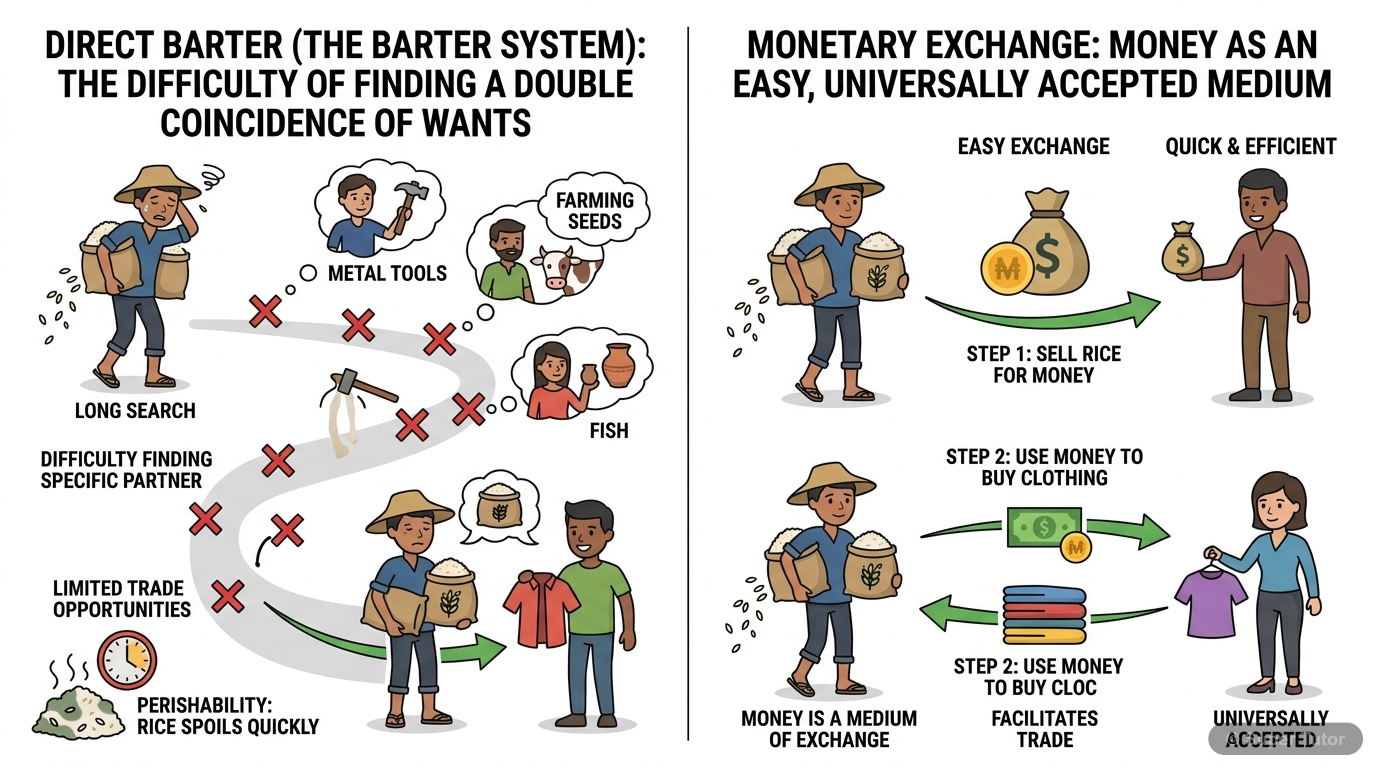
How Money Solves This Problem:
Money acts as a medium of exchange. A person can sell goods or services for money and then use that money to buy whatever he/she needs. Money eliminates the need for double coincidence because:
- The seller accepts money (not a specific good in return).
- The buyer pays money (not a specific good).
- Each party can then independently buy what they need.
Example:
Suppose a shoemaker wants to buy wheat. Under barter, he would need to find a wheat farmer who also needs shoes — a double coincidence. This is very difficult.
With money:
- The shoemaker sells shoes to anyone who needs them and receives money.
- He then goes to a wheat farmer and buys wheat with that money.
- The wheat farmer does not need to want shoes; he simply accepts money.
Conclusion: Money removes the need for double coincidence of wants by separating the act of buying from the act of selling, making transactions much easier and more efficient.
3How do banks mediate between those who have surplus money and those who need money?Show solution
Role of Banks as Mediators:
Step 1 – Accepting Deposits:
People who have surplus money deposit it in banks in savings accounts, fixed deposits, etc. Banks pay them interest on these deposits.
Step 2 – Lending to Borrowers:
Banks use a major portion of these deposits to give loans to individuals, farmers, businessmen, and industries who need money. Banks charge a higher rate of interest on loans than what they pay on deposits.
Step 3 – Profit for Banks:
The difference between the interest charged on loans and the interest paid on deposits is the bank's main source of income (profit).
Example:
- Bank pays 4% interest to depositors.
- Bank charges 10% interest from borrowers.
- The 6% difference is the bank's earnings.
Conclusion: In this way, banks mediate between those with surplus funds and those who need funds, ensuring that idle money is put to productive use in the economy.
4Look at a 10 rupee note. What is written on top? Can you explain this statement?Show solution
"Reserve Bank of India" and in the centre there is a promise statement:
"I promise to pay the bearer the sum of Ten Rupees" — signed by the Governor of the Reserve Bank of India.
Explanation of the Statement:
1. The statement means that the Reserve Bank of India (RBI), on behalf of the Central Government of India, guarantees the value of the currency note.
2. The RBI Governor's signature represents the government's assurance that the note is a legal tender and will be accepted for transactions.
3. This is called a fiat money system — the currency has value because the government declares it to be legal tender, not because it is backed by gold or silver.
4. Any person holding the note can use it to buy goods and services, and no one can legally refuse to accept it as payment.
Conclusion: The statement reflects that modern currency is authorised by the government and backed by its guarantee, which gives people confidence to use it as a medium of exchange.
5Why do we need to expand formal sources of credit in India?Show solution
Reasons to Expand Formal Sources of Credit:
1. Lower Interest Rates: Formal sources charge much lower interest rates compared to informal lenders (moneylenders may charge 30–50% or more), reducing the burden on borrowers.
2. Avoid Debt Traps: Informal lenders often use unfair means to recover loans, pushing borrowers into debt traps. Formal credit is regulated and safer.
3. Reach the Poor: Currently, the poor and small farmers are largely excluded from formal credit. Expanding formal credit ensures they get affordable loans for productive activities.
4. Regulated Terms of Credit: Formal sources follow RBI guidelines, ensuring fair interest rates, transparent terms, and legal protection for borrowers.
5. Economic Development: Cheap and accessible credit enables people to invest in businesses, agriculture, and education, contributing to overall economic development.
6. Reduce Exploitation: Informal lenders often exploit borrowers through high interest, collateral demands, and social pressure. Formal credit reduces such exploitation.
Conclusion: Expanding formal sources of credit is essential to ensure that all sections of society, especially the poor, have access to affordable credit, which is crucial for their development and well-being.
6What is the basic idea behind the SHGs for the poor? Explain in your own words.Show solution
Basic Idea Behind SHGs:
1. Pooling Savings: Members of an SHG (usually 15–20 people) save a small amount regularly (e.g., ₹25–₹100 per month). These savings are pooled together.
2. Internal Lending: Members can borrow from this common pool for small needs at a reasonable rate of interest decided by the group itself.
3. Bank Loans: Once the group functions well for 1–2 years and maintains proper accounts, it becomes eligible to take a loan from a bank in the group's name. This loan is then distributed among members who need it.
4. No Collateral Needed: Since the loan is given to the group collectively, individual members do not need to provide collateral (security), which is a major barrier for the poor.
5. Empowerment: SHGs, especially women's SHGs, help members become financially independent, make collective decisions, and address social issues.
Example: Grameen Bank of Bangladesh is a famous example where millions of poor women have benefited through group-based credit.
Conclusion: The basic idea is to organise the poor into groups so they can help each other financially, reduce dependence on moneylenders, and gain access to formal credit at affordable rates.
7What are the reasons why the banks might not be willing to lend to certain borrowers?Show solution
Reasons Why Banks May Not Lend:
1. Lack of Collateral: Banks require collateral (security such as land, property, gold) as a guarantee. Poor people and small farmers often do not have assets to offer as collateral, so banks refuse to lend.
2. No Proof of Income: Banks need assurance of repayment. If a borrower has no regular or documented income (e.g., daily wage workers, small farmers), banks consider them high-risk.
3. Poor Credit History: If a borrower has previously defaulted on loans or has a bad credit record, banks are unwilling to lend again.
4. Small Loan Amounts: Banks find it unprofitable to process many small loans (as needed by the poor) because the administrative costs are high relative to the loan amount.
5. High Risk of Default: In uncertain occupations (e.g., farming dependent on monsoon), banks fear that borrowers may not be able to repay if the activity fails.
6. Lack of Documentation: Many poor people lack proper documents (identity proof, address proof, income certificates) required by banks.
Conclusion: Due to these reasons, banks are often reluctant to lend to the poor, small farmers, and informal sector workers, forcing them to depend on expensive informal sources of credit.
8In what ways does the Reserve Bank of India supervise the functioning of banks? Why is this necessary?Show solution
Ways in Which RBI Supervises Banks:
1. Currency Issuance: RBI is the only authority to issue currency notes in India on behalf of the Central Government.
2. Cash Reserve Ratio (CRR): RBI requires banks to keep a certain minimum fraction of their deposits as cash reserves with the RBI. This ensures banks always have enough cash to meet depositors' demands.
3. Monitoring Loan Activities: RBI monitors the loans given by banks — to whom they are lending, at what interest rates, and whether proper procedures are followed.
4. Setting Interest Rate Guidelines: RBI periodically sets guidelines on interest rates to ensure banks do not charge excessively high rates.
5. Inspection of Banks: RBI regularly inspects the accounts and functioning of banks to check for irregularities.
6. Lender of Last Resort: If a bank faces a financial crisis, RBI provides emergency funds to prevent the bank from collapsing.
7. Licensing: RBI grants licences to new banks and can cancel licences of banks that do not follow rules.
Why This Supervision is Necessary:
- Banks hold the savings of millions of people. If banks fail or misuse funds, people lose their hard-earned money.
- Without supervision, banks might lend recklessly, charge unfair interest rates, or engage in fraudulent activities.
- RBI supervision ensures the stability, safety, and trustworthiness of the banking system.
- It protects the interests of depositors and maintains public confidence in banks.
Conclusion: RBI's supervision is essential to maintain financial discipline, protect depositors, and ensure the smooth functioning of the economy.
9Analyse the role of credit for development.Show solution
Role of Credit for Development:
1. Supports Agriculture: Farmers need credit to buy seeds, fertilisers, equipment, and to meet expenses before the harvest. Without credit, agricultural production would suffer.
2. Promotes Business and Industry: Entrepreneurs and businessmen need loans to set up factories, buy machinery, and expand operations. Credit enables investment and production.
3. Helps the Poor: Credit allows poor people to invest in small income-generating activities (e.g., buying a sewing machine, setting up a small shop), helping them improve their livelihoods.
4. Enables Education and Housing: Individuals can take loans for higher education or to build homes, improving their quality of life and human capital.
5. Multiplier Effect: When credit is used productively, it generates income, which is spent and re-spent in the economy, creating a multiplier effect on growth.
When Credit Can Be Harmful:
- If credit is taken for consumption (not production) or in high-risk situations, it can lead to debt traps.
- Informal credit at high interest rates can worsen the condition of the poor.
Conclusion: Credit, when available at reasonable rates and used productively, is a powerful tool for development. It enables investment, increases income, and improves living standards. However, it must be accessible, affordable, and regulated to prevent exploitation and debt traps.
10Manav needs a loan to set up a small business. On what basis will Manav decide whether to borrow from the bank or the moneylender? Discuss.Show solution
Basis for Decision — Comparison of Terms of Credit:
Manav will compare the following factors:
| Factor | Bank | Moneylender |
|---|---|---|
| Interest Rate | Low (10–12%) | Very high (30–50% or more) |
| Collateral | Required (land, property) | May or may not require |
| Documentation | Extensive (income proof, ID) | Minimal |
| Flexibility | Fixed repayment schedule | Flexible but exploitative |
| Speed | Slow (takes time to process) | Quick and immediate |
| Legal Protection | Yes (regulated by RBI) | No legal protection |
Manav's Decision:
1. If Manav has collateral and proper documents: He should prefer a bank loan because the interest rate is low, terms are transparent, and he is legally protected. This will reduce his debt burden.
2. If Manav lacks collateral or documents: He may have no choice but to approach a moneylender, but he must be careful about the high interest rates and unfair terms.
3. Risk Consideration: If the business involves high risk, borrowing at high interest from a moneylender could push Manav into a debt trap if the business fails.
Conclusion: Manav should ideally borrow from a bank as it offers lower interest rates, fair terms, and legal protection. He should avoid moneylenders unless absolutely necessary, as their high interest rates can make repayment very difficult and worsen his financial condition.
11In India, about 80 per cent of farmers are small farmers, who need credit for cultivation.
(a) Why might banks be unwilling to lend to small farmers?
(b) What are the other sources from which the small farmers can borrow?
(c) Explain with an example how the terms of credit can be unfavourable for the small farmer.
(d) Suggest some ways by which small farmers can get cheap credit.Show solution
Banks may be unwilling to lend to small farmers due to the following reasons:
1. Lack of Collateral: Small farmers own very little land or assets. Banks require collateral as security, which small farmers cannot provide.
2. High Risk: Agriculture depends on monsoon and weather conditions. If the crop fails, the farmer cannot repay the loan, making it a risky investment for banks.
3. Small Loan Amounts: Small farmers need small loans, which are not profitable for banks due to high processing costs.
4. No Documented Income: Small farmers do not have regular, documented income, making it difficult to assess their repayment capacity.
5. Remote Location: Many small farmers live in rural areas far from bank branches, making it difficult for banks to reach them.
---
(b) Other sources from which small farmers can borrow:
Small farmers can borrow from the following informal sources:
1. Moneylenders (local village moneylenders)
2. Traders and commission agents who supply agricultural inputs
3. Landlords (who may also be employers)
4. Relatives and friends
They can also borrow from semi-formal sources such as:
5. Agricultural Cooperative Societies
6. Self Help Groups (SHGs)
---
(c) How terms of credit can be unfavourable for the small farmer — with an example:
Example:
Ramu is a small farmer who borrows ₹5,000 from a local moneylender at 30% annual interest to buy seeds and fertilisers for his crop.
- If the crop is good, he earns ₹8,000 and repays ₹6,500 (principal + interest), keeping only ₹1,500.
- If the crop fails due to drought, he earns nothing but still owes ₹6,500.
- To repay, he borrows again, and the debt keeps growing — this is a debt trap.
Unfavourable Terms Include:
- Very high interest rates (30–50%)
- Demand for collateral (land, jewellery)
- Requirement to sell produce only to the lender at low prices
- No legal protection if the lender behaves unfairly
---
(d) Ways by which small farmers can get cheap credit:
1. Cooperative Societies: Small farmers should form or join agricultural cooperative societies that provide loans at low interest rates.
2. Self Help Groups (SHGs): Farmers can form SHGs, pool savings, and access bank loans collectively without individual collateral.
3. Government Schemes: The government should expand schemes like Kisan Credit Card (KCC) that provide easy and cheap credit to farmers.
4. Expansion of Bank Branches: More rural bank branches and Regional Rural Banks (RRBs) should be set up to reach small farmers.
5. Microfinance Institutions: NGOs and microfinance institutions can provide small loans at reasonable rates to farmers who cannot access banks.
6. Subsidised Credit: The government can provide interest subsidies on agricultural loans to reduce the cost of borrowing for small farmers.
Conclusion: A combination of cooperative credit, government schemes, and expansion of formal banking in rural areas is essential to ensure small farmers get cheap and adequate credit.
12Fill in the blanks:
(i) Majority of the credit needs of the ____________ households are met from informal sources.
(ii) ____________ costs of borrowing increase the debt-burden.
(iii) ____________ issues currency notes on behalf of the Central Government.
(iv) Banks charge a higher interest rate on loans than what they offer on ____________.
(v) ____________ is an asset that the borrower owns and uses as a guarantee until the loan is repaid to the lender.Show solution
(ii) High costs of borrowing increase the debt-burden.
(iii) Reserve Bank of India (RBI) issues currency notes on behalf of the Central Government.
(iv) Banks charge a higher interest rate on loans than what they offer on deposits.
(v) Collateral is an asset that the borrower owns and uses as a guarantee until the loan is repaid to the lender.
13Choose the most appropriate answer.
(i) In a SHG most of the decisions regarding savings and loan activities are taken by
(a) Bank.
(b) Members.
(c) Non-government organisation.
(ii) Formal sources of credit does not include
(a) Banks.
(b) Cooperatives.
(c) Employers.Show solution
Justification: In a Self Help Group (SHG), the group members themselves collectively decide how much to save, to whom loans should be given, the rate of interest on internal loans, and the repayment schedule. The bank or NGO only facilitates the process; decision-making power rests with the members.
---
(ii) Correct Answer: (c) Employers.
Justification: Formal sources of credit include institutions regulated by the government and the Reserve Bank of India, such as banks and cooperative societies. Employers are informal sources of credit — they are not registered or regulated by any government authority, and loans from employers are personal arrangements without legal oversight.
ADDITIONAL PROJECT / ACTIVITY
1The following table shows people in a variety of occupations in urban areas. What are the purposes for which the following people might need loans? Fill in the column. Also classify the people into two groups: those who might get a bank loan and those who might not. What is the criterion used for classification?Show solution
| Occupation | Reason for Needing a Loan |
|---|---|
| Construction worker | To meet household expenses during periods of no work; medical emergencies; children's education |
| Graduate student who is computer literate | Education loan for higher studies; to buy a laptop or computer; to start a small IT business |
| A person employed in government service | To buy a house (home loan); purchase a vehicle; children's education or marriage expenses |
| Migrant labourer in Delhi | To meet daily living expenses; send money home; medical emergencies |
| Household maid | To meet household needs; children's school fees; medical emergencies; small savings for festivals |
| Small trader | To buy stock/inventory; expand the business; purchase equipment or a shop |
| Autorickshaw driver | To buy or repair an autorickshaw; meet daily household expenses |
| A worker whose factory has closed down | To meet daily living expenses while unemployed; start a small business or self-employment activity |
---
Part 2: Classification into two groups
Group A — Likely to get a Bank Loan:
1. Graduate student who is computer literate (education loan, employable)
2. A person employed in government service (stable income, can offer collateral)
3. Small trader (has business assets, can show income)
4. Autorickshaw driver (vehicle as collateral, regular income)
Group B — Unlikely to get a Bank Loan:
1. Construction worker (irregular income, no collateral)
2. Migrant labourer in Delhi (no fixed address, no documents, no collateral)
3. Household maid (low and irregular income, no collateral)
4. A worker whose factory has closed down (no current income, no collateral)
---
Criterion Used for Classification:
The criterion used is the ability to fulfil bank requirements, which includes:
1. Regular and documented income — Banks need assurance of repayment.
2. Collateral — Banks require an asset as security against the loan.
3. Proper documentation — Identity proof, address proof, income certificates.
4. Credit history — Previous loan repayment record.
People with stable income, assets, and proper documents are more likely to get bank loans. Those with irregular income, no assets, and poor documentation are unlikely to get formal bank credit and must depend on informal sources.
Stuck on a step?
Ask Super Tutor AI to explain any solution on this page in a simpler way — free, 24x7.
Ask a Doubt FreeFrequently Asked Questions
What are the important topics in Money and Credit for Bihar Board Class 10 Social Science?
How to score full marks in Money and Credit — Bihar Board Class 10 Social Science?
Where can I get free NCERT Solutions for Money and Credit Class 10 Social Science?
Sources & Official References
Content is aligned to the official syllabus. Refer to the board website for the latest curriculum.
More resources for Money and Credit
Important Questions
Practice with board exam-style questions
Syllabus
What topics to cover
Revision Notes
Key points for last-minute revision
Study Plan
Step-by-step plan to ace this chapter
Flashcards
Quick-fire cards for active recall
Formula Sheet
All formulas in one place
Chapter Summary
Understand the chapter at a glance
Practice Quiz
Test yourself with a quick quiz
Concept Maps
See how topics connect visually
For serious students
Get the full Money and Credit chapter — for free.
Quizzes, flashcards, AI doubt-solver and a step-by-step study plan for Bihar Board Class 10 Social Science.