Alcohols, Phenols and Ethers — Practice Quiz
Bihar Board · Class 12 · Chemistry
Try a 4-question quiz on Alcohols, Phenols and Ethers for Bihar Board Class 12 Chemistry: tap an answer to check it and see why.
Interactive on Super Tutor
Studying Alcohols, Phenols and Ethers? Get the full interactive chapter.
Quizzes, flashcards, AI doubt-solver and a step-by-step study plan — built for practice quiz and more.
Free trial, no card needed.
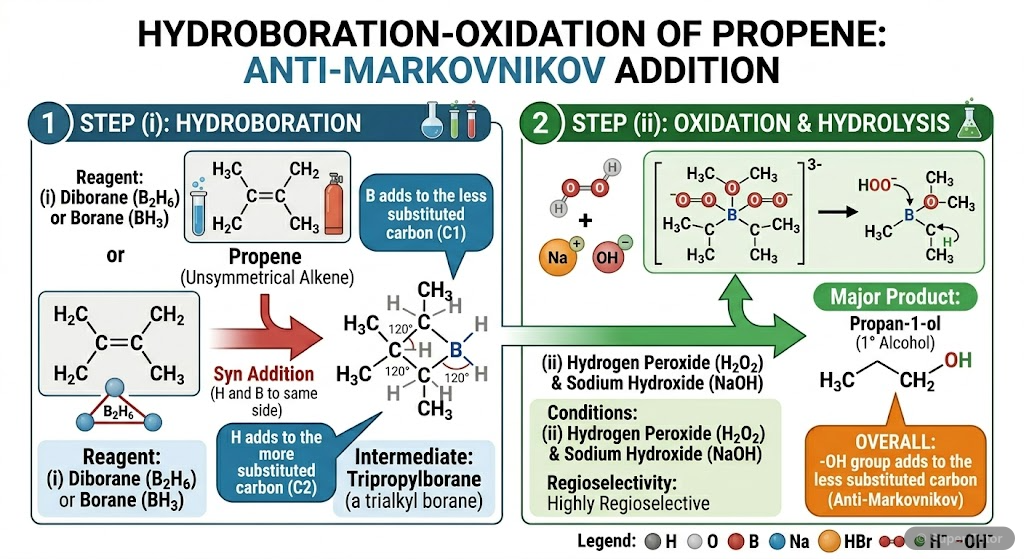
Learn better with visuals Super Tutor pairs illustrations like this with notes and quizzes for Alcohols, Phenols and Ethers.
Quick Quiz: Alcohols, Phenols and Ethers
0/4Tap an answer to check it instantly. No sign-up needed for these 4.
What is the IUPAC name of the compound CH₃CH₂CH₂OH?
The common name of C₆H₅OH is:
Which reagent is used for the hydroboration-oxidation of alkenes to prepare alcohols?
The boiling point of alcohols is higher than corresponding alkanes due to:
Sample Questions
Which of the following compounds are classified as secondary alcohols?
Show answer
CH₃CH(OH)CH₃, CH₃CH(OH)CH₂CH₃
Secondary alcohols have the OH group attached to a carbon atom that is bonded to two other carbon atoms. CH₃CH(OH)CH₃ (propan-2-ol) and CH₃CH(OH)CH₂CH₃ (butan-2-ol) are both secondary alcohols. The others are primary or tertiary alcohols.
Which of the following reactions can be used to prepare phenols?
Show answer
Hydrolysis of diazonium salts, Fusion of chlorobenzene with NaOH, Cumene process
Phenols can be prepared by: (1) hydrolysis of diazonium salts with water, (2) fusion of haloarenes like chlorobenzene with NaOH at high temperature and pressure, and (3) the cumene process involving oxidation of cumene. The other options are methods for preparing alcohols, not phenols.
What is the main product when ethanol is heated with concentrated H₂SO₄ at 443 K?
Show answer
Ethene
When ethanol is heated with concentrated H₂SO₄ at 443 K (170°C), dehydration occurs to form ethene (CH₂=CH₂) and water. At lower temperatures (413 K), diethyl ether would be formed instead. The high temperature favors elimination over substitution.
The Lucas test is used to distinguish between:
Show answer
Primary, secondary and tertiary alcohols
Lucas test uses concentrated HCl and ZnCl₂ to distinguish between primary, secondary, and tertiary alcohols based on the rate of formation of alkyl halides. Tertiary alcohols react immediately (turbidity appears), secondary alcohols react within 5 minutes, and primary alcohols do not react at room temperature.
+84 more questions on Alcohols, Phenols and Ethers (Bihar Board Class 12 Chemistry)
Practise AllFrequently Asked Questions
What are the important topics in Alcohols, Phenols and Ethers for Bihar Board Class 12 Chemistry?
How many practice questions are there for Alcohols, Phenols and Ethers?
Sources & Official References
Content is aligned to the official syllabus. Refer to the board website for the latest curriculum.
More resources for Alcohols, Phenols and Ethers
Important Questions
Exam-style questions with answers
Revision Notes
Key points for last-minute revision
Formula Sheet
The chapter's formulas in one place
Chapter Summary
Understand the chapter at a glance
Concept Maps
See how topics connect
Study Plan
Step-by-step plan for this chapter
Flashcards
Quick-fire cards for active recall
Syllabus
What topics to cover
NCERT Solutions
Every textbook question solved step by step
For serious students
Get the full Alcohols, Phenols and Ethers chapter — start free.
Quizzes, flashcards, an AI doubt solver and a study plan for Bihar Board Class 12 Chemistry. Free to start, no card needed.