The d-and f-Block Elements — Practice Quiz
Bihar Board · Class 12 · Chemistry
Try a 4-question quiz on The d-and f-Block Elements for Bihar Board Class 12 Chemistry: tap an answer to check it and see why.
Interactive on Super Tutor
Studying The d-and f-Block Elements? Get the full interactive chapter.
Quizzes, flashcards, AI doubt-solver and a step-by-step study plan — built for practice quiz and more.
Free trial, no card needed.
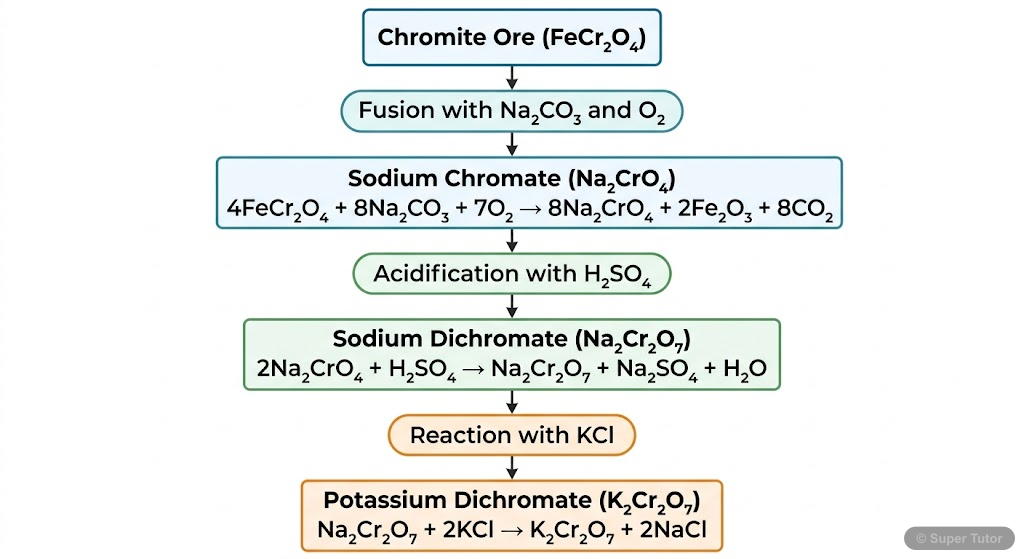
One of 16 illustrations for The d-and f-Block Elements in Super Tutor — alongside flashcards, concept maps and practice questions.
Quick Quiz: The d-and f-Block Elements
0/4Tap an answer to check it instantly. No sign-up needed for these 4.
Which of the following elements belongs to the d-block of the periodic table?
The electronic configuration of Chromium (Cr, Z=24) is:
The highest oxidation state shown by manganese is:
Lanthanoid contraction refers to:
Sample Questions
Which of the following are characteristic properties of transition elements? (Select all correct answers)
Show answer
Formation of colored compounds, Variable oxidation states, Catalytic properties, Paramagnetism
Transition elements show colored compounds due to d-d transitions, variable oxidation states due to similar energies of ns and (n-1)d orbitals, catalytic properties due to multiple oxidation states, and paramagnetism due to unpaired electrons. They are not highly reactive with water like alkali metals.
Which of the following compounds are used as oxidizing agents? (Select all correct answers)
Show answer
K₂Cr₂O₇ (Potassium dichromate), KMnO₄ (Potassium permanganate)
K₂Cr₂O₇ and KMnO₄ are strong oxidizing agents because they contain metals (Cr and Mn) in high oxidation states (+6 and +7 respectively) that can be easily reduced. FeSO₄ and CuSO₄ are not typically used as oxidizing agents.
The magnetic moment of an ion with 3 unpaired electrons is approximately:
Show answer
3.87 BM
The magnetic moment is calculated using the spin-only formula: μ = √[n(n+2)] BM, where n is the number of unpaired electrons. For n=3: μ = √[3(3+2)] = √15 = 3.87 BM.
Which series of elements constitutes the f-block?
Show answer
Lanthanoids and actinoids
The f-block consists of lanthanoids (4f series, Ce to Lu) and actinoids (5f series, Th to Lr). These elements have partially filled f-orbitals and are also called inner transition elements.
+89 more questions on The d-and f-Block Elements (Bihar Board Class 12 Chemistry)
Practise AllFrequently Asked Questions
What are the important topics in The d-and f-Block Elements for Bihar Board Class 12 Chemistry?
How many practice questions are there for The d-and f-Block Elements?
Sources & Official References
Content is aligned to the official syllabus. Refer to the board website for the latest curriculum.
More resources for The d-and f-Block Elements
Important Questions
Exam-style questions with answers
Revision Notes
Key points for last-minute revision
Chapter Summary
Understand the chapter at a glance
Concept Maps
See how topics connect
Study Plan
Step-by-step plan for this chapter
Flashcards
Quick-fire cards for active recall
Syllabus
What topics to cover
NCERT Solutions
Every textbook question solved step by step
For serious students
Get the full The d-and f-Block Elements chapter — start free.
Quizzes, flashcards, an AI doubt solver and a study plan for Bihar Board Class 12 Chemistry. Free to start, no card needed.